Key takeaways
- Every post carries three things: voice, facts and timing. The brand team owns the voice, each location owns the facts and each region owns the timing.
- Good multi-location social media management starts with a fact sheet for every location, because a post with the wrong hours sends customers to a locked door.
- Locations do not need equal effort. Sorting them into lead, guided and brand run groups saves hours and protects the brand from quiet accounts.
- Google Business Profile accuracy, location tags and NAP data work like promises a post makes to a customer. Each one has to be true.
- Before hiring an agency, ask for reporting split by location, a named owner for local data and a quote broken into line items.
A customer sees your Instagram post about a weekend offer and heads to the nearest store. The branch closed early for a local holiday, and the offer is not even running there. The post looked great, but it was wrong for that store.
That gap is what multi-location social media management is really about. The brand knows how to sound good, while only the location knows what is true today.
SOCi's 2026 Local Discovery Index found that 78% of consumers use social networks to search for local businesses. Its platform data also shows localized posts earning about 12 times the engagement of brand posts.
This guide covers how to run multi-location social media marketing across brand, regional and location levels, set approval rules and line up local SEO signals. It also covers how to judge a franchise social media marketing agency before you sign.
If you would rather start by comparing specialists, browse these social media marketing companies and shortlist the ones with real franchise or multi-location experience.
Why Multi-Location Social Media Management Needs a Different Approach
Running one shop is simple. One person knows how it sounds, when it opens and what is happening in town. With forty locations, that knowledge gets split up. The brand team knows the brand voice. The store manager knows the facts. A regional lead knows the timing, such as when a local festival starts or when schools break for the holidays. Most problems in multi-location marketing start when someone has to write about something they cannot see. The same split works whether your locations sit in two cities or five countries.
Location pages matter more than most teams expect. SOCi’s 2026 Local Discovery Index found that 43% of consumers look a business up on social media before they visit, and 60% become a customer of a local business after a social post or video. Your location pages do that job every day.
1. Voice belongs to the brand
Tone, look and the way you greet customers should come from one place. A one page guide with sample captions is enough.
2. Facts belong to the location
Opening hours, parking, staff names and holiday dates are local facts. The brand team cannot know them, and guessing gives you an offer post on a day the store is shut.
3. Timing belongs to the region
Festivals, school breaks and public holidays fall on different dates in different regions. Regional leads decide when a national campaign should land in their market, and when it should wait.
How to Build a Local Social Media Marketing Strategy
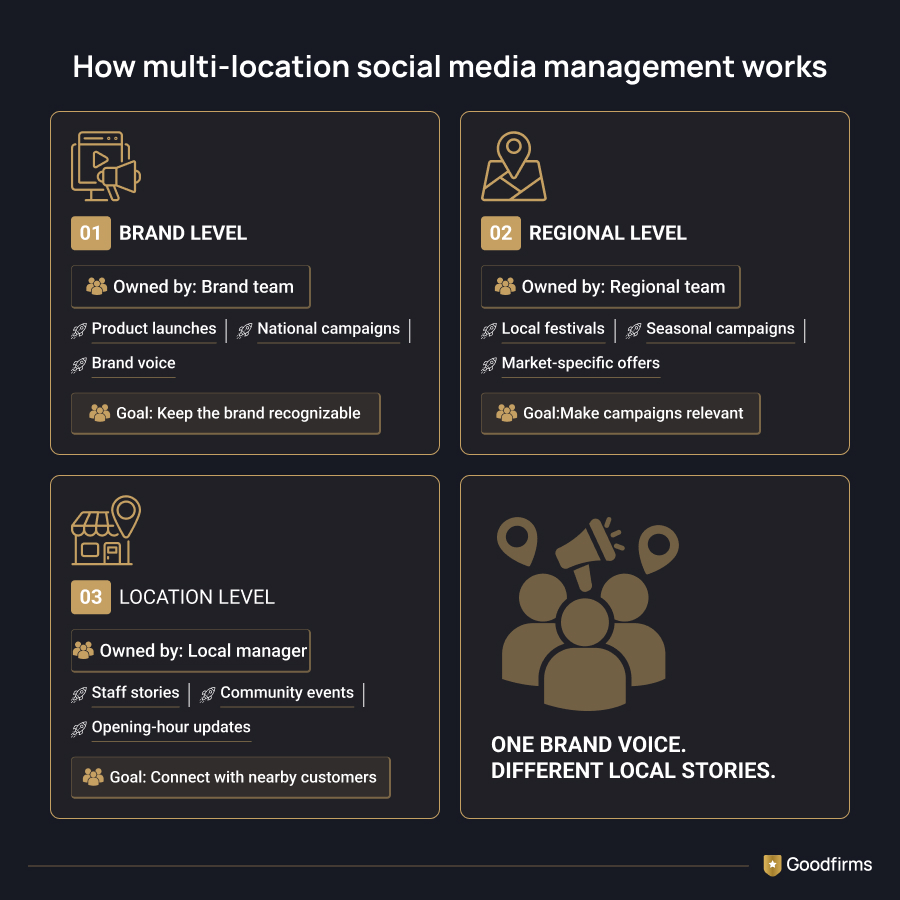
A social media strategy for franchises works best when each level has one clear job. Brand content builds familiarity. Regional content makes the brand feel relevant to a market. Location content gets people through the door. They line up with voice, timing and facts, so everyone knows who owns what.
1. Brand level content
Product launches, national offers and company news live here. It is built once and used everywhere. It is pre-cleared, so locations can post it right away.
2. Regional content
Seasonal campaigns, regional holidays and regional offers belong here. A regional manager signs off before anything goes live, and this is where timing gets decided.
3. Location level content
This is where customers meet the people behind the counter. Staff spotlights, local events, hours changes and weather closures all belong here. Give each location a one page fact sheet.
For a gym branch, it might list weekday and Sunday hours, public holiday hours, two hours of free parking, the yoga class that only runs there and who replies to messages. Anyone writing a post pulls from that sheet, so the facts stay right.
Replies count as location content too. SOCi found that 24% of consumers skip a business after a DM goes unanswered, so someone has to own comments, messages and review responses at every location. Teams that need extra hands can look at online reputation management companies.
4. Sort your locations into three groups
Locations will not all post with the same energy. Three groups work for most networks:
- Lead locations have an engaged manager and a steady customer base. They write their own posts inside the guidelines.
- Guided locations post from a shared bank of captions and images and add their own facts from the fact sheet.
- Brand run locations are new, short staffed or quiet. The brand team posts for them until they are ready to step up.
5. Set approval tiers
A simple set of rules handles most franchise systems:
- Brand level content goes out with no local approval.
- Regional content needs a regional manager's sign off.
- Location level content follows guidelines on tone, banned topics and response times. The brand team runs spot checks instead of approving every caption.
- Anything touching pricing, legal claims, or a live crisis goes through the brand team.
A shared calendar and approval workflow inside social media management software makes these tiers easy to run across dozens of accounts. Local managers get room to write like people from the area, and the brand team keeps a clear view of every account, from 40 locations to 400.
Local SEO for Multi-Location Businesses: 3 Key Signals
Multi-location SEO and social media work as one system. Whitespark's 2026 Local Search Ranking Factors report added social signals as a local ranking factor for the first time, at roughly 5% influence on local search appearance. Three signals matter most, and each one is a promise your page makes to a customer.
1. Google Business Profile alignment
This signal promises that the shop is open when you say it is. Every location needs its own profile with the right address, phone number, hours and category. A social post that sends people to a profile with old hours wastes the click. Update the profile and the social accounts together. Teams short on time can bring in local SEO companies for profile and citation cleanup.
2. Location tags and geo targeted ads
This signal promises that an offer belongs to a real place. A tagged post or an ad aimed at a set radius reaches people near the address. A restaurant’s lunch special should target the area around it, by radius or postal code, which keeps the budget on people who can actually walk in.
3. NAP consistency
This signal promises that you exist where you say you do. Name, address and phone number must match everywhere. If Facebook lists ‘Green Leaf Pharmacy, 12 Park Road’ and the Google Business Profile lists ‘Green Leaf Chemist, Unit 4, 12 Park Rd’ with an older phone number, customers and search engines can both get confused. Run a NAP audit on a fixed schedule instead of waiting for a complaint.
A location with accurate data, tagged posts and clean listings is better placed than one with beautiful content on messy data.
How Other Brands Made it Work
Here are three brands that ran into the same problem and fixed it in different ways. The numbers come from case studies published by the software companies involved, so take them as examples of what is possible.
1. Belgravia Leisure (Australia and New Zealand, 259 venues)
- The problem: Guest reviews at its venues often sat unanswered for over a week.
- What they did: They rolled out in steps. National campaigns went first, then state teams, then each venue.
- What changed: 66% of venues now post every month, compared with an industry average of about 30%. Review replies now take under 2 days instead of 11.
2. Walfinch (United Kingdom, 27 locations)
- The problem: The brand team wanted every location to show up online without losing control of how the brand looked.
- What they did: Fonts and graphics were locked, so posts stayed on brand. Quieter franchisees got ready made post ideas, and all messages went into one inbox.
- What changed: Compared with the quarter before, impressions rose 340% and engagement rose 113%.
3. BaseCamp Franchising (US, Canada, Spain and Portugal, 180 plus locations)
- The problem: Franchisees got their content as quarterly PDFs and shared drives, and they could not post local updates of their own.
- What they did: Everything moved to one platform. The brand team sent out branded content, and each franchisee could post locally.
- What changed: Compared with the quarter before, social reach across locations grew 178%.
All three did the same basic thing. They gave locations an easy way to post for their own area, and the brand team kept the look and the rules in one place.
Questions for a Franchise Social Media Marketing Agency
Most agencies have a decent portfolio. Fewer can run this system across 20 or 100 locations. Ask these in the first meeting. If they share a case study, ask who ran the account and for how long.
1. Can you show reporting broken down by location?
Brand wide totals can hide weak locations behind a blended average. You need to see which ones are falling behind.
2. How do you handle a local manager who wants to post off brand?
The answer should include approval tiers, response times and escalation steps. "We just check in with them" does not count as a workflow.
3. Who owns Google Business Profiles and NAP data?
Some agencies split social and local SEO into two teams that never talk. Ask for one accountable person. If you are still choosing, compare SEO agencies on Goodfirms that handle Google Business Profile work alongside social.
4. What happens when a location closes without warning?
Describe the weekend offer story from the start of this guide. A local holiday, a power cut or a staff shortage can close a store while an offer post is queued. Listen for a clear process: who pauses the posts, who updates the profile hours and who tells customers.
5. What is in the base price, and what triggers an extra charge per location?
This is where contracts go sideways six months in. Get the answer in writing.
What Multi-Location Social Media Management Costs
Pricing has no standard format. Two quotes can look the same and cover very different work.
For a rough reference point, our digital marketing cost guide puts social media work for small and mid-size businesses at about $500 to $5,000 a month, and full service agency retainers at $5,000 to $10,000 or more. Your quote will move with the number of locations, so treat these as a sanity check.
1. Common pricing models
- A flat monthly fee multiplied by the number of locations.
- Tiered bundles, where a set number of locations sits under one retainer and extra locations cost more.
- Local SEO work, such as profile management and citation cleanup, billed as a separate line.
Ask which model you are looking at before comparing numbers.
2. What a lower quote often leaves out
A cheaper quote can skip reporting by location, Google Business Profile upkeep and NAP audits. Over a few months, hours drift out of date, addresses stop matching and local rankings slide.
3. Line items to request
Ask for the price split into posting cadence, reporting by location, Google Business Profile management, NAP audits, ad spend management and response times for comments and DMs. Also ask who keeps the location fact sheets current. Social media management cost looks very different once each item is priced on its own. When you compare social media marketing agency pricing, set the full list of inclusions side by side across every quote.
Conclusion
Multi-location social media management comes down to giving each part of a post to the person who can see it. The brand team holds the voice, regions hold the timing and locations hold the facts. The brands above show that clear roles make it work.
A good first step takes about an hour. Pick five locations and search for each one on your phone the way a neighbor would. Check the hours, the last post date, any local detail and whether the latest comment got a reply. That shows you where to fix things first.
FAQs - Multi-Location Social Media Management
1. What is multi-location social media management?
It is the practice of running social media for a brand with several physical locations. The goal is one brand voice plus content that stays accurate for each local market. It covers content, approvals, listings and replies.
2. How many social profiles should a franchise with 50 locations maintain?
Keep one strong brand profile per platform and a Google Business Profile for every address. Add a full local page only where a manager will post consistently. Other locations can be tagged on the brand page.
3. Should every location have its own Instagram or Facebook page?
No, not by default. A location earns its own page when someone will respond to comments and keep hours and info current. An abandoned page hurts more than having none. Start small and add more as managers keep up.
4. How do you measure ROI for each location and for the brand?
Track location metrics such as local engagement, local search impressions and calls or visits tied to that address. Keep them separate from brand metrics like follower growth and national campaign reach. One monthly sheet with a row per location keeps it simple.
5. How much control should local managers have in franchise social media management?
With social media management for franchises, the brand team sets clear guardrails on voice, visuals and risky topics. Local managers then work inside those limits with their own photos, events and replies. Review the setup each quarter and give more freedom to locations that follow the rules.