Key takeaways
- Digital marketing costs range from $1000 to $50,000+ per month, depending on channels, business size, and hiring model
- SEO: $250 – $10,000/month
- PPC / Google Ads management: 10–20% of monthly ad spend; $1500 – $10,000/month minimum
- Social media management: $500 – $5,000/month (SMB); $15,000- $20,000/month with paid strategy on multiple platforms.
- Content marketing: $5,000 – $20,000/month (agency program). The basic execution is $2,000/ month.
- Email marketing: $300 – $2,000/month (software + management service), enterprise exceeds 20,000/month.
- Influencer marketing: $10 – $1,000,000+ per post, depending on audience size
- Full-service agency retainers typically range from $5,000–$10,000+/month depending on channels, strategy depth, and business size.
Digital marketing pricing in 2026 is harder to evaluate than most businesses expect. Two companies can spend the same amount and see completely different outcomes depending on the channels they use, the agency they hire, and how clearly success was defined before the work started.
This guide breaks down digital marketing costs by service, pricing model, business size, and engagement type — along with the hidden expenses most businesses only discover after signing a contract.
CTA: Looking for agencies that match your budget and your market?Goodfirms has a verified list of top digital marketing companies, which lets you filter by specialization, minimum project size, and verified client outcomes
Digital marketing pricing in 2026 depends less on a single service and more on growth goals, competition, channel mix, and execution complexity. Most businesses now combine SEO, paid ads, content marketing, social media, email automation, and CRO into broader multi-channel strategies — making pricing far more variable than it was even a few years ago.
How Much Does Digital Marketing Cost in 2026?
Digital marketing costs in 2026 typically range from $1,000 to $20,000+ per month, depending on campaign scope, channels, competition, and business goals. Small and mid-size businesses commonly spend between $2,500 and $20,000/month on SEO, PPC, content marketing, and social media management, while enterprise brands running large-scale multi-channel campaigns often exceed $50,000/month. Freelancer-led or limited single-channel engagements can start around $500–$1,500/month, depending on the level of expertise and deliverables.
Digital Marketing Service Pricing Overview
Digital marketing pricing varies widely across services, with costs influenced by channel complexity, campaign scale, competition level, and whether the work focuses on strategy, execution, or long-term growth management.
|
|
|
|
|
|---|---|---|---|
|
|
|
|
|
|
|
|
|
|
|
|
|
|
|
|
|
|
|
|
|
|
|
|
|
|
|
|
|
|
|
|
|
|
|
Here’s how pricing typically breaks down across the major digital marketing services businesses invest in most often.
Digital Marketing Pricing Breakdown by Service
Digital marketing costs vary significantly by channel, with SEO, PPC, content marketing, social media, and email marketing each following different pricing models based on competition, scope, and execution complexity.

-
SEO Pricing
SEO pricing typically falls between $250 and $10,000 per month, depending on scope and business size. Most businesses (about 63%) invest between $500 and $5,000 monthly. On average, agencies charge around $3,209 per month, while freelancers average approximately $1,348. Hourly SEO rates most commonly fall in the $100–$150 range, with roughly 25% of professionals pricing within this bracket. (Source: Ahrefs - SEO Pricing Survey)
According to Goodfirms SEO pricing survey, 59.6% of SEO providers use monthly retainers as their primary pricing model, making retainers the dominant structure across the SEO industry.
Before shortlisting agencies, it's worth checkingtop-rated SEO companies on Goodfirms — verified reviews, real pricing ranges, and outcome data all in one place.
-
PPC / Google Ads Cost
Most PPC agencies charge 10–20% of your monthly ad spend as a management fee, with a minimum floor of around $1,500/month and flat-fee management reaching $10,000+/month for larger accounts, regardless of spend level. (Source: HawkSEM - PPC Management Pricing)
PPC costs vary by platform (Google, Facebook, Instagram, LinkedIn) based on auctions, competition, targeting, and ad formats, as noted in the GoodFirms PPC Advertising Cost guide. Ad costs also vary by industry; WordStream's benchmark data puts the average cost-per-click at $1.16 in eCommerce and $6.75 in legal services. The management fee and the ad budget are two separate line items — don't let anyone bundle them without telling you what the split is.
-
Social Media Marketing Cost
Social media companies manage content creation, scheduling, community management, and monthly reporting — cost runs $500–$5,000/month for most SMBs. Adding a paid social strategy can increase overall monthly cost. (Source: Sprout Social - Social Management Cost 2026)
-
Content Marketing Pricing
Content marketing companies pricing varies based on the level of strategy, production, and distribution included in the engagement. Entry-level content execution packages typically start around $1,000–$20,000 per month, while more strategic, full-service content marketing may increase. Freelance content writing rates also vary widely, with many professional writers charging between $60 and $200+ per hour depending on subject-matter expertise and content complexity. (Sources: WebFX)
-
Email Marketing Cost
Email marketing agencies offer services that typically range from $300–$2,000 per month, depending on campaign volume, automation complexity, and subscriber size. Enterprise-level email marketing programs with advanced segmentation, automation, lifecycle campaigns, and dedicated strategy can exceed price ranges. (Sources: Campaign Monitor)
-
Influencer Marketing Cost
Here's what Influencer Marketing Agencies typically charge for Instagram posts: check the cost by tier:
- Nano-influencers(1K–10K followers): $10–$100 per post
- Micro-influencers (10K–50K followers): $100–$500 per post
- Mid-tier influencers (50K–500K followers): $500–$5,000 per post
- Macro-influencers(500K–1M followers): $5,000–$10,000 per post
- Mega-influencers(1M+ followers): $10,000+ per post
Source: Influencer Marketing Hub 2025 Benchmark Report
Digital Marketing Packages & What They Include
Most agencies package their services into tiers. Here's what those tiers actually look like in practice:
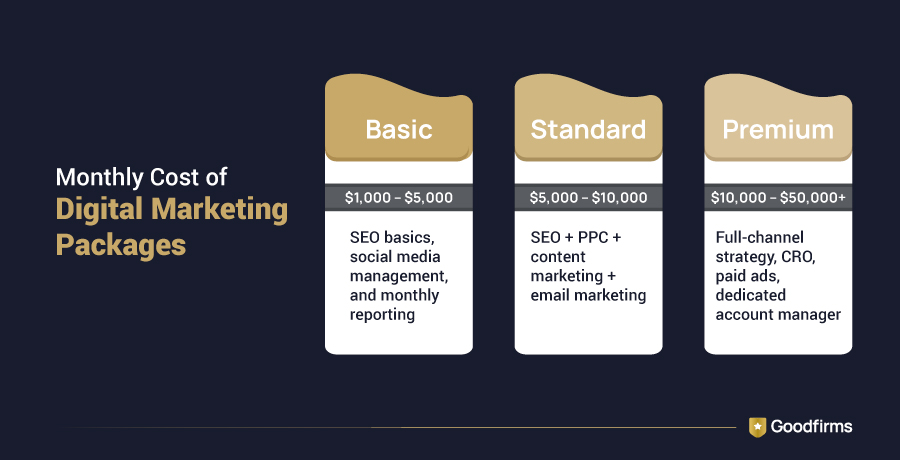
Note: Package pricing covers agency management fees only. Ad spend for PPC and paid social is billed separately and is not included in these package costs.
What Lower-Cost Packages Often Exclude:
The "$1,000/month" Basic digital marketing package usually covers content creation, scheduling, and community management, but excludes spend, creative production, and third-party tools. Once these operational expenses are added, the true monthly marketing investment is significantly higher than the base retainer alone.
Goodfirms Suggests: Before you sign anything, ask one question: What is explicitly excluded from this package, and what will appear on a separate invoice?
Digital Marketing Cost by Business Size
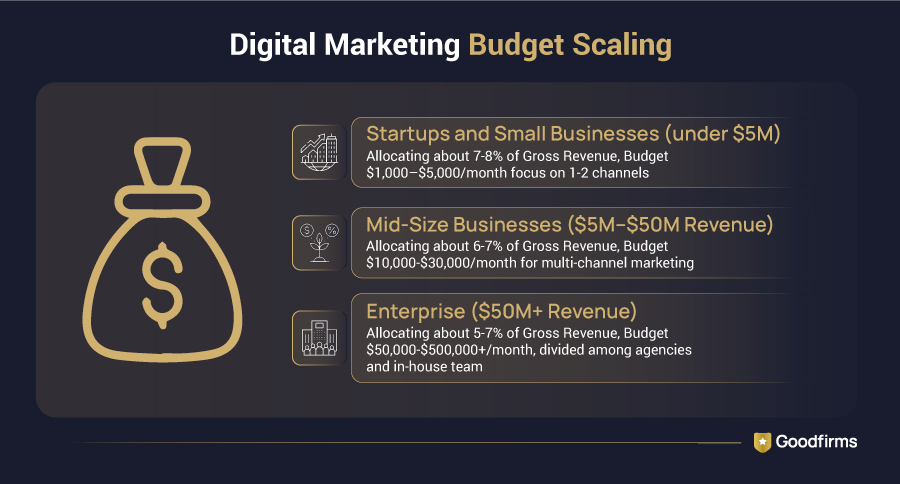
Marketing budgets typically scale with business growth, revenue targets, competitive pressure, and the number of acquisition channels required to support expansion.
-
Startups and Small Businesses (Under $5M)
The US Small Business Administration recommends allocating about 7–8% of gross revenue toward marketing for businesses under $5M in annual revenue. In real terms, for 2026, that's a digital marketing budget of roughly $1,000–$5,000/month for most small businesses.
The biggest mistake small businesses make with this budget is spreading it across too many channels. Pick one or two, fund them properly, and measure them before adding anything else.
-
Mid-Size Businesses ($5M–$50M Revenue)
At this stage, 6 to 8% is a realistic marketing budget for proper multi-channel digital marketing with strategic oversight. You can afford a real agency retainer here rather than piecing together freelancers for each channel.
-
Enterprise ($50M+ Revenue)
Enterprise digital marketing budgets span a wide range of 5 to 7% marketing budget typically divided between a primary agency, specialist channel partners, and an in-house team that manages the relationship and owns the strategy.
According to Gartner’s 2025 CMO Spend Survey, average marketing budgets remained relatively flat at 7.7% of company revenue across industries.
How to Choose the Right Digital Marketing Model
The right model depends less on budget alone and more on what phase your business is in and what you actually need the engagement to deliver.
|
|
|
|
|---|---|---|
|
|
|
|
|
|
|
|
|
|
|
|
|
|
|
|
|
|
|
|
Freelancers execute well on a single channel and cost the least. Agencies cost more but bring a broader team, strategic oversight, and accountability structures that a single freelancer can't match. In-house teams offer the deepest brand knowledge but carry the highest fixed cost and the most management overhead. For most SMBs, a boutique agency or full-service retainer gets you further faster than trying to manage multiple freelancers across channels.
If you are still shortlisting, Goodfirms directory of top digital marketing agencies in India, USA, UK and across the globe, lets you filter by service focus, minimum project size, and verified client outcomes — a faster starting point than sifting through Google results cold.
Average Digital Marketing Budget Allocation in 2026
Digital marketing budgets are typically distributed across a mix of paid acquisition, organic growth, and operational tools. While the exact split varies by business size and industry, most companies prioritize spending based on performance channels, long-term visibility, and the systems required to run and measure campaigns effectively.
The biggest shift in 2026 is the budget moving toward AI-assisted content production and marketing automation. According to Salesforce's State of Marketing report, businesses using marketing automation drive a 14.5% increase in sales productivity and a 12.2% reduction in marketing overhead overall.
What Factors Influence Digital Marketing Pricing?
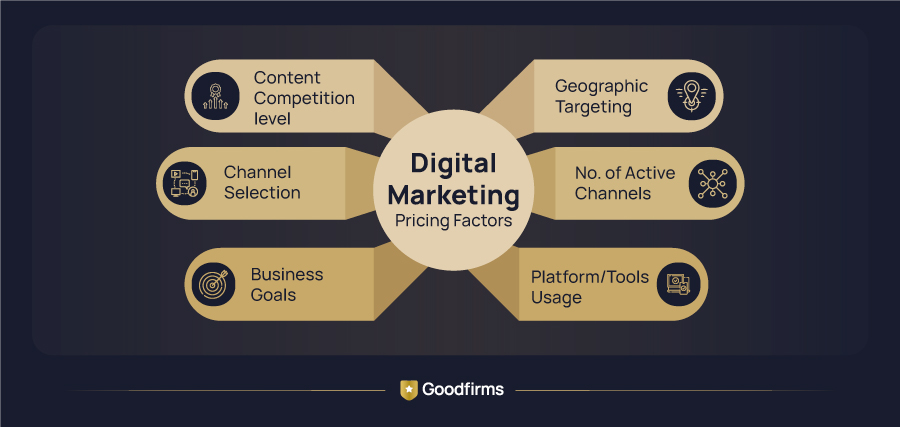
Your goals set the baseline cost. A B2B lead generation campaign costs more to build than a brand awareness push because the work is closer to direct revenue. Your industry's competition level sets the floor on paid channel costs — and that's largely out of your control. Geography adds or removes budget pressure depending on whether you're targeting local, national, or international audiences. The number of channels you run determines headcount and tooling requirements. And content complexity — healthcare, legal, fintech — adds 30–50% to production costs because the writers need domain knowledge that generalist agencies can't provide.
Goodfirms Verdict: The businesses that get burned by digital marketing are rarely the ones who overspent. They are the ones who approved a budget without agreeing on what success looked like at 90 days. An agency can only be accountable to a standard you set before you hire them.
How to Budget for Digital Marketing in 2026
Building a realistic digital marketing budget means working backward from your revenue goals — not forward from whatever's left over after other costs.
|
|
|
|
|---|---|---|
|
|
|
|
|
|
|
|
|
|
|
|
|
|
|
|
|
|
|
|
Source: Digital Applied 2026 Agency Pricing Analysis
How to Choose the Right Digital Marketing Agency
The agency decision tends to get more attention than it deserves at the start and less than it deserves once you're locked in. Here's what to actually pay attention to:
Red flags before you sign:
- Any promise of guaranteed rankings or guaranteed ROI — reputable agencies don't make these commitments because they can't control the variables
- Deliverables described in vague terms like "grow your social presence" or "improve your visibility" — if you can't measure it, it's not a deliverable
- Long contracts with no performance benchmarks or exit provisions
- Packages are described by what they include, but never by what they don't
Questions worth asking before you commit:
- Who specifically will be working on this account day-to-day, and how senior are they?
- How do you define success at 30, 60, and 90 days?
- What exactly is included vs excluded in the scope?
- How often will you report performance, and what metrics will you track?
- How will communication work — weekly calls, email, Slack?
- What do your contract terms, exit clause, and notice period look like?
- How do you handle strategy vs just execution?
- What results have you achieved in similar projects, with proof?
- How do you adapt if something is not working?
- What happens if performance targets are not met?
The main contract models:
- Monthly retainer — most common; works well for ongoing multi-channel delivery
- Project-based — best when the scope is clearly defined with a fixed endpoint
- Performance-based — tied to agreed outcomes; needs careful KPI definition upfront
- Hourly — best suited for advisory work, audits, or one-off consulting
Hidden Costs in Digital Marketing You Must Know
If you have ever ended a quarter wondering where the marketing budget actually went, this is usually where the gap comes from. The headline number in a proposal often doesn’t reflect the full cost of execution once everything is live.
- Tools and software: Most digital marketing stacks rely on multiple tools for SEO, analytics, scheduling, design, and reporting. These are often not fully included in agency retainers and may be billed separately or passed through as additional costs depending on the setup.
- Ad spend: Paid media budgets are always separate from management fees. Agency fees cover strategy, setup, and optimization — but the actual advertising spend is paid directly to platforms like Google or Meta and sits outside the service fee.
- Content production: Creative work such as photography, video production, design, and copywriting is frequently scoped outside of core retainers. These costs depend on the level of production required and are often billed as individual projects.
- Revisions and scope changes: Most retainers include a limited number of revisions and clearly defined deliverables. Any additional changes or work outside the agreed scope typically results in extra charges, which is why clear scope definition upfront is critical.
How to Reduce Digital Marketing Costs Without Losing ROI
The most expensive marketing mistake is not overspending on the wrong agency. It's underfunding the right channel until it can't produce results. Spending less does not automatically mean getting less — but it does require being deliberate about where the cuts happen.
- AI tools for content production: AI-assisted tools like Jasper, Surfer SEO, and Claude can reduce research, outlining, and first-draft production time by 50–70%, helping agencies and in-house teams scale content production more efficiently. Strategy still needs a human — execution doesn't always.
- Automate what repeats: Email sequences, social scheduling, lead nurturing workflows, and performance reporting are all automatable. Marketing automation platforms typically pay for themselves within a few months at most budget levels.
- Narrow your channel focus: The most expensive mistake most businesses make is funding five channels at 20% of what each actually needs. Pick the two channels with the clearest path to your buyer, fund them properly, measure them, and only add a third once both are performing.
Digital Marketing Cost FAQs:
How much does SEO cost for a small business in 2026?
Typical SEO pricing for small businesses ranges from $250 to $10,000+ per month, depending on competition, content requirements, technical complexity, and agency expertise. According to Ahrefs' industry survey, 63% of businesses spend between $500 and $5,000/month, with agencies averaging $3,209/month and freelancers averaging $1,348/month.
What is a reasonable digital marketing budget for a startup?
Most startups spend between $1,000 and $5,000 per month on digital marketing during early growth stages, usually focusing on one or two primary acquisition channels. The US Small Business Administration recommends allocating 7–8% of gross revenue to marketing for businesses under $5M in annual revenue.
Is digital marketing worth the cost?
Yes, when the strategy is right, the channels match the buyer, and results are measured against a defined standard. No, when it's poorly targeted, under-resourced, or measured by traffic and follower counts rather than pipeline and revenue. The service doesn't fail — the setup does.
How do digital marketing agencies charge?
Four models cover most of the market: monthly retainers (fixed fee for ongoing work), project fees (fixed price for defined scope), hourly rates (for advisory or audit work), and performance-based fees tied to agreed outcomes. Most agencies default to retainers for ongoing relationships, with performance components added for paid media accounts.
What is included in a digital marketing retainer?
A digital marketing retainer typically covers ongoing strategy management, campaign execution across agreed channels, monthly performance reporting, and a dedicated account contact. Basic retainers often cover one or two channels with standard reporting, while premium retainers include multi-channel delivery, dedicated strategists, CRO testing, and weekly reporting. Always confirm in writing what deliverables are fixed monthly and what fall outside the scope.
Conclusion:
Digital marketing costs in 2026 vary widely because businesses compete under very different conditions. The companies that generate the strongest ROI are usually not the ones spending the most — they are the ones aligning budget, channel selection, attribution, and business goals from the beginning. Whether you work with freelancers, agencies, or in-house teams, the real value comes from clarity, execution quality, and measurable outcomes. If you are evaluating agencies, the Goodfirms verified directory of top digital marketing companies lets you compare providers by specialization, pricing range, industry focus, and verified client reviews.
Additional Reference Links for Cost:
1. Ahrefs SEO Pricing Survey
2. HawkSEM PPC Pricing Guide
3. Sprout Social Management Pricing
4. Campaign Monitor Email Pricing
5. Influencer Marketing Hub 2025 Benchmark Report
6. WebFX Agency Pricing
7. Digital Applied 2026 Agency Pricing Analysis