Key takeaways
- Most of what's sold as AI optimization today, schema markup and visibility tracking included, does nothing to move AI citations on its own.
- A single verified expert quote produced a 400% lift in blended search visibility. The algorithm rewards real experience, not confident-sounding text.
- Rewriting what's already on page one doesn't help you get cited. It can actively hurt your rankings.
- AI can draft and brief. It cannot have walked through the work itself, and that gap is where information gain lives.
- Whatever edge you find will decay as competitors copy it and AI ingests it. That's not a failure, it's proof the edge was real.
- Agencies selling GEO as a bolt-on service are mostly selling tracking. The real work of owning citations happens in-house.
There's no dashboard that tells you when your content has quietly become invisible to AI search. It just happens, page by page, until the traffic numbers don't add up and nobody can say exactly when the slide started.
That's the argument Cody C. Jensen, CEO and Founder of Searchbloom, made on a recent episode of the Goodfirms Podcast, Conversations that Matter. Cody started his career inside Google, then ran search at a string of major agencies before he walked away and built Searchbloom from his basement with no team and no plan. Twelve years later, he's one of the few people in this industry willing to say most "AI Optimization" is old SEO wearing a new badge, and he backs that up with his own data.
Who Is Cody Jensen?Cody C. Jensen is the founder and CEO of Searchbloom, a search engine marketing agency covering SEO, Google Ads, and AI SEO. On this episode of the Goodfirms Podcast: Conversations That Matter, Cody breaks down why generative AI has made human expertise scarcer instead of obsolete, what's actually being gamed in AI citations right now, and the one mistake he wants marketing leaders to stop making this year. |
The Relabeling Problem
Google's E-E-A-T guidelines start with Experience, and Cody treats that word literally. A model can hold expertise on nearly any topic. However, it cannot know what your office smells like the moment the coffee finishes brewing, and that gap is why human writing beats LLM writing every time.
That gap is also where he draws his sharpest line, the difference between real AI-era search work and the AEO or GEO relabeling of old SEO. Two tactics top his list. Schema markup gets sold as an AI SEO win, but LLMs don't parse it for citations directly. It only helps indirectly, through traditional rankings that retrieval systems pull from. The second is tracking dressed up as strategy: agencies set up visibility monitoring and call it AI SEO without doing anything to move sentiment or share of voice.
"It's being mentioned. It's being in the conversation because we've moved away from a deterministic ranking system," Cody said. Google has shifted from deterministic to probabilistic modeling, so the same query can return different results for every single user.
Information Gain Is the Whole Game
Cody's answer to what separates a cited page from a buried one comes down to one idea: information gain.
Rewriting what's already on page one, even with better keywords, gets a page nowhere. It can actively hurt rankings. Real information gain means adding something the SERP doesn't already have. Cody uses a five-to-seven rule: aim for five to seven net-new concepts per asset, whether that's a homepage, a blog post, or a single expert quote.
He put E-E-A-T in concrete terms, too. Speak in the first person. Reference specific numbers from direct experience. "After being in the plumbing industry for 24 years, I have seen firsthand at least 100 cases where DIYers try to fix their water heater on their own," he offered as an example.
The Quote That Moved Visibility 400%
One data point from Cody's research stands out. Adding a direct, verified subject-matter-expert quote produced roughly a 400% lift in blended search visibility.
"LLMs, they don't think. They don't care what people say. They are not sentient, they are not conscious. They are prediction models," Cody said. Ask a model for an opinion, and it produces something plausible. It doesn't carry the weight of a real, attributed point of view, and it doesn't move rankings the way a genuine quote does.
His fix for producing that kind of information at scale is what he calls a digital voice twin. Record regular interviews with product owners or executives inside an AI project, building toward a minimum of six hours of transcripts. Once that library exists, you can ask the twin what that person would say about a topic, get a draft quote back, and confirm it with them in a single message instead of a week-long approval cycle.
Where AI Belongs, and Where It Doesn't
Cody drew a clear line for the workflow split. AI can handle briefs and ideation reasonably well, though the output usually needs shaping toward a specific audience. From there, he prefers a human to write the first draft, then hand it back to AI for a focused second pass on information gain alone, what's missing, independent of what the SERP already covers. It's the kind of discipline that separates the content marketing agencies actually doing this work from the ones just running everything through a prompt.
"Human in the loop, HIL, is going to be one of the most commonly referred to acronyms in this world over the course of the next five years."
On agencies versus in-house teams, Cody was candid about his own business, too. He argues agencies shouldn't really sell GEO as a standalone service, because owning citations and sentiment is work that belongs inside the company. What Searchbloom sells instead is consulting, a 15-chapter playbook on building a marketing coordinator function in-house, managing forums like Reddit and Quora transparently, and spotting content gaps worth filling with formats like YouTube videos. That's a different pitch than most digital marketing companies make when they hand over a retainer.
Rapid Fire With Cody Jensen
1. One word for the current state of SEO? Volatile.
2. More overrated right now, llms.txt or schema markup? llms.txt. "It's a fabricated thing. It doesn't work."
3. Long-form pillar page or short answer-first page? Long-form, because short answers already sitting in the corpus don't need your website to show up.
The Receipt for Every Edge
The worst mistake isn't picking the wrong tactic. It's assuming an edge, once found, stays an edge forever.
"Information gain decay is the receipt. If your edge never erodes, then you never had one to begin with," Cody said. Competitors copy what works, and the corpus absorbs it over time. The fix isn't chasing one big win. It's auditing your business regularly for what only you can say, and saying it before the next model update makes it common knowledge.
Conclusion
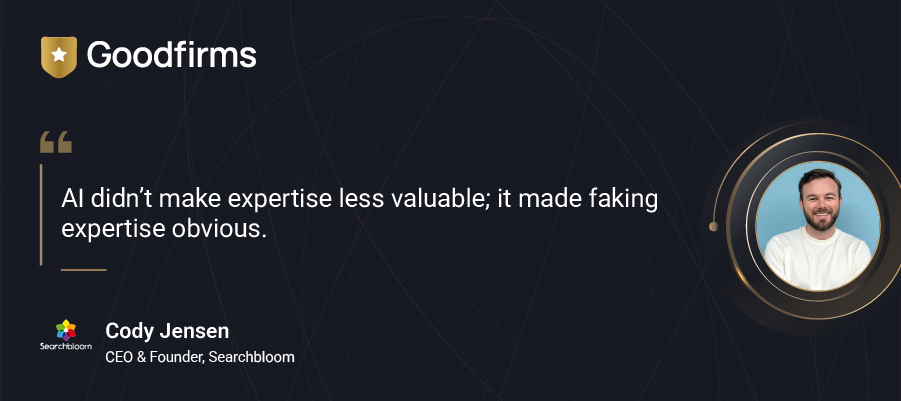
AI didn't make expertise less valuable; it made faking expertise obvious. Cody's point isn't complicated: information gain, real quotes, and a human in the loop still decide who gets cited and who gets buried. It's the same discipline that separates the top-rated SEO agencies from the ones just chasing keyword volume.
You don't need an AI SEO background to act on it. Ask what net-new information your last ten pieces of content actually added. Ask who's giving the quotes. Ask if anyone's tracking what's already decaying. The answers usually tell you everything.
Where to Find Cody Jensen and Searchbloom
Website: Searchbloom
LinkedIn: Cody C. Jensen
Conversations That Matter is the Goodfirms podcast featuring the practitioners, founders, and operators behind some of the most interesting companies in the world. Subscribe wherever you listen.