Key takeaways
- A thriving Slack community works like a public reputation engine, not just a support channel — every honest answer becomes proof of brand reliability.
- Purpose comes before setup: define whether the room exists for support, feedback, or category authority before building a single channel.
- The first ninety days decide everything — a handful of active founding members beats hundreds of silent ones.
- Success should be measured by weekly active participation and retention impact, not total member count.
- Whether managed in-house or outsourced, a Slack community only stays alive through consistent daily attention.
Most brand Slack workspaces have more channels than active conversations, and most brands launch one anyway because a competitor has one.
What gets missed in that rush is the gap between adoption and actual usage of the Slack community — a gap that can undermine consistent brand communication and engagement. The problem is that the gap between Slack adoption and actual community usage isn't specifically a corporate communications issue. It's more directly a community engagement, customer engagement, or community management issue.
A Slack community isn't just a support channel; it's a live, community-facing extension of your brand that demonstrates how your company nurtures, supports, and engages its employees and customers. Every fast, honest answer inside that workspace becomes evidence of the brand's reliability that no press release can showcase.
Explore the top digital marketing companies to find a partner who can help your brand communicate as consistently inside a Slack community as it does everywhere else.
Building a thriving Slack community requires considerable time and effort, but it is well worth it, as it creates compounding and noteworthy returns.
According to Focus Digital 2026, engaged community members show 31% higher retention than customers who never participate, even after accounting for product usage.
That retention gap tracks with a communication problem. According to Goodfirms’ research - Customer Experience Management: Demand, Trends, Challenges, and the Future Scope, 71.2% of surveyed businesses named proper communication with customers as a core implementation challenge. A Slack community is one of the few channels that addresses that gap directly — in public, in real time.
This article breaks down how to build a thriving Slack community for your brand in 2026 — from defining its purpose and structuring channels to seeding it in the first 90 days, moderating it, and measuring whether it's actually working. Let’s start with knowing what a Slack community is and how it benefits brands in 2026.
What Is a Slack Community?
At its simplest, a Slack community is a free, ready-made space where people can talk, share resources, and answer each other's questions in one place. It doesn't add another app to anyone's routine. Most professionals already keep Slack open during working hours, so encouraging customers and employees to join your brand's community doesn’t take time and is not a hassle of a new download or a learning curve.
How Do Slack Communities Benefit Brands in 2026?
Built well, Slack communities pay off in a few concrete ways:
- Faster answers — customers get help in minutes, not ticket queues. Quick, reliable responses build the kind of trust that keeps customers coming back.
- A live feed of feedback — real objections and feature gaps surface without a survey. Product and marketing teams act on what customers are actually saying instead of guessing.
- Public proof of reliability — every honest answer becomes reputational evidence no press release can match. Prospects see how a brand treats people before they ever become a customer.
- Stronger retention — engaged members stick around longer than customers who never participate. Retained customers cost less to keep than new ones cost to acquire.
- Lower support load — common questions get crowdsourced instead of ticketed. Support teams spend less time on repeat queries and more time on complex issues.
These gains aren't theoretical. A Fortune 100 company has already put this to the test — here's what happened.
Case Study: Northwestern Mutual redefines automation in the financial services industry using Slack
Northwestern Mutual, a 165-year-old financial firm with nearly 5 million clients, moved its Technical Service Center from Skype to Slack. Automating these processes on Slack earned Northwestern Mutual the platform's Excellence in Automation Award — and the real-time visibility and faster feedback loops that came with it now support the client service the firm is known for.
Caitlin Walsh, Communications and Policy Manager at Square, sums up the shift in one line:

A lot of us know how to work remotely, but we all still crave a connected and socially engaged workplace, and Slack really helps with this.
The benefits are clear enough. Now comes the more significant part - the steps to building a thriving Slack community for your brand.
Steps to Building a Thriving Slack Community for Your Brand
The steps below cover what it takes to go from an empty Slack workspace to a room members check daily, starting with the decision that shapes everything else: why the community exists in the first place.
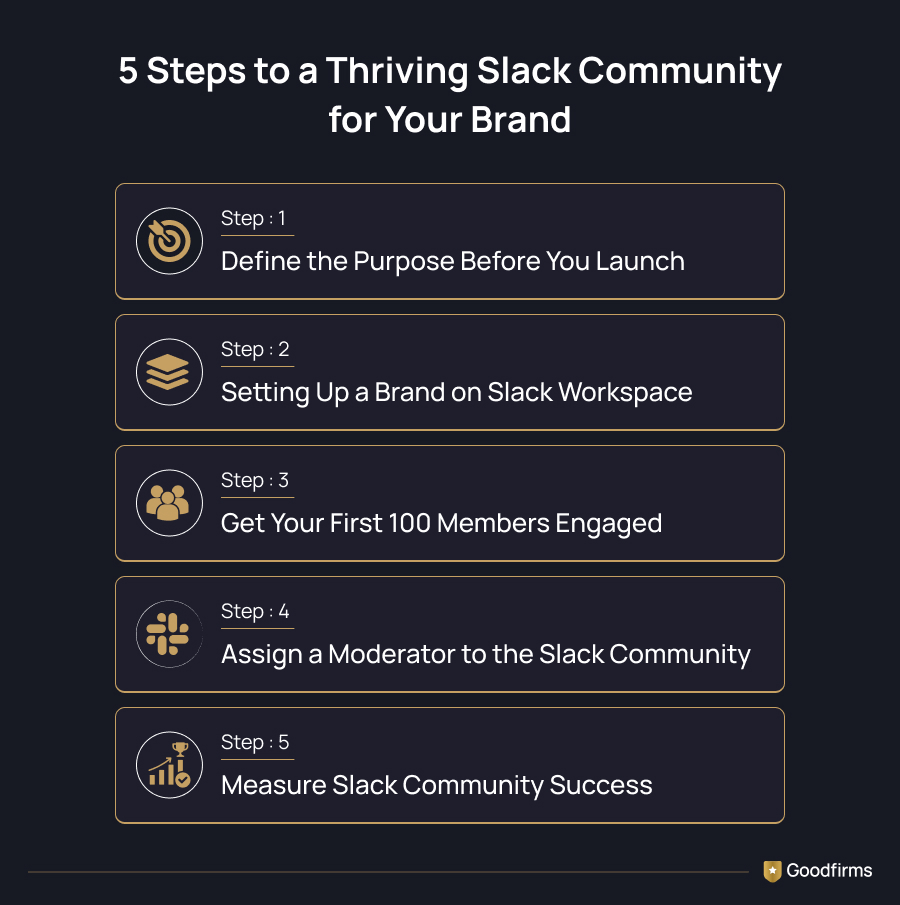
Let's have a detailed look at every step to create a powerful, thriving community for your brand in 2026.
Step 1: Define the Purpose Before You Launch
Defining the purpose means deciding what kind of room the community becomes. A workspace built only around troubleshooting starts to feel like a support queue, and members drift off once their question is answered. The communities that stay active pair problem-solving channels with a few lighter ones: a space for member wins, a casual off-topic thread, or a monthly poll people can drop into just for fun.
Pick one primary reason the community exists
Before setting up channels, decide whether the workspace exists mainly for peer-to-peer support, product feedback, or category authority. A developer tools brand needs a room built around debugging help; a marketing SaaS brand needs a room built around campaign strategy, not release notes. Trying to serve all three purposes at once usually means none of them get built out properly.
Set goals your team can actually track
Attach the community to something measurable from day one, whether that's support ticket deflection, feature request volume, or renewal rates among active members. Goals don't need to be ambitious in month one. They need to be specific enough that six months in, someone can say whether the investment paid off.
Step 2: Set Up Your Brand on Slack Workspace
Start narrow. New members should land in a #welcome channel, a #general channel, and two or three topic channels tied directly to real problems your audience has, not to your product's feature list. A workspace that opens with ten channels overwhelms new members before they've posted a single message.
Choose between open access and a gated application
Public workspaces fill up fast with lurkers, and eventually with spam accounts pitching unrelated services. A short application, even something as simple as a one-question form asking what the person is working on, filters for people who actually intend to participate. The 2026 shift toward invite-only, curated rooms mentioned earlier is largely a response to this exact problem: open rooms lose signal as they scale.
Write self-promotion rules into the workspace on day one
Every active brand on Slack eventually attracts other vendors trying to reach the same audience. Decide up front where self-promotion is allowed, whether that's a dedicated #share-your-work channel or a weekly thread, and post the rule somewhere new members will actually see it before they need it.
Step 3: Get Your First 100 Members Engaged
The first ninety days set the tone for everyone who joins after. Twelve active members outperform four hundred silent ones because new members mirror the behavior they see upon arrival.
Recruit founding members by hand before the public launch
Reach out directly to existing power users, early customers, or people already active in your support inbox who clearly like talking shop. Ask each one, before launch day, to post a real question or resource in the first week so the room opens with genuine activity rather than silence.
Build a weekly ritual from the start
A recurring "what are you working on" thread, a monthly “Ask Me Anything” session with an engineer or product lead, or a Friday roundup of the week's goals achieved gives members a reason to check back on a schedule. Technical hosts tend to draw more engagement than executive ones, because members trust peer-level expertise over a polished company voice.
Respond to the first post from every new member
The single biggest predictor of whether a first-time poster returns is how quickly someone answers them. A one-hour response window on someone's first question does more to retain that member than any onboarding email sequence.
Step 4: Assign a Moderator to the Slack Community
Community moderation needs a named owner, not a rotating duty nobody prioritizes. For example, a Slack community of an eCommerce operator describes the same early discipline for anyone joining a room: spend the first stretch reading conversations across the main channels and learn the unwritten norms around self-promotion, link sharing, and question formatting before jumping in. A similar observation-first habit can be applied by whoever runs the space on the brand's side.
Assign daily presence to one person
Someone on the team needs to check the workspace daily, answer the first question in new threads, and quietly redirect off-topic self-promotion. A workspace nobody actively tends goes quiet within weeks, no matter how strong the launch was.
Turn your most active members into champions
A handful of members will naturally start answering questions faster than the brand team does and welcome newcomers unprompted. Give them something real in return, such as early access to betas or a direct line to product, rather than just a badge. Ownership, not perks, is what keeps champions active over the long run. Members who feel like insiders bring others in without being asked.
Step 5: Measure Slack Community Success
Total member count is the easiest number to report and the least useful one to optimize for. A workspace with three thousand silent members says nothing about business impact, while a workspace with three hundred weekly-active ones can meaningfully move support and retention numbers.
Track weekly active participants, not total membership
The share of members who post, reply, or react in a given week is a far better health signal than cumulative signups. A community growing in headcount while weekly activity flatlines is a warning sign, not a success story.
Tie activity to support deflection and retention
Compare support ticket volume for topics the community regularly covers before and after launch, and compare renewal rates between community-active customers and those who never engage with the space. Given the retention data above, this comparison is usually where the community's business case gets made or lost.
Measuring success can yield positive numbers that motivate you to continue building the Slack community for your brand. But running a Slack community is not a one-day job. It requires consistent and regular attention. That's a separate decision, and it usually comes down to whether you can delegate that job to your in-house help or outsource it to a public relations agency.
Should You Manage Your Community In-House or Hire a Public Relations Agency?
This decision usually comes down to internal bandwidth rather than budget alone. An in-house community lead who already understands the product tends to answer technical questions faster and build trust more quickly, but many marketing teams don't have the headcount to spare for daily moderation on top of existing responsibilities.
|
Factor |
In-house Management |
Public Relations Agency |
|---|---|---|
|
Speed to launch |
Slower — hiring or reassigning takes time |
Faster — specialized teams can start within weeks |
|
Product-specific answers |
Stronger, since staff already know the roadmap |
Requires ramp-up time and documentation |
|
Cost structure |
Fixed salary or reassigned headcount |
Variable, scales with community size |
|
Long-term trust-building |
Higher, since members recognize the same faces |
Depends on the continuity of assigned staff |
Brands planning to outsource the task of managing Slack community can compare options through Goodfirms’ vetted list of the best public relations agencies, many of which run technical support and community operations for SaaS and B2B clients. You can also look for this list of the best community software if the goal is tooling rather than staffing.
Whether you are staffing, outsourcing, or doing it yourself, below are the most common mistakes to avoid while building Slack communities.
Common Mistakes Brands Make With Slack Communities
A handful of patterns show up repeatedly in workspaces that stall out within a few months:
- The brand posts constantly while members rarely do, turning the space into a one-way newsletter with extra steps.
- No written rule exists around self-promotion, so the room slowly fills with other vendors pitching the same audience.
- Nobody owns daily moderation, so first-time questions sit unanswered for days and new members quietly stop posting.
- The workspace launches to hit a quarterly KPI and loses daily attention within six weeks, right when the founding cohort needed the most reinforcement to become self-sustaining.
Even with those mistakes avoided, a few practical questions tend to come up before a brand commits to launching one.
Frequently Asked Questions About Creating a Successful Slack Community
Here's what founders and marketers ask most before launching a new Slack community.
How much does it cost to run a Slack community?
Slack's free tier supports a small, focused community without added cost, and paid tiers typically run far less than most other line items in a demand-generation budget. The real cost is staff time: someone needs to check the workspace daily, answer new questions quickly, and follow up when active members go quiet.
How many members does a brand's Slack community need before it's considered successful?
Success depends on weekly activity, not total headcount. A workspace with a hundred members where twenty post or reply every week is healthier than one with two thousand members and near-zero weekly engagement. Track active participation rate rather than cumulative signups when judging whether the community is working.
Should a brand's Slack community be public or invite-only?
Invite-only or lightly gated communities tend to hold higher signal quality as they scale, since a short application filters for people who genuinely intend to participate. Fully open workspaces are easier to grow quickly, but require heavier moderation to manage spam and low-effort posts once membership passes a few hundred people.
What's the difference between a Slack community and a Discord community for brands?
Slack tends to fit B2B, technical, and professional audiences better because it matches tools people already use during work hours, lowering the friction to show up. Discord skews toward gaming, creator, and consumer audiences who expect a more social, always-on interface. The right choice depends on where your specific audience already spends time, not on which platform is trending.
How long does it take for a brand's Slack community to become self-sustaining?
Most communities need three to six months of consistent brand-led activity before members start answering each other's questions without prompting. The first ninety days matter most: workspaces that go quiet early train new members to expect silence, which is difficult to reverse later. Consistent daily presence in the early months is what determines whether the community becomes self-sustaining or stays dependent on the brand.
Can a small team realistically run a Slack community alongside other marketing work?
Yes, provided the scope stays narrow. A single owner checking the workspace once or twice daily, combined with two or three founding members who post consistently, can sustain a focused community of a few hundred people. Problems tend to appear when a small team tries to run several broad channels at once instead of one or two well-defined ones.
Bottomline: What Makes a Brand Slack Community Thrive
A thriving Slack community is built with daily attention. The top corporate communications companies that get it right treat the workspace less like a campaign with a start and end date and more like a public-facing extension of brand reputation.
What separates a thriving Slack community from an abandoned one comes down to a few consistent choices: a clear purpose defined before launch, a founding cohort seeded with real activity, daily moderation instead of rotating duty, and success measured by weekly engagement rather than total headcount.
The brands seeing real return from their Slack communities in 2026 aren't the ones with the highest member counts. They're the ones where a stranger can drop a hard question on a Tuesday afternoon and get a genuinely useful answer within the hour, from someone who isn't even on the payroll.