Key takeaways
- A startup marketing strategy fits on one page: one positioning sentence, one ICP, two channels, one metric.
- Test messages with hundreds of dollars before scaling with thousands; the market's favorite variant is often not the founder's.
- Stage the budget honestly: under $2k/month runs on founder effort, $2-10k buys focus, $10k+ buys speed. The tier mistake is acting one level up.
- In 2026, optimize to be quoted by AI answers, not just ranked: answer-first pages, presence on review platforms, consistent entity data.
- Review every two weeks. Kill losing channels after six weeks, and move the budget to what works.
A startup marketing strategy is a short written plan that answers three questions: who you sell to, why they should choose you over the obvious alternative, and which two or three channels will carry that message until revenue can fund more. Building one involves seven steps: positioning, message testing, channel selection, an owned foundation, launch spikes, measurement, and an iteration cadence. I have spent ten years in marketing and worked on more than 80 client projects, most of them for inbound marketing agencies, helping founders execute against tight budgets. This article is the process we actually use, staged for three budget levels, plus the layer most older guides skip entirely: getting your startup recommended by AI search.
Prefer to compare vetted providers instead of building this yourself? Browse Goodfirms' directory of top digital marketing companies to see how agencies stack up on reviews, pricing, and specialties.
What a Startup Marketing Strategy Must Answer
A working strategy answers three things: your positioning, your audience, and the one metric you are trying to move this quarter. If a document does not answer all three, it is a to-do list, not a strategy.
Positioning is one sentence: for whom, against what alternative, and why you win. Audience is one specific segment you can describe by job title, behavior, or community, not "SMBs" or "developers." The metric is a single number that the whole plan serves, such as qualified demos per month or weekly activated users. One metric forces trade-offs, and trade-offs are the whole point of strategy.
An example makes it concrete. A pre-seed B2B tool we advised set "ten qualified demos per month" as its only target for a quarter. That single choice killed a planned podcast, funded outbound instead, and gave every weekly meeting a pass-or-fail question. Vague goals produce busy teams. One number produces decisions.
Most guides present marketing strategies for startup companies as channel checklists. A checklist tells you what exists. It does not tell you what to skip, and skipping is what a startup budget requires. Across 80+ client projects, the most common gap I see is not a missing channel. It is a deck with ten channels and no sentence explaining why the product should win. Fix the sentence first.
Step-by-Step: How to Create a Marketing Strategy for a Startup
The process below takes one to two weeks of focused work. Do the steps in order, because each one feeds the next.
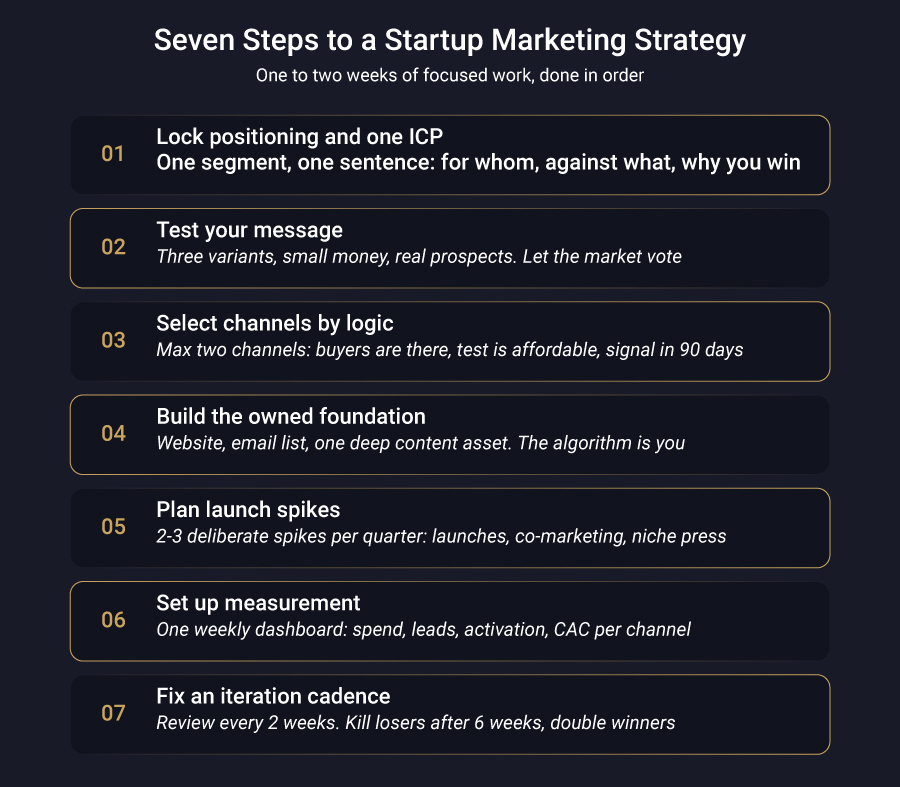
Below are all seven steps to a startup marketing strategy explained in detail.
Step 1: Lock positioning and one ICP
Choose one ideal customer profile, even if the product could serve five. Write the sentence: for [segment] who [struggle with X], [product] is the [category] that [key difference]. A dev-tools client of ours replaced "for developers" with "for platform engineers at Series A to C SaaS companies," and every later decision, from channel choice to pricing page copy, got easier. In CB Insights' post-mortem analysis, 42% of failed startups cited no market need. Positioning is where you catch that problem while it is still cheap.
Step 2: Test the message before you scale it
Write three different value propositions, then test them with little money and real prospects: 20 cold outreach messages per variant, or three landing page headlines with $100 to $200 of traffic behind each. You are looking for a clear gap in reply or conversion rate, not perfection. The pattern we see repeatedly: the variant the founder likes least wins about as often as the favorite. Let the market vote before the budget does.
Step 3: Select channels by logic, not fashion
Pick a maximum of two channels using three filters: your buyers already gather there, you can afford a test big enough to produce a signal, and you will see that signal within 60 to 90 days. A B2B infrastructure startup usually lands on founder-led LinkedIn plus two or three niche communities. A consumer app might land on short-form video plus referral mechanics. Neither should copy the other. Affordability is the filter founders skip most often: a paid test needs enough conversions per variant to produce a readable signal, and if that math exceeds your monthly budget, the channel is not wrong; it is premature.
Step 4: Build the owned foundation
Before spending on rented channels, set up the assets you control: a website whose first screen states your positioning sentence, an email list with one concrete reason to join, and one deep content asset that answers your buyers' hardest question. Rented platforms change their rules without asking you. Your site and your list are the only channels where the algorithm is you.
Step 5: Plan launch spikes
Steady channels grow slowly, so schedule two or three deliberate spikes per quarter: a Product Hunt or community launch, a co-marketing swap with a company sharing your audience, or a data story pitched to niche press. Spikes matter less for the traffic itself and more for the data and backlinks they generate, which feed Steps 6 and 7. One fintech client got more qualified conversations from a single co-marketing webinar with a complementary tool than from a quarter of blog posts, because the partner's list already trusted the topic.
Step 6: Set up measurement before the first dollar
One dashboard, reviewed weekly: spend, leads or signups, activation, and cost per acquisition by channel. Nothing else at this stage. If you cannot name your CAC per channel, you do not have a strategy; you have expenses. A spreadsheet plus a free analytics tool is enough at this stage; buying a dashboard product before you have traffic is procrastination with a login.
Step 7: Fix an iteration cadence
Review the dashboard every two weeks with two standing rules: kill any channel that misses its threshold after six weeks of honest effort, and move its budget to whatever is working. Startups rarely die from picking the wrong channel. They die from staying on the wrong channel for two quarters out of sunk-cost pride.
The 2026 Layer: AI Search and Being Recommended by ChatGPT
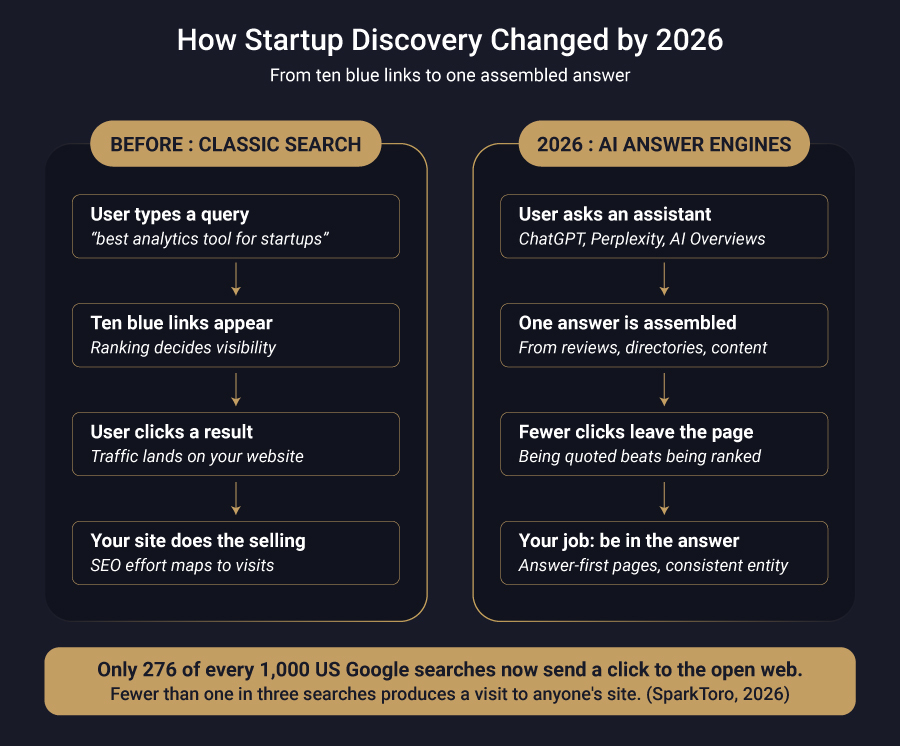
In 2026, a growing share of your buyers never see a list of blue links. They see one answer assembled by ChatGPT, Perplexity, or Google's AI Overviews, and your job is to be inside that answer. The click data from this year is unambiguous: 68% of US Google searches now end without a single click, and only 276 of every 1,000 send a click to the open web, according to SparkToro's 2026 study. Fewer than one in three searches produces a visit to anyone's site.
This is the section missing from almost every startup digital marketing strategy guide still circulating — most haven't caught up to Generative Engine Optimization (GEO) as a discipline — so here are three actions a founder can take this month.
First, restructure key pages so the opening two sentences of each section directly answer the question in its heading. Answer engines quote passages, not pages, and a buried answer does not get quoted.
Second, be present in the sources these models actually cite: review platforms and directories such as GoodFirms, comparison articles in your category, and active community threads. When someone asks an assistant for "best [your category] tools," the answer is stitched together from exactly these places.
Third, keep your company's entity data consistent. Use the same one-line description of what you do on your site, LinkedIn, directories, and press mentions, and once a month, ask ChatGPT and Perplexity what they recommend in your category. Treat a wrong or missing answer the way you would treat a broken landing page.
None of this replaces classic SEO, because the inputs overlap heavily. What changes is the target: you are writing to be the answer, not only the ranking.
Budget-Staged Marketing Plan for a Startup: Three Tiers
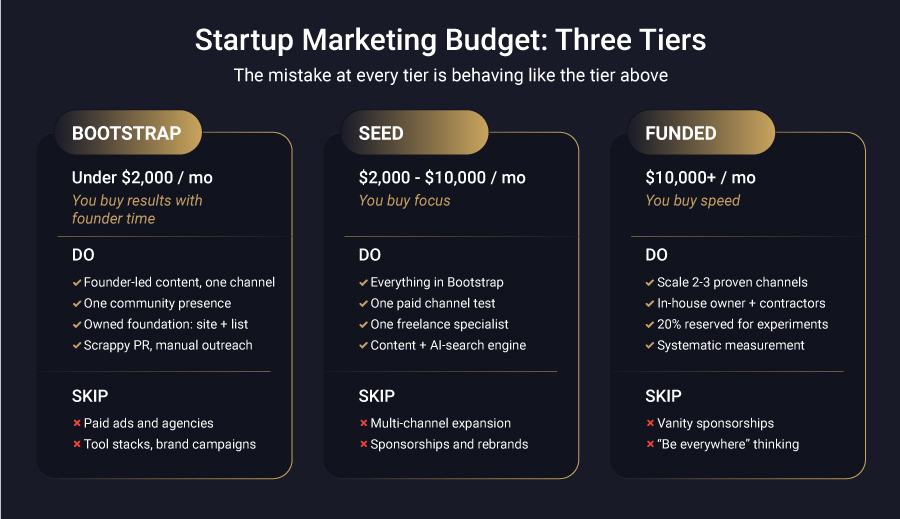
A realistic marketing plan for a startup is staged by budget, not ambition. Below $2,000 a month, you buy results with founder time. Between $2,000 and $10,000, you buy focus. Above $10,000, you buy speed. The mistake at every tier is behaving like the tier above.
|
Tier |
Monthly budget |
Do |
Skip |
|---|---|---|---|
|
Bootstrap |
Under $2,000 |
Founder-led content on one channel, one community, owned foundation, scrappy PR, manual outreach |
Paid ads, agencies, tool stacks, brand campaigns |
|
Seed |
$2,000-$10,000 |
Everything above, plus one paid channel test, one freelance specialist, a content and AI-search engine |
Multi-channel expansion, sponsorships, and rebrands |
|
Funded |
$10,000+ |
Two or three proven channels scaled, an in-house owner plus contractors or an agency, 20% reserved for experiments |
Vanity sponsorships, channels without an owner, "we should be everywhere" thinking |
Two notes from experience. At bootstrap, consistency beats production value: one founder post per week for six months outperforms a polished campaign that ships once. And when you set a saas startup marketing budget, anchor it to pipeline math, not to the average 10 to 20 percent of revenue that generic benchmarks suggest, because pre-revenue companies have no revenue to percentage.
Whatever the tier, write down what you are explicitly skipping this quarter. A skip list is the cheapest management tool in marketing: it turns every shiny-object debate into a two-minute check against a decision you already made.
If you are comparing outsourced options instead of hiring, review how startup marketing packages from top social media marketing companies map to these tiers before you sign anything. Match the scope to your stage: a foundation-level package while you are still validating your first channels, and a full multi-channel package once your budget reaches the funded tier and the early data supports scaling.
Adapting the Plan: B2B and SaaS Startups
A b2b startup marketing strategy follows the same seven steps with two adjustments. Longer sales cycles push you toward fewer, deeper bets: account-based outreach, founder-led social proof, and content marketing that helps your champion sell internally. And because buying committees decide, your message must work twice, once for the daily user and once for the budget holder.
A saas startup marketing strategy adds a product layer on top. Your trial or demo flow is a marketing channel, so measure signup-to-activation with the same discipline as ad spend, and let onboarding emails and in-product prompts carry part of the conversion work. For SaaS, the cheapest growth is usually expansion within accounts you already won, which pure acquisition plans ignore. In both cases, keep the one-page strategy from Step 1 as the parent document and treat these adjustments as amendments, not a rewrite.
Common Mistakes That Kill Startup Marketing
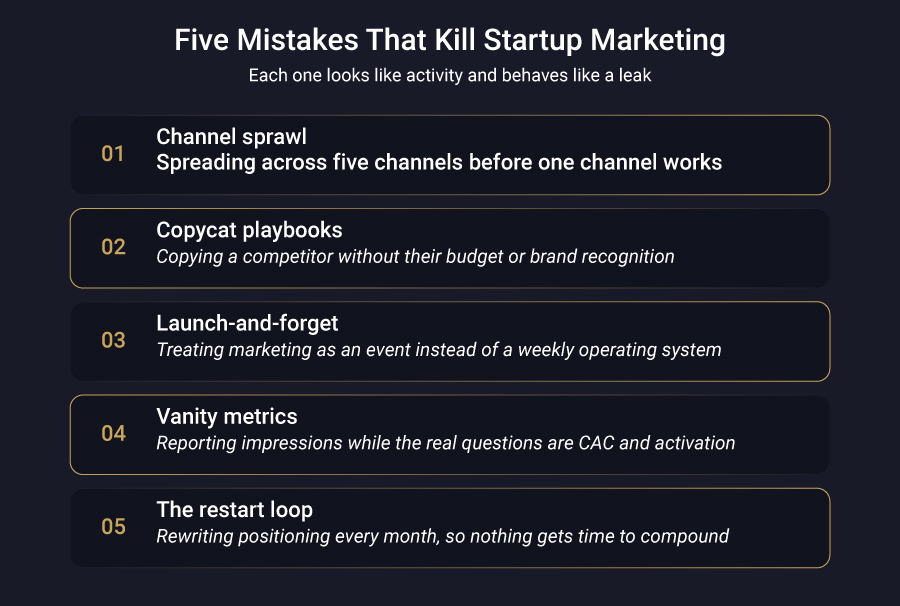
Five patterns show up again and again across the projects we take over. Each one looks like activity and behaves like a leak.
1. Spreading across five channels before one channel works.
2. Copying a competitor's playbook without their budget or brand recognition.
3. Treating marketing as a launch event instead of a weekly operating system.
4. Reporting impressions and followers while the real questions are CAC and activation.
5. Rewriting positioning every month, so nothing ever gets the time to compound.
When to Hire a Startup Marketing Company (and How to Choose)
DIY marketing stops being cheap when it starts costing you the roadmap. The signals you have outgrown it: nobody reviews the numbers weekly, a proven channel is stuck for lack of specialist skill, CAC is rising, and the team is out of ideas, or the founder's hours spent on marketing now cost more than a retainer would.
When you evaluate providers, use five criteria. Ask for case studies at your stage, because enterprise wins say little about seed-stage constraints. Prefer depth in the one or two channels your plan needs over full-service menus. Demand reporting tied to pipeline and CAC, not impressions. Find out who will actually work on your account, since pitch teams and delivery teams often differ. And favor month-to-month terms or a three-month pilot over long lock-ins. Price matters less than fit at this stage: a cheap retainer that reports impressions is more expensive than a fair one that reports pipeline.
The market has credible options at different stages and specialties. NoGood runs growth experimentation for venture-backed consumer and SaaS brands. Single Grain focuses on paid acquisition and providing SEO services for tech companies. Deviate Labs is known for creative growth campaigns across industries. RGray, the startup marketing agency I founded, works with early-stage tech and Web3 companies on strategy and execution. Shortlist three, ask each for a stage-specific plan, and choose the team whose questions about your business impress you most.