AI can revolutionize how people around the world work, communicate, and interact with each other today.
Famously known as the “New Oil” of the digital ecosystem, countries around the world are capitalizing on this promising tech, propelling AI development companies globally to bring positive changes to how countries conduct cyber operations, gather intelligence, and conduct warfare.
To this end, AI is also playing a significant role in optimizing logistical operations, surveillance, and battlefield decision-making for many countries world over; making it a crucial asset for modern defense systems.
This means that countries heavily investing in AI will have a strategic edge. Among all the countries, the U.S. and China truly lead in AI development as they have a strong ecosystem, deep pockets, and huge data pools. Other countries like India, Japan, and the UK are important players in this field, but they are no match for the U.S. and China's AI ambitions.
The U.S. and China are leading in the AI race, and there is a cutthroat rivalry between these two countries when it comes to AI adoption and reaping its benefits. The question that may cross your mind is—who will win this race? The U.S. or China?
Let’s have a look at the details on this subject.
Understanding the Competition: Why the U.S. and China Lead the Global AI Race?
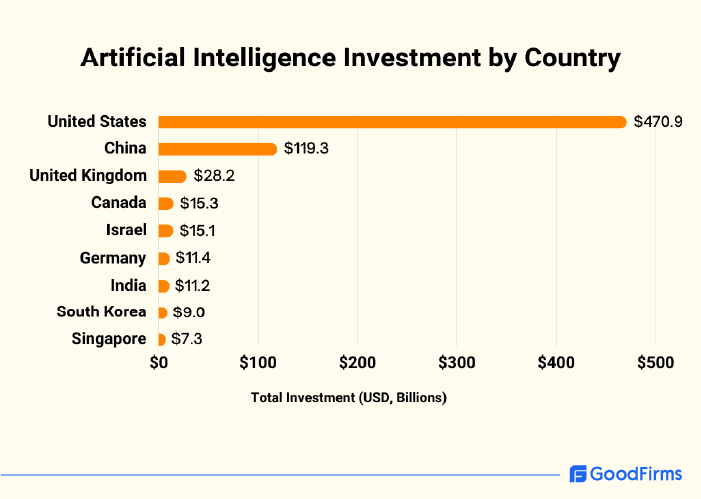
It’s been almost three years since the U.S. has been at the forefront of AI adoption, research, and development, and most other countries in the world are still struggling to catch up. There is only one country that is closely in competition with the U.S. in AI development, and that is China.
The figures below clearly show the global AI competition in terms of investment by different countries.
(Source: Statista)
So, what makes the U.S. and China make significant strides in AI?
Let’s examine three main pillars that enable the U.S. and China to lead the Global AI race.
Three Key Pillars Supporting the U.S. and China to Lead the Global AI Race
The United States and China are at the forefront of the global AI race. But what has helped them to stay ahead in this fierce competition? Below are the 3 key pillars that are helping the U.S. and China lead in the global AI race.
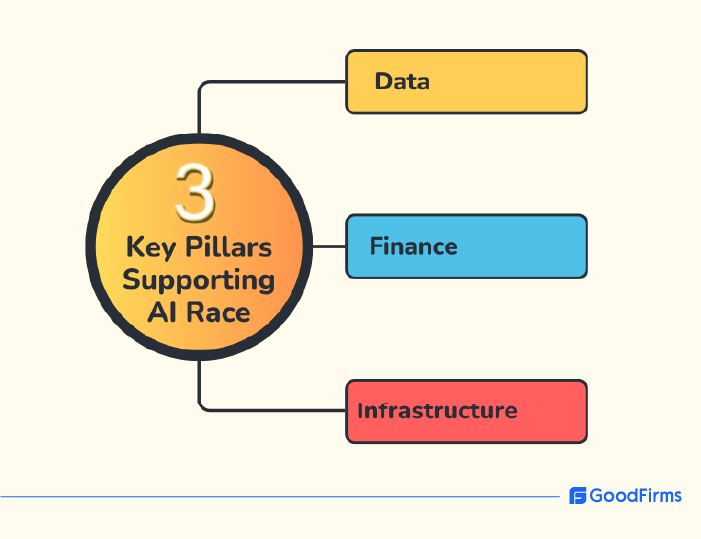
Let's know these three key pillars - data, finance, and infrastructure that fuel the growth and prominence of these two countries in this facet in detail.
#1 Data
It is data that makes AI powerful. The U.S. encompasses tech giants like Google, Meta, Microsoft, Apple, Netflix, Amazon, and more. These tech giants can collect diverse datasets from all over the world. They have unlimited global reach and, therefore, can collect vast amounts of data required for building versatile AI models useful in multiple industries.
On the other hand, China has a 1.4B+ population, which can create the richest and largest pool of data, and also its speed of digital adoption is higher when compared to other countries. This huge chunk of data generated every day enables AI to learn in terms of facial & voice recognition, predictive analytics, and sending personalized recommendations.
#2 Finance
AI development requires considerable investment, and the U.S. has a well-established venture capital ecosystem that can fund AI startups. Tech giants like Microsoft, Amazon, Meta, Google, and more are actively investing billions of dollars annually in AI research, development, infrastructure, and talent acquisition.
Whereas, China Government allocates a huge amount of funding to AI development through five-year plans and direct subsidies. National and state-backed tech giants like Tencent, Alibaba, Huawei, Baidu are getting billions in funding and policy support to encourage working on AI projects. Unlike U.S., China is more focused towards building smart cities, surveillance systems, and industrial automation.
#3 Infrastructure
AI development requires infrastructure and talent that encourages innovation and creativity. The U.S. possesses world-class universities and labs, innovation hubs, entrepreneurial culture, and industry-academic collaboration environments that enable it to excel in AI research and development. As policies in the U.S. are liberal when compared to Europe and China, creativity and innovation have no boundaries despite privacy debates prevailing there.
On the other hand, China is making huge investments in AI learning & education, PhD programs, and coding bootcamps to ensure the country builds a talented pool of AI developers, researchers, and experts. With Government support, China is implementing AI solutions for healthcare, transportation, surveillance, and smart cities.
On July 23rd, 2025, the U.S. government released “Winning the AI Race: America’s AI Action Plan,” and exactly three days later, China published its “Global AI Governance Action Plan.” Both powerful countries are in tough competition when it comes to establishing and penetrating AI into their ecosystems. These countries have come up with some key policies in their AI plans. Let’s have a look at them.
United States’ Key Policies in AI Action Plan
Below are the United States’ key policies in the AI action plan explained in detail.
Partnership: The Commerce and State Departments in the U.S. are planning to partner with industry to deliver secure, full-stack AI export packages that include software, applications, models, hardware, and standards to countries around the world.
Building Data Centers: The U.S. is promoting the rapid building of data centers and semiconductor fabs by expediting and modernizing permits. Also, they are planning to create new national initiatives to surge occupations that are highly in demand like electricians and HVAC technicians.
Driving Adoption and Innovation: The U.S. government is planning to mitigate the strenuous regulations that obstruct AI development and implementation.
Updating Federal Procurement Guidelines: Making sure that the U.S, government only contracts with frontier large language model developers who ensure that their systems are objective and free from top-down ideological bias.
China's Key Policies in the AI Action Plan
Below are China’s key policies in the AI action plan explained in detail.
Improved Collaboration: The Chinese Government is planning to encourage collaboration of all stakeholders ,including research institutions, enterprises, and individual citizens to accelerate the development of digital infrastructure that can help in AI research, development, and implementation.
Bold Experimentation: Planning to establish an innovation-friendly policy that helps AI experts promote technical collaboration and transform research outcomes by reducing and removing technological barriers.
Enhancing Digital Infrastructure Construction: China now wants to speed up the construction of next-generation networks, data centers, global clean power, intelligent computing power, and other infrastructure to promote AI development.
Promoting High-Quality Data Supply: The Chinese government envisions driving AI development by leveraging high-quality data, collaborating to facilitate the laws and orders that allow free flow of data, exploring the construction of a global platform for data sharing, and creating high-quality data sets to provide more provisions for AI development.
So, these were the different policies that the U.S. and China are implementing when it comes to AI development. Moving further, let’s now have a comparison look at who is ahead, the U.S. or China, when it comes to following investment models now and in the future.
AI Project Funding: Different Models of Investment
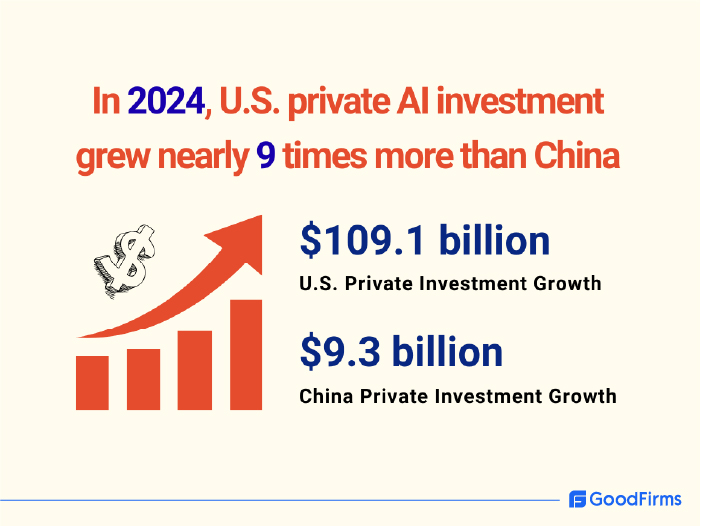
When it comes to funding AI projects, the U.S. follows a market-driven approach, whereas China follows a state-driven model. Let’s have a look at the below comparison table of both countries in terms of their investment models.
U.S. vs. China - AI Investment Models
| Venture Capital (U.S.) | State Funding (China) |
| Relies on venture capital and private equity. | Relies on Government funding. |
| AI startups like OpenAI, Anthropic, Scale AI, etc., are financed by venture capital. | The state invests in AI projects that align with the national strategy. |
| Investors look for high returns and, therefore, invest in commercial AI application development projects quickly. | The Government provides subsidies, low-interest loans, and infrastructure for AI projects. |
(Source: Stanford)
This was about the way the U.S. and China fund their AI projects. Now, let’s have a look at which country has highly skilled and brainy AI developers? U.S. or China? Let’s have a look.
Talent War Between U.S. and China - Who Has Better AI Developers?
Below are the 5 factors that differentiate the quality and quantity of AI developers in the U.S. and China. Let’s have a look at those factors.
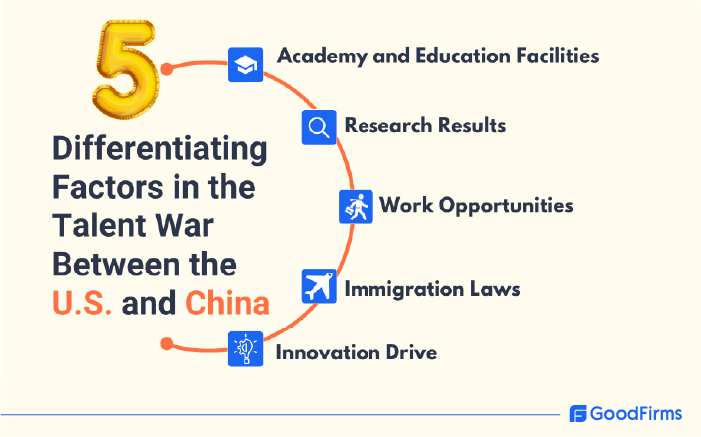
Below are the differentiating factors in the talent war between the U.S. and China explained in detail:
#1 Academy and Education Facilities
U.S. - Already hosts the world’s top AI universities like MIT, Stanford, Berkeley, Carnegie and every year they produce not just researchers, but startup founders. Also, the country attracts global talent who study and work here.
China - This country produces four times more computer science majors each year than the U.S., and the government is focused on investing in universities and training centers imparting AI education. China has a greater number of AI experts, but is still coping with the U.S. in terms of quality of talent.
#2 Research Results
U.S. - Leads in top-tier research papers like NeurIPS, ICML, CVPR, and ACL. Many AI breakthroughs, like transformers and GPT models, originated in institutions here. Also, researchers here prioritize open-source contributions and global collaboration.
China - Has a strong focus on applied AI research for computer vision, surveillance, and smart cities. When it comes to research, China has overtaken the U.S. by quantity, but still, concerns exist about quality and originality.
#3 Work Opportunities
U.S. - AI developers get opportunities to work with venture capital, big tech labs, and startups. However, there are better opportunities for frontier AI research experts in LLMs, AGI, and robotics. This country offers higher salaries & stock options, and therefore attracts global talent.
China - Here, Government support ensures steady jobs and funding. AI developers in China have huge deployment opportunities in fintech, healthcare, eCommerce, surveillance, and smart cities. However, there is less entrepreneurial freedom when compared to Silicon Valley.
#4 Immigration Laws
U.S. - Attracts talent from India, China, and Europe, but has visa restrictions, which are pushing some talent back to their origin countries. Under some government initiatives, Chinese AI PhDs in the U.S are facing pressure to return to their country.
China - Aiming to bring back Chinese researchers working abroad through the “Thousand Talents Program.” Also, some returnees are now leading state-backed AI labs. This country is still struggling to attract non-Chinese global talent compared to the U.S.
#5 Innovation Drive
U.S. - The culture here is more about radical innovation as they encourage risk-taking projects and startups. AI developers in this country are thriving in environments like Silicon Valley, and open-source communities.
China: AI developers here excel in learning, mass adoption, and scaling. The culture here is more about deployment and execution than radical innovation.
Precisely, when it comes to AI, the U.S. is ahead in terms of research and development, whereas China is ahead in terms of deployment and scaling.
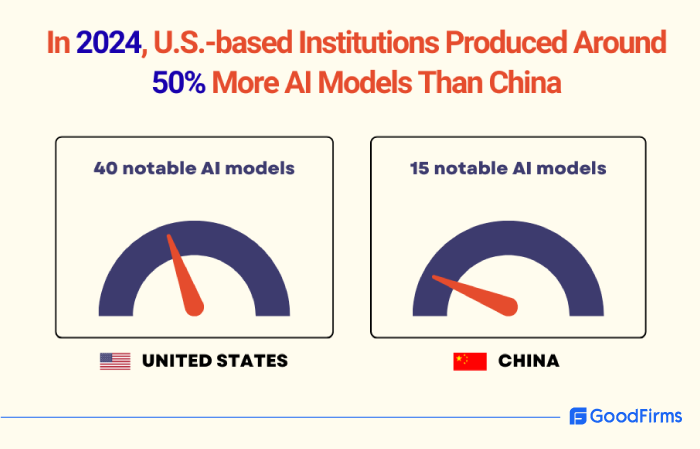
But, it is also a fact that in 2024, U.S.-based institutions produced around 50% more AI models than China.
(Source: Businesswire)
Now, let’s have a look at the current and future AI market valuation in the U.S. and China to get a better understanding of this competitive landscape.
Who is Ahead in AI Market Valuation Worldwide? The U.S. or China?
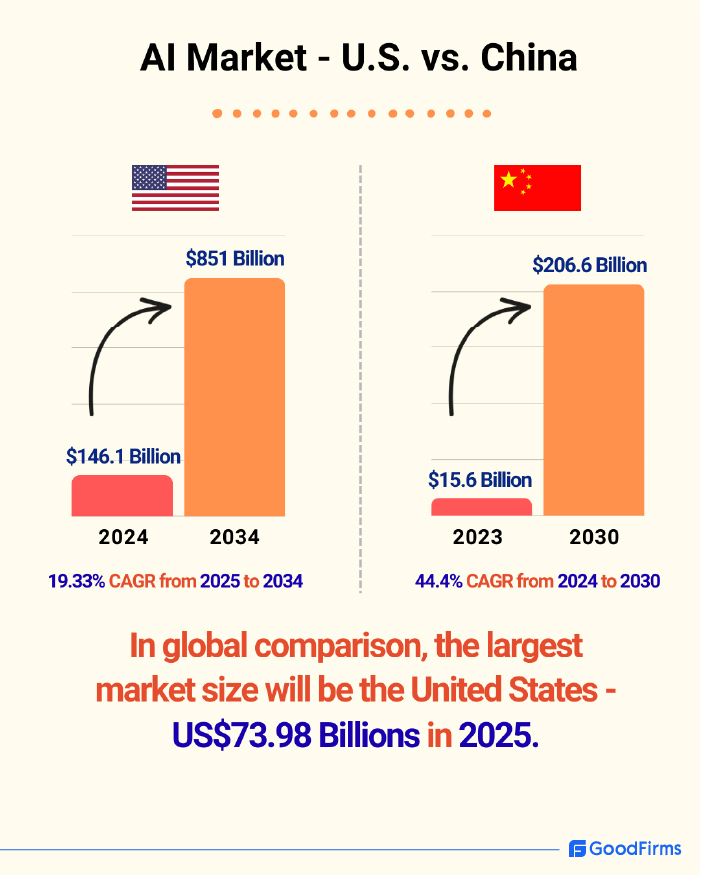
The figures below prove that the U.S. is ahead in AI market valuation worldwide.
(Source: Statista)
So, now we know the U.S. is leading in terms of AI market size. But what about AI deployment in the U.S. and China? Let’s have a look at how these leading countries have deployed AI in different industries.
AI Deployment by the U.S. and China
The U.S. and China are harnessing AI across multiple business sectors differently. The U.S. is inclined towards innovation in private industries, whereas China is driven by state-led policies that prioritize rapid and wide integration for its defense and economy. The U.S. wants to control exports, whereas China is looking forward to self-reliance. Below are some examples of how the U.S. and China are deploying AI in various industries.
Government and Public Services
U.S. - The Department of Defense in the United States is implementing AI-powered solutions to protect its citizens against cyber threats, anomaly detection, and surveillance.
China - AI is helping in integrating intelligent governance, avoid financial frauds and suspicious online behaviour, and using facial recognition for public security.
Healthcare
U.S. - AI is used to analyze medical imaging and lab results, develop personalized treatment plans, streamline administrative tasks, and enhance patient engagement.
China - Applying AI for improving the accuracy of detecting diseases, online health services, disease prevention, and avoiding fraudulent reimbursement claims.
Entertainment
U.S. - Known for developing AI apps that include personalized content recommendations, content creation, fraud detection, and privacy prevention.
China - Tech companies in China are investing heavily in AI for developing powerful video and image generation models, chatbots, and focusing on outsourcing app development services.
Energy
U.S. - AI tools like PolicyAI are used to help speed up federal permitting processes for energy projects. Also, AI is used for grid modernization and reliability, and renewable energy optimization.
China - AI solutions for supply and demand forecasting, optimizing renewable energy, and grid management are being used to enhance efficiency and national energy security.
Transportation
U.S. - Companies like Waymo are operating autonomous fleets, and John Deere is developing autonomous farming vehicles. AI is also used to analyze real-time traffic and road conditions.
China - Known for robotaxis and driverless subways, and using systems like “Urban Brain” for intelligent traffic management to reduce congestion and accidents.
Manufacturing
U.S. - Possesses smart factories with optimized production processes, streamlined supply chains, quality assurance, accelerated generative design, and predictive maintenance.
China - Using AI, China has come up with “Dark Factories” that are fully automated robotic factories operation around the clock requiring minimal human supervision.
Retail and eCommerce
U.S. - AI has enabled U.S.-based retailers to integrate personalized recommendations, inventory optimization, automation in customer service, visual search, and virtual try-ons in their store.
China - AI solutions are enabling China-based retailers to deliver better services through hyper-personalized customer experiences, intelligent automation, and optimized supply chains.
Agriculture
U.S. - AI-powered tractors, robotic sprayers, and drone-assisted surveillance systems are being used for improving speed and efficiency in farming and monitoring crop healthy, pest/disease outbreaks, and soil conditions.
China - AI-enabled drones are being used for tasks like seeding, fertilizing, and pest control. Also, AI analyzes the data to help farmers optimize their planting, irrigation, and harvesting.
Finance
U.S. - Financial firms like JPMorgan perform algorithmic trading using AI, which helps them trade at optimal times at optimal prices. Bank of America's chatbot, Erica, helps its customers resolve queries 24/7.
China - Major banks like ICBC and Bank of China are using AI to automate tasks, detect fraud, provide credit advisory, and perform financial analysis.
Logistics
U.S. - Logistics companies based in the U.S. are using AI for predicting demands, manage inventory, and identifying supply chain risks to improve productivity and efficiency.
China - AI-powered robotics can automate and speed up operations such as picking, sorting, and packing in large eCommerce warehouses.
So, now we know how the usage of AI applications is carried out by the U.S. and China in different industries. But, the question still remains - who will win this race of AI development?
In both the countries - the U.S, and China, AI has become imperative for social, economical, and political progress.
US Vice President JD Vance said in an event in late July, “We want the world to be built on an American technology stack, not on Chinese or some other country’s technology stack.”
At the same time, Chinese President Xi Jinping said that “AI should not be a game of rich countries.”
So, the competition is tough between these two countries. The U.S. leads in terms of research innovation and talent, whereas China leads in terms of Government support for real-world AI adoption and deployment.
Finally, let’s have a look at the strengths and weaknesses of the U.S. and China to draw a conclusion to this article.
The AI Race: U.S. and China's Strengths and Weaknesses
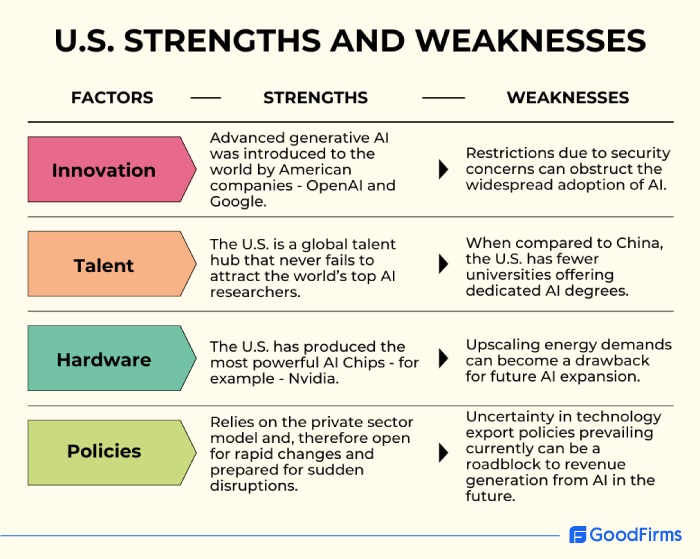
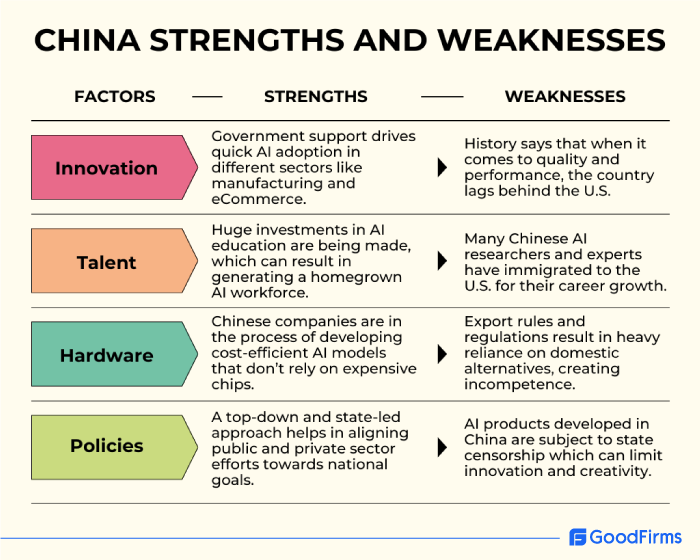
The U.S. emphasizes research and innovation, whereas China is more focused on quick AI development and scaling. The former relies heavily on a private-sector-led model, while the latter follows a state-coordinated top-down approach. The comparison tables below clearly show the strengths and weaknesses of these powerful countries in terms of AI research, development, and deployment.
U.S. and China's AI Rivalry - Who is Triumphing Today and Who Might Be at the Supermacy Tomorrow?
To conclude, the U.S. is triumphing today, but China may lead in the future with its strengths, such as government support and massive investments in AI education. The U.S. is ahead in terms of prominence in research and development, skilled workforce, and innovation, but China is no less, as it leads in real-world adoption like smart cities, and manufacturing electric vehicles powered by AI intelligent systems.
The outcome of this AI race is uncertain as it heavily depends on rapidly changing Government rules and regulations, market conditions, technological breakthroughs, ethical choices, and global collaborations.
However, the top leaders in software and mobile app development need to be prepared for this rapidly changing environment and keep themselves updated with the latest Government policies, technology, and tools to stay ahead in the game.