Modern consumers no longer fit into the conventional buying models. Their demands are no more pent-up. Convenience, affordability, flexibility, and accessibility are the four factors that matter to the new-class consumers these days. Shopping without planning - “On-demand” trend is picking up at high speed. Demand delivery market is booming with more and more players pitching for on-demand delivery apps driven by the convenience shoppers.
An on-demand delivery application like Uber, DoorDash, Instacart, Shipt, Google Express, Amazon Flex, etc., come with great accessibility and flexibility that make it easier for people to quickly order and experience what they need. Technology is empowering on-demand delivery services.
So, have you ever wondered how these on-demand delivery applications are built? One simple way is to use the no-code method, where the best App Development Software is leveraged to build some of the top on-demand delivery apps with less app development time, and cost.
Application builder tools offer unparalleled accuracy, efficiency and productivity to developers, allowing them to effortlessly develop secure and performance-driven on-demand delivery applications without huge investments.
Here, we have come up with an interesting blog that tips you on how to create an on-demand delivery app quickly. The blog highlights various components and aspects of on-demand app development, such as types, examples, process, features, etc., to clarifying some of the widely asked questions regarding on demand app development, including;
- What is an on-demand delivery app?
- What are the major types of on-demand delivery apps?
- What are the key features of an on-demand delivery app? What are their benefits?
- How to create an on-demand delivery app quickly using a no-code On-Demand app maker?
- Which is better? Developing an on-demand delivery app using the best App development software or hiring the best app developers?
What is an On-Demand Delivery App?
An on-demand delivery application refers to a digital platform that offers real-time shopping services to consumers within a short time span whenever they require. These apps provide an easy to use interface to the consumers through which they can request and receive products and services at any time right from their mobile phones. It is one of the most popular business models across the globe as it allows users to order their favorite products and services with just a few clicks, use the integrated payment facility, or use crypto for payments, and leverage 24*7 customer service.
On-Demand Delivery Application Market Size:
The global on-demand delivery market is poised to touch 115.94 billion by 2032. App creation software plays a greater role in quickly creating applications that have less involvement of the developers as most of the development processes are automated. The software can be used to build high-performing Android and iOS apps that offer a great user experience. Rise of on-demand e-commerce platforms, increasing smartphone penetration, emergence of contactless shopping and changing user preferences are the major factors driving the growth of this market. Further advancements in the emerging technologies like AI, automation, etc., will also contribute to better market growth in the near future, eliminating critical challenges associated with last mile delivery, labor issues, regulatory compliances, etc.
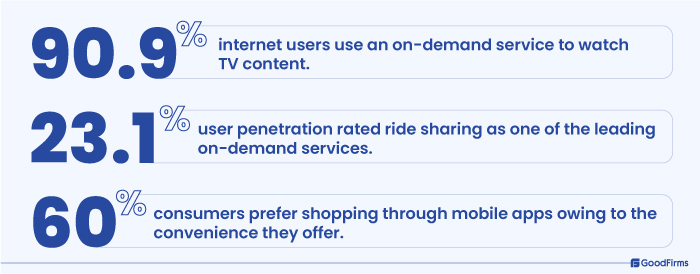
On-Demand Consumer Statistics:
Here are some of the most impressive on-demand consumer statistics which you should be aware;
Types of On-Demand Delivery Apps
On-Demand delivery applications are of 3 types:
- B2B on-demand delivery apps - Asana, Trello
- B2C on-demand delivery apps - UberEats, Zomato
- D2C on-demand delivery apps - OLX, Airbnb
The most common on-demand delivery apps that are available today are;
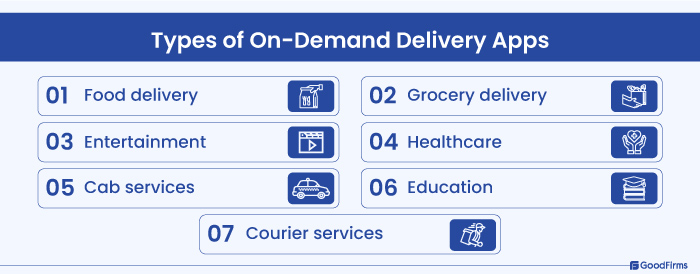
The demand for on-demand delivery apps has been at an all time high owing to the convenience and benefits they bring to the end users. From essential household items and healthcare to entertainment and traveling, on-demand apps are enabling businesses to serve their consumers as per their convenience level. Some of the on-demand apps that dominate the market currently are as follows;
Food delivery
On-demand food delivery apps have the maximum demand in the United States owing to which the US online food delivery market is expected to cross $353.30 billion in 2024. These apps connect users with their preferred restaurants and deliver the food at any time, and at any location. Users just need to select the dish they want and the food is delivered within a short span of time. Such on-demand food delivery apps have easy payment gateways. Top 5 on-demand food delivery apps include DoorDash, Grubhub, Uber Eats, Deliveroo, and Zomato due to their strong market presence, exceptional customer services, quick delivery, and user-friendly app interface.
Grocery delivery
On-demand grocery delivery apps are also popular among end users to get timely doorstep delivery of daily use essentials, such as pantry staples, meat, seafood, fruits and various other household products. Top 5 on-demand grocery delivery apps include Instacart, Shipt, FreshDirect, Amazon Fresh, and Gopuff due to delivering cost-effective products, discounts and deals, quality products, customer service, and on-time delivery.
Entertainment
The global on-demand video market is expected to grow with a 13.00% CAGR in the next few years, signaling significant growth. Entertainment-based on-demand delivery apps allow users to access their favorite videos, movies, shows and documentaries without requiring a video playback device. Users can directly access these videos through their phones, smart TVs and computer systems, allowing them to watch on the go, whenever they want. Top 5 on-demand entertainment apps include Netflix, YouTube, Amazon Prime Video, Disney+, and Spotify due to easy subscription, quality live and on-demand content.
Healthcare
On-demand healthcare apps are gaining more popularity with increasing awareness about preventive care, real-time medical advice, and cost-efficient consultations. Through these apps, both healthcare professionals and patients can remotely connect with each other for medical prescription, guidance, flexible care and treatment. For both doctors and patients, these offer features like real-time medical treatment, virtual consultation, scheduling telehealth appointments, etc. Top 5 on-demand healthcare apps include Doctor On Demand, MDLIVE, Amwell, Healow, and K Health | 24/7 Virtual Care, due to their quality and instant services, convenient scheduling, discounts and promos, and much more.
Cab services
Another major type of on-demand delivery apps is online cab booking services. These apps connect the rider with the nearest available cab driver based on preferences like car type, ride type, distance, etc. Top 5 on-demand cab services apps include Uber, Ola, Lyft, Cabify, and DiDi. These types of apps provide an easy way for people to commute. The global on-demand travel and transportation market is poised to grow with a 19.4% CAGR, reaching a $885.00 billion milestone in the next few years.
Education
Learning, educating, and attending classes has also become more convenient with the on-demand learning apps. These apps are increasingly being used by learners for flexible learning, career advancements and to gain knowledge on the go. Top 5 on-demand learning apps include Udemy, edX, Google Classroom, Photomath, and Sololearn.
Top Features of an On-Demand Delivery App
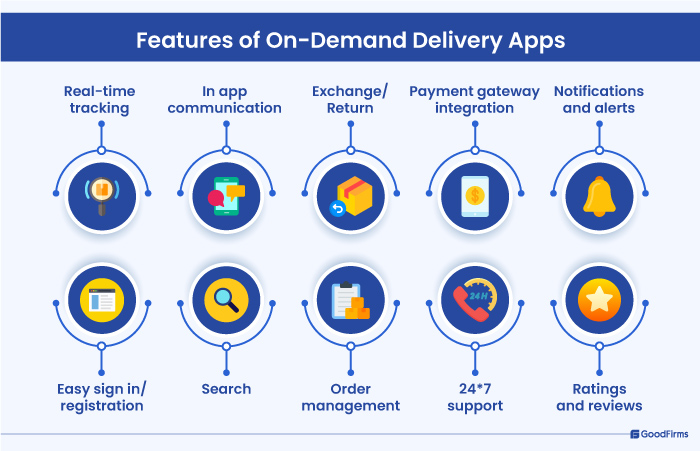
Here are some of the most important features of on-demand delivery applications that plays a significant role in ensuring enhanced user experience and satisfaction;
Real-time tracking
Real-time tracking and monitoring features are important when it comes to determining the status of the orders/products/services in transit. It helps users in acquiring the live status and location information of the orders/drivers to get a clear idea on delivery. For instance, food delivery and cab service providers rely on real-time tracking to share the live location of their delivery partners with the consumers.
Payment gateway integration
A payment gateway integration is must when selling a product or service through on-demand delivery apps. It helps both business and users in secure exchange of money whether it is purchase, refund or adding money through vouchers. A reliable payment gateway should support multiple payment methods with maximum security. It is beneficial in securely processing transactions without any issues.
Notifications and alerts
Notifications and alerts keep users notified about all the latest updates. Businesses use this feature to convey about new products, recommendations, upcoming sale, discounts, order updates, etc., to users. Push notifications drive customer engagement and hence increase app usage.
24*7 support
This feature in on-demand applications plays a critical role in ensuring proper customer satisfaction and experience. Through this feature, app users can connect with the customer support team at any time to report their grievances. In-app communication is one of the widely used 24*7 customer support methods.
Search
The ease to find a product or related information highly influences the purchasing decisions of users. It is vital to have precise search functionality that enables users to easily and quickly get the information they need.
Order management
Order management features in an on-demand application help with enhanced inventory visibility, order orchestration, returns management, order fulfillment, etc. This feature greatly helps businesses in automating the order management process to hassle-free manage sales and purchase orders.
In app communication
In app communication is important in connecting and interacting with the targeted users and customers. Through this, both customers and customer service agents can exchange photos, audio and videos to instantly address the issues.
Exchange/Return
The application should also support reverse logistics functions, such as exchange and returns. These features make it easy for the customers to place the requests for returns and exchange when the product does not meet the expectations or requirements.
Easy sign-in/registration
Users prefer hassle-free processes whether it is ordering, registering or signing in. An on-demand application should come equipped with smart authentication options for easy registration and sign in.
Process to Create an On-Demand Delivery App Quickly (With a few examples)
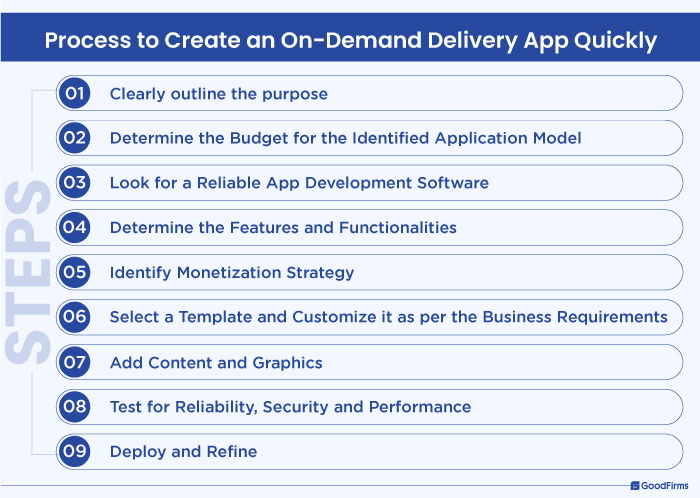
Clearly outline the purpose
The process to create an on-demand delivery app quickly using low-code development software starts with a clearly outlined purpose. A well-defined purpose acts as the foundation of development. While outlining the purpose, businesses should focus on a few factors like goals, objectives, what, why, and how? Make it a point to define the required features, integrations, technologies, and other aspects.
Determine the Budget for the Identified Application Model
This is a very crucial step as both excessive budget or inadequate budget will affect either the company’s revenue or the app development process. The overall budget covers the cost of a wide range of app development components, such as templates, plugins, premium extensions, payment gateway, support and maintenance, AI integration, supported platforms, APIs, app store deployment, etc. Carefully consider each aspect of the on-demand application development and then set the budget accordingly.
The overall cost to develop an Android, or iOS application using an app creation software, without writing a code can be based on the plan that you choose; It could be:
- Free - Meant for small projects with limited functionalities, Mostly single user.
- Paid version - Can be Basic, Pro, Business, and Enterprise (Premium). The number of users can vary from 10 users to unlimited under these plans. Features and functionalities also vary as per the plan chosen.The cost to build an app with an app development software under the paid plan can vary as follows;
- Monthly Payment - $15- $250
- Annual Subscription - $100 - $3000
- Quote Based ( Depending upon the project requirements the cost is fixed)
- One-Time Payment - $4000 - $10,000
The factors that can influence the costs for different on-demand delivery apps are as follows;
| App type | Factors to be considered |
| Food Delivery | Cross platform compatibility, real time updates, restaurant admin panel, food delivery partner panel, customizations, payment |
| Grocery Delivery | Cross platform compatibility, real time updates, Store admin panel, delivery partner panel, customizations, payment |
| Medicine Delivery | Cross platform compatibility, real time updates, pharmacy admin panel, delivery partner panel, regulatory compliance, customizations, payment |
| Travel and Transportation |
Cross platform compatibility, real time updates, rider panel, driver panel, customizations, payment |
| Education | Cross platform compatibility, real time updates, learner panel, instructor panel, customizations, payment |
| Courier | Cross platform compatibility, real time updates, driver panel, user panel, admin panel, customizations, payment, tracking |
Open-source and free app development software solutions allow businesses to conveniently use the software to easily design, develop and deploy the on-demand solutions.
Look for a Reliable App Development Software
Based on the budget estimation, choose the right app development software that meets your business needs. There are different types of instant app development software that can be selected as per the scalability, customization and agility requirements. Also, evaluate whether you want a native app, hybrid app or cross-platform on-demand application. Goodfirms is a trustable platform to get a reliable list of the best app development platforms and software. You can leverage relevant filters like popular features, pricing model, devices supported, deployment, etc., to find the perfect cost-effective match.
Determine the Features and Functionalities
Determining the right features and functionalities is critical to achieve maximum RoI and desired results. The app should have all the basics and must have features for effortlessly ordering the favorite products or services. The management should determine the essential features like order management, user registration, payment gateways, alerts & notifications, real-time tracking, customer support, etc. Additional features based on your target users and business goals can also be included to ensure enhanced user satisfaction and better experience.
The leading features and functionalities of different on-demand delivery platforms are as follows;
| App Type | Notable Features |
| Food Delivery |
|
| Grocery Delivery |
|
| Medicine Delivery |
|
| Travel and Transportation |
|
| Education |
|
| Courier |
|
Identify Monetization Strategy
In this step, businesses establish revenue models for their on-demand app platforms. They should clearly define a model that can assist them with customer satisfaction while ensuring revenue generation. The most commonly used monetization models include in-app subscriptions, in-app advertisements, order-based, commission-based, delivery fee, revenue-sharing, licensing, partnerships, etc.
One can also perform competitive analysis to identify the most suitable monetization strategies used by the competitors. Here are the examples of revenue models followed by popular on-demand delivery businesses as follows;
- Zomato: In-app subscriptions, Zomato Advertisements, order-based commissions, delivery fee
- Uber: Dynamic/Surge pricing, Ads, ride-based commission
- GrubHub: Commission fee, delivery fee, in-app advertisements, Grubhub+ membership, Grubhub Gift Cards
- Amazon Fresh: In-app advertising, subscription-based, delivery fee, revenue-sharing with partners, service fee for gift wraps, personalization and data monetization, etc.
- Netflix: Subscription-based, content licensing, partnership with telecom providers
- Spotify: Freemium, subscription-based, in-app advertising, artist and label partnerships
- Lyft: Commission-based, booking fee, surge pricing, in-app advertising
- Udemy: Revenue-sharing with instructors, course hosting charges, commission on promotions
- Audible:Subscription-based, revenue-sharing with publishers, affiliate program
Select a Template and Customize it as per the Business Requirements
After selecting the monetization strategy, features, budget and a reliable instant app development software, the next step is to select an app development template. Choosing the right template for your on-demand delivery app should closely match the mission and vision of the business. It should be customizable to align with the branding guidelines in terms of layout, color schemes, specific functionalities, integrations and plugins, etc. Also consider app user flows, business process flows, etc., in customizing the app development template.
Here is a template of an ideal on-demand food delivery app that offers pre-designed features for doorstep food delivery, such as user registration, restaurant listing, menu browsing, order placement, delivery tracking, etc.

Source: Jotform
A reliable template for on-demand grocery delivery app looks like this;

Source: Uizard
An on-demand medicine delivery app should look like this;
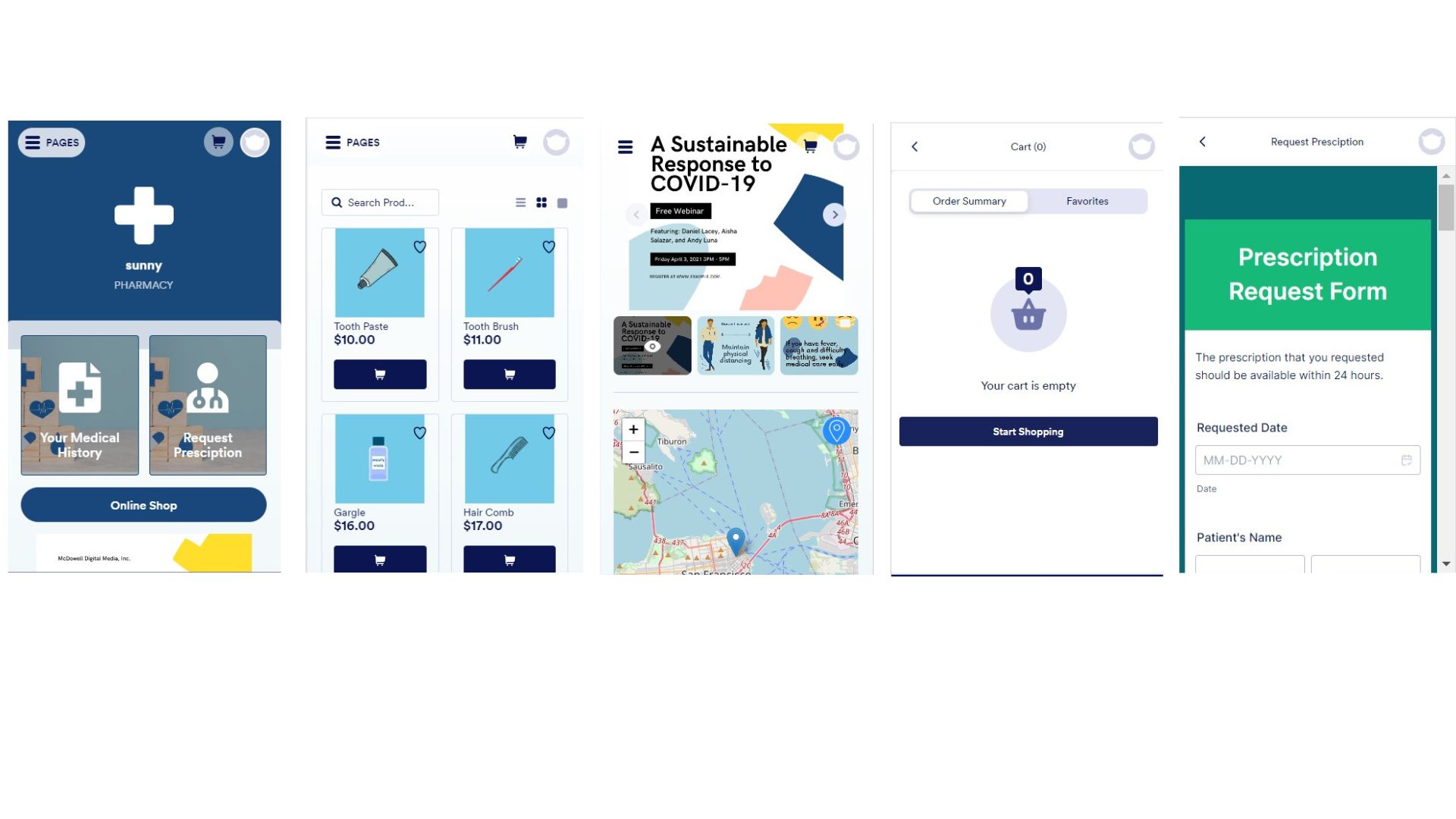 Source: Jotform
Below mentioned is the template of an on-demand cab services app;
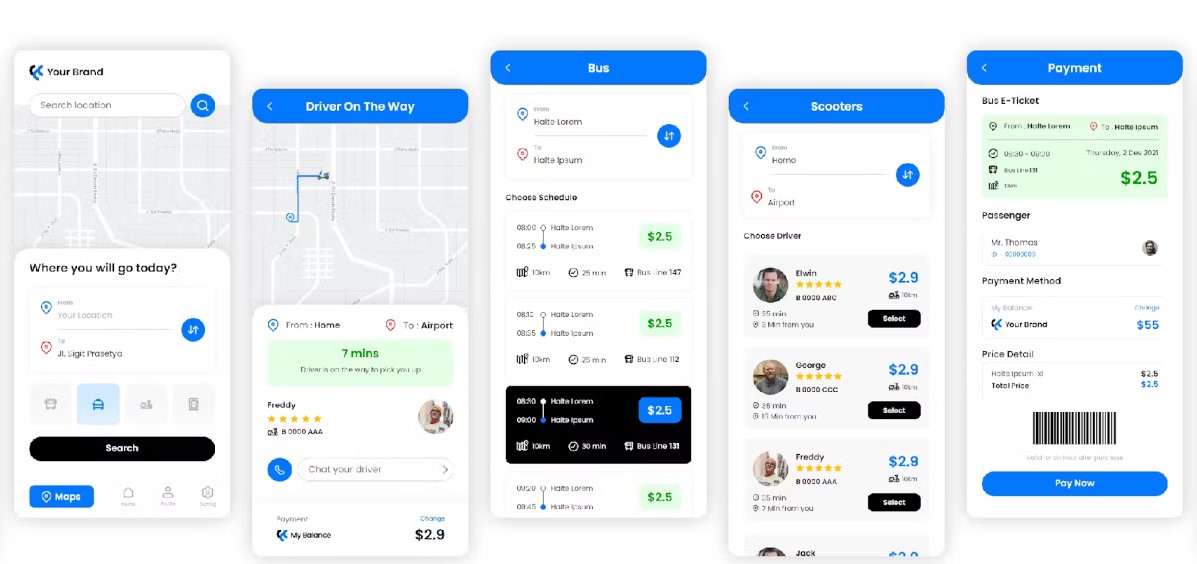
Source: envato
The template for an on-demand education app is as follows;
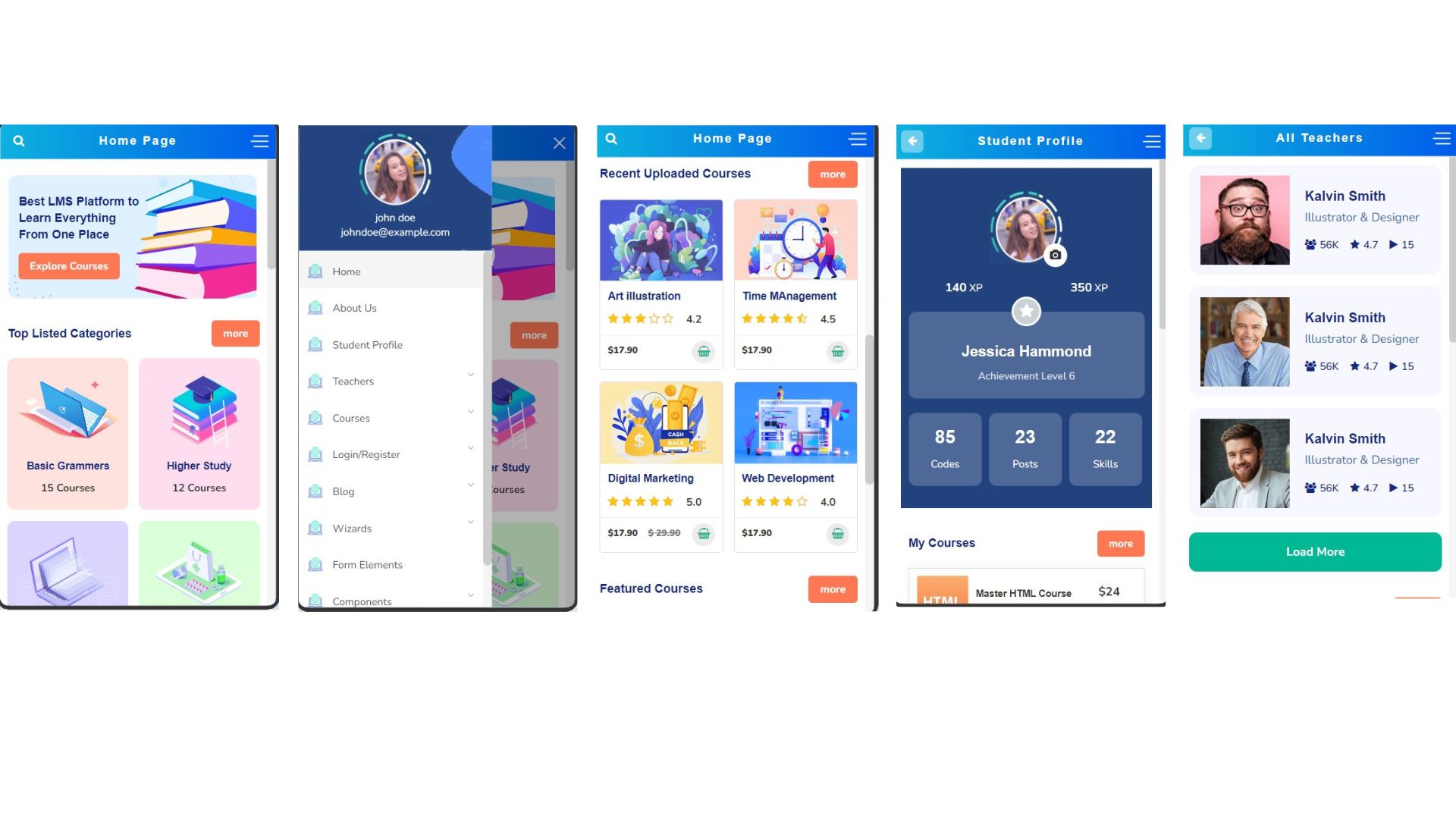
Source: ThemeForest
An ideal on-demand courier services app look like this;
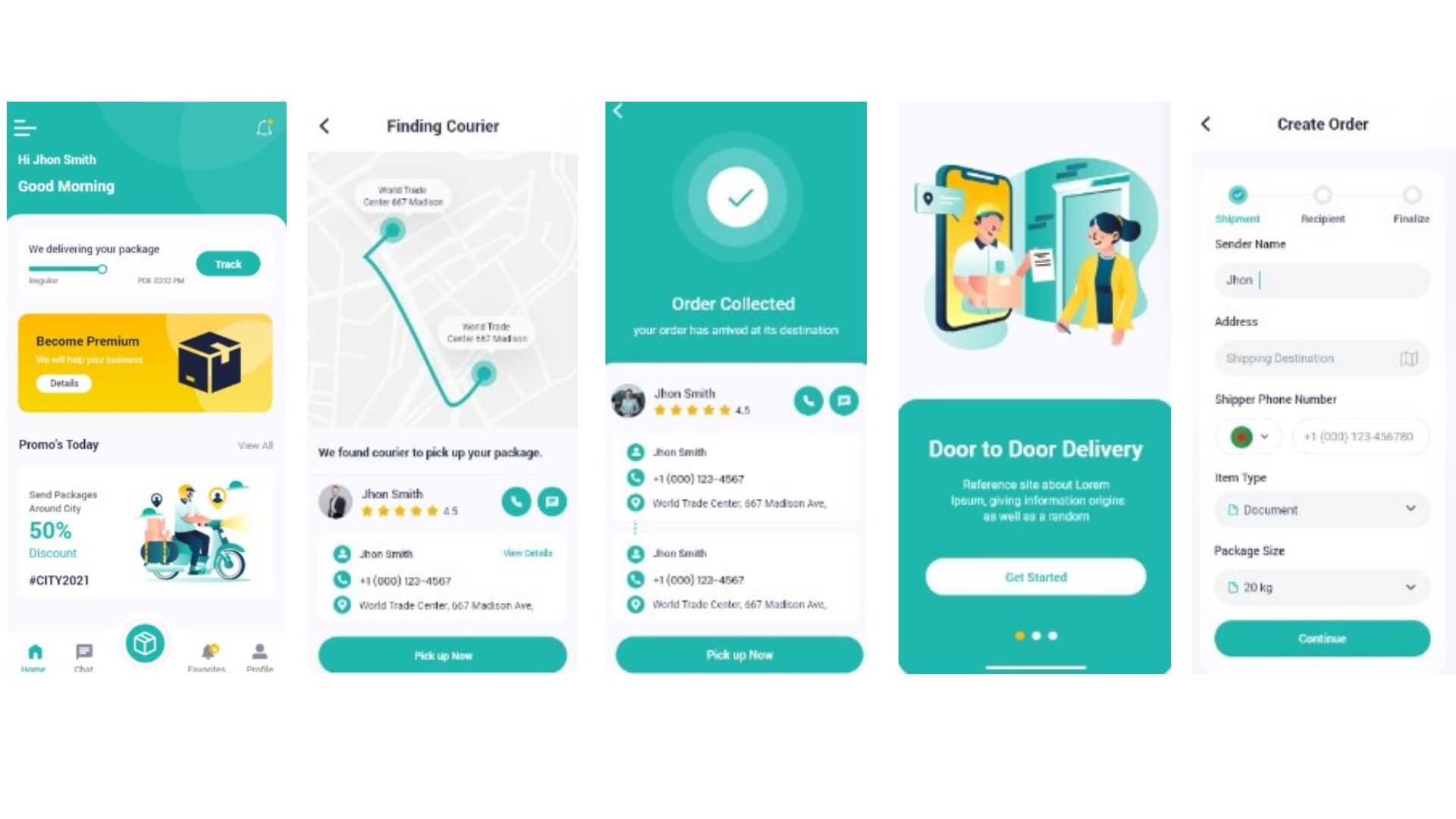
Source: ThemeForest
Add Content and Graphics
Now as the customizations are slowly taking place, businesses need to add the text, headings, images, videos and other graphics to the application. They should focus on adding useful and relevant content for service descriptions, keywords, product listings and other information. In addition, the graphics should be intuitive and of high quality to ensure enhanced user experience. The content and graphics should be in accordance with the type of on-demand delivery app.
Test for Reliability, Security and Performance
Once the customizations and content addon are completed, the next step is to test the developed application for reliability, security and performance. One should conduct thorough testing of the app to ensure that it can operate smoothly under varied and extreme conditions. Also, it is critical to check the app for security vulnerabilities and performance issues so that they can be eliminated before the app functioning gets impacted. This is beneficial in ensuring that the on-demand delivery app meets the quality standards across various devices and operating systems. Additionally, bug bounty programs can be introduced to rapidly resolve security issues at large scale.
Ex-Uber chief security officer paid a whopping $100,000 to hackers after they gained access to 57 million records of Uber customers.
Amazon, which is running its Amazon fresh, on-demand grocery delivery service has also experienced security breaches owing to which Amazon paid $30 million in penalty.
Only, continuous and thoroughly testing the app is the solution to such cybersecurity issues. Automated testing is a sophisticated method to detect and eliminate critical cybersecurity vulnerabilities.
Deploy and Refine
“Change is the only constant.” - Heraclitus, Ancient Greek Philosopher
This is the last step in which the app is deployed to relevant app stores like Google Play Store and Apple App Store. Developers check everything properly and then tasks like user feedback collection and app performance monitoring are performed on a regular basis to make necessary adjustments and changes to the app. These functions also help businesses enhance app functionality and improve user satisfaction over time.
Not only features, but business and revenue models can also be refined to strengthen the sustainability of the brand in the long run. For example, Uber recently changed their business model in India. Earlier, Uber used to charge from drivers but now, Uber service fee will be charged from the Company or the authorized users to reduce the complexities involved.
Similarly, Uber Eats SE, a subsidiary of Uber in Sweden, also changed their business model after years of practical research and knowledge to acquire better revenue and profits.
Another example of deploy and refine is Grubhub. In 2023, after going through intense user feedback and other options, Grubhub also updated Grubhub+ membership program in hope of delivering better user experience and driving more sales and revenue.
Developing a Delivery App with an App Development software Vs Coding
Developing a mobile application through application development software is relatively a new concept than traditional coding. The software offers drag and drop interface, automation features, easy customizations, integrations, cross platform compatibility and many more functionalities that helps developers easily build on-demand apps at comparatively low costs without much IT and coding expertise. However, traditional coding still outperforms the app development software when the project has complexity in terms of features, customizations and integrations. Security is a serious concern and it purely depends upon the vendor’s experience, industry expertise; whereas, with coding, multiple security measures are implemented at the development stages to safeguard their data. Whether you are developing a delivery app with an app development software or through coding, both have their advantages as well as disadvantages, and the better way to evaluate is by considering your project requirements, timeline, and budget. Here is a comparison table highlighting the differences between two as follows;
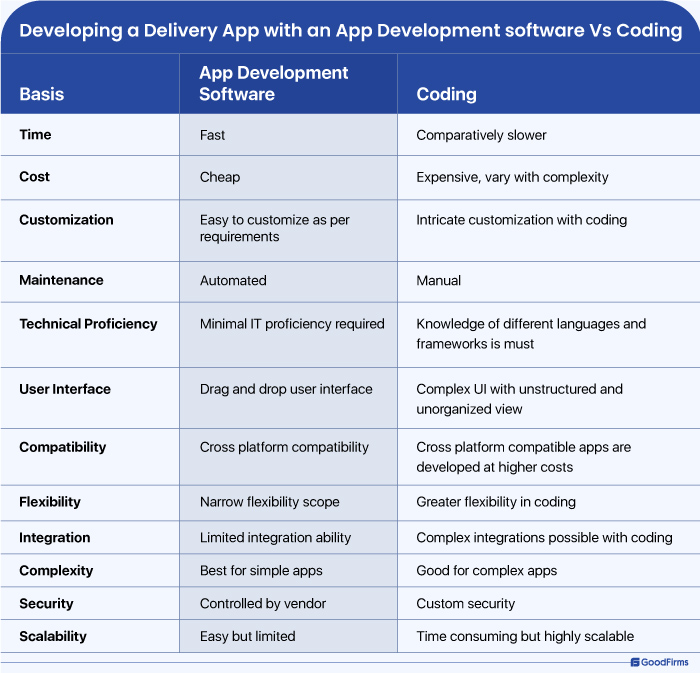
Let us see how the development steps varies for both:

Developing an On-demand delivery app using an app development software:
- Choose the best app builder tool
- Create an interface using the drag and drop features
- Define and relate the data
- Define the functionalities using the built-in features
- Test, modify if required, and launch
Developing an On-demand delivery app using Coding:
- Decide the programming language and other tech stack
- Decide the framework
- Set-up facilities to manage your code base
- Build the App Backend
- Create APIs
- Build the App Frontend
- Integrate the functionalities
- Add the security features, and 3rd party integrations
- Test, iterate, and launch
- Maintain and update
So, based on the project, timeline, budget, resources, one can decide to choose the right approach. A combined approach also facilitates rapid development.
Conclusion
On-demand is definitely going to be the future competitive advantage to those businesses that are ready to plunge into this market. As long as consumers are looking for convenience, urgency, and ubiquity, the app development software market is only going to grow further, and vice versa. The global Application Development Software Market recently touched $325.21 billion in 2023 and is expected to grow further with a CAGR of 28.5% in the near future. The app development software solutions are evolving and integrating new technologies to achieve better performance and functioning. Growing smartphone users are the major driving factor of the growth of on-demand delivery apps. By 2028, the total number of smartphone users worldwide is likely to touch 7.7 billion. This means, the growth of mobile applications are also going to shoot up. On-demand apps developed as no-code applications using app development tools are undoubtedly going to have a huge market. Such tools and technologies offer reusable and composable components, modules and connectors that can be customized by developers to efficiently create performance driven apps.


.jpg)