Key takeaways
- AI cost estimators give you a fast, genuinely useful starting number by matching your inputs against thousands of past projects.
- AI cost estimators work just as well for pricing out new features or a redesign on an app you already have.
- They're reliable for rough ranges and comparing feature scope, which makes early budgeting decisions much quicker than waiting on calls.
- Where they get less precise is integrations, compliance, and edge cases, the same spots where even experienced human estimators tend to struggle.
- A follow-up agency quote adds the discovery-call context that an estimator can't gather on its own.
- Treat the AI number as a strong first draft, then validate it against two or three real quotes before you finalize a budget.
I've spent time testing AI cost calculators, just like you, and here's my takeaway: they're a genuinely useful starting point, not a finished answer, whether you're pricing a brand-new app or scoping a feature on one you already run. If you've run your app idea through one and you're wondering whether to trust the number, stick with me.
I'll walk you through what's happening behind that figure, where these AI app cost calculating tools save you real time, and when it's worth getting a second opinion.
Before we get into it, if you already know you'd rather work with real numbers instead of an estimate, you can go straight to a shortlist of mobile app development companies and request quotes based on your actual project scope.
It makes sense why founders start here. A real quote used to mean a call and days of waiting. Now you get one in under a minute, a genuine upgrade. What's worth understanding is what that number is built on, and that's what this piece covers.
AI Estimate vs Agency Quote, at a Glance
|
Factor |
AI Cost Estimator |
Agency Quote |
|---|---|---|
|
Speed |
Instant |
1 to 3 business days |
|
Typical accuracy |
Wide range, often 30 to 50 percent off |
Tight range, scoped to your exact requirements |
|
Catches hidden requirements |
No |
Yes, through discovery calls |
|
Accountability |
None, it's just a number |
Someone stands behind the figure |
|
Best used for |
Early, rough budgeting |
Final decision-making |
How Does an App Development Cost Calculator Actually Work?
Most intelligent app development cost estimation tools follow the same basic logic. You answer a short set of questions, and the tool matches those answers against a dataset to produce a number.
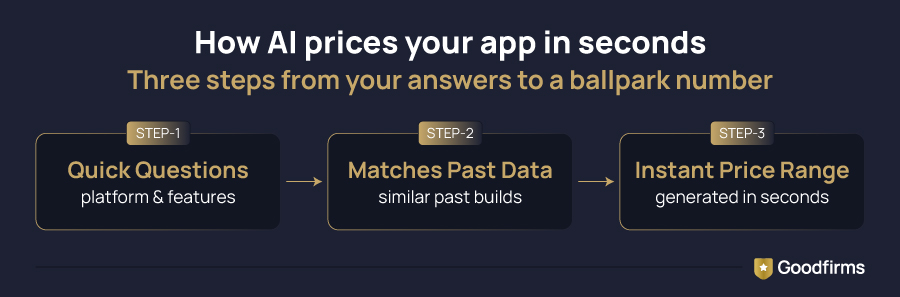
What inputs do the tools typically ask for?
- Target platforms: iOS, Android, or both
- Core features and how complex each one is
- Design preferences and backend needs
- Whether you're building for a regulated industry
How do they use historical data? The tools can be trained on thousands of your past projects, so a marketplace app with in-app payments and real-time chat gets priced against similar past builds. Goodfirms' own research on app development costs, based on a survey of 267 mobile app development companies, puts the overall range anywhere from $15,000 for a simple app to $500,000 or more for a complex platform. That spread is the raw material these tools draw from.
Some of the newer tools take this a step further by using AI to read a written project description instead of a dropdown form. You describe your app in a couple of sentences, and the tool infers the likely features before pricing them against the same historical data. It feels more sophisticated, but the underlying math hasn't changed; it's still pattern matching against past projects, just wrapped in a friendlier interface.
Why can they produce an instant ballpark? Because it's pattern matching, not judgment, it takes seconds instead of days, which is genuinely useful when you're still deciding if an idea is worth pursuing. Estimators also vary by dataset size, a single agency trained on its own projects versus broader industry data, which is why two tools can give two different numbers for the same idea, and neither is technically wrong.
How accurate are AI cost estimators for mobile apps?
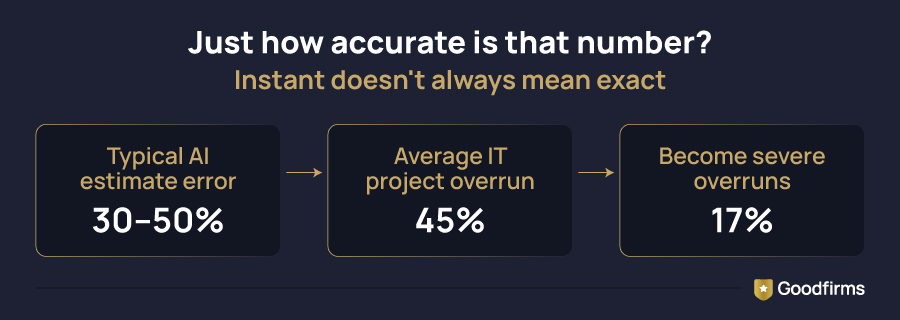
This is where most people get tripped up: instant and accurate aren't the same thing, and research on software estimating in general backs that up.
|
Where They're Reliable |
Where They Miss |
|---|---|
|
Rough ranges and feature-to-feature comparisons |
Third-party integrations |
|
Platform tradeoffs, like native vs. cross-platform |
Compliance needs (HIPAA, PCI DSS) |
|
Early-stage budgeting sanity checks |
Unusual technical constraints |
Regulated industries show this clearly. Goodfirms' data puts healthcare app development at $50,000 to $300,000 or more once HIPAA compliance is factored in, while fintech app development starts at $80,000 and climbs past $500,000 given the security work involved, numbers a short questionnaire can't fully price in.
This isn't only an AI problem, either. Human estimators with full project context still miss their numbers by a wide margin, so a short questionnaire landing 30 to 50 percent off is about what you'd expect. Unclear requirements are consistently the biggest reason why a gap AI estimates, since they're generated before requirements are even discussed.
Goodfirms insight: In the years we've spent connecting businesses with vetted software teams, the projects that stay closest to their original estimate are almost always the ones where the client walked in with a documented feature list, not just an idea. The estimate is only as good as the scope behind it, whether a machine or a person is doing the estimating
Where do AI estimates fall short, and why does a human agency quote win?
A calculator can't ask follow-up questions. A person can, and that difference matters more than it sounds.
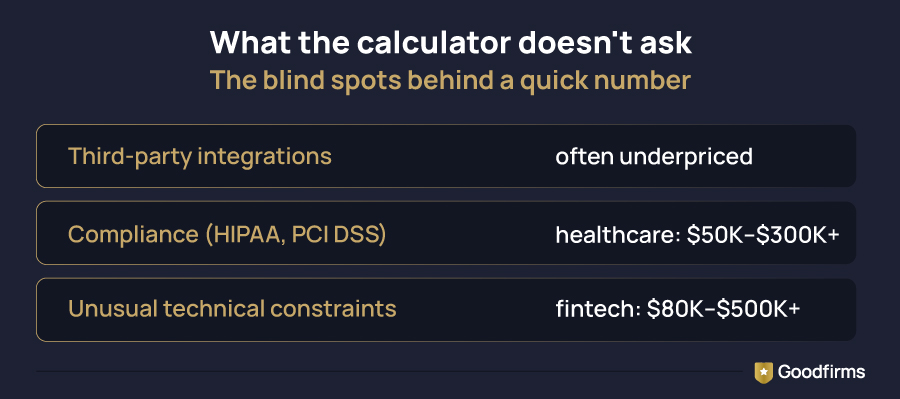
Discovery calls surface hidden requirements. A good agency asks about your existing tech stack, growth plans, and constraints you didn't think to mention. Those details often change the scope, and therefore the price, in ways no form field could capture. This is where unclear requirements, one of the biggest drivers of overruns, get caught early instead of mid-build.
Accountability and fixed-scope commitments. When an agency gives you a quote, someone is putting their name behind that number. If the project runs over due to their own estimation error, that's on them to manage, not you. An AI tool has no such accountability built in; it produces a number and moves on.
Local rates, timelines, and post-launch support. AI tools tend to average out global data, which flattens real differences in regional rates and delivery timelines. A human quote reflects the actual team building your app, in your market, and usually comes with a clearer picture of maintenance costs, which the same Goodfirms survey puts at 15 to 25 percent of the build cost every year.
Outsourcing to a different region can genuinely save you money, with that same research putting the savings as high as 60 percent on labor costs alone. But an AI tool rarely tells you which regions make sense for your project, or how time zone differences might offset some of that saving. That nuance only comes from talking to a team directly.
How do you use an AI to estimate in a smart way?
None of this means you should skip the AI tool; it just means you should use it correctly. Treat the number as a starting point rather than a final budget, and use it to sanity check whether your idea is financially realistic before you invest more time in it.
Write down what features matter most, your timeline, and what "done" means for your first version before you talk to agencies.
Then, validate the estimate against two or three real quotes. Say an AI tool prices your fitness app at $45,000, and you hear back from three agencies with $48,000, $52,000, and $95,000. The first two confirm your ballpark was close. The third is worth a follow-up call, since it likely spotted a requirement, like wearable integration, that the AI tool never accounted for.
A quick gut check before you request quotes. If your AI estimate came back suspiciously low, that's usually a sign the tool didn't fully capture your scope, not that you found a bargain. Apps with real-time features, payments, or any regulatory requirement almost always land higher than a generic calculator suggests. If your number feels too good to be true, treat that as a prompt to talk to an agency sooner rather than later.
Conclusion
Here's where I've landed after going through all of this: an AI cost estimate is a genuinely useful first step, not a final word. It's fast, it's free, and it's good enough to tell you whether your app idea is in the right financial neighborhood before you commit real time to it. Used well, it can save you a handful of exploratory calls before you're even ready to talk numbers seriously.
What I'd caution against is treating that first number as anything more than a conversation starter. None of the research on IT project accuracy, whether it's about AI tools or human estimators, suggests that the first number holds up once real requirements enter the picture.
That's the honest verdict on mobile app development cost estimation tools, and it's worth carrying into every AI-generated number you look at going forward. So run the calculator if you want to, there's no harm in it.
FAQs - AI App Development Cost Estimation
1. Can AI accurately estimate app development cost?
AI tools can give you a reasonable ballpark based on patterns from similar past projects, and that's genuinely useful early in planning. Where they fall short is accuracy for anything outside common patterns, like compliance needs or unusual integrations. Treat them as a starting point, and follow up with two or three real quotes to close that gap.
2. Are AI app cost calculators free?
Most basic calculators are free to use, since they're designed to capture leads for the company offering them, and you'll often see an option to talk to a sales team right after you get your number. Some more detailed estimation tools, especially ones tied to enterprise software or specialized industries, may sit behind a signup form or a paid tier before you can see a full breakdown.
3. Should I trust an AI estimate over an agency quote?
No, and the research on IT project overruns explains why. Even experienced human estimators with full project context regularly miss their original budgets by a wide margin, so a tool working off a short questionnaire is unlikely to do better. An agency quote comes from a discovery conversation that accounts for your actual requirements, which makes it far more reliable when you're ready to make a real decision.
4. What information do AI cost estimators need?
Most tools ask for your target platforms, core features, design complexity, and whether you need backend or maintenance support, and some ask whether you're operating in a regulated industry. The more specific and honest your inputs are, the closer the estimate gets to reality, though it still won't replace the context an agency gathers through an actual conversation with your team.