Key takeaways
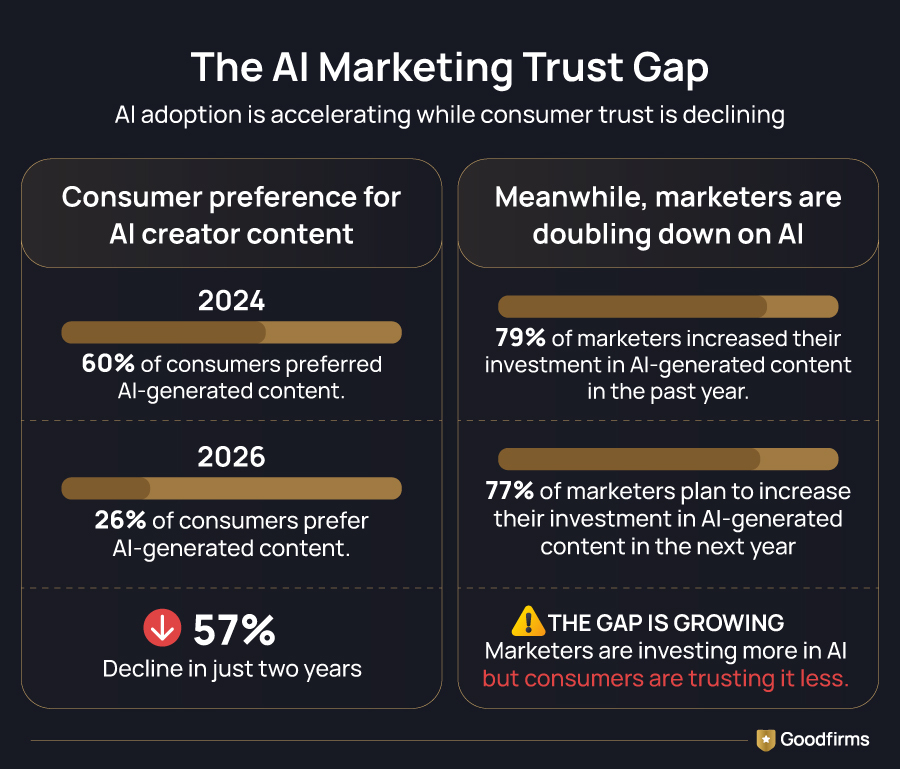
- Consumer preference for AI-generated creator content dropped from 60% to 26%, making authenticity a growing competitive advantage.
- YouTube's AI-content crackdown has affected channels representing roughly 35 million subscribers, raising the stakes for low-quality automation.
- 77% of employees have entered company data into AI tools, turning AI governance into a critical marketing responsibility.
- 79% of marketers increased AI investment despite consumer preference for AI content continuing to decline.
- Brands that paired AI with human oversight—such as Aerie and Almond Breeze—delivered stronger sales and sentiment outcomes than those facing AI-related backlash.
Every social media manager has felt it: the AI tool promised to save hours, and instead it created a new full-time job — checking the AI's work.
That's the real story behind the challenges with AI in social media marketing right now, and five recent brand cases show exactly how it plays out, including which brands turned the same pressure into measurable growth.
The Biggest Challenges With AI in Social Media Marketing
| Challenge | Key Finding | Why It Matters |
|---|---|---|
| Brand Voice Erosion & Authenticity Concerns | Consumer preference for AI creator content fell from 60% to 26% in two years | Authenticity is becoming a competitive advantage for brands |
| Platform Suppression of Low-Quality AI Content | YouTube has terminated roughly 16 channels and demonetized millions of AI-generated content subscribers | Reach, visibility, and monetization increasingly depend on original human input |
| AI Content Quality & Backlash Risks | Major brands, including Coca-Cola, faced criticism over AI-generated campaigns perceived as inauthentic | Poorly reviewed AI content can damage trust and weaken campaign performance |
| Data Privacy & Governance Risks | 77% of employees have entered company data into AI tools; 82% used personal accounts | AI data handling is now a marketing governance issue, not just an IT concern |
| Difficulty Measuring AI Marketing ROI | Marketers increased AI investment even as consumer preference for AI content declined | Adoption is accelerating faster than performance measurement, creating accountability gaps |
Struggling to overcome the challenges of social media marketing? Explore top social media marketing companies and digital marketing companies to find an experienced agency that can strengthen your social strategy, improve campaign performance, and protect your brand voice.
Challenge 1: Consumer Preference for AI Creator Content Fell from 60% to 26% — Then Nike Got Caught in it
Ask five AI tools to write a caption about "community," and you'll get five nearly identical captions back. That sameness is the risk: a brand's voice is one of the few things a competitor can't copy, and generic AI output quietly erodes it.
In May 2026, Nike posted on X about its partnership with tennis player Jannik Sinner, writing that he "can do it all" and adding, "This isn't just history — it's his story in the making," a line built on the classic "it isn't X, it's Y" construction — the exact sentence rhythm AI writing tools reach for constantly. A user flagged the phrasing, posting: "They let a GPT AI-ism through on the main Nike page? I thought marketing teams had caught this stuff by now." Hundreds of replies followed.
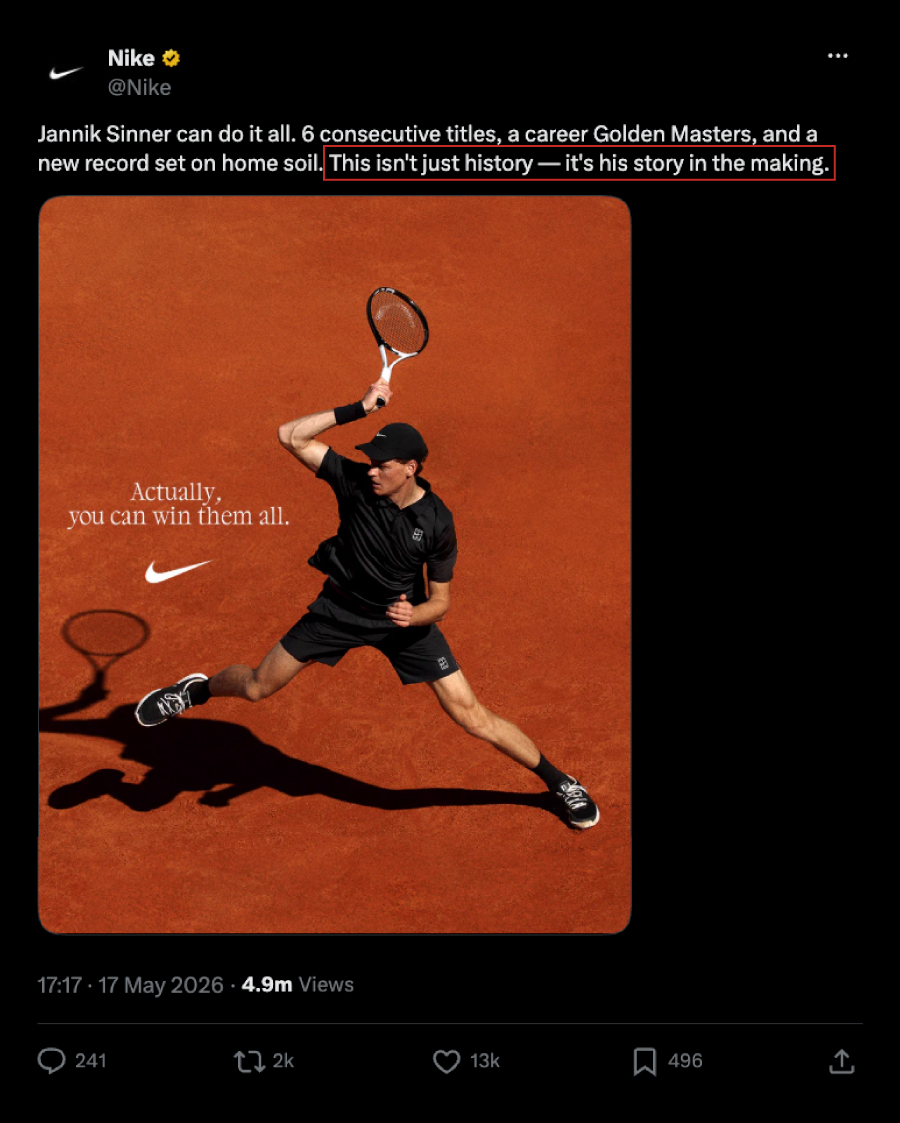
A user flagged Nike’s post on X, “This isn’t just history - it’s his story in the making,” as GPT AI-ism, though writers have used such constructions long before AI existed.
Whether the line was actually AI-written is unconfirmed — Fast Company's Rob Walker notes that writers have used that construction long before AI existed. But that's the sharper point: the accusation didn't need to be true to cost something. Brands are now unusually exposed to charges of inauthenticity, and AI has become what Walker calls an "inauthenticity force multiplier."
Aerie bet the opposite way. Extending its decade-old "Aerie Real" no-retouching pledge, the brand committed to never using AI-generated people or bodies in its campaigns. The result shows up in American Eagle Outfitters' own SEC filing: Aerie's comparable sales rose 11%, and revenue rose 12% year-over-year in Q3 FY2025, with the company citing "significant trend change" across the business. That's a real, audited number — not a marketing claim.
The industry backdrop explains why this bet paid off: only 26% of consumers now prefer AI-generated creator content. The decline points to a growing challenge around consumer trust in AI-generated content, particularly when audiences feel brands are replacing authenticity with automation. Businesses adopting AI software need to balance automation with the human oversight required to preserve that trust.
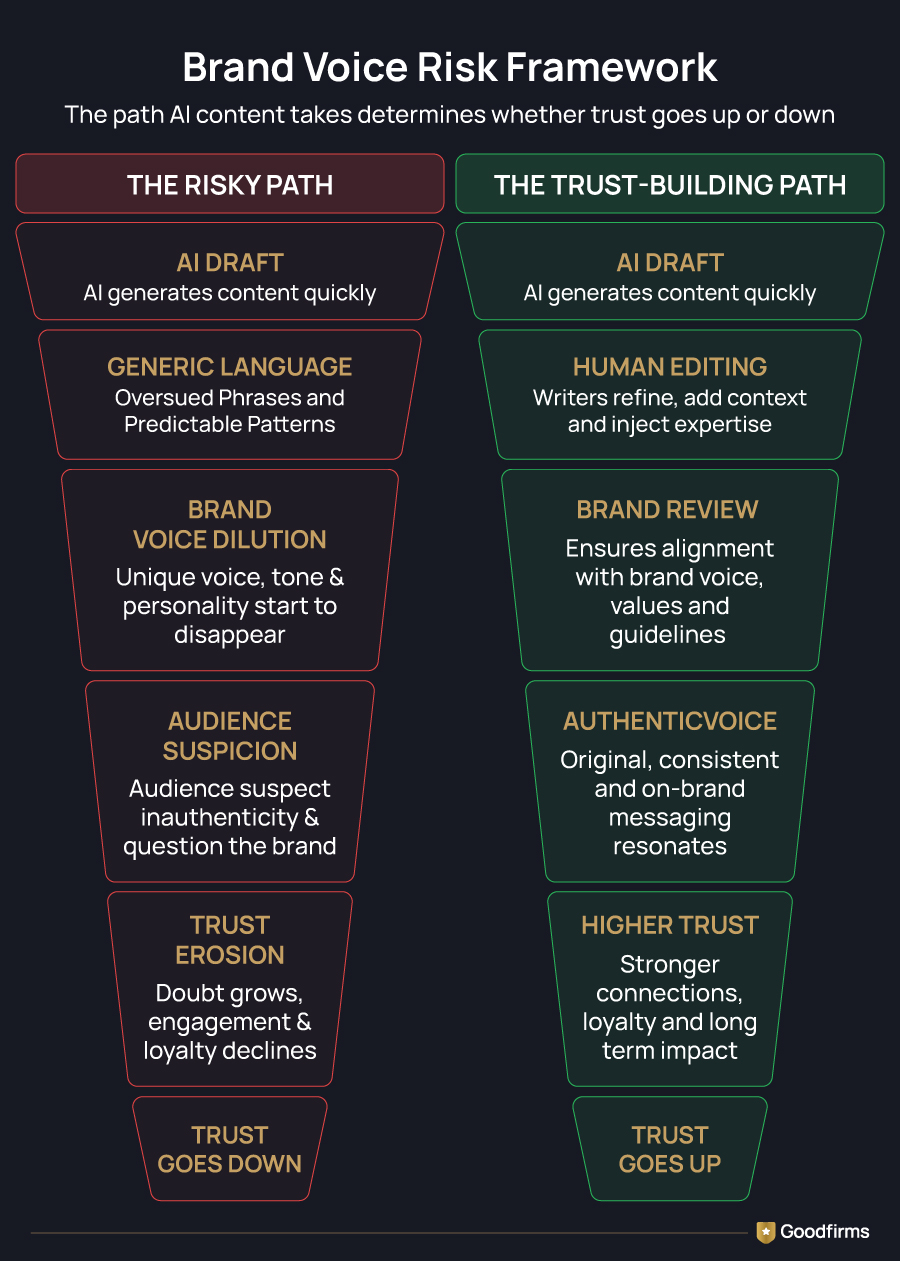
What actually works: Draft with AI, never publish an AI draft unedited, and run every piece through a documented brand-voice check before scheduling. Aerie's filed numbers make the case better than any pledge alone could: visible human authenticity isn't just defensive, it shows up on the balance sheet. Teams building this habit internally often bring in outside help — AI-assisted digital marketing agencies can help set up that brand-voice check as a standing part of the workflow.
Challenge 2: YouTube has Wiped 35 Million Subscribers in its ''AI Slop" Crackdown — Almond Breeze Made the AI Backlash the Joke Instead
Since December 2025, YouTube has terminated high-profile channels — including two that were removed for repeatedly posting AI-generated fake movie trailers — and, by mid-2026, had wiped out roughly 16 channels and 35 million subscribers in its ongoing "AI slop" crackdown.
The platform's stated test isn't whether AI was used at all, but whether a reviewer can identify content as mass-produced from a template with no visible human creative direction. Separately, the EU AI Act's Article 50 transparency rules became legally enforceable on August 2, 2026, adding regulatory teeth behind the platform-level rules. The direction of travel is clear: AI transparency in marketing is quickly becoming both a platform expectation and a regulatory requirement.
Almond Breeze took the opposite approach. It's early-2026 "The Pitch" campaign cast the Jonas Brothers watching their own agents pitch increasingly absurd AI-generated concepts — floating in space, riding an almond dressed as a milkman — before the ad pulls back to its real point: real ingredients don't need artificial polish. Marketing Brew reported that Meltwater's social listening data showed the campaign driving overwhelmingly positive sentiment, with 43% of responses positive and only 3.5% negative in January.
What actually works: Use AI for the invisible work — research, scheduling, performance analysis — and keep the public-facing voice human. Almond Breeze's numbers point to something sharper still: making the AI-fatigue conversation itself the creative angle, rather than something to sidestep. If you're worried your own content might get flagged like this, it's worth comparing notes with verified branding agencies that build disclosure and originality checks right into how they produce content.
Challenge 3: Two Consecutive Years of AI Backlash — Coca-Cola's Ongoing AI Ad Struggle
Coca-Cola's second consecutive AI-generated holiday ad in 2025 fixed some of the previous year's technical flaws — the truck wheels finally rotate instead of sliding across the ice — but reviewers still called the result "soulless," pointing to an inconsistent mix of polished and cartoonish scenes and a spot that felt more like an imitation of nostalgia than the real thing.
Meta's Advantage+ platform compounded the same underlying problem elsewhere, autonomously swapping brands' approved ads for AI-generated variants without permission and producing distorted, off-brand results across multiple advertisers.
For marketers, the bigger lesson is that many AI content quality issues don't appear during content generation—they appear after publication, when audiences spot inconsistencies, inaccuracies, or off-brand messaging.
Dove chose differently in 2024, pledging to never use AI to represent real people in its advertising — a commitment it has held through 2025 campaigns like "The Code," across two consecutive years, even as AI ad adoption accelerated industry-wide.
What actually works: AI should speed up the first-draft stage only, never replace the review stage — and where a platform offers an opt-out from automated ad-swapping, take it. The gap between Coca-Cola and Dove isn't a technology gap. It's a governance gap. Brands implementing AI at scale can work with experienced artificial intelligence companies to establish the technical controls and workflows needed to keep human oversight in place.
Challenge 4: 77% of Employees have Leaked Company Data into AI Tools — Most Without IT Ever Knowing
At one SaaS company, marketing employees used a generative AI tool to build customer presentations, feeding in client names, emails, and internal sales notes. A vulnerability in the AI vendor's platform was later exposed that prompt history, prompting the public disclosure and client notifications. This isn't rare: 77% of employees have pasted company data into AI tools rather than anything IT or legal approved.
As a result, many organizations are beginning to formalize AI governance policies that define which tools can be used, what information can be shared, and who is responsible for review and approval.
What actually works: No customer data, no competitor content, no unreleased product details go into a third-party AI prompt — full stop. Teams handling regulated or sensitive client data may find it faster to route AI adoption decisions through vetted software development companies and data governance partners rather than let individual marketers choose tools ad hoc.
Challenge 5: Marketers Increased AI Spend by 79% — Even as Consumer Approval Fell to Just 26%
A 2025 industry survey found 79% of marketers increased their investment in AI-generated creator content over the prior year, with 77% planning to shift even more budget toward it, while consumer preference for that same content had fallen to just 26%. Analysts have called this the end of AI marketing's "honeymoon phase": spend accelerating in the opposite direction from actual audience response.
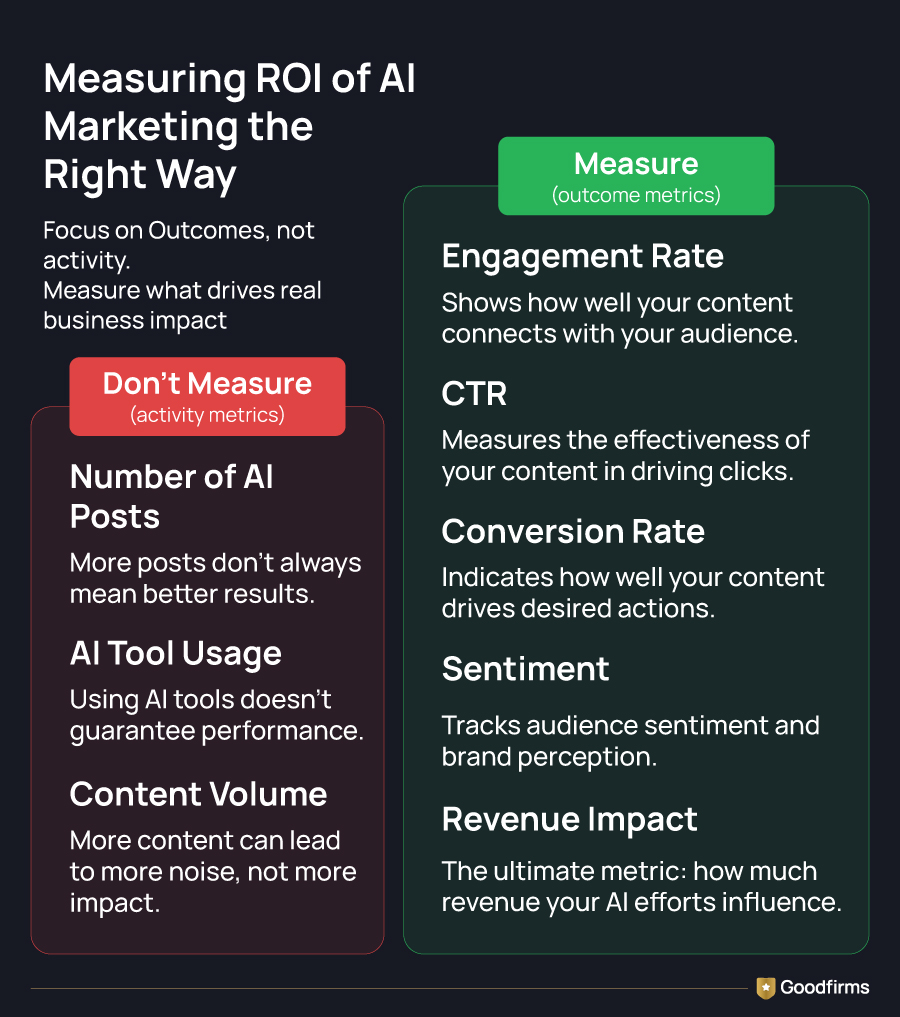
What actually works: rack engagement-per-post and variation win-rate for AI-assisted content performance specifically, rather than counting AI adoption as the win itself. Strong AI marketing performance metrics focus on engagement quality, conversion impact, and revenue contribution rather than content volume alone. Aerie's field sales numbers and Almond Breeze's sentiment data above show what it looks like when a team can point to a real result instead of a feeling.
Ethical Concerns and Long-Term Limitations of AI in Social Media Marketing
The challenges with AI in social media marketing don't end with brand voice, platform visibility, or ROI. Some of the most important issues are longer-term concerns that are harder to measure but can have a lasting impact on customer relationships.
One of the biggest ethical concerns of AI in marketing is transparency. As AI-generated images, videos, captions, and influencer content become more sophisticated, consumers increasingly want to know whether the content they're seeing was created by a person, generated by a machine, or produced through a combination of both. This growing demand for AI transparency in marketing is one reason platforms like YouTube have expanded disclosure requirements for AI-generated and AI-assisted content.
Consumer expectations are changing alongside technology. Research shows growing skepticism toward synthetic content and increasing preference for authentic human perspectives. As a result, consumer trust in AI-generated content is becoming a critical factor in social media performance. A campaign may generate impressions and engagement in the short term, but repeated reliance on generic AI-generated content can gradually weaken credibility and audience loyalty.
Another concern is accountability. When AI-generated content contains factual errors, misleading information, or offensive messaging, responsibility ultimately falls on the brand—not the tool. This is why many organizations are introducing formal AI governance policies that define how AI can be used, who reviews AI-generated content, and what level of human oversight is required before publication.
These issues also highlight the broader limitations of AI in social media marketing. AI can analyze patterns, generate variations, and accelerate workflows, but it cannot fully understand cultural context, customer emotions, brand history, or emerging social sensitivities the way experienced marketers can. Human judgment remains essential for protecting reputation and maintaining trust.
The brands most likely to succeed with AI won't necessarily be the ones using the most automation. They'll be the ones practicing responsible AI marketing—using AI to improve efficiency while ensuring that creativity, accountability, and strategic decision-making remain firmly in human hands. In an environment where authenticity is increasingly valued, that balance may become one of the most important competitive advantages a brand can build.
So, Which Approach Actually Wins?
Across all three paired cases, the split holds: brands that let AI replace judgment — Nike's suspected shortcut, Coca-Cola's unreviewed ad, Meta's unsupervised automation — took the hit. Brands that embraced responsible AI marketing—using AI to support human decision-making rather than replace it or make the tension itself part of the story, showed it in real numbers: Aerie's filed 11% comp growth, Almond Breeze's 43%-to-3.5% sentiment swing.
That's the actual throughline behind every challenge with AI in social media marketing: the problem was never the technology. The deeper issue lies in the growing ethical concerns of AI in marketing, particularly around authenticity, disclosure, accountability, and creative ownership. These questions also reveal some of the core limitations of AI in social media marketing—AI can accelerate production, but it cannot fully replace human judgment, context, or trust. It's what job you hand it — and, as Nike's case shows, sometimes just what job people assume you handed it.
If you're weighing outside help to get this balance right, comparing verified generative engine optimization companies on Goodfirms can help you find a partner equipped for both today's social channels and the emerging AI-driven discovery landscape.
Best Practices for Using AI in Social Media Marketing Without Damaging Trust
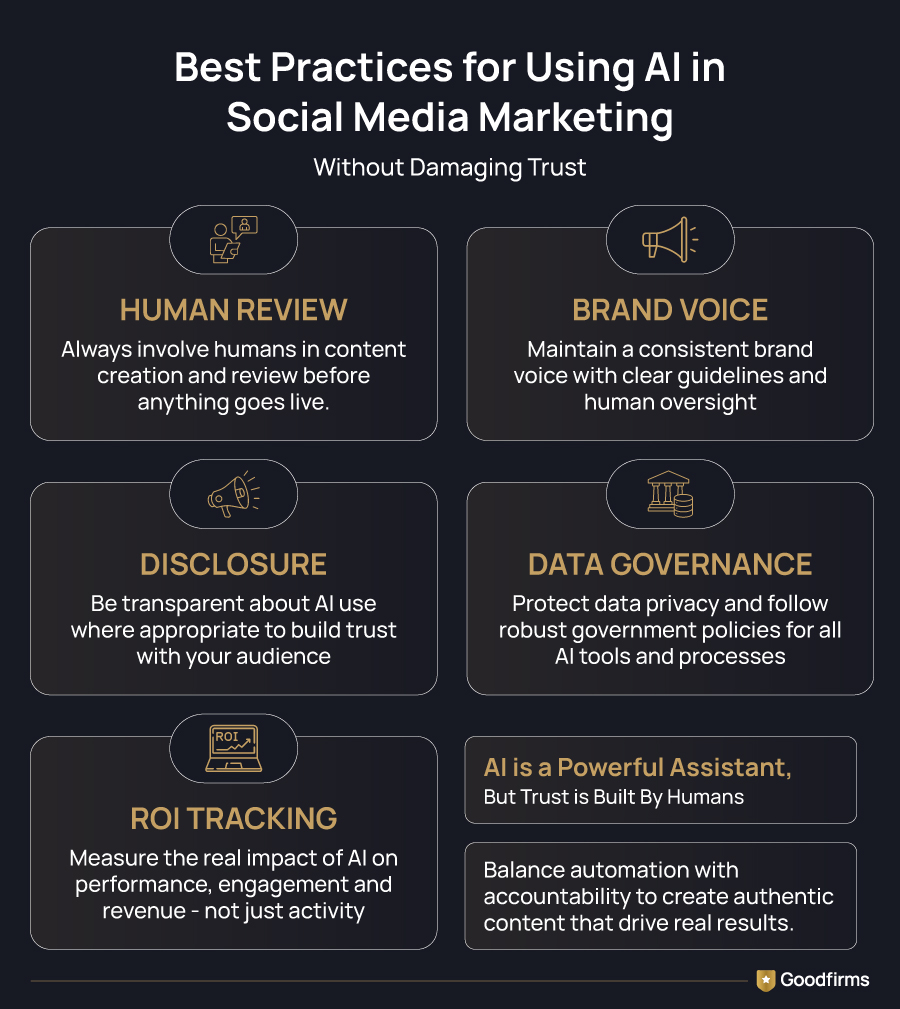
AI can dramatically improve efficiency, but brands that rely on automation without oversight often face the same problems highlighted throughout this article: inconsistent messaging, audience skepticism, compliance risks, and unclear business impact. The most successful organizations treat AI as an assistant rather than a replacement for human judgment.
1. Establish Human Review Workflows
AI should accelerate content creation, not bypass editorial review.
A practical workflow is:
AI Draft → Human Editor → Brand Review → Compliance Check → Publish
Before any post goes live, reviewers should verify:
- Brand voice consistency
- Accuracy of facts and claims
- Cultural relevance and context
- Legal and compliance requirements
- Platform-specific best practices
This approach helps prevent the types of issues seen in controversial AI-generated campaigns where errors, awkward phrasing, or off-brand messaging reach the public.
Best practice: Never allow AI-generated content to be published automatically without human approval. For brands managing high volumes of AI-assisted content, working with experienced content marketing companies can also help establish consistent editorial and brand-review workflows.
2. Create Clear AI Disclosure Standards
Consumers increasingly expect transparency when AI is involved in content creation.
Brands should define:
- When AI-generated content requires disclosure
- Which content types need labels
- How disclosures appear across platforms
- Approval processes for AI-generated visuals and videos
Examples include:
- AI-generated images
- Synthetic influencers
- AI voiceovers
- AI-created video content
Transparent disclosure can strengthen trust while helping organizations stay aligned with evolving platform policies and regulations.
Best practice: If audiences could reasonably assume content is human-created, consider whether disclosure improves transparency and credibility.
3. Protect Brand Voice With Formal Guidelines
One of the most common challenges with AI in social media marketing is that AI-generated content can gradually dilute a brand's personality.
To prevent this:
Create a documented AI brand voice playbook that includes:
- Approved tone and messaging
- Preferred vocabulary
- Words and phrases to avoid
- Examples of high-performing content
- Industry-specific terminology
- Brand storytelling principles
Teams should regularly compare AI-assisted posts against top-performing historical content.
Best practice: Train AI on your strongest content examples, but require final human editing to preserve authenticity.
4. Implement Strong Data Governance Policies
Many AI data privacy risks in marketing occur because employees unknowingly share sensitive information with external tools.
Organizations should establish clear rules covering:
Never Enter Into Public AI Tools
- Customer information
- Email addresses
- Sales pipeline data
- Financial information
- Proprietary research
- Unreleased product information
Require Approval For
- New AI platforms
- Third-party integrations
- AI-generated customer communications
- Automated decision-making systems
Regular employee training is equally important, especially as marketing teams adopt new AI applications.
Best practice: Treat AI tools with the same security scrutiny as any other software handling company data.
5. Measure Business Outcomes, Not AI Adoption
Many organizations track AI usage but fail to measure whether AI improves results.
Instead of asking:
"How much AI are we using?"
Ask:
"Is AI improving performance?"
Track metrics such as:
| Metric | Why It Matters |
|---|---|
| Engagement rate | Measures audience response |
| Click-through rate | Evaluates content effectiveness |
| Conversion rate | Connects content to business goals |
| Cost per acquisition | Assesses efficiency |
| Sentiment score | Detects trust and brand perception |
| Revenue influenced | Measures business impact |
This helps avoid the common mistake of equating automation with success.
Best practice: Compare AI-assisted content against human-created benchmarks rather than evaluating AI in isolation.
Wrapping Up
The challenges with AI in social media marketing are no longer theoretical—they're showing up in brand perception, platform policies, data governance, and performance metrics. The data tells a clear story: consumer preference for AI-generated content has fallen to 26%, platforms are cracking down on low-quality AI output, and marketers are investing heavily in AI without always proving business results. The brands seeing the strongest outcomes aren't abandoning AI, but using it with clear human oversight. As AI adoption accelerates, the real competitive advantage won't come from automating more content—it will come from preserving authenticity, protecting trust, and measuring what actually drives growth.