As AI transforms the entire business world, one thing is certain: this amazing technology is not only for giants and Fortune 500 companies; small and medium-sized businesses are also leveraging it for their benefit.
History says that SMBs have experienced fierce competition against giants having bigger budgets, more resources, and access to advanced technology. Constraints in budget, resources, and technology meant that it was challenging for SMBs to deliver at the same level as larger companies. All thanks to AI, which is changing the dynamics for small businesses and making them more capable of competing with large enterprises.
Precisely, AI is raising the standards of small and medium-sized businesses in terms of productivity and scalability, which seemed to be quite challenging in the past. Artificial Intelligence has immense potential for small and medium-sized businesses in the U.S., and therefore, they are hiring AI developers to build systems that can help them improve efficiency and productivity and gain a competitive advantage.
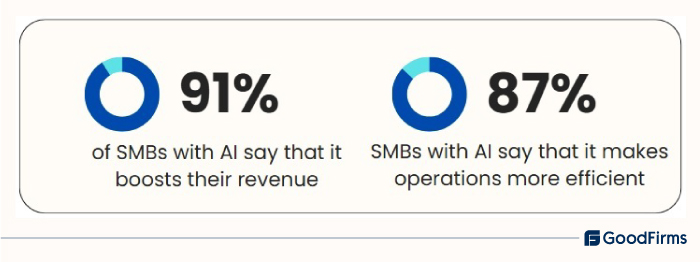
(Source: Salesforce)
AI is no longer a luxury; it has become a necessity for staying competitive in the current fast-paced business world. Whether it is about improving efficiency or decision-making capabilities, AI is integral to the growth of SMBs.
But how?
In this article, we will explore the game-changing AI tools that small businesses are popularly using in 2025. This will help you understand how AI can help you improve productivity by automating tasks and delight customers through the best services, leading to business growth and expansion.
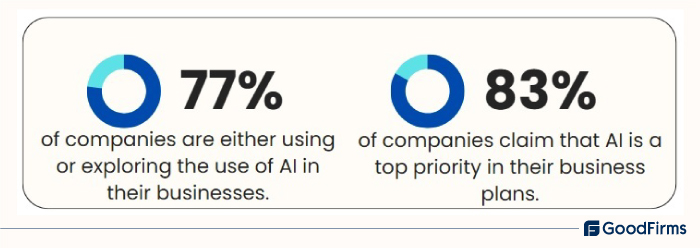
(Source: aithority.com)
So, let’s begin by knowing the most popular ways U.S. SMBs are using AI within their organizations.
The Most Popular Ways U.S. SMBs are Using AI
Artificial Intelligence is making many tasks easier for U.S SMBs and solving their key pain points. As per a recent report 75% of small businesses are applying AI tools for a wide range of tasks that utilize a lot of time and budget. Below are some of the top use cases of AI tools in US-based SMBs.
Optimizing Sales & Marketing Campaigns
Whether it is about drafting an engaging email or posting social media updates on multiple platforms simultaneously, AI can be the game-changer. Crafting perfect sales and marketing campaigns manually can take a lot of time and effort for humans. On the other hand, AI-powered tools can help you automate planning and strategize campaigns flawlessly in a fraction of the time.
Examples of AI Tools for Sales & Marketing Campaigns
HubSpot AI is a well-known AI tool that helps in AI-driven lead scoring, campaign personalization, and performance insights. It can help in automating complex tasks across sales, marketing, and customer service. Users can make data-driven decisions as it includes predictive analytics with enriched insights.

Phrasee is a specialized AI tool that optimizes marketing copy for emails, push notifications, and SMS campaigns. It is one of the best AI platforms for sales and marketing, helping businesses generate brand-aligned, data-optimized, and high-performing content that can engage, convert, and scale across various digital channels. The strength of this AI tool lies in its ability to combine robust AI generation, intelligent optimization, and deep performance insights.

Outreach.io is an AI sales engagement platform that optimizes email, calls, and cadences. It is one of the most premium AI-powered tools that excels at automating reach, coaching reps, and improving deal insights.

Google Analytics 4 can predict churn, purchase probability, and estimate campaign ROI. It is the latest version of Google Analytics that is built to track user behavior across websites and apps. SMBs are using this game-changing AI tool to identify customers most likely to buy again, and get alerts if sales from any platform suddenly increase, and keep track of ad campaigns that are driving revenue and not just clicks.
Automating Customer Service
Having a systematic approach to customer service is critical to every type and size of business. Especially when it comes to small and medium-sized businesses, they are prone to customer dissatisfaction because of the scarcity of resources. To overcome this challenge, it becomes highly significant for these types of businesses to use AI tools specially designed to handle customer grievances and complex issues.
Examples of AI Tools for Automating Customer Service

Freddy AI Agent automates ticketing, intent detection, and self-service across email, chat, and phone. A perfect AI tool for small or medium-sized eCommerce businesses for automatically handling order status queries with a chatbot. Routing refund requests directly to the finance team and alerting support managers if customer complaints rise after a product launch.

MonkeyLearnperformsAI text analysis to classify and prioritize support tickets. It helps businesses to analyze thousands of reviews and survey responses quickly. It also automates repetitive manual tagging/sorting tasks. You can proceed with a basic version of this tool and scale as data volume grows. Moreover, it proves to be a quite affordable AI tool for customer service, and you don’t need to hire an expensive in-house data science team to get a similar software built.

Drift is an AI chatbot that qualifies leads and resolves customer queries. This AI tool is especially designed for SMBs and B2B companies wanting to convert web traffic into sales opportunities. It helps in engaging visitors instantly through personalized experiences. Moreover, it ensures hot leads get to the right representative at the right time, which leads to sales alignment and never missing even a single opportunity.
Talkdesk AI is an AI tool that automates customer interactions with predictive routing and AI agents. This AI tool has the ability to handle high call volumes so you don’t need to hire a huge number of sales professionals. Moreover, it helps in providing faster, personalized services which leads to improved customer satisfaction.
Streamlining Administrative Tasks
Administrative tasks take much human time and effort, and that burden can be overwhelming for SMBs. Whether it is about scheduling meetings, taking notes, workflow automation, or HR activities, there are AI-powered tools available that can speed up your administrative tasks, improve productivity, and therefore allow you to focus on profit-generating tasks.
Examples of AI Tools for Streamlining Administrative Tasks

Zapier + AI automates workflows intelligently across 6,000+ apps like Google Workspace, Hubspot, Shopify, Slack, and more without any coding. It's an ideal solution for SMBs that lack development teams, but at the same time want to streamline operations. It enables the reduction of repetitive manual tasks and boosts productivity to a great extent.
Automation Anywhere is an AI + RPA tool for finance, HR, and compliance workflows. This application can automate repetitive business processes across multiple departments, such as finance, HR, IT, customer service, etc. It is popular as a low-code platform with cloud computing capabilities, making it a perfect choice for SMBs wanting to adopt automation without huge IT infrastructure.

Workday AI is an AI platform that automates HR workflows like payroll, scheduling, and benefits. It integrates AI + machine learning directly into HR and payroll systems. Its ultimate goal is to augment HR, finance, and workforce decisions with smarter automation and insights. Precisely, this tool helps businesses hire smarter, retain talent, forecast better, and automate back-office workflows.

Trello (Butler AI) is a visual management tool (Kanban boards) that automates task assignments, due dates, and board actions. Its built-in automation engine, Butler, acts as Trello’s AI-powered assistant. It enables automating repetitive tasks inside Trello using rules, buttons, and scheduled commands without coding knowledge.
Personalized Advertising
AI has the ability to tailor advertising campaigns as per individual customer preferences. SMBs these days are using AI to identify customer preferences and based on that segment their audiences, and deliver personalized messages that resonate. High levels of personalization powered by AI can help in increasing engagement and conversion rates.
Examples of AI Tools for Personalized Advertising

Albert.ai is an AI-driven marketing automation platform specializing in autonomous digital advertising across channels like search, display, social, and programmatic. Often called the “self-driving car for marketing” because it manages campaigns end-to-end with minimal human intervention. It eliminates the need for a large marketing team to manage multiple campaigns manually.

Revealbot is anAI-powered ad automation and personalization tool for Meta & Google Ads. It helps marketers and agencies Its strength lies in automation, custom rules, and advanced reporting, reducing the manual work of digital advertising. It reduces repetitive campaign management tasks, protects budgets by cutting poor ads and scaling winners automatically, and just perfect for SMBs working with small teams or managing multiple client accounts.

Trapica is an AI-driven targeting and audience optimization platform that focuses on audience targeting, budget allocation, and campaign optimization across major platforms like Facebook, Instagram, Google, Twitter, LinkedIn, and TikTok. It is designed for marketers, SMBs, and agencies who want to improve ad efficiency without heavy manual management.

Pattern89 is an AI-driven creative intelligence platform for digital advertising that predicts ad performance and personalizes creatives. It helps marketers optimize ad creatives, targeting, and performance by analyzing massive datasets of past campaigns. This AI tool for personalized advertising is best known for predicting which ad creative elements will perform best before launching campaigns.
Mapping the Customer Journey
Knowing your customers’ journey becomes extremely important for satisfying and retaining them. AI tools have the potential to track customer interactions throughout their different touchpoints, enabling you to extract insights about their entire journey with your business. By using these insights, you can improvise your customer experience strategies, ensuring the quality of your services match with your customers’ expectations and drive long-term loyalty.
Examples of AI Tools for Mapping the Customer Journey

BlueConic is a Customer Data Platform (CDP) that unifies first-party customer data from multiple touchpoints. It tracks customer behavior in real time and creates journey-based segmentation. Its goal is to give businesses a single customer view (SCV) that enables personalization, segmentation, and predictive marketing. Unlike traditional CRMs, it’s real-time, AI-powered, and marketer-friendly (doesn’t require IT-heavy setups).

Microsoft Dynamics 365 Customer Insights is an AI-driven journey orchestration and visualization tool that is Microsoft’s AI-powered Customer Data Platform (CDP). It unifies customer data from multiple sources to create a single, 360-degree customer profile. Moreover, it combines data enrichment, segmentation, and predictive AI to help businesses personalize marketing, sales, and service.

Mixpanel is a product and user analytics platform that tracks in-app customer journeys with AI-driven funnel analysis. Unlike tools like Google Analytics (focused on traffic), Mixpanel focuses on user behavior and product usage to drive retention, engagement, and growth. Its AI-powered insights help teams make data-driven decisions about features, funnels, and customer journeys.

Kustomer (Meta) is an AI-powered CRM that provides journey-based customer service. It focuses on providing omnichannel, AI-powered customer support by unifying all customer interactions (chat, email, social, voice, WhatsApp, etc.) into a single timeline view. This AI platform for mapping customer journey emphasizes automation and personalization, reducing support costs while improving customer experiences.
Flawless Inventory Management
Implementing flawless inventory management is critical to reducing waste, improving supply chain efficiency, and ensuring high returns on investment. AI tools for inventory management can help analyse customers’ purchasing patterns and predict demand. This helps you to prevent overstocking or stockout situations, making your operations more efficient, and reducing costs associated with excess inventory, and also avoid missed sales opportunities.
Examples of AI Tools for Flawless Inventory Management

Slimstock is an AI tool for inventory management that also provides predictive analytics for stock planning and replenishment. Its flagship product, Slim4, uses AI, machine learning, and advanced forecasting to help businesses maintain the right stock levels, reduce waste, and improve service levels. Moreover, it is trusted by SMBs and large enterprises in industries like retail, manufacturing, distribution, and e-commerce.
Zoho Inventory is an AI-driven reorder alerts, tracking, and multi-warehouse management system that is designed mainly for small and medium-sized businesses (SMBs). It helps businesses track stock, manage orders, automate reordering, and integrate with sales channels. it works seamlessly with Zoho CRM, Zoho Books, and other Zoho apps.

Pensa Systemsoffers Drones + AI for real-time store shelf inventory insights. Instead of relying on manual audits or RFID/barcode scans, Pensa’s drones fly through store aisles, capture video of shelves, and use AI to identify gaps, misplaced items, and stock levels. Designed for retailers, CPG brands, and SMBs in retail/e-commerce with physical stores.

Logility is an AI-based demand planning, inventory balancing, and logistics software that everages AI, machine learning, and advanced analytics to help businesses manage forecasting, inventory, demand, production, and supply planning. It is known for enabling digital supply chain transformation, it serves both SMBs and large enterprises across industries like retail, manufacturing, CPG, and distribution.
So, these were the different ways SMBs in U.S. are using AI to improve their processes and tackle their problems more strategically.
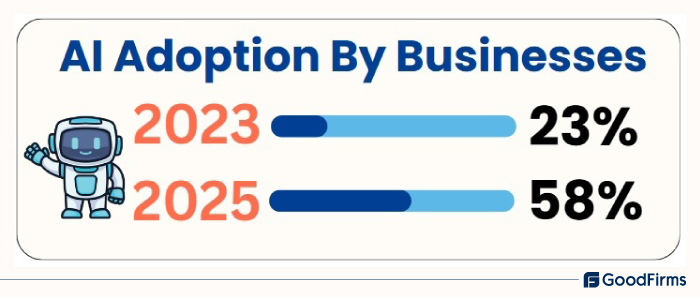
During the earlier AI days, it was difficult for small and medium-sized companies to integrate it into their processes due to complex implementations, high costs, and many other constraints. But, as the technology advances, it has become possible for even smaller companies to integrate AI without having to make huge investments in terms of money and human resources.
With the availability of several AI-powered tools that now integrate seamlessly with the tools small businesses already use, whether it is for performing predictive analysis or chatbots that attend to your customers 24/7.
Therefore, AI tools, which are now easily accessible, are becoming a must-have requirement for SMBs in the U.S. wanting to scale, work smarter, and stay competitive in the marketplace.
(Source: U.S. Chamber Report)
This means that AI tools are benefiting businesses in the U.S. to a great extent. Let’s have a look at those benefits in detail.
How do AI tools benefit SMBs in the U.S.?
Small and medium-sized businesses constantly find different ways to solve huge challenges with fewer facilities and resources. Artificial Intelligence helps them do that. But, how? Let’s have a look at some of the benefits of AI that empower small and medium-sized businesses to become smarter, resilient, and more competitive.
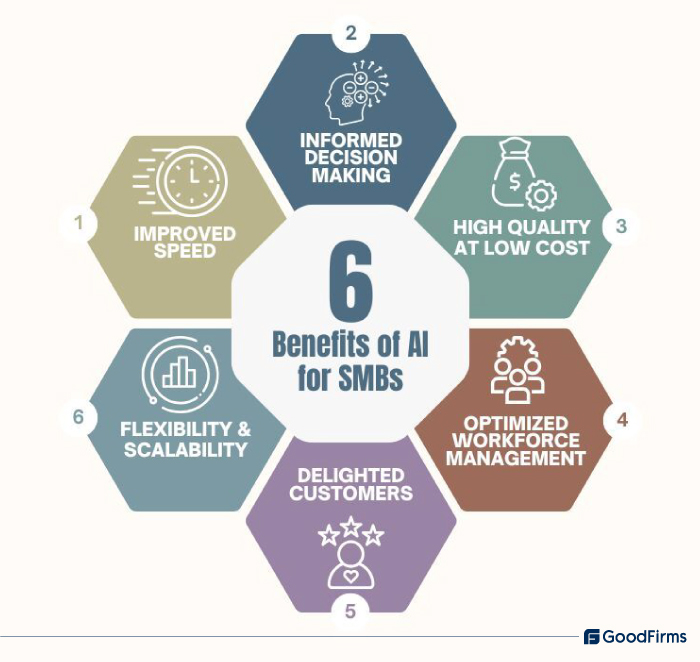
Let's have a look at these benefits of AI in detail.
Improved Speed
Small and medium-sized businesses usually face a lot of challenges when it comes to getting tasks done quickly. With limited resources, it becomes difficult for them to complete even the routine tasks on time. AI tools help in automating tasks like scheduling, invoicing, emailing, and more, allowing employees to focus more on strategic decision-making and profit-generating tasks. This results in improved speed and productivity.
Informed Decision Making
AI tools have the ability to provide data-driven insights about customer behavior, demands, and inventory which can help SMBs to make informed decisions relating to resources, purchases, and investments. Decision-making is critical to any size or type of business. Rather than relying on guess works and instincts, it is always better to make decisions based on AI-driven reports containing real data.
High Quality at Low Cost
AI-powered tools are now helping employees to automate many tasks which were earlier done manually taking up a lot of time and money. At the same time AI helps in maintaining quality services. This helps in freeing up the budget and using the same in tasks that impact efficiency, growth and productivity leading to enhanced product development and customer experiences.
Optimized Workforce Management
SMBs need to work with limited staff, and often, due to mismanagement, some employees are overburdened with multiple tasks. AI tools for task management are designed to make it easy for managers to schedule tasks, track performance, and complete projects on time while ensuring flawless execution.
Delighted Customers
AI tools for customer support enable businesses to provide timely and personalized services to customers without hiring a huge team. Whether it is about recommending products and services or providing 24/7 support, AI can help businesses do that seamlessly. Personalized and enhanced customer experiences lead to delighted clients, resulting in consistent business success and growth.
Flexibility & Scalability
To stay competitive, it is integral to be ready for changes in technology and market trends. AI tools help SMBs respond quickly to changing demands, scale operations, and adjust to transforming marketing strategies without investing enormous resources. Integrating AI tools in daily operations helps small and medium-sized businesses be flexible and scalable, enabling them to compete with large enterprises.
There are several benefits that SMBs might get after implementing AI tools within their processes.
Moving further on this topic, let’s have a look at how to integrate AI in your workflows successfully.
How to Integrate AI in SMBs' Workflows Successfully?
Investing in AI tools can be a financial burden for SMBs if they are not integrated well with the existing systems. Below is a step-by-step approach towards integrating AI into small and medium-sized businesses in the most practical ways.
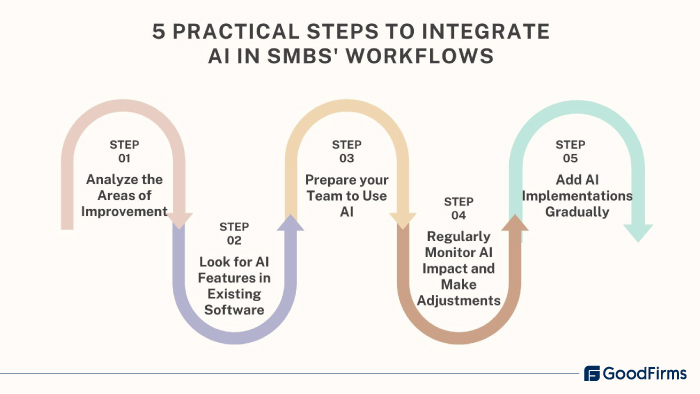
Let's have a look at these 5 practical steps in detail.
#1 Analyze the Areas of Improvement
There are different departments and processes running within departments in a business. You just need to analyze the areas of your business that require more speed, accuracy, and efficiency. For example, if a particular process requires repetitive tasks and takes up more human resources' time, that area requires integrating AI, as it would be more effective when applied to significant pain points to improve and gain measurable results.
#2 Look for AI Features in Existing Software
Integrating AI into your business doesn’t necessarily mean that you invest in expensive and standalone AI solutions. There might be many software that you are already using in your organziation that are having AI features. For example, you are using an email marketing tool which might have built-in AI features. All you need to do is look for AI features in tools you are already using and start applying them within your business processes.
#3 Prepare your Team to Use AI
Make your team understand that AI is not here to replace them. AI is here to add speed, efficiency, and flawlessness in their jobs. Provide them with training on new AI tools that you are planning to integrate into your business processes. Encourage them to experiment with AI-powered tools that can make their jobs easier.
#4 Regularly Monitor AI Impact and Make Adjustments
Your job doesn’t end with integrating AI into your business processes. Regularly monitoring and optimizing as you grow is significant to long-term success. You need to find out answers to questions like, "Are chatbots improving customer service? Has your AI-powered inventory management succeeded at reducing waste?" Getting answers to such questions is important for making adjustments that can help you gain real results.
#5 Add AI Implementations Gradually
AI offers a plethora of automation possibilities within a business. But, being a small or medium-sized business, it is not possible to invest in too many AI-powered products all at once. You can start with one or two AI-driven solutions, evaluate their results, and then move on to more solutions. For example, if you have implemented chatbots into your website and you are experiencing great results from it, you can integrate AI into your marketing automation software to automate your marketing efforts and gain considerable results.
These steps can make integrating AI tools easier. But, like every coin has two sides, AI integration in SMBs has many challenges. Let’s have a look at the challenges you might face while implementing AI tools practically within your organization and how to overcome them.
Common Challenges of Integrating AI Tools
Small and medium-sized businesses (SMBs) are increasingly adopting AI tools and integrating them into their current systems. But they are likely to face some hurdles that large enterprises usually don’t have to. Below are those common challenges and their solutions.
High Implementation Cost
Challenge: Implementing AI tools requires investment in terms of infrastructure, subscription costs, and skilled resources.
Solution: Start with low-cost AI tools and basic subscription plans, and gradually, when your business grows, you can move to advanced solutions.
Lack of Technical Expertise
Challenge: SMBs might not have AI specialists, data scientists, or IT teams on their payroll who can build, use, or manage AI tools.
Solution: You can delegate your projects to the best app development companies or partner with freelancers on a project basis.
Integrating with Existing Systems
Challenge: Software and workflows already being used in the organization might not align well with newly adopted AI tools.
Solution: You can select modular AI solutions available that can be integrated via APIs with existing software.
Uncertain ROI
Challenge: Uncertainty whether investment in AI tools would be able to deliver considerable returns or not.
Solution: Start with small-scale projects, track KPIs, and share only wins to build confidence internally and gain larger AI investments.
Security & Ethical Concerns
Challenge: SMBs having a limited security budget can possibly face higher risks of cyberattacks when implementing AI tools.
Solution: Consider using reputed AI tools with high-end security features including data anonymization, encryption, and access controls.
Yes, AI adoption can be challenging for SMBs, but there is a solution to every problem. All you need to do is start with basic AI-powered tools and gradually expand usage in different areas of your business after you experience positive results.
So, if you are ready for AI integration within your organization, it is also important to know emerging AI trends that can help you gain a competitive advantage. Below are some of the latest AI trends to watch out for.
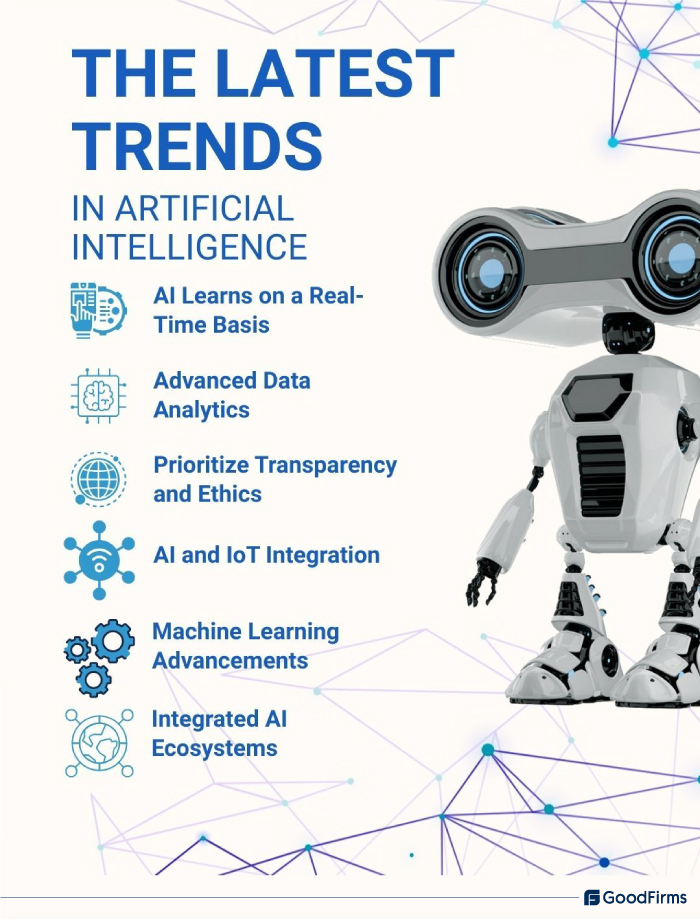
AI Latest Trends Explained
AI Learns on a Real-Time Basis: Instead of rule-based algorithms, AI systems would learn in real time without constant manual updates.
Advanced Data Analytics: AI will now provide deeper insights and more accurate predictions, helping companies to make better decisions than ever before.
Prioritize Transparency and Ethics: As AI adoption grows, there will be a check on the way data is collected and processed. Businesses will need to prioritize transparency and ethics.
AI and IoT Integration: Businesses will be able to enhance operational efficiency, make optimum use of resources, and improve customer experiences with this integration.
Machine Learning Advancements: With rapid advancements in machine learning, businesses will be able to offer unprecedented personalization and predictive capabilities.
Integrated AI Ecosystems: AI features will be available in different software applications being used for multiple processes like finance, HR, and customer service, reducing the need for standalone systems.
Final Thoughts: The Future of AI Has Arrived
It is an inevitable fact that AI is no longer the future - it is already here, transforming the way small businesses are operating and competing with large companies. AI tools are helping SMBs to enhance efficiency, save money, improve productivity, and making smarter decisions leading to unlocking new growth opportunities.
The potential of AI is versatile, and as a small or medium-sized business owner, now is the time for you to explore, experiment, and implement AI tools that match your needs. You can start with a free trial of AI-powered tools or get customized AI software built by one of the top software development companies to get the exact features you need in your system.
So, what are you waiting for? Embrace AI to follow an innovative and futuristic approach and experience your business thriving and growing in this competitive digital era.