Key takeaways:
- Flutter fintech apps use a single codebase that eliminates duplication across iOS and Android, cutting development timelines by over 50% without sacrificing performance or security.
- Flutter's native ARM compilation gives fintech apps true native-level performance, the technical foundation that separates it from every other cross-platform framework in the market.
- Flutter fintech apps deliver pixel-perfect UI consistency across all devices, a direct trust signal in an industry where 75% of users judge credibility by interface quality.
- Flutter's built-in security architecture supports PCI-DSS, GDPR, and ISO 27001 compliance, making it the most regulation-ready cross-platform framework for fintech app development.
- Flutter fintech apps scale from MVP to enterprise without architectural changes; the same framework that powers a five-person startup powers Nubank's 100-million-user neobank.
- Flutter integrates natively with AI, blockchain, and open banking APIs, giving fintech companies the ecosystem connectivity their competitive advantage depends on.
- Google Pay's Flutter migration saved 60–70% of engineering time and reduced its codebase by 35%, the most publicly documented proof of how Flutter app development cost compares to native in production fintech at scale.
- Flutter is the best framework for fintech app development in 2026, not because it leads every benchmark, but because it leads every benchmark that actually matters in financial services.
Companies that are moving to Flutter for fintech app development in 2026 are not making theoretical arguments about why it's a good framework. They're publishing the numbers.
Google Pay cut its codebase from 1.7 million lines of code to 1.1 million — while adding features. Nubank's pull requests now merge in under 10 minutes, compared to over 70 minutes on their previous native setup. These are not marketing claims. They're factually documented outcomes from engineering teams that went through the decision the hard way.
Looking for the best Flutter Developers for developing fintech apps? Find the best Flutter development companies from our list quickly.
This article covers what Flutter actually delivers for fintech app development in 2026: the technical reasons it works, the real-world business cases behind it, and what the companies that have already built on it have learned.
So, let’s quickly start with knowing what Flutter is and what makes it the best framework for Fintech applications.
What is Flutter, and Why Use it for Fintech Apps?
Flutter is an open-source UI software development kit built by Google. It lets developers build iOS, Android, and web applications from a single codebase written in Dart. Unlike frameworks that rely on a bridge to native components, Flutter renders its own UI using a high-performance graphics engine, which is why it achieves native-level performance rather than approximating it.
For detailed information about Flutter as a framework, you can also go through Flutter - Definition, Key Trends, and Statistics
Specifically for fintech applications, three of Flutter's properties matter more than anything else:
Single codebase across platforms. A fintech company building separate iOS and Android apps is duplicating every feature, every security patch, and every compliance update. Flutter eliminates that duplication. One team, one codebase, both platforms.
Compilation to native ARM code. Flutter does not interpret or bridge; it compiles directly to native code. For financial applications where a lag in transaction processing or a dropped real-time data update can erode user trust, this distinction matters.
Security architecture that supports fintech requirements. Flutter supports biometric authentication, encrypted storage, secure API communication, and certificate pinning out of the box. These are requirements, not optional extras, in regulated financial applications.
Precisely, Flutter allows:
- Building iOS, Android, and web apps using a single codebase
- Enabling native-level performance of the app.
- Integrating rich UI components and customizable widgets
- Rapid development using hot reload
- Strong security architecture
These qualities of Flutter make it particularly well-suited for fintech and Flutter banking software development, where performance, reliability, and security are non-negotiable at every stage of the product lifecycle.
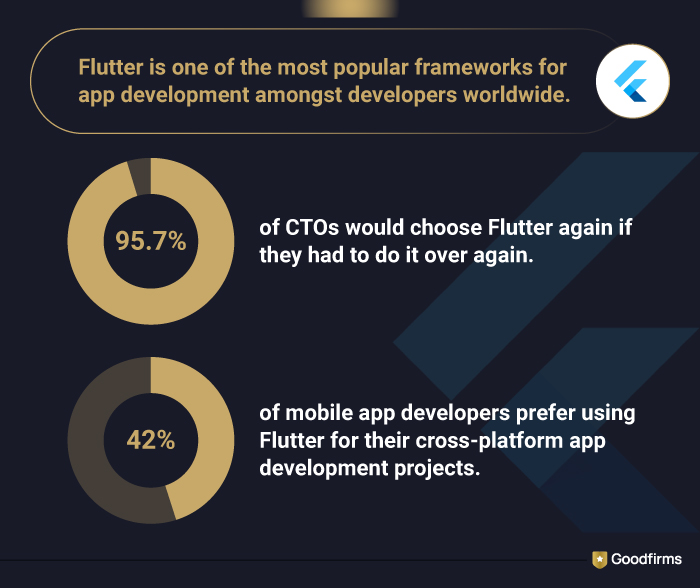
Sources: 2024 Stack Overflow Developer Survey, Flutter CTO Report, Statista
This means Flutter is a preferred choice for both developers and CTOs for app development. And Flutter has earned this preference through performance, security, and the ability to meet compliance requirements at scale. The comparison table below shows exactly how Flutter has earned its preference over competitors like React Native and Native Development in the Fintech industry.
Flutter vs. React Native vs. Native Development for Fintech
|
|
|
|
|
|
|
|
|
|
|
|
|
|
|
|
|
|
|
|
|
|
|
|
|
|
|
|
|
|
|
|
|
|
|
|
|
|
|
|
The table above showcases that - if you are building a quick MVP to test a fintech concept, React Native makes sense. If you are building a single-platform app where performance depth is non-negotiable, native development becomes the right choice. But if you are building a complex, cross-platform fintech product that needs to scale, stay compliant, and earn user trust from day one — Flutter is the answer.
But what specifically makes Flutter an ideal choice for fintech app development? Here is the full picture.
Benefits of Flutter Fintech Apps
Flutter is known for building highly secure cross-platform apps — from payment platforms to full-scale banking app development — delivering seamless user experiences across every category of financial services. Its capability to shorten the development lifecycle and build aesthetically appealing and high-performance apps has enabled financial industries to launch beautiful, secure, and extremely user-friendly mobile apps with speed, which leads to low development costs and reduced time to market. Below are seven benefits of using Flutter specifically for fintech app development.
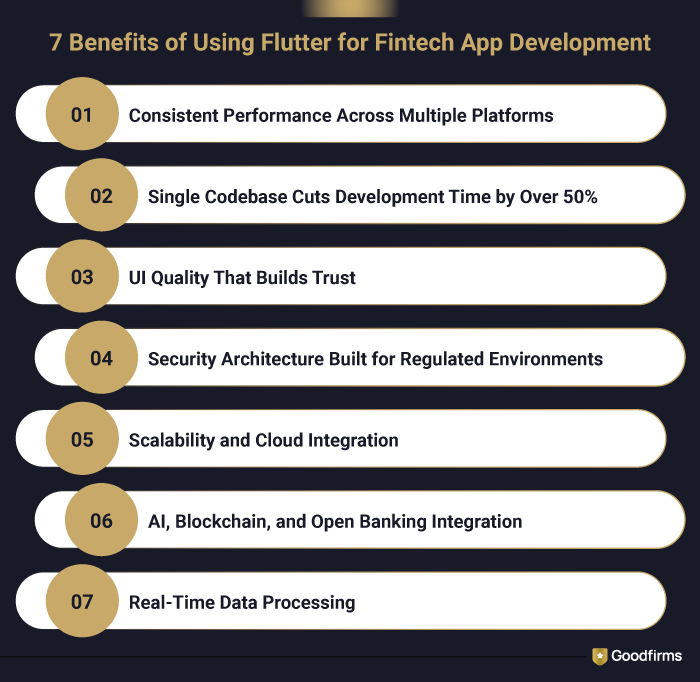
Let’s have a look at these benefits in detail.
1. Consistent Performance Across Multiple Platforms
In fintech, inconsistent performance is not a UX problem; it's a trust problem. If a payment fails on Android but not iOS, or if a trading app lags on older devices, users don't report a bug. They switch providers.
Flutter's rendering engine operates independently of the platform's native UI components, which means it delivers the same visual performance and interaction behavior on iOS and Android regardless of device age or operating system version. For fintech businesses serving globally diverse user bases — where device fragmentation is significant — this consistency removes a variable that native development cannot eliminate without ongoing platform-specific work.
According to MoldStud, by the end of 2026, over 70% of financial services organizations will prefer cross-platform app development to ensure consistent performance across multiple platforms.
2. Single Codebase Cuts Development Time by Over 50%
Developers working in Flutter consistently report development timelines that are more than 50% shorter than equivalent native builds. The mechanism is simple: every feature is written once. Every test runs once. Every security patch deploys once. Every compliance update is made in one place.
For fintech companies operating in markets where regulatory changes require rapid updates — new KYC requirements, updated disclosure rules, revised payment rails — the ability to push changes across both platforms simultaneously is operationally significant, not just a cost efficiency.
As per Flutter CTO Report 2024, 56.4% of developers confirmed Flutter development is over 50% faster than native app development, while 81% reported at least 20% faster delivery.
3. UI Quality That Builds Trust
In financial services, interface quality carries trust signals that directly affect conversion, retention, and average order value. A cluttered or inconsistent interface on a wealth management app communicates something about the company behind it.
Flutter's widget library and rendering engine allow for pixel-perfect UI implementation that looks and behaves identically across platforms and devices. Complex financial data — portfolio charts, transaction histories, real-time market data — can be presented with the visual clarity that users have come to expect from leading fintech products. The same design standards that Google Pay and Nubank's design teams implemented are technically accessible to any team building on Flutter.
According to Medium, 75% of users judge a company’s credibility based on its digital interface design.
4. Security Architecture Built for Regulated Environments
Flutter's security capabilities address the specific requirements of regulated financial services:
- Biometric authentication: Fingerprint and Face ID integration for secure login without passwords stored in device memory
- Encrypted storage: Secure local storage for tokens, session data, and credentials
- Certificate pinning: Prevention of man-in-the-middle attacks by validating server certificates against known values<
- Code obfuscation: Dart compiles to native ARM code that cannot be reverse-engineered in the way that interpreted or bridged frameworks can
Flutter-based architectures can be designed to comply with GDPR, PCI-DSS, and ISO 27001 frameworks. This is not unique to Flutter, but Flutter's architecture makes clean security implementation significantly less complex than frameworks that rely on platform bridges for native functionality.
According to Security Magazine, 66% of U.S. consumers would not trust a company that falls victim to a data breach.
5. Scalability and Cloud Integration
Flutter applications are architected to scale independently of the mobile layer. Through microservices architecture, secure API-driven communication, and native integration with cloud platforms including Google Cloud, AWS, and Azure, Flutter fintech apps can handle high concurrent transaction volumes without performance degradation.
This is the architecture Nubank relies on to serve over 100 million customers. It is also what allows teams to deploy independent service updates without releasing a new app version — a critical capability in environments where app store review cycles can create compliance lag.
According to Cloud Native Computing Foundation, 85% of fintech startups rely on cloud-native platforms to support rapid growth and global expansion.
6. AI, Blockchain, and Open Banking Integration
Flutter's integration compatibility with external technology layers is a practical advantage for fintech companies building on evolving infrastructure:
AI and machine learning: Flutter apps can communicate with ML model APIs for real-time fraud detection, behavioral analytics, and personalized financial recommendations, especially when leveraging the best AI software and tools. The framework does not add latency to these integrations.
As per Vertu, AI-powered fraud detection reduces financial fraud losses by up to 52%.
Blockchain and DeFi: Flutter interfaces cleanly with blockchain networks and smart contract APIs, making it a strong choice for blockchain development. It supports building crypto wallet applications, asset tokenization platforms, and decentralized finance (DeFi) products with seamless performance and secure integrations.
As per World Journal of Advanced Research and Reviews, Blockchain reduces cross-border payment costs by up to 60% and settlement time by 90%.
Open banking APIs: Flutter supports robust integration with payment gateways, KYC software, AML platforms, banking software and APIs, and financial data analytics tools. For fintech companies whose competitive advantage depends on ecosystem connectivity, this interoperability is foundational.
According to The Financial Brand - Open banking & API ecosystems improve customer experience scores by 33%.
7. Real-Time Data Processing
Fintech users expect transaction confirmations, fraud alerts, portfolio movements, and market data to appear in real time. Any perceptible delay in this data — particularly in trading or payment applications — undermines the core value proposition.
Flutter supports WebSockets, real-time database synchronization, and event-driven architecture. Combined with its efficient state management and rendering engine, this allows UI updates to occur at high frequency without performance degradation. Nubank's decision to build a server-driven UI layer on top of Flutter — allowing backend teams to push UI/UX design changes without triggering an app store release — is one of the more sophisticated implementations of this capability in production fintech.
As per State of the AI Connected Customer Report by Salesforce - 82% of customers expect real-time transaction updates and instant notifications from financial apps.
The benefits are clear. The adoption of Flutter in fintech app development services is growing. And the results? The case studies below prove it.
Real Examples of Flutter Fintech Apps
Trust is the currency of fintech. The companies below understood that the framework they chose would either support or undermine the trust they were trying to build with their users. Flutter supported it. Here is the evidence.
Google Pay: 35% Smaller Codebase, 60–70% Engineering Time Saved
When Google Pay decided to rewrite its app in Flutter, it started with three engineers building a vertical slice of the application. The experiment worked. They scaled to 50 engineers for a beta launch in Singapore, then brought in 100 more for the India and US rollout.
The results were documented publicly. The new Flutter codebase was 35% smaller than the original — 1.1 million lines instead of 1.7 million — despite the fact that new features were added during the migration. At the same time, the team estimated they saved 60–70% of engineering time because Flutter's unified codebase eliminated the overhead of maintaining parallel Android and iOS builds.
The lesson from Google Pay's migration is not just that Flutter is efficient. It's that the efficiency compounds: fewer engineers can maintain more functionality, security patches deploy to both platforms simultaneously, and feature development no longer requires writing everything twice.
Nubank: Pull Requests Merging 7x Faster
Nubank is Latin America's largest digital bank. Before Flutter, their iOS and Android teams were consistently out of sync — one platform would ship a feature before the other, developers needed separate skill sets for each codebase, and the entry barrier for engineers wanting to contribute to mobile was high.
After migrating to Flutter, their engineering team published the internal metrics. Flutter pull requests now take an average of 9.9 minutes to merge. The previous platform average was 70.45 minutes. Their merge success rate improved by 30%.
The organizational impact went beyond building speed. New engineers at Nubank can contribute to the mobile codebase within days of being onboarded — something that was not possible when mobile development required mastering separate Kotlin and Swift stacks. Backend engineers can now contribute to the mobile frontend. The boundary between teams collapsed.
Nubank also built a tool on top of Flutter that allows them to localize app content and push updates without releasing a new version of the app — a meaningful capability for a company operating across Brazil, Mexico, and Colombia with different languages and regulatory requirements per market.
Credit Agricole: 250-Person Team, One Codebase
Credit Agricole's adoption of Flutter demonstrates something that smaller fintech deployments cannot prove on their own: that Flutter's single-codebase architecture holds up under the compliance requirements, security standards, and operational complexity of a major regulated European bank.
The CA24 app runs on Flutter in production, serving millions of customers across a banking group that operates under GDPR, PSD2, and the full weight of European financial regulation. The framework did not need to be adapted or worked around to meet those requirements. It was architected to support them — and a 250-person team at one of Europe's most established banking institutions validated that architecture at scale.
For fintech companies evaluating Flutter banking app development against native alternatives, Credit Agricole is not a case study about a startup moving fast. It is a case study about a century-old banking institution making a deliberate, compliance-aware, operationally significant infrastructure decision — and getting it right.
Hence, Google Pay proved that Flutter works for global payment platforms. Nubank proved it works for neobanks at scale. Credit Agricole proved it works for regulated European banking. The question is where else it works — and the answer is broader than most teams expect. Below are the types of fintech apps built successfully using Flutter.
Types of Fintech Apps Built Successfully Using Flutter
- Neobanks and digital banks: Flutter has become the go-to framework for neobank app development, delivering full-feature banking applications with real-time account management, transaction feeds, and payment initiation. Nubank is the benchmark case.
- Payment and digital wallet apps: High-frequency transaction handling with biometric security and cross-platform consistency. Google Pay is the benchmark case.
- Investment and trading platforms: Real-time data display, portfolio management, and order execution. Flutter's rendering performance handles high-frequency UI updates without degradation.
- Lending and credit applications: KYC integration, document capture, credit decision flows, and loan management. Flutter's camera and document handling capabilities support the data collection requirements.
- Cryptocurrency and DeFi platforms: Wallet management, blockchain interaction, and real-time market data. Flutter's API integration capabilities handle the backend communication complexity of crypto currency exchange platforms and DeFi applications.
- Insurance applications: Policy management, claims processing, and premium calculation with GDPR-compliant data handling.
The use of Flutter in fintech apps is broad and versatile. Still have questions about using Flutter in fintech app development? The FAQs below might help.
Flutter Fintech Apps: FAQs
The majority of fintech businesses arrive at the same questions before leveraging Flutter for their app development projects. Here are those questions — and the answers that resolve them.
How long does it take to build a Flutter fintech app?
An MVP with core banking functionality — account management, payments, transaction history, and basic security — typically takes three to six months with a team of five to eight engineers. Nubank launched its life insurance feature in three months using Flutter. Timeline is heavily dependent on compliance requirements and backend integration complexity.
Is Flutter secure enough for fintech apps?
Flutter's security architecture — native compilation, encrypted storage, biometric authentication, and certificate pinning — meets the requirements for PCI-DSS, GDPR, and ISO 27001 compliance when implemented correctly. The framework does not create inherent security weaknesses, but it does not eliminate the need for a secure backend, proper API design, and compliance review.
How does Flutter compare to React Native for fintech?
Flutter's own rendering engine gives it a performance and UI consistency advantage over React Native's bridge-to-native approach. For fintech applications where real-time data display and transaction speed are critical, Flutter's architecture is better suited. With a larger pool of React Native developers, hiring for React Native projects becomes more practical and scalable for businesses.
Which companies use Flutter for fintech apps?
Google Pay, Nubank (100M+ users), Credit Agricole, and ING are the most cited examples in production fintech. Each chose Flutter for different reasons — Google Pay for global scale and engineering efficiency, Nubank for team scalability and development velocity, Credit Agricole for platform unification.
How Much Do Flutter Fintech Apps Cost?
Flutter app development cost is driven primarily by team size, compliance complexity, and integration scope. And in almost every scenario, it comes in significantly lower than maintaining separate iOS and Android native builds. Google Pay estimated 60–70% engineering time savings post-migration. For a new build, the elimination of duplicate development typically reduces cost by 30–50% compared to a dual native approach, depending on feature complexity. For detailed information about how much your fintech app can cost, you can go through a detailed Goodfirms article - Neobank App Development Cost in 2026: A Full Breakdown.
Planning to launch a new fintech venture or upgrade your digital banking platform? Find the right Neobank Tech Stack here.
Conclusion: Flutter Stands Out as the Most Powerful Framework in 2026
As fintech enters a new era of smart automation, real-time information, and enhanced security, selecting the right development framework like Flutter has become beneficial in terms of implementing innovative business strategies and technologies.
Flutter has gained a position as an extremely scalable and modern framework for app development, specifically for finance companies. The reason behind that is its ability to offer quick development with cross-platform consistency and high-quality performance. Also, it has the potential to empower high-end security apps that can seamlessly integrate with the latest technologies like AI, blockchain, cloud, and real-time APIs.
As a result, Flutter has emerged as a top framework of choice for leading fintech software development companies worldwide.
Flutter app development is enabling fintech companies, whether startups or enterprises, to manage Flutter app development cost efficiently while staying compliant, secure, and customer-centric, ultimately gaining a competitive advantage and improved revenue generation.
Precisely, Flutter is not only the right framework for fintech in 2026, but it is also the backbone of next-gen fintech companies with a modern approach.