B2B Sellers - B2B buyers are hardly interested in talking to your sales reps.
Why, you may ask?
Well, think of a writer who toots her own horn. Tell me, who'd be interested in listening to her? No one would believe in her talent unless one of her clients puts in a positive word for her.
Likewise, a sales guy talking about a product would typically come across as absolutely biased and, more likely, brainwashed to deliver only positive views about the business/product he's selling.
I know what you are thinking:
"If not the sales reps, then who should the B2B buyers check in with about the quality of a product or service?"
Simple! Get your happy customers talking for you, on your website, B2B review sites, social media handles, and more. If you can get your happy customers to leave reviews on platforms such as Goodfirms, Clutch, G2, and the like, your job is half done. Gartner has reported that 44% of millennial B2B buyers "avoid" talking to sales representatives while making purchases.
If your customers are ready to praise you, left, right, and center, on online customer review platforms specifically, then nothing like it. Your sales are sure to skyrocket. Happy customers are the best promoters of your product or service.
And here's the thing, this is no longer just a "nice to have." Today's B2B buyers do their homework long before they ever pick up the phone or fire off an email. By the time they reach out to a vendor, 70–80% of their decision is already made.
Review platforms like Goodfirms, Clutch, and G2 are exactly where that homework gets done. So if your presence there is strong, if your happy clients have spoken up, buyers arrive already leaning toward you. That's not just good for credibility. That's a pipeline driver
Your future clients are already on Goodfirms researching your competitors. Don’t let them make a decision without seeing your success stories. Claim Your Free Profile today and start building the review-driven pipeline your business deserves.
Still not convinced? Here's what the numbers say: 92% of B2B buyers consult peer reviews before purchasing. Goodfirms alone lists 110,000+ companies across 90+ countries. And buyers who find vendors through review platforms? They convert at significantly higher rates than cold traffic.
The writer who lets her clients do the talking wins every time — and so will you. This blog highlights the importance of B2B Customer Review Platforms for B2B sellers and some top-class formulas to drive reviews.
Gartner has reported that 44% of millennial B2B buyers " avoid" talking to sales representatives while making purchases
This blog highlights the importance of B2B Customer Review Platforms for B2B sellers and some top-class formulas to drive reviews on the same.
Okay! Before we move on to the crucial parts of the blog, glance at top digital marketing agencies on Goodfirms first. These firms are fully equipped to help you find quick ways to generate more reviews. But then, after a quick glance, do get back here and finish reading this blog because we've shared a couple of unique ideas you won't find elsewhere.
So, let's start.
The Rise and Rise of Customer Review Sites
The B2B industry has witnessed a dramatic rise in customer review platforms in the last few years.
Goodfirms, G2, Clutch, 99Firms, Manifest, Goodtal, and more are among today's top customer review platforms that have captured the imagination of the B2B masses.
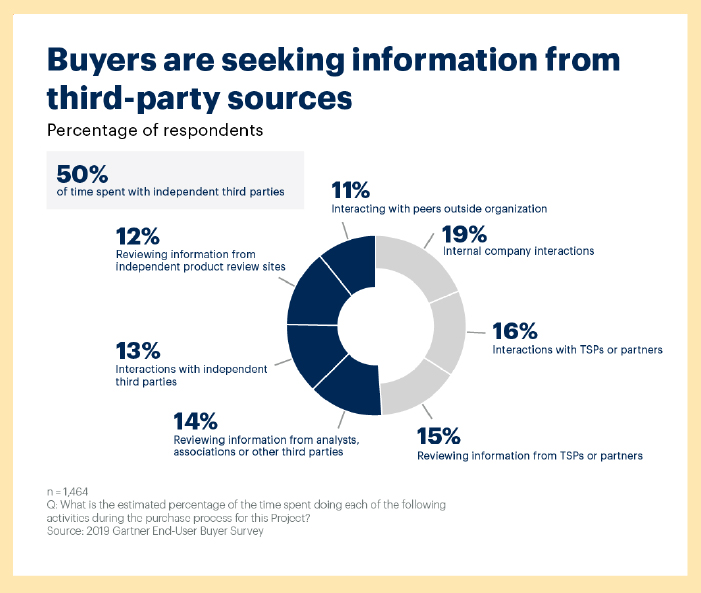
In fact, 85% of B2B software buyers trust online reviews and spend nearly 50% of their time consulting Independent third-party sources, including credible customer review sites, before making any purchases.
Source: https://www.gartner.com
The single most reason that could be cited for the rising popularity of customer review platforms is the legitimacy of the reviews showcased on these sites. In other words, reviews on these sites are construed as fair and credible compared to reviews on business websites.
This means in little to no time, B2B sellers would have little or no influence on B2B buyers' purchase decisions as the latter would come to rely totally on customer reviews for their purchases.
Bottom line: B2B sellers need singularly focus on driving online reviews on online review platforms and even their websites if they want buyers to line up at their online doorstep.
Perhaps, the question that's popping up in your mind right now is: "Besides offering legit reviews, in what other ways a customer review platform could profit B2B businesses?"
Fair enough! Let us shed more light on how b2b review sites benefit B2B sellers.
Ways Customer Review Platforms Benefit B2B Sellers
As mentioned above, B2B buyers are increasingly willing to trust customer review sites, otherwise known as third-party sites, and add them to the information mix they gather before they make any purchases, mainly because they are legit reviews and enable experiencing the products or services second-hand through the eyes of other customers.
First-Party B2B Review Sites
- Reviews are directly left by customers on business websites and so are owned by the company.
- Reviews are considered less credible and legit as there are higher chances of reviews being tweaked.
- As the business can claim the review to be its own, it can be marked up with a review schema. Schema markup ensures your reviews and ratings are Google Indexed, which in a way vouches for the originality of the content. However, third-party reviews displayed on your business website cannot be marked up with schema as it’s copied directly from a third-party website.
Third-Party B2B Review Sites
- Reviews are written for customer review sites through the “send review request” link or widgets added to the emails sent by B2B sellers and so are owned by the review site.
- Reviews are considered absolutely legit.
- Third-party sites also can be marked up with review schema.
This and many other benefits drive B2B buyers to customer review platforms and, more importantly, incentivize sellers to build their brand presence. Without much ado, let's start with the benefits.
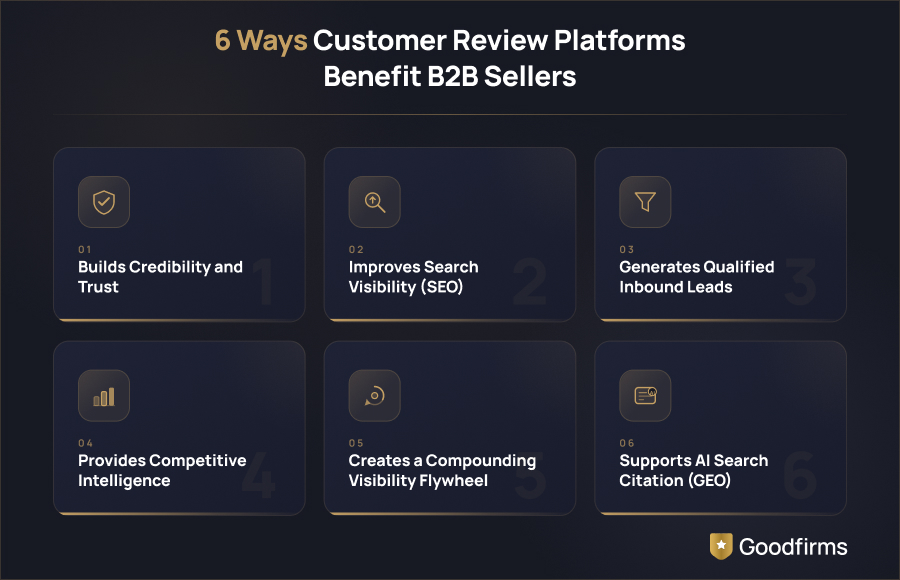
The 6 Core Benefits
1. Builds Credibility and Trust
Legit, verified reviews from real clients give your brand third-party credibility that no owned marketing channel can replicate. B2B buyers trust platforms like Goodfirms precisely because they are independent — and that independence is what makes your listing valuable.
2. Improves Search Visibility (SEO)
Review platform pages frequently rank on Google's first page for competitive B2B service keywords. A well-maintained Goodfirms or Clutch profile gives your business a second organic search presence — capturing high-intent buyer traffic you would otherwise miss entirely, at no additional ad spend.
3. Generates Qualified Inbound Leads
Buyers who find you via review platforms are already researching your category — they arrive with intent. By the time a client reaches out via Goodfirms or Clutch, they have typically completed 70–80% of their decision-making process. This shortens sales cycles and dramatically improves close rates.
4. Provides Competitive Intelligence
Monitoring reviews on competitor profiles reveals their service gaps and tells you exactly what buyers wish they had done differently — a free, continuously updated source of market intelligence.
5. Creates a Compounding Visibility Flywheel
More reviews → higher platform ranking → more profile views → more review opportunities. Unlike a single ad campaign, your review profile grows in authority over time. Each new review compounds the value of every previous one.
6. Supports AI Search Citation (GEO)
In 2025, AI-native search tools — ChatGPT, Perplexity, Google AI Overviews — actively cite content from established B2B review platforms when answering vendor-related queries. A strong Goodfirms or Clutch presence makes your business more likely to be surfaced in AI-generated answers, not just traditional search results.
Here's a 4-Step-Drill to Identify Third-Party Reviews Platforms For B2B Software and Service Sellers
There's no denying that there are a dime a dozen customer review platforms. Some are very general, catering to all types of products and services. Some customer review platforms are particular and cater to particular types of industries. For instance, Yelp is mainly used for local restaurant reviews, while Getapp and Capterra are referred to for software reviews.
Also, there are sites just meant for physical product reviews. The point is to whittle down to a third-party site(s) that aligns with your business and helps you take advantage of reviews to grow your customer base.
So how do you determine which B2B review sites are more effective because it's not easier for businesses to persuade their customers to share reviews on dozens of different sites?
Here are a few things B2B sellers need to consider while identifying third-party sites for driving reviews. If you need help, you can consult UK-based digital marketing companies for their specialized advice.
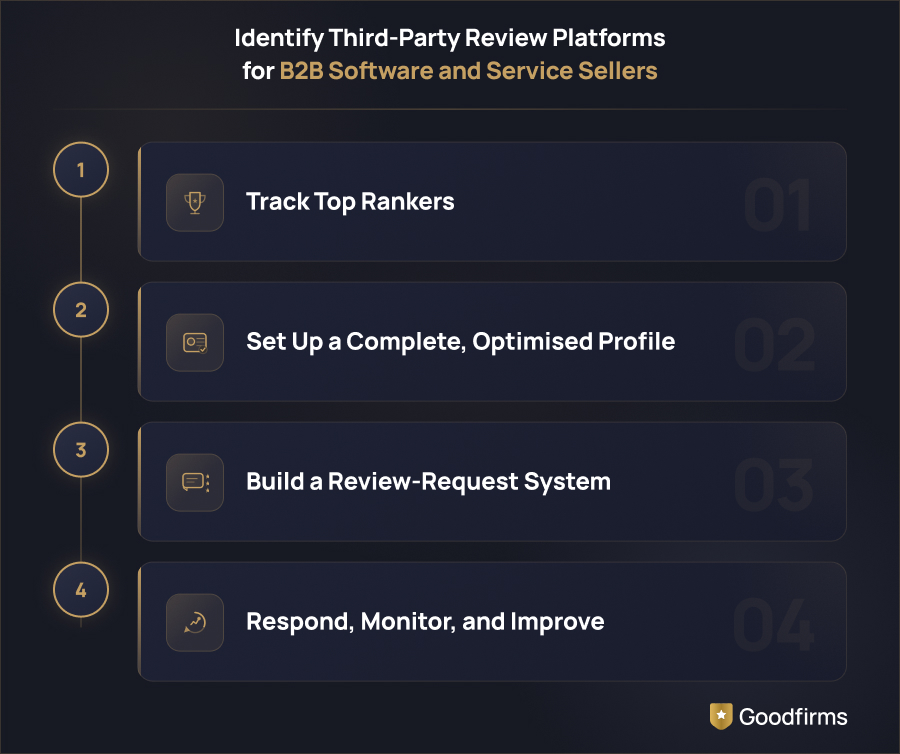
Step 1: Track Top Rankers
B2B sellers research and figure out top-ranking customer review platforms in their respective categories. Then they get listed there. Repeat the same drill for listing your website as well. Why? Because all your customers are also visiting these sites as they rank high on Google searches.
Search Google for terms your buyers actually use: "best [your service] companies", "top [software category] tools", "[service] reviews 2025." The platforms appearing on page one are the ones your buyers are using right now. List every platform that appears for five or more of your target keywords — those are your priority listings.
Step 2: Set Up a Complete, Optimised Profile
Once you have identified B2B review sites that could fetch you more traffic and business, your next step is to set up your profile on all the relevant platforms. Include a Facebook Business Page and Google Business Profile in that mix.
An incomplete profile is a missed opportunity. For maximum ranking and conversion performance, your profile should include:
- Portfolio examples with measurable outcomes (specific numbers, not vague claims)
- Specialisations, industries served, and team size
- Pricing range and engagement types
- Awards, certifications, and verified case studies
- Profiles with rich detail rank higher within platforms and convert better when buyers land on them. Treat your review platform profile with the same rigour as your website's homepage.
Step 3: Build a Review-Request System (Not a One-Off Ask)
Once you have identified the ideal review platform(s) to partner with, the next best step is to help drive more reviews for your business.
It is easier to drive your customers to leave reviews on Goodfirms. All you must do is: 1) Log in to your vendor profile on Goodfirms, 2) Click on the review button, 3) Fill in the required fields. An automated review form will directly reach your client to be filled up by them.
Ad hoc review requests yield inconsistent results. Build a repeatable system:
- Identify the right moment: immediately after a successful project delivery, 2–4 weeks post-launch when outcomes are visible, or at annual renewal
- Assign a responsible team member to every review request
- Use Goodfirms' native automated review form to minimise client effort
- Track request-to-completion rates monthly and iterate
- Frame your request with context, not pressure: "We'd love a quick review on Goodfirms — it typically takes 5–7 minutes and your honest experience genuinely helps other buyers make better decisions."
Step 4: Respond, Monitor, and Improve
Getting the review is only half the job. What you do after it lands determines how much value it actually creates for your business.
First, respond to every review — publicly. A thoughtful response to a positive review signals that your company is engaged and genuinely values its clients. A measured, professional response to a mixed or critical review does something even more powerful: it shows future buyers that you are accountable, mature, and safe to do business with. Buyers read responses as carefully as they read the reviews themselves.
Second, monitor your reviews regularly — not just on your primary platform, but across every site you are listed on. Set up Google Alerts for your brand name alongside the platform names, or schedule a monthly audit. Unresponded reviews, especially negative ones, send a worse signal than no reviews at all.
Third, use your reviews to improve. Patterns in client feedback — what they praise, what they wish had gone differently — are direct product and service intelligence. Build a habit of sharing review insights with your delivery and leadership teams quarterly. The businesses that treat reviews as feedback loops, not just marketing assets, are the ones whose review scores keep climbing.
Top B2B Review Platforms: Quick Reference
Not all review platforms are equal. Focus on 2–3 platforms where your specific buyer persona is most active, rather than spreading thin across all of them.
|
Platform |
Best For |
Verification |
Key Edge |
|
Goodfirms |
IT services, agencies, SaaS |
Manual + research-backed |
3-pillar methodology; strong global SEO rankings |
|
Clutch |
Dev agencies, marketing firms |
Analyst-interviewed |
Detailed client interviews; high buyer-intent traffic |
|
G2 |
B2B software products |
LinkedIn-verified users |
Category grids; largest SaaS review database |
|
Capterra |
Software buyers (SMBs) |
Email-verified |
Gartner-backed; strong for SMB decision-makers |
|
Trustpilot |
B2B/B2C crossover |
Invitation + open |
High consumer trust; useful for brand perception |
How AI Search Engines Surface Your Review Presence
In 2026, a growing share of B2B research begins with AI-native tools: ChatGPT, Perplexity, Google AI Overviews, and Microsoft Copilot. These engines don't just rank pages; they synthesize answers from trusted sources and cite them directly in responses.
For B2B sellers, this means your review platform profiles and the content surrounding them must be structured for AI citation, not just traditional keyword ranking. Here is how:
Write in direct, factual sentences - AI engines favor clear, declarative statements over vague marketing language. For example, "Goodfirms verifies every review through a manual research process" is far more likely to be cited than something like "Goodfirms offers the best review experience", because specificity and factual clarity are what AI engines extract and surface
Use structured Q&A formats - Content written in a question-and-answer format is disproportionately pulled into AI Overview responses. Structuring your profile content or supporting pages around common buyer questions, such as "What does this company specialize in?" or "Who do they typically serve?", significantly increases the chances of being cited in AI-generated answers.
Earn citations on high-authority platforms - AI engines weigh content from established, frequently cited domains. A review on Goodfirms carries more citation weight than a testimonial on your own website, because platforms like these have deep training-data presence and are recognized as trusted third-party sources.
GEO Profile Tip - When writing your profile description, lead with a factual one-sentence summary: what your company does, for whom, and the primary outcome you deliver. This format is exactly what AI engines extract when generating sourced answers about vendor categories.
Why Buyers Leave Your Profile Without Reaching Out
Stickability is the quality that keeps buyers on your profile, or your content, long enough to take action. A profile with great reviews but poor stickability loses buyers before they convert. Check your B2B review presence against this SQ checklist:
- Your profile headline leads with buyer outcomes, not your company description ("We help fintech companies reduce vendor risk" not "IT Services Company since 2012")
- Your most recent reviews are within the last 90 days, stale review profiles signal stagnant businesses to active buyers
- Your profile includes specific portfolio examples with measurable results, actual numbers, timelines, client types, not vague claims
- Every published review has received a public, personalised response from your team within 7 days
- Your reviews vary in perspective, technical leads, business owners, and end users, giving buyers a 360° view of the client experience
- Your blog content and case studies link to and contextualise your review platform profiles, creating content loops that extend dwell time
Rule of Thumb: If a buyer spends less than 60 seconds on your review profile, it is doing less than half of its possible work. Rich profiles with recent, varied, responded-to reviews consistently produce longer session times and higher contact rates.
The Bottom Line: Reviews Are Revenue Infrastructure
B2B review platforms are not a "nice to have" marketing checkbox. In 2025, they are core infrastructure for trust, discoverability, and pipeline generation, operating simultaneously across SEO, AI-search citation, buyer research behaviour, and social proof.
The businesses winning on these platforms share three traits: they have built a systematic review collection process, they maintain fully optimised and active profiles, and they treat every review as a distributable content asset, not a static entry on an external website.
Start with one platform. Build your profile completely. Request five reviews this month using Goodfirms' automated tool. Respond to every one publicly. Then scale the system. The compounding effect, in SEO ranking, AI citations, buyer trust, and closed deals, is significant, measurable, and fully within your control.
The 5 Questions Every B2B Buyer Asks Before Choosing a Vendor
1: What are B2B review sites?
B2B review sites are third-party platforms, such as Goodfirms, Clutch, G2, and Capterra, where verified business clients post detailed reviews of service providers and software vendors. They serve as trusted, independent sources that B2B buyers use to evaluate vendors before making purchasing decisions.
2: Why are B2B review platforms important for businesses?
B2B review platforms build credibility, improve SEO visibility, generate qualified leads, and shorten sales cycles. Because 70–80% of B2B buying decisions happen before a buyer contacts a vendor, a strong reviewed presence on these platforms means buyers arrive already convinced of your value.
3: How do I get more reviews on Goodfirms or Clutch?
Use the platform's native review request tools immediately after project milestones. Personalize the outreach, minimize friction using direct links and pre-filled context, and follow up via email and LinkedIn. A consistent monthly system outperforms seasonal bursts.
4: Which B2B review platform is best for IT and software companies?
Goodfirms and Clutch are generally the strongest for IT service companies and agencies. G2 leads for B2B SaaS products. Maintain active profiles on 2–3 platforms where your specific buyer persona is most active.
5: Do B2B review sites help with SEO?
Yes — significantly. Review platform pages frequently rank on Google's first page for competitive B2B service keywords. A well-optimised Goodfirms or Clutch profile creates a second organic search presence and captures buyer-intent traffic you would otherwise miss.