Key takeaways
- Liquidity providers make or break trust: tight spreads and instant fills come down to one partner, and getting it wrong costs real money and trust.
- Three core types exist, and most exchanges need more than one: market makers keep books tight, OTC desks handle block trades, DEX pools price automatically.
- Pricing follows three models, each with a trade-off: a monthly retainer, a loan-plus-call-option structure, or a profit-share deal, depending on cash flow versus dilution risk.
- Headline liquidity numbers can mislead: centralized exchanges are projected to hold 88.4% of the market in 2026, so traders check order-book depth, not 24-hour volume.
- Vetting matters more than picking a name: the right provider shows verifiable depth, puts spread and uptime commitments in writing, and holds required licenses.
A well-built cryptocurrency exchange platform earns traders’ trust the moment someone opens the order book and sees tight spreads with instant fills. That first impression comes down to one partner working quietly behind the interface: the crypto exchange liquidity provider.
Ever tried to buy or sell a big chunk of crypto and watched the price move on you mid-trade? That's what happens when there's not enough liquidity, and it costs real money, real trust, and the exchange's reputation.
Partnering with the right crypto liquidity providers keeps spreads tight, absorbs large orders without moving the price, and gives traders a reason to stay past their first trade. Get that partnership right from day one, and even a new exchange can compete credibly with established venues.
Check Goodfirms' Best Crypto Liquidity Providers with verified reviews to make the right choice.
Before diving into what these providers do and cost, here's a quick comparison of the top names in 2026 and where each one fits best.
Best Crypto Exchange Liquidity Providers in 2026 Comparison
Here's how the leading names compare before we look at what sets each one apart.
|
Provider |
Best Fit |
What to Evaluate |
|---|---|---|
|
Wintermute |
Algorithmic market making across centralized and decentralized venues |
Exchange coverage, quote uptime, and OTC desk terms |
|
Cumberland |
Large block trades for funds and treasuries |
Settlement speed, credit terms, and minimum trade size |
|
Jane Street |
TradFi-grade quantitative trading extended into digital assets |
Track record in traditional markets, risk controls, and asset coverage |
|
B2C2 |
Institutional liquidity backed by a regulated financial group |
Counterparty credit rating, settlement currencies, and API reliability |
|
Keyrock |
EU-regulated market making, OTC, and options coverage |
MiCA licensing status, supported markets, and reporting transparency |
|
Kronos Research |
Asia-based high-frequency trading and liquidity provision |
Regional exchange relationships, latency, and volume commitments |
|
B2Broker |
Multi-venue liquidity aggregation for exchanges and brokerages |
Number of upstream liquidity sources, distribution network, and jurisdictional coverage |
|
GSR Markets |
Combined market making, OTC, and venture backing for token projects |
Depth of exchange relationships, venture involvement, and long-term partnership terms |
|
Enigma Securities |
FCA-regulated liquidity access via proprietary trading infrastructure |
Regulatory scope, parent-company backing, and API/platform access |
|
Optiver |
Traditional-markets market maker extending into digital assets |
Legacy market-making credentials, risk systems, and crypto-specific product maturity |
The table above gives a quick snapshot of where each provider fits. Here's a closer look at what sets each one apart, and what's worth verifying before any of them ends up on a term sheet.
A Closer Look at the Top Crypto Liquidity Providers
Each of these providers brings a different mix of coverage, regulatory standing, and specialization to the table. Here's what makes each one worth considering.
1. Wintermute
Wintermute is a London-headquartered algorithmic trading firm that quotes across dozens of exchanges simultaneously, and it recently stood up a registered US broker-dealer to bring its market-making activity onto regulated rails. It pairs that CEX/DEX coverage with an OTC desk, so the same firm can post resting liquidity and fill a large block trade.
2. Cumberland
Cumberland grew out of the Chicago proprietary trading firm DRW and has focused on digital assets since 2014, giving it over a decade of continuous OTC execution experience. Its client base skews toward funds and corporate treasuries that need to move size without leaving a footprint on public order books.
3. Jane Street
Jane Street built its reputation as a quantitative trading firm in traditional equities and fixed income before extending that infrastructure into crypto markets. Bringing decades of TradFi risk management into a newer asset class is exactly the kind of proprietary-desk-with-a-crypto-arm profile the sector has been consolidating around.
4. B2C2
B2C2 is majority-owned by SBI, a major Japanese financial conglomerate, which gives it a regulatory and balance-sheet backing that many crypto-native firms lack. Founded in 2015, it has built a reputation for pricing continuously around the clock rather than only during standard trading hours.
5. Keyrock
Keyrock is a Brussels-based firm operating under the EU's evolving MiCA framework, positioning it among the licensed desks the market is increasingly gravitating toward. Beyond core market making, it also runs OTC and options desks, so token issuers can consolidate multiple liquidity needs with one regulated partner.
6. Kronos Research
Kronos Research is based in Taipei and represents the Asian side of the institutional liquidity map, running high-frequency strategies across regional exchange partnerships. Its focus spans both proprietary trading and client-facing liquidity provision, giving it exposure to both sides of the market-making business.
7. B2Broker
B2Broker takes a different approach from the desks above: rather than trading as a single counterparty, it pools liquidity from multiple upstream sources and distributes it across a network of exchanges, brokerages, and other venues. That aggregator model makes it a fit for platforms that want breadth of access rather than a direct relationship with one market maker.
8. GSR Markets
GSR Markets has operated in crypto since 2013, making it one of the longer-tenured firms on this list, and it layers venture capital investment on top of its market-making and OTC services. That combination means it often works with token projects from an early funding stage through to post-listing liquidity support.
9. Enigma Securities
Enigma Securities is a London-based liquidity provider owned by Makor Capital, an FCA-regulated brokerage with a decade-long track record outside of crypto. That regulatory lineage lets it offer bespoke liquidity through its own trading platform and APIs to clients who need a compliant counterparty.
10. Optiver
Optiver has operated as a market maker since 1986, decades before crypto existed, and has since brought that infrastructure into digital assets. Its scale and traditional-markets pedigree make it one of the more established names moving institutional volume into crypto rather than a firm that grew up crypto-native.
With the top providers laid out side by side, the next step is knowing exactly what to check before picking one.
What Do Crypto Exchange Liquidity Providers Actually Do?
An individual, firm, or institution that supplies digital assets to a trading platform or liquidity pool, enabling people to trade, is known as a crypto exchange liquidity provider.
The job of crypto exchange liquidity providers comes down to one thing: making sure a buyer and a seller can find each other at any moment, without either side waiting around. In practice, that takes one of three functions:
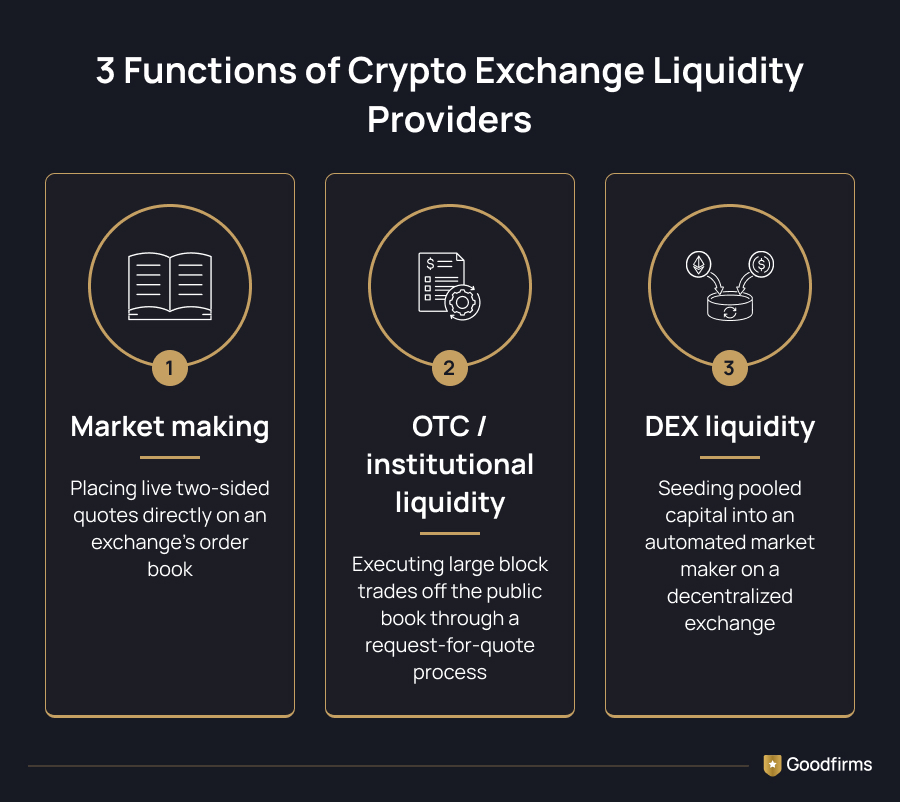
These three functions sound similar but solve different problems. A market maker keeps spreads tight and a book populated for everyday retail flow. An OTC desk protects a fund or treasury from moving the market when it needs to buy or sell a large position in one shot. A DEX pool lets any wallet trade a token permissionlessly, with pricing set algorithmically rather than by a counterparty. Most exchanges and token issuers end up relying on more than one type at once, and the specialized fintech software development companies are frequently the ones wiring multiple provider feeds into a single exchange backend.
Demand for services offered by crypto exchange liquidity providers isn't limited to crypto funds and trading firms anymore. Businesses using cryptocurrency to transact need that same liquidity, too.
A Goodfirms survey - Cryptocurrency Adoption in B2B Payments - found that 44% of businesses have used cryptocurrency as a mode of transaction, whereas 56% of businesses have yet to do so.
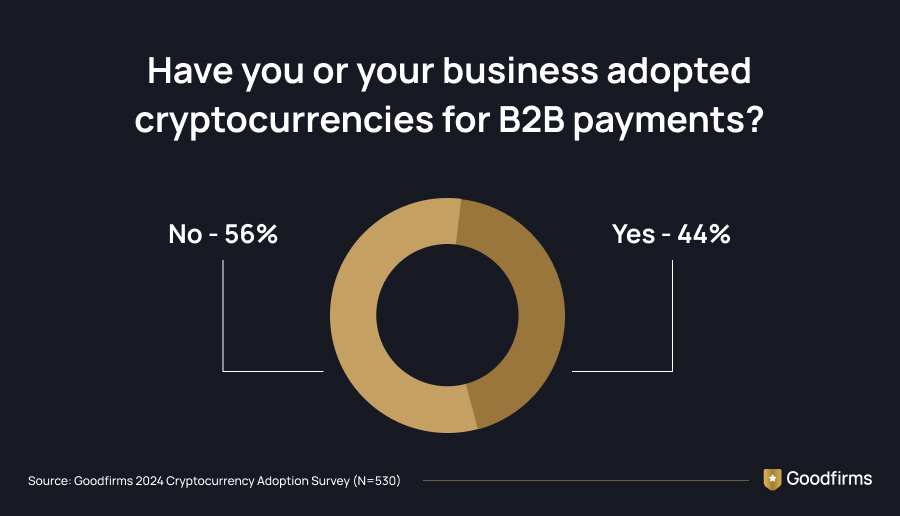
Every business on that adopting side needs a crypto liquidity provider able to move real transaction volume without disrupting the price.
That growing reliance raises a practical question: what does bringing one of these providers on board actually cost?
What Does a Crypto Liquidity Provider Cost in 2026?
Pricing for a crypto liquidity provider generally falls into three pricing models as follows.
|
Pricing Models |
How It Works |
Trade-off |
|---|---|---|
|
Monthly retainer |
$10,000–$50,000+/month, and an additional setup fee of $50,000–$100,000 |
Predictable, no dilution risk, but a real cash cost every month |
|
Loan + call option |
The project lends the provider 3% to 5% of circulating supply, and the provider gets a call option at an agreed strike price instead of a fee. |
Little upfront cost, but expensive later if the token price climbs past the strike |
|
Profit-share |
Provider keeps a negotiated share of trading profits, common for DEX-only mandates |
Aligns incentives well, but has limited use outside DeFi-native setups |
Here's how each of those three models actually works once a deal is signed.
Pricing Models Explained with Real-World Examples
Retainer: The project pays a fixed monthly fee plus a setup cost, and keeps full token ownership throughout. GSR's public proposal to StakeDAO used this model at $100,000 upfront, $20,000 a month, and a $1 million loan, and Flowdesk runs its Market-Making-as-a-Service product entirely this way.
Loan + Call Option: The project lends tokens to the market maker for trading capital instead of paying a fee, and the market maker earns through a call option at a set strike price; Wintermute and Auros commonly use this structure, and it gets expensive fast once the token price runs past that strike.
Profit-Share: Instead of a fixed fee, the provider earns a proportional cut of the trading fees its capital generates. On Uniswap, every trade through a pool pays a flat 0.3% fee, and a liquidity provider holding 1% of that pool automatically earns 1% of the fees collected. So, a pool generating $1,000 in fees over a week pays that provider $10, credited straight into their position rather than paid out as an invoice.
None of these pricing models matter if the liquidity behind them isn't deep enough to handle a real trade. A cheap provider can still leave an exchange exposed the moment a big order comes in and there's nothing there to absorb it. That's why it matters to look past surface numbers like spread or trading volume and understand how much liquidity is actually available when it's needed.
Why Liquidity Depth Matters More in 2026?
Liquidity depth matters more in 2026 because the gap between a market that looks liquid and one that actually is has widened. As per Coherent Market Insights, centralized exchanges will handle the bulk of crypto trading in 2026.
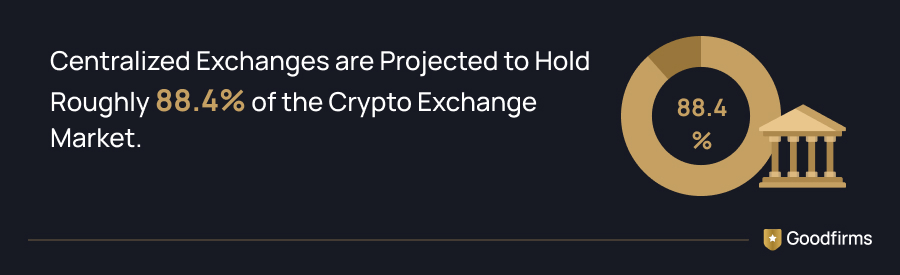
This concentration in trading volume doesn't guarantee concentration in executable depth. The depth crypto exchange liquidity providers bring directly shapes where that trading volume lands.
On paper, prices look tight. Bitcoin and Ethereum trade with almost no gap between buy and sell prices, most of the time. Smaller coins tell a different story. Solana's price gap runs five to eight times wider than Bitcoin's or Ethereum's. That's why traders now look past 24-hour trading volume as a liquidity signal. They check order-book depth and consider how much Bitcoin sits ready to trade near the current price. Above $650 million is generally considered strong, institutional-grade liquidity.
That gap between headline numbers and executable size is what industry insiders have started calling out publicly. Leo Mindyuk, founder of the trading firm ML Tech, wrote in CoinDesk's Crypto Long & Short newsletter that:

Executable crypto liquidity at scale is “more fragmented and fragile than most institutions assume.
- Leo Mindyuk, Founder of the trading firm, ML Tech
Wintermute founder and CEO Evgeny Gaevoy, whose firm now runs a registered US broker-dealer, has made a similar point about market structure in a recent publication:

Digital asset markets will evolve in more than one direction rather than consolidating onto a handful of venues, the way some predicted.
Put together, both observations point to the same conclusion: fragmentation is the default state of crypto liquidity, not a temporary problem waiting to be solved. A provider that can't demonstrate depth on the specific venues and pairs a business actually needs isn't offering much protection, no matter how impressive its aggregate volume looks.
That fragmentation also explains why no single type of liquidity provider covers every need. Depth on one venue or pair doesn't automatically mean depth everywhere,which is why the market split into different provider types in the first place, each built to solve a different piece of the liquidity problem.
Market Makers vs. OTC Desks vs. DEX Liquidity
Each type of liquidity provider solves a different problem, and knowing which one fits your situation is the first step before comparing individual firms.
|
Provider Type |
How It Works |
Best Fit |
|---|---|---|
|
Market maker |
Posts continuous two-sided quotes directly on an exchange's order book |
Token listings and keeping spreads tight for everyday trading flow |
|
OTC / institutional desk |
Executes large block trades off the order book through request-for-quote pricing |
Funds and treasuries moving significant size without shifting the market |
|
DEX / AMM liquidity |
Pooled capital priced algorithmically through an on-chain automated market maker |
Permissionless assets and DeFi-native tokens without a centralized counterparty |
Crypto exchange liquidity firms rarely fit neatly into one column. Wintermute and Cumberland, for instance, run both market-making and OTC operations, while a firm like B2Broker works more as a liquidity aggregator — pooling multi-asset liquidity from top-tier sources and routing it across venues rather than trading against clients as a single counterparty.
With the right provider type identified, here's what actually separates a strong liquidity partner from a risky one.
What to Look for When Choosing a Liquidity Provider?
Selecting the right liquidity provider comes down to whether its coverage, terms, and track record actually match your business's needs, not how polished its pitch deck looks.
- Depth and venue coverage: Does it show real order-book depth on your specific pairs, and is it genuinely live on every exchange you need, not just its flagship listings?
- Written performance commitments: Will it put a maximum spread, minimum depth, and uptime requirement into the contract itself, not just a sales deck?
- Regulatory standing: Does it hold the licenses your target markets require, such as MiCA authorization for EU-facing mandates?
- Settlement and counterparty risk: How does it custody and settle size, and does the relationship run pre-funded or on credit?
- Fee structure and incentives: Is it paid through a retainer, a loan-and-option deal, or a profit share, and how does that shape its incentives?
- Track record: How long has it operated, and can it point to verified reviews or comparable integrations it has actually shipped?
Testing a provider with a smaller trade size before committing full volume is a reasonable way to judge execution quality firsthand. Below are some red flags which are useful to know before partnering with a crypto exchange liquidity provider.
Red Flags to Watch for in a Crypto Exchange Liquidity Provider
A handful of warning signs tend to show up before a liquidity partnership turns costly.
- No verifiable licenses or registrations in any jurisdiction where the provider claims to operate.
- A pattern of client complaints about slow settlements, unresponsive support, or missed commitments over time.
- Vague or hidden fee structures are buried in the fine print rather than spelled out upfront.
- Weak security practices, or no clear risk-management protocols protecting client and business funds.
- Limited public information about the team behind the provider, or their actual trading experience.
- Reluctance to share audited financials, verifiable references, or a real track record when asked.
A handful of questions come up again and again once businesses start comparing providers — here are the ones worth answering directly.
FAQs About Crypto Exchange Liquidity Providers
These are straightforward answers to questions that businesses ask most often before choosing a liquidity provider.
How Do I Know If a Liquidity Provider Is Regulated?
Ask directly for jurisdiction-specific licenses rather than relying on marketing language. A provider serving EU markets should hold MiCA authorization, and one operating in the US should be able to name the specific regulatory framework it falls under. Firms like B2C2 and Keyrock make their regulatory backing part of their public positioning, which is a good sign; a provider that deflects the question or offers only vague reassurances deserves closer scrutiny before signing anything.
Can a Small or New Exchange Get Quality Liquidity Providers?
Yes, though the terms usually look different than what an established exchange gets. Smaller platforms often work with liquidity aggregators such as B2Broker, which pool liquidity from multiple sources rather than requiring a direct relationship with a single large market maker. This route typically costs less upfront and doesn't require the trading history that firms like Optiver or Jane Street tend to expect from clients before agreeing to a mandate.
What's The Difference Between a Liquidity Aggregator and a Market Maker?
A market maker, such as Wintermute or Cumberland, trades directly against clients as a single counterparty, quoting its own prices from its own capital. A liquidity aggregator, such as B2Broker, doesn't trade against anyone directly; it pools pricing and liquidity from multiple upstream providers and routes it to exchanges and brokerages. Aggregators suit platforms that want broad access without managing several separate provider relationships.
How Long Does Onboarding a Crypto Liquidity Provider Typically Take?
Timelines vary by provider type and integration complexity. A retainer-based market maker with existing API infrastructure can often go live within a few weeks once contract terms are settled. Loan-and-option arrangements tend to take longer, since they involve legal structuring around the token loan and strike price. Regulated providers operating under frameworks like MiCA may also require additional compliance documentation before onboarding is complete.
Do Liquidity Providers Help With Getting a Token Listed On Major Exchanges?
Many do, though it depends on the firm. Providers such as GSR Markets combine market-making services with venture involvement, which often puts them in a position to support a project from an early funding stage through its listing and post-listing liquidity. Others, like pure OTC desks, focus only on execution and don't get involved in listing negotiations, so it's worth confirming this scope upfront rather than assuming it's included.
What Happens If a Liquidity Provider Stops Honoring its Quote Commitments?
This is exactly why written performance commitments matter more than a verbal agreement. A contract that specifies a maximum spread, minimum depth, and uptime requirement gives an exchange grounds to flag a breach and, if needed, exit the relationship. Without those terms in writing, a business has little recourse beyond ending the relationship informally, often after spreads have already widened and trader trust has already taken a hit.
Bottom Line: Choosing the Right Crypto Liquidity Provider in 2026
Crypto exchange liquidity providers aren't interchangeable, and the market consolidating around fewer, larger desks in 2026 makes this a higher-stakes decision than it was two years ago. The providers worth signing with can show live venue coverage today, will put spread and depth commitments in writing, and can point to a regulatory footprint that matches where the business actually operates.
Choosing the right liquidity provider alone won't guarantee success. Compare Goodfirms' best cryptocurrency exchange development companies to find who can integrate it right. Get both pieces right, and liquidity becomes infrastructure that a business barely has to think about again.