Key takeaways
- Crypto wallets are moving away from seed phrases toward MPC and biometric-based recovery.
- AI is now built into wallets to catch suspicious transactions before they happen.
- Account abstraction is turning wallets into smart contracts with programmable rules.
- Multi-chain and cross-chain support is becoming a baseline expectation, not a bonus feature.
- Hardware wallets are getting smarter without giving up their offline security edge.
- Wallets are connecting directly to payment gateways and exchange infrastructure.
- Businesses building wallets need to think beyond storage and treat wallets as financial platforms.
Future trends for crypto wallet technology point to one shift above all: wallets are stopping being storage tools and becoming financial platforms. The clearest proof came in April 2026, when Nasdaq-listed eToro paid $70 million to acquire MPC wallet provider Zengo — a bet that self-custody, not custodial trading, is where the market is headed. This blog breaks down the security shifts, feature upgrades, and innovations behind that shift, and what they mean for anyone building or using a wallet today.
Looking to build a wallet that keeps up with where the market is going? Check out verified cryptocurrency wallet development companies and find a team that already builds for what's next.
Quick Glance: What This Blog Covers
|
Area |
What's Changing |
|---|---|
|
Seed phrases |
Being replaced by MPC and biometric recovery |
|
Fraud protection |
AI now flags suspicious activity in real time |
|
Wallet structure |
Smart contract wallets with programmable rules |
|
Chain support |
Wallets managing assets across multiple blockchains from one app |
|
Hardware wallets |
Smarter, NFC-based, still fully offline |
|
Payments |
Wallets connecting directly to payment gateways and exchanges |
|
Business adoption |
Wallets built as embedded, multi-asset financial platforms |
Before we get into where wallets are headed, it helps to be clear on what a crypto wallet actually is.
What is a Crypto Wallet
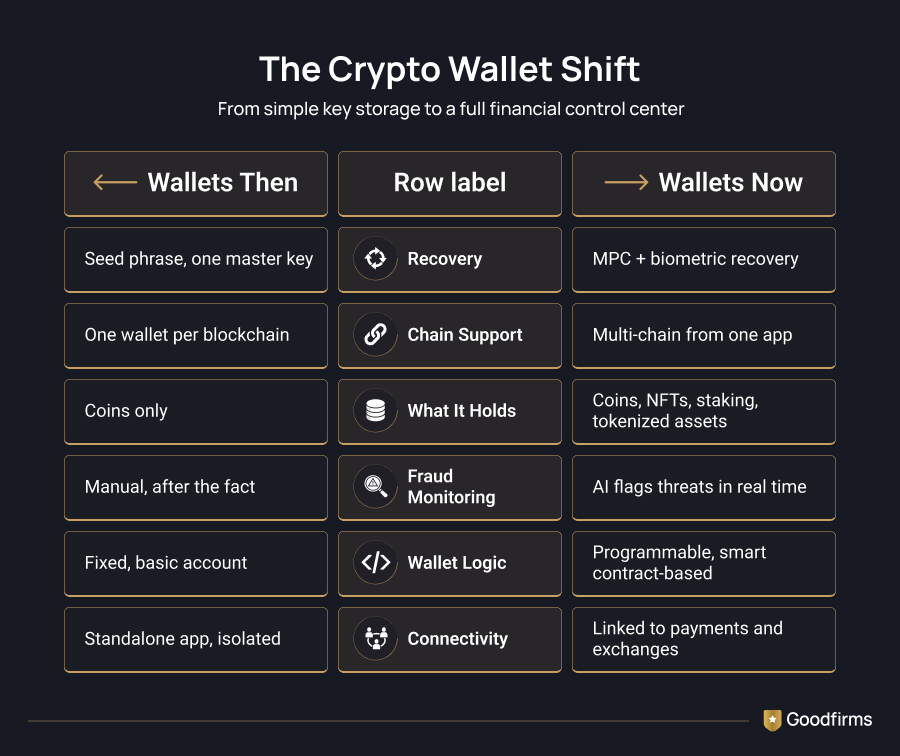
In simple terms, it's a tool that stores your private keys, the codes that prove you own your crypto, and lets you access, send, or receive it. It doesn't store coins the way a physical wallet holds cash. It just holds the keys that unlock your assets on the blockchain. That basic job hasn't changed. What has changed is everything around it, how those keys get protected, how you prove it's really you, and how many things a wallet can do besides just sitting there holding keys. That's exactly what we're getting into next.
Why Crypto Wallet Technology Is Moving So Fast
Crypto adoption isn't just about trading anymore. People are using wallets for payments, staking, gaming, and holding NFTs, all from one app. Wallets are also expected to talk directly to trading infrastructure instead of sending users elsewhere, which is why more providers are pairing wallet development with a capable cryptocurrency exchange platform from the start. That shift is pushing wallet providers to rethink what a wallet actually needs to do.
Security can't just be strong; it has to be simple enough for someone who's never touched crypto before. Features can't just work; they have to work across chains without the user noticing the difference. This is exactly why crypto wallet technology has turned into one of the most active areas of blockchain development right now.
Crypto Wallet Security: What's Changing
Security has always been the backbone of wallet design. What's changing is how that security gets delivered to the user.
1. Wallets Are Dropping the Seed Phrase
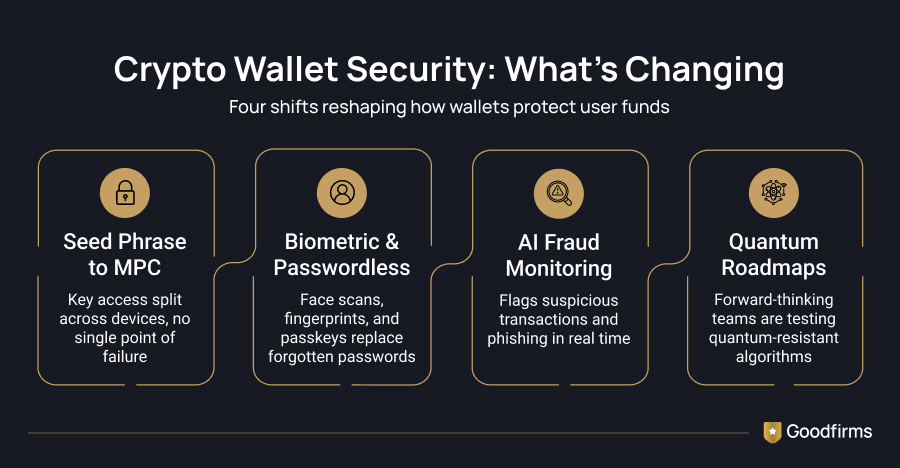
For years, losing your seed phrase meant losing your funds, permanently. That's finally starting to change. More wallets are moving toward a crypto wallet without a seed phrase, using MPC (Multi-Party Computation) to split key access across multiple devices or parties instead of storing one master key in one place. If one piece gets compromised, the funds stay safe. This alone is one of the biggest shifts happening in crypto wallet security today.
Traditional finance is already betting on it. In April 2026, trading platform eToro acquired Zengo, a Tel Aviv-based MPC wallet provider with 2 million users, for roughly $70 million,its first acquisition since going public. eToro's CEO framed the deal around self-custody becoming central to where finance is heading. It's a clear signal that keyless, seed-phrase-free wallets have moved past early adopter territory and into something regulated platforms are willing to pay to own.
2. Biometric and Passwordless Access
Face scans, fingerprint checks, passkeys, and wallets are leaning hard into these. A passwordless crypto wallet cuts out the weakest link in security, which is usually the user forgetting or mishandling their credentials. It also makes wallets far less intimidating for people new to crypto.
The problem is bigger than it sounds. A 2026 Oobit survey of 1,000 U.S. crypto holders found 35% had lost access to a wallet or account, and 31% of those never recovered their funds,most often from forgotten passwords or lost seed phrases, not sophisticated attacks. Passkeys are the industry's answer: wallets including Exodus, Binance, and OKX have already replaced seed-phrase logins with Face ID and fingerprint-based access.
3. AI Is Watching Your Transactions
AI-powered crypto wallet security is no longer a nice-to-have. Wallets are starting to flag unusual transaction patterns, block suspicious approvals, and catch phishing attempts before funds move. This kind of real-time monitoring used to be reserved for banks. Now it's showing up in everyday crypto wallets.
MetaMask has already put numbers behind this shift. After integrating security firm Wallet Guard's phishing-detection engine, the company reported a 250% improvement in phishing detection on malicious dApps. In August 2026, MetaMask went further, launching Agent Wallet,a self-custodial wallet built specifically for AI agents to trade autonomously, with every transaction routed through mandatory simulation and threat scanning before execution, and flagged activity requiring human approval via two-factor authentication.
4. Getting Ready for Quantum Threats
This one's still early, but it's on every serious wallet provider's roadmap. Quantum computing could eventually break the cryptography that wallets rely on today. Forward-thinking teams are already testing quantum-resistant algorithms, so they're not scrambling when the threat becomes real.
Algorand is one of the furthest along: its foundation published a three-phase roadmap in June 2026 targeting full quantum resistance by the end of 2027, starting with post-quantum wallet accounts in Q3 2026. Ethereum is moving too,a roadmap published by Vitalik Buterin in February 2026 outlines a gradual, account-by-account path to post-quantum signatures, though Ethereum's own team is clear that no quantum computer today can actually break its current cryptography. This is preparation, not a live emergency.
Smart Features Shaping Future Trends in Crypto Wallet Technology
Security gets people to trust a wallet. Features get them to actually use it every day.
1. Smart Contract Wallets and Account Abstraction
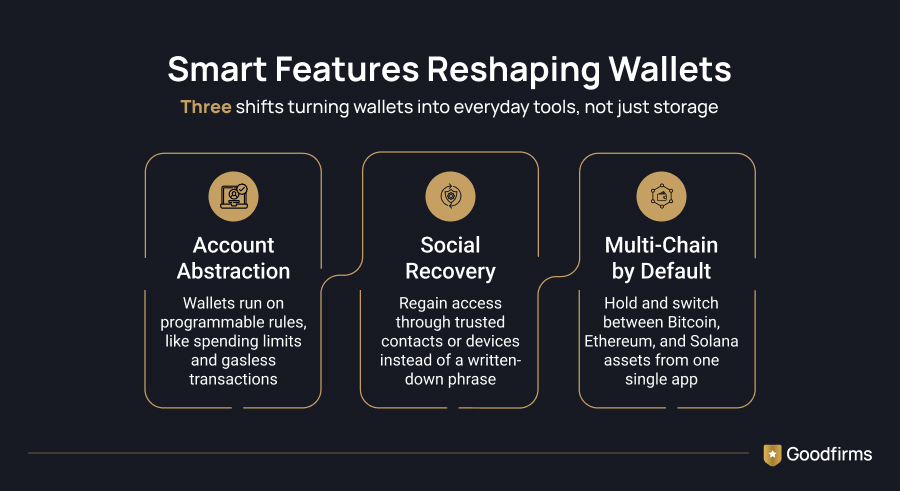
A smart contract wallet doesn't just hold keys; it runs on programmable rules. Spending limits, session-based approvals, and gasless transactions are all possible because the wallet itself acts like a smart contract instead of a basic account. This is what's known as account abstraction, and it's quickly becoming the standard for how new wallets are built.
Coinbase put this into production early,its Coinbase Smart Wallet, launched in June 2024, runs on ERC-4337 with no seed phrase at all; recovery happens through passkeys synced via iCloud Keychain or Google Password Manager instead. It's a working example of what account abstraction looks like once a major platform ships it, not just proposes it.
Teams working on this need serious technical depth, and that's where working with experienced smart contract development companies makes a real difference.
2. Social Recovery Instead of Backup Phrases
Paired with account abstraction, social recovery wallet setups let users regain access through trusted contacts or devices instead of a written-down phrase. It's a much friendlier way to handle the "what if I lose access" problem without compromising on security.
Argent was among the first to prove this works at scale,its guardian-based recovery model launched on Ethereum mainnet in 2020, and by 2024 the wallet had surpassed 500,000 registered users, establishing social recovery as a viable model for mainstream users, not just a Web3-native niche.
3. One Wallet, Every Chain
Nobody wants five different wallets for five different blockchains. That's why multi-chain crypto wallet technology is becoming the norm. Users expect to hold Bitcoin, Ethereum, and Solana assets in one place, switch between them freely, and not think twice about which network they're on.
MetaMask made this shift concrete in December 2025, when it added native Bitcoin support and expanded multichain accounts, letting a single wallet connection interact with EVM chains, Bitcoin, Solana, and other Layer-1s at once, according to ConsenSys's own product brief. What started as an Ethereum-only wallet is now positioning itself as chain-agnostic infrastructure.
A cross-chain wallet setup also makes it far easier for businesses to serve a broader user base without forcing them into one ecosystem. This kind of flexibility is also fueling growth across the wider web3 development companies space, since most new products are being designed chain-agnostic from day one.
Innovations Taking Crypto Wallets Beyond Storage
Storage was the starting point. It's nowhere near the finish line anymore.
1. Hardware Wallets Are Getting an Upgrade
A hardware crypto wallet used to mean a clunky USB device. Now you've got NFC-based cards, QR-based signing, and devices that stay fully air-gapped while still being genuinely easy to use. The offline security edge hasn't gone anywhere; it's just wrapped in a much smoother experience.
2. Non-Custodial Still Wins, But It's Getting Easier
The core idea behind a non-custodial crypto wallet hasn't changed. Users hold their own keys, so no third party can freeze or misuse their funds. What's improved is the tooling around it, better recovery options, clearer permission controls, and interfaces that don't require a crypto background to navigate.
3. Wallets Built Into Everyday Apps
Wallet-as-a-Service is picking up serious momentum. Businesses are embedding crypto wallet development directly into their own apps, so users can hold and move assets without ever downloading a separate wallet app. Teams exploring this path often start by reviewing a practical crypto wallet development guide before committing to a build approach. This is a big reason crypto is starting to feel less like a niche activity and more like a normal part of using an app.
4. Wallets Supporting More Than Just Coins
NFTs, staking positions, tokenized assets, and wallets are being built to handle all of it under one roof. This kind of expansion is why demand keeps climbing for skilled NFT development companies, since wallet providers need partners who understand multi-asset support, not just basic coin transfers.
Crypto Wallet Technology in Payments and Business
Wallets don't operate in isolation anymore. How well they connect to the rest of a user's financial activity is quickly becoming just as important as how secure they are.
1. Wallets Are Linking Directly With Payment Gateways
A wallet that can't plug into a solid payment infrastructure feels incomplete, no matter how strong its security is. That's why more wallet providers are building direct integrations with a reliable cryptocurrency payment gateway instead of treating payments as an afterthought.
2. Getting the Payment Gateway Basics Right
For teams still figuring out this side of the build, it helps to understand the fundamentals before development starts. Walking through a solid crypto payment gateway guide upfront can save a lot of rework down the line.
3. Comparing Payment Gateway Software
Once a business is ready to move from research to execution, comparing actual cryptocurrency payment gateway software options gives a much clearer picture of what's already working well in the market.
4. Wallets and Exchange Connectivity
Exchange connectivity matters just as much as payments do. Wallets increasingly need to talk directly to trading infrastructure, which is why pairing wallet development with a capable cryptocurrency exchange platform is becoming a common move for businesses building serious crypto products.
What This Means for Businesses Building Crypto Wallet Technology
None of the trends above happens without the right technical foundation behind them. Businesses that want to build wallets aligned with where the market is heading should look at working with established blockchain development services that already have MPC, account abstraction, and multi-chain experience under their belt.
Ethereum still anchors a huge share of wallet activity, too, from smart contract wallets to token support. Teams building on it benefit from partnering with experienced Ethereum development companies that understand the network's quirks inside out.
Future Trends for Crypto Wallet Technology: What Comes Next
Crypto wallets stopped being simple storage tools a while back, and there's no going back from here. What's happening now is a genuine rethink of how people access, secure, and use their digital assets. Seed phrases are on their way out. AI is quietly working in the background to catch threats before they cause damage. Wallets are becoming programmable, multi-chain, and built to fit into daily life instead of standing apart from it.
For anyone building in this space, the takeaway is simple. The wallets that win over the next few years won't be the ones with the most features bolted on. They'll be the ones that make serious security feel effortless for the person actually using it. That's the real trend behind every trend on this list.
FAQs - Future Trends for Crypto Wallet Technology
1. What is the biggest security trend in crypto wallets right now?
MPC-based wallets are leading the shift, replacing single seed phrases with split key access across multiple devices, which removes the single point of failure that's caused so many losses in the past. This approach is also why more wallet providers are marketing MPC as a core selling point rather than a backend detail.
2. Are seed phrases going away completely?
Not entirely, but they're becoming optional rather than mandatory. Many new wallets now offer a crypto wallet without a seed phrase as the default setup, with traditional phrases available as a backup option for users who prefer them. This gives users the choice to pick whichever recovery method feels safest to them.
3. How is AI actually used in crypto wallets?
AI models monitor transaction patterns in real time, flagging anything that looks like phishing, unauthorized approvals, or unusual fund movement before the transaction goes through. Over time, these models also get better at recognizing a specific user's normal activity, which helps reduce false alarms.
4. What is account abstraction in simple terms?
It means a wallet functions like a smart contract instead of a basic account, allowing features like spending limits, gasless transactions, and social recovery that a traditional wallet can't support. It also opens the door for developers to build custom rules directly into how a wallet behaves.
5. Do I need a different wallet for every blockchain?
Not anymore. Multi-chain crypto wallet technology now lets users manage assets across several blockchains from a single wallet, without needing separate apps for each network. This also makes it easier to track a complete portfolio without jumping between multiple interfaces.
6. Are hardware wallets still worth using?
Yes. They remain one of the safest options available, and newer designs have made them far easier to use without sacrificing their offline security. For anyone holding larger amounts of crypto long term, they're still considered one of the more dependable choices.