Key takeaways
- Crypto payments are turning into a standard checkout option, not a niche add-on, especially for global and high-ticket sales.
- You do not need to hold crypto yourself. Most gateways convert straight to fiat before it hits your account.
- There are four common ways to accept crypto payments on a website: a hosted gateway, a payment button or invoice, a custom API, or a plugin on your existing store.
- Shopify and WooCommerce both support crypto checkout through ready-made plugins, no rebuild needed.
- Transaction fees usually run lower than card processing, but setup, network, and conversion fees still need checking.
- Compliance, refund policy, and volatility exposure are the three things to lock down before you go live.
I have been noticing more businesses ask how to accept crypto payments on a website lately, and it is not just crypto-native brands anymore. SaaS companies, agencies, and everyday online stores are adding it as a checkout option to reach a wider, often more international, customer base. What surprised me when first looked into this is how little technical know-how it actually takes now. With the right crypto payment gateway, you can realistically get set up in a day or two. Here is everything I would tell a business owner before they start.
Already know you want crypto on your checkout page? Skip ahead and set it up here: crypto payment gateway
Why Businesses Are Accepting Crypto Payments
Before getting into the how, it is worth knowing the why. A few reasons keep coming up whenever I ask businesses why they started accepting cryptocurrency payments online in the first place.
- Lower processing fees. Card payments come with interchange fees, chargebacks, and currency conversion costs that add up fast. Crypto payments usually cost less to process, especially for cross-border sales where card networks charge extra on top of the base rate.
- Faster settlements. Bank transfers can take days, particularly across countries with different banking hours and holidays. Crypto transactions settle in minutes, sometimes seconds, depending on the network you use for the transfer.
- Access to new customers. A growing number of buyers, especially in gaming, digital goods, and Web3-adjacent industries, prefer paying in crypto. Not offering it means losing that segment of buyers to a competitor who already does.
- Lower exposure to traditional card chargebacks. Confirmed on-chain transactions generally cannot be reversed through the card-network chargeback mechanism. However, merchants still need a clear refund and dispute process.
- Better margins on international sales. If you sell to customers outside your home country, currency conversion and cross-border card fees eat into margins quietly over time. Crypto sidesteps a lot of that friction.
None of this means you should drop your existing payment options, though. I would treat crypto as one more checkout method sitting alongside cards and bank transfers, not a full swap. Every business I have seen do this well added crypto on top of what already worked, not instead of it.
Goodfirms Research Insight
44% of surveyed businesses had already adopted cryptocurrency for payments, with 89.6% of adopters citing cross-border payments as a primary use case.
Ways to Accept Crypto Payments on Your Website
Once you have decided crypto is worth adding, the next question is which setup actually fits your business. There is not one single way to accept crypto payments on a website, and honestly, most of the confusion I see comes from people trying to use the wrong method for their setup. It really comes down to your platform, your technical resources, and how much control you want over the payment flow.
|
Setup option |
Technical skill |
Best for |
|---|---|---|
|
Hosted gateway |
Low |
Small businesses |
|
Payment button/invoice |
Very low |
Freelancers/services |
|
Ecommerce plugin |
Low |
Shopify/WooCommerce stores |
|
API integration |
High |
SaaS/marketplaces |
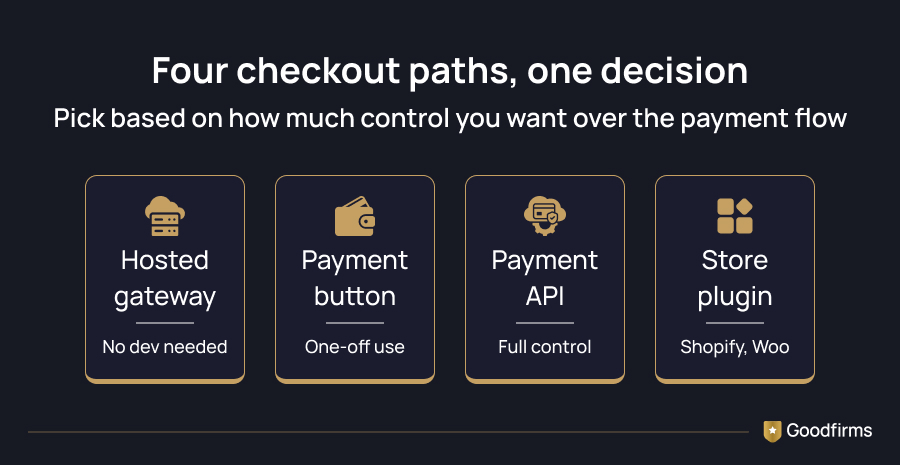
1. Hosted Payment Gateway
This is the simplest route for most businesses, and honestly, the one I would point a first-timer adopters. Providers like Coinbase Commerce, BitPay, or CoinGate offer a crypto payment gateway for website checkout that is basically plug-and-play. You add a snippet of code or a plugin, and the gateway handles wallet addresses, conversion rates, and confirmations for you. You do not need to understand blockchain mechanics to use one.
Best for: small businesses and stores that want to start accepting crypto payments without touching the backend or hiring a developer.
2. Payment Button or Invoice
If you are not running a full ecommerce store, a payment button or a generated invoice link works well. Freelancers, consultants, and service-based businesses often use this for one-off payments where building a full checkout flow would be overkill for the volume they handle.
Best for: businesses that need to accept crypto payments occasionally, not as a core, ongoing checkout flow.
3. Payment API
For businesses that need custom logic, like linking payments to user accounts, subscriptions, or internal balances, an API-driven setup makes more sense. Your development team connects your backend directly to the payment processor, so you get full control over how the payment flow behaves at every step.
Best for: marketplaces, SaaS platforms, gaming businesses, and high-volume websites that need full control over the payment flow and cannot rely on a standard plugin.
4. Plugin for Ecommerce Platforms
Most major ecommerce platforms now have ready-made crypto plugins. This is the quickest way to add cryptocurrency payment processing for business without a full rebuild of your store. Shopify, WooCommerce, Magento, and BigCommerce all support this route through their app marketplaces.
Best for: existing online stores that want to accept crypto payments on your website without disrupting the current checkout setup that customers are already used to.
Popular Crypto Payment Gateways
Once you know which integration method fits your website, the next step is comparing the payment providers that support it. The right choice depends on your preferred cryptocurrencies, settlement currency, fees, supported countries, and ecommerce platform.
|
Crypto Payment Gateway |
Best suited for |
Typical integration |
|---|---|---|
|
Coinbase Commerce |
Businesses looking for a straightforward crypto checkout |
Hosted checkout/API |
|
BitPay |
Businesses that want crypto payments with fiat settlement options |
Checkout/API/plugins |
|
CoinGate |
Ecommerce businesses supporting multiple cryptocurrencies |
Plugins/API/payment buttons |
Now that the options are laid out, let me walk you through what the actual setup looks like if you are running a Shopify or WooCommerce store, since that covers most of the people reading this.
How to Accept Crypto Payments on an E-commerce Website
Adding crypto payments to an existing store is easier than most people expect once you know the steps. Here is the flow I would follow, regardless of which platform you are on.
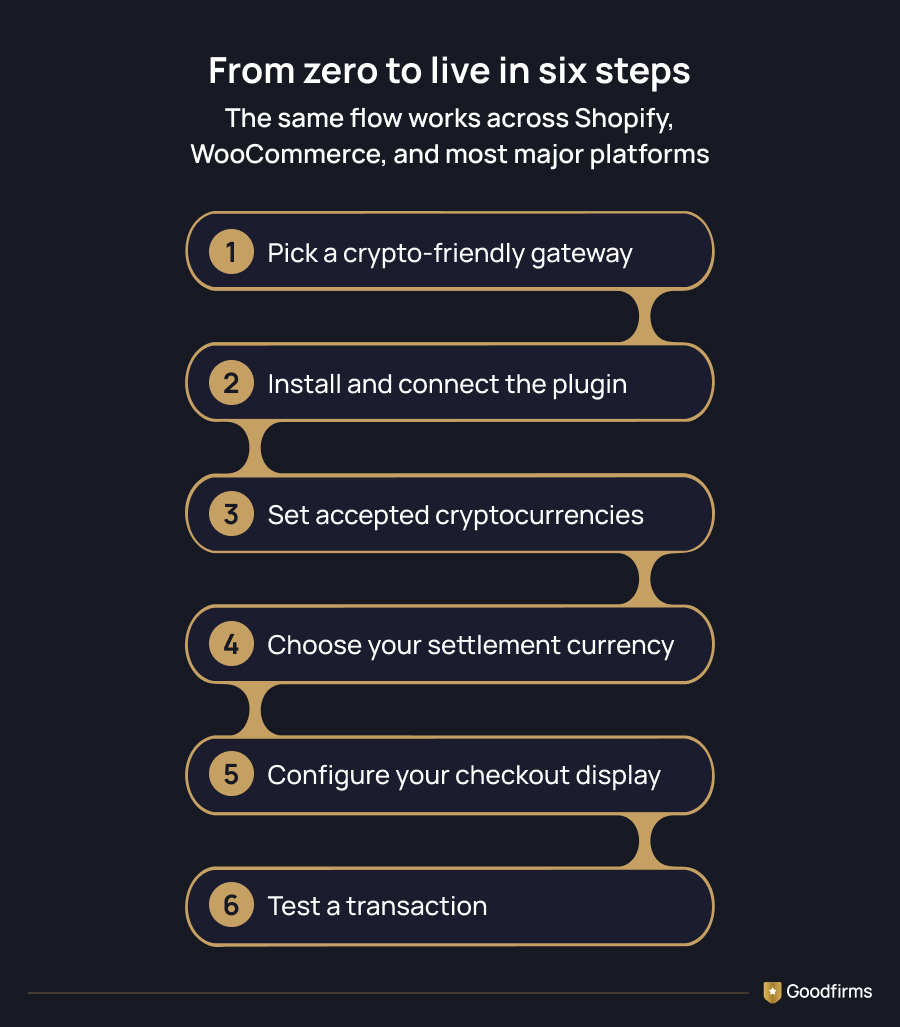
Step 1: Pick a crypto-friendly payment gateway. Look for one that already has a plugin for your platform. This saves you from custom integration work and shortens your go-live timeline considerably.
Step 2: Install and connect the plugin. Most gateways offer a direct app or plugin from the Shopify App Store or WooCommerce plugin directory. Installation usually takes a few minutes, and setup wizards walk you through account linking.
Step 3: Set your accepted cryptocurrencies. Decide whether you want to accept Bitcoin, Ethereum, stablecoins, or all of them. Stablecoins are worth considering since they reduce volatility risk for both you and your customer.
Step 4: Choose your settlement currency. You can receive payouts in crypto or have them auto-converted to fiat. Most small businesses prefer fiat settlement to avoid tracking price swings on funds sitting in a wallet.
Step 5: Configure your checkout display. Decide how the crypto option appears at checkout. Some businesses list it as one option among several, while others give it a dedicated page for crypto-first buyers.
Step 6: Test a transaction. Run a small test payment before going live to confirm everything, from wallet connection to order confirmation emails, works as expected. This is the step I would never skip. Most of the first-time setup problems I have come across trace back to someone launching without testing this end-to-end.
If your store setup needs more custom work than a plugin can handle, it is worth bringing in ecommerce development companies who have handled crypto integrations before and already know the common pitfalls to avoid.
How to Accept Crypto Payments Without Holding Crypto
One thing I hear a lot when businesses look into accepting cryptocurrency payments online is worry about price swings. Fair concern. The good news is you do not have to hold crypto at all if you would rather not deal with that risk
Most gateways offer instant conversion, where the customer pays in crypto, and the gateway converts it to your local currency before it ever hits your account. You never actually touch the coins, and your books stay in your usual currency without any extra accounting work.
If you do want to hold some crypto as part of a treasury strategy, or you are running a business where customers expect to be paid out in crypto too, that is where proper cryptocurrency wallet development comes in, giving you secure custody and clear control over what you convert versus what you keep on hand for later.
Crypto Payments vs Traditional Payment Gateways
I find it helps to see how crypto actually stacks up against the payment methods you are probably already using, since that comparison usually settles the "is this even worth it" question fast.
|
Factor |
Crypto Payments |
Traditional Payment Gateways |
|---|---|---|
|
Speed |
Minutes, sometimes faster |
1 to 3 business days |
|
Fees |
0.5% to 1% typically |
2% to 3% plus fixed fees |
|
Reversibility |
Final once confirmed |
Can be disputed and reversed weeks later |
|
Global reach |
Can support cross-border payments without relying solely on traditional banking rails |
Depends on the banking infrastructure by country |
|
Setup effort |
More upfront research, but plugins close the gap |
Familiar to most developers already |
- Speed: Card and bank payments can take one to three business days to settle. Crypto transactions settle in minutes, sometimes faster depending on network congestion.
- Fees: Traditional gateways charge 2 to 3% per transaction plus fixed fees. Crypto gateways typically run lower, closer to 0.5 to 1%.
- Reversibility: Card payments can be disputed and reversed weeks later. Crypto payments are final once confirmed, which cuts both ways depending on your business model.
- Global reach: Card payments depend on banking infrastructure that varies by country. Crypto works the same way everywhere there is internet access.
- Setup effort: Traditional gateways are already familiar to most developers. Crypto gateways need a bit more research upfront, but plugins have closed most of that gap.
Neither one wins outright, honestly. Most businesses I have seen end up running both side by side and just letting the customer pick whichever they trust more at checkout.
What It Costs to Accept Crypto Payments
Cost is usually the first thing business owners want to know, and fair enough, it was my first question too. Here is roughly what to expect once you start comparing providers.
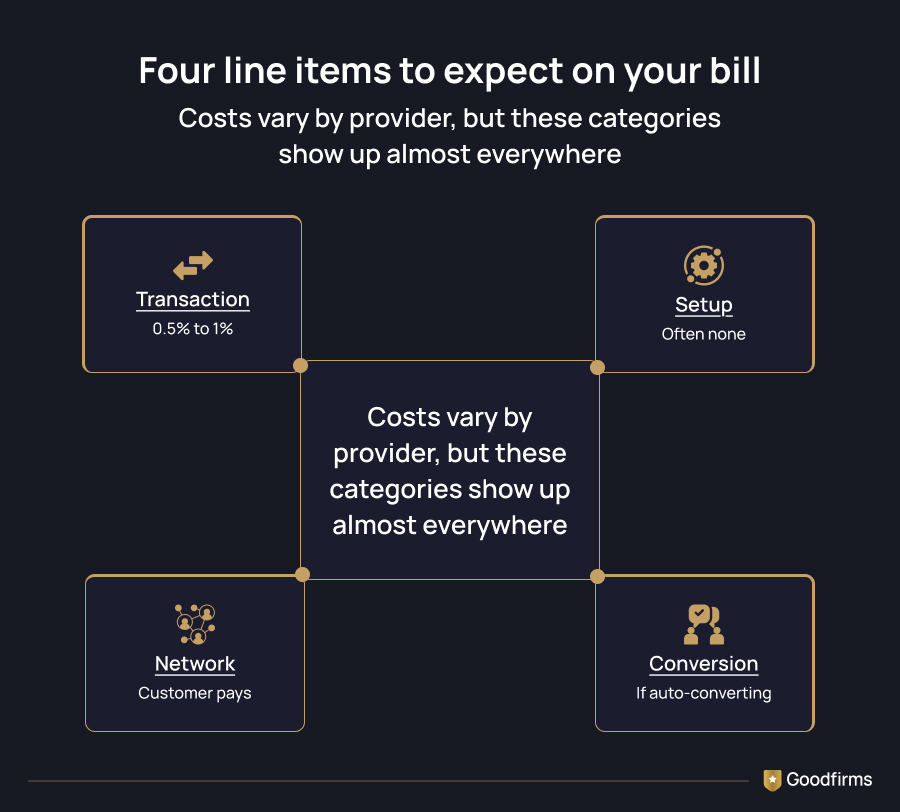
- Transaction fees: Most gateways charge somewhere between 0.5% and 1%, noticeably lower than the 2 to 3% typical with card processors.
- Setup fees: Many gateways do not charge anything to get started, though enterprise-grade API integrations can involve a one-time setup cost.
- Network fees: Blockchain transactions carry their own network fee, which the customer usually pays, not the merchant.
- Conversion fees: If you choose instant fiat conversion, expect a small additional fee for that service on top of the transaction fee.
These numbers vary by provider, so get a full breakdown before signing anything. A gateway that looks cheap upfront can add hidden costs at settlement, so read the fine print on payout terms.
Choosing the Right Crypto Payment Gateway
Not all gateways are built the same, and picking the wrong one can cost you in fees or flexibility down the line. A few things worth comparing before you commit to one:
- Supported coins: Make sure the gateway supports the coins your customers actually use, not just Bitcoin.
- Fee structure: Some gateways charge flat fees, others take a percentage. Get a clear breakdown before committing.
- Settlement speed: Check how quickly funds move from your wallet to your bank account.
- Compliance support: Look for KYC and AML tools built in, especially if you operate in regulated regions.
- Integration ease: A gateway with existing plugins for your platform will save development time and reduce back-and-forth with your dev team.
- Customer support: When a payment gets stuck, you want a support team that responds fast, not a ticket queue that sits for days.
This is really the best way to accept crypto payments long term: comparing a few providers side by side rather than picking the first one that shows up in search results. A good place to start that comparison is this list of cryptocurrency payment gateway companies.
Common Mistakes Businesses Make
Even with the right gateway picked out, a few things trip up businesses during rollout. Worth watching out for before you launch:
- Not testing the full flow. Businesses often test the payment itself but skip checking order confirmation, inventory sync, and refund handling.
- Ignoring compliance early on. Waiting until after launch to think about KYC and AML requirements can create problems later, especially at scale.
- Choosing a gateway based on fees alone. A slightly higher fee with better uptime and support is usually worth it over the cheapest option on paper.
- Skipping customer education. Not every buyer knows how to pay in crypto. A short note at checkout explaining the steps reduces abandoned carts.
- Forgetting a refund policy. Crypto refunds work differently from card refunds since transactions are irreversible. Have a clear, written policy ready before your first sale goes through.
Things to Check Before You Go Live
Beyond the setup itself, a few practical points often get missed in the rush to launch, and they are worth a final check before flipping the switch.
- Legal and tax compliance: Crypto payment rules vary by country and even by state. Confirm what is required in your jurisdiction before launch, and loop in an accountant if needed.
- Volatility exposure: If you are holding crypto instead of converting to fiat, decide how much price risk you are comfortable carrying on your balance sheet.
- Refund process: Crypto refunds need a defined process since transactions cannot simply be reversed like a card charge once confirmed.
- Reporting and reconciliation: Make sure your gateway exports data in a format your accounting team can actually use without manual cleanup.
Goodfirms Insights: Regulatory uncertainty is the biggest hesitation we heard too. In the same survey, 79.2% of businesses flagged unclear regulations as their top challenge with crypto transactions, ahead of volatile prices and limited merchant acceptance. Worth factoring in before you commit to a launch date
When Do You Need a Crypto Payment Development Company?
If your setup needs more than a plugin, like custom API integration or a full payment flow built around your product, it is worth working with specialists rather than piecing it together in-house. You can compare payment gateway development companies for the integration work itself, or blockchain development companies if you need deeper crypto infrastructure built from the ground up, including wallet architecture and custody logic.
Either route saves you from learning blockchain development from scratch, and a specialist team will usually flag compliance gaps you would not catch on your own until much later.
You probably don't need one if:
- Shopify/WooCommerce
- standard gateway
- Basic crypto checkout
You probably do if:
- custom API
- marketplace
- subscriptions
- wallet/custody
- internal accounting integration
- custom settlement logic
Conclusion
If there is one thing I want you to take from this, it is that accepting crypto payments on a website is not the technical hurdle it used to be. Whether you go with a hosted gateway, a plugin, or a custom API setup, the right approach really just depends on your platform and how much control you need over the payment flow. Start simple, test everything before you go live, keep compliance in mind from day one, and let the setup grow as your transaction volume and your customers ask for more.
FAQs - How to accept Crypto Payments on website
1. Is it hard to accept crypto payments on a website?
Not anymore. Most gateways offer plug-and-play plugins for platforms like Shopify and WooCommerce, so you can start accepting crypto payments without custom development or hiring a specialist developer. Setup usually takes an afternoon, including testing a transaction end-to-end. The steeper part is deciding which coins and settlement currency to offer, not the technical installation itself.
2. Do I need to hold cryptocurrency to accept crypto payments?
No. Most gateways offer instant conversion to fiat, so you receive regular currency in your bank account without holding any crypto yourself at any point. The customer pays in crypto, the gateway converts it behind the scenes, and the payout lands in your usual settlement currency. You can opt into holding crypto later if your business model changes.
3. What is the best way to accept crypto payments for a small business?
A hosted payment gateway is usually the easiest option for small businesses since it needs minimal setup and no custom backend work from a developer. It also keeps ongoing maintenance low, since the provider handles wallet security and compliance updates on their end. As transaction volume grows, some businesses eventually move to an API setup for more control.
4. Which cryptocurrencies should I accept on my website?
Bitcoin and Ethereum are the most requested, but stablecoins are worth including since they reduce exposure to price volatility for both sides of the transaction. Offering three to four options usually covers most customer preferences without overcomplicating your checkout page. Check what your target audience actually uses before finalizing the list.
5. How do I accept Bitcoin payments on the website checkout specifically?
Most crypto gateways support Bitcoin by default, so there is rarely a separate integration needed just for it. You simply enable it as one of your accepted coins during setup, and the gateway handles wallet generation and confirmations automatically. From the customer's side, it looks identical to paying with any other supported coin.
6. Are crypto payments safe for online businesses?
Yes, crypto transactions generally cannot be reversed through traditional card chargeback mechanisms once confirmed. However, merchants still need to manage fraud, wallet security, refunds, and compliance risks. Just make sure your gateway has proper security and compliance checks in place, including KYC and AML support if you operate in regulated markets. Reputable providers also carry insurance and monitoring for suspicious activity, which adds another layer of safety.