Key takeaways
- Blockchain in marketing improves transparency and record verification.
- Key use cases include ad verification, loyalty programs, and product tracking.
- Smart contracts can automate influencer payments and affiliate commissions.
- High costs, privacy risks, and inaccurate data can limit its effectiveness.
- Start with a small pilot to measure business value before investing.
Marketing teams rely on data to make decisions, but trusting that data is not always easy.
Advertisers question campaign reports, brands struggle to verify product claims, and customers want more control over how their information is used. When several companies work together, keeping records consistent becomes even harder.
This is where blockchain in marketing comes into the picture. It allows businesses to record and verify information through a shared digital ledger, making certain transactions easier to track and audit. Brands can use it for advertising verification, customer loyalty programs, influencer payments, and product traceability.
Let's look at how blockchain works in marketing, where businesses can use it, and what they should consider before adopting it.
Choosing the right architecture and development approach is easier with an experienced technical partner. Explore these blockchain development companies to compare providers, technical expertise, client reviews, and project experience.
What is Blockchain in Marketing?
A blockchain is a ledger shared between several parties. Once an entry is written, it can't be changed without everyone seeing it. Smart contracts, which are small programs stored on the ledger, can then act on those entries automatically.
Marketers point it at four jobs: recording ad impressions and payments, verifying that an ad reached a real person, logging consent and data origin, and issuing loyalty rewards as tokens.
Two things get mixed up a lot, so let's clear them. Using blockchain as infrastructure behind a campaign is one thing. Promoting a crypto project or an NFT drop is another, and this article is only about the first. Also, you don't need cryptocurrency. A ledger can store impressions or consent events with no token anywhere, and plenty of enterprise setups run on permissioned networks that only approved parties can join.
Why Marketers are Looking at It Now
Because measurement is still a trust problem, and an expensive one.
The ANA's Q2 2026 Programmatic Transparency Benchmark found that 45.1% of programmatic spend reached impressions that were measurable, viewable, fraud-free and free of made-for-advertising sites. That's a record, up from 43.3% in Q1.
In Q1 2026, the ANA reported that top performers turned 54.0% of spend into qualified impressions, while the weakest group managed 32.1%. The ANA's takeaway was that quality, not cost, separates winners from losers.
AI is making the fraud side harder. Juniper Research has projected that ad fraud losses will reach $172.3 billion by 2028, as AI helps bots imitate real users. Advertisers want evidence they can check themselves, not a report from the same intermediaries who sold them the inventory.
That appetite for checkable evidence is the real argument for blockchain.
Benefits of Blockchain in Marketing
Blockchain can help businesses address specific problems involving data verification, transactions, and coordination between marketing partners.
1. Greater Advertising Transparency
Advertisers often depend on platforms and intermediaries for campaign performance reports. Differences in reporting methods can make it difficult to verify where advertising budgets go.
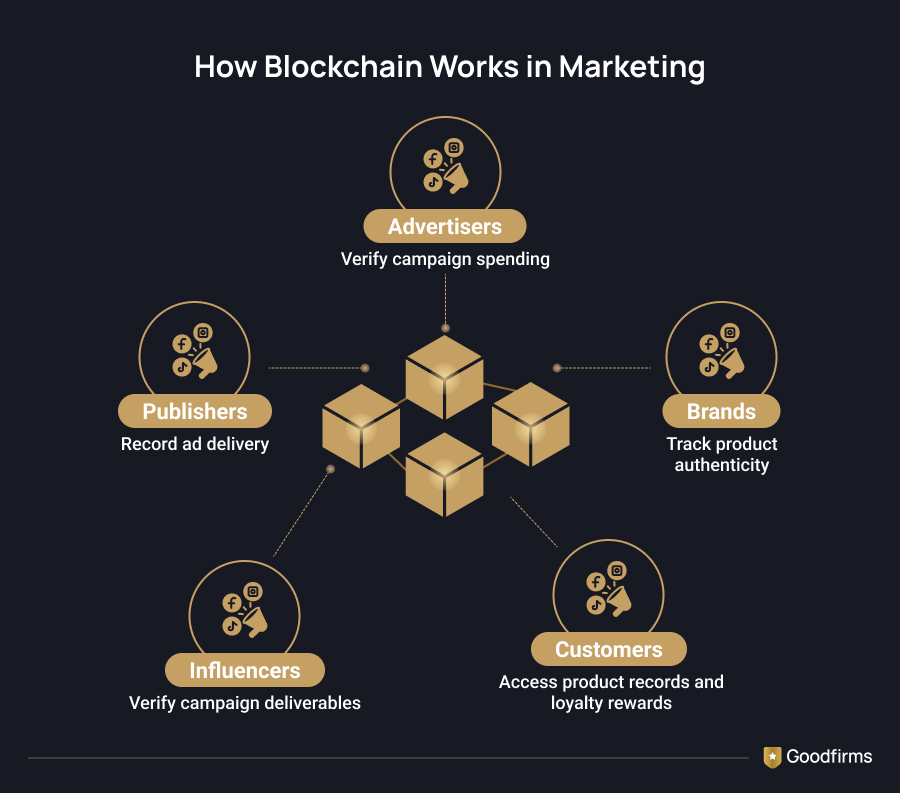
Blockchain can record selected campaign events, verification results, and payment transactions in a shared ledger. Advertisers and publishers can use these records to investigate discrepancies and reconcile invoices.
This can improve accountability across the advertising supply chain, although independent verification is still needed to confirm genuine ad delivery.
2. Better Support for Fraud Detection
Fake clicks, bot traffic, and invalid impressions can waste advertising budgets. Blockchain can help preserve an audit trail of campaign activity, making suspicious discrepancies easier to investigate.
For example, an advertiser could compare recorded impressions with results from an independent ad verification provider before approving payment.
The technology does not detect bots on its own. Its usefulness depends on the quality of the fraud detection systems supplying the data.
3. Improved Customer Data Control
Customers want to know how businesses collect and use their personal information. Blockchain can support auditable consent records, helping organizations track when customers grant or withdraw permission for specific uses.
A company could record a consent event and use it to verify whether a customer has authorized a particular type of communication.
Personal information should not be placed directly on a public blockchain without careful assessment. Businesses must still meet applicable privacy requirements and ensure consent changes are reflected in the systems that use the data.
4. More Accountable Marketing Partnerships
Brands frequently work with influencers, affiliates, agencies, and publishers. Managing agreements, deliverables, commissions, and payments across these relationships can create unnecessary administrative work.
Smart contracts can automate certain actions when predefined conditions are met. For example, an affiliate payment could be initiated after a qualifying sale has been verified and the return period has passed.
This can reduce manual reconciliation, but teams must account for refunds, disputed transactions, and inaccurate tracking data.
5. Stronger Product Authenticity Checks
Brands can use blockchain to record product-origin information, manufacturing details, and supply-chain events. Customers can access selected records by scanning a QR code or visiting a product verification page.
This can help businesses support claims about authenticity and sourcing. However, the information is only as trustworthy as the checks used to collect it.
Use Cases of Blockchain in Marketing
Blockchain has several practical applications. The right choice depends on a business's existing processes and the problem it needs to solve.
1. Digital Advertising Verification
Digital advertising involves multiple parties, each with its own reporting systems. Blockchain can provide a shared record of selected campaign events, verified impressions, and payment status.
An advertiser could compare these records with its verification provider's report before settling an invoice. If the figures differ, the parties have a common record to investigate.
Best suited for: Advertisers and publishers that face recurring reporting disputes or need better campaign accountability.
2. Influencer and Affiliate Marketing
Influencer campaigns involve content approvals, contractual deliverables, engagement reporting, and payment schedules. Affiliate programs add referral tracking and commission calculations to the mix.
Blockchain can record agreements, confirmed deliverables, and eligible transactions. Smart contracts may automate payments when agreed conditions are satisfied.
For example, a brand could release an influencer's payment after an authorized reviewer confirms that the required content has been published.
Businesses planning automated influencer payments or affiliate commissions can explore smart contract development companies to find technical partners for building and testing contract-based workflows.
3. Customer Loyalty Programs
Most loyalty programs operate within individual brands. Customers earn points in one system and cannot always use them elsewhere.
Blockchain can support shared reward records across participating businesses. An airline, hotel, and retail partner, for instance, could allow customers to earn rewards through one brand and redeem them with another.
This arrangement requires clear agreements about reward values, redemption rules, expiration, and financial responsibility. A traditional loyalty platform may be more practical when only one company is involved.
4. Product Traceability and Brand Trust
Product authenticity matters in industries such as luxury goods, cosmetics, food, and pharmaceuticals. Customers may want evidence of where a product came from and how it reached the retailer.
Blockchain can record selected supply-chain events, including manufacturing batches, authorized distribution, and shipment history. Brands can make relevant information available through product pages or QR codes.
The marketing benefit is straightforward: customers have more information to assess a brand's claims. Businesses must still verify the physical product and the information recorded about it.
Blockchain also supports applications beyond marketing, including the tokenization of physical assets. Read our guide to real estate tokenization to learn how blockchain can represent ownership interests in property.
5. Customer Consent Management
Businesses often collect customer information through websites, apps, loyalty programs, and partner platforms. Keeping consent records consistent across these systems can be difficult.
Blockchain can help create an auditable record of consent and data-sharing events. For example, a customer who agrees to receive offers from selected partners could have that permission recorded for authorized participants to verify.
Sensitive personal information should generally remain in appropriate off-chain systems. Businesses must also ensure that withdrawing consent triggers the necessary changes across connected platforms.
6. Digital Collectibles and Brand Engagement
Brands can issue blockchain-based digital collectibles linked to events, communities, or exclusive experiences.
A sports brand, for example, could offer digital collectibles to event attendees and give owners access to special content or selected future experiences.
Brands exploring digital collectibles, token-based customer experiences, or decentralized engagement platforms can compare Web3 development companies before choosing a development partner.
The collectible itself does not guarantee engagement. Customers need a clear reason to participate, such as an experience or reward they genuinely value.
Real-World Examples of Blockchain in Marketing
Colli del Garda: Product Traceability
Italian olive oil producer Colli del Garda worked with IBM on blockchain-based traceability. The project focused on making information about product quality and production practices more accessible to consumers.
It illustrates how product records can support a brand's communication about provenance and give customers more information about what they purchase.
Source: IBM's Colli del Garda case study.
Blockchain for Advertising Accountability
Research published in the Journal of Business Research has examined blockchain's potential to improve transparency and accountability in digital advertising.
The approach addresses a familiar problem: advertisers, publishers, and intermediaries may report campaign activity differently. Shared records can help participants audit transactions and investigate discrepancies.
This research supports the potential use of blockchain in advertising, but it should not be taken as proof that every blockchain advertising platform has eliminated fraud.
Source: Research on blockchain technology and digital advertising.
Challenges of Blockchain in Marketing
Despite its potential, blockchain comes with limitations that businesses should consider before investing.
1. Implementation Costs
Building a blockchain marketing solution can involve software development, system integration, security audits, infrastructure, and ongoing maintenance.
Businesses should compare these costs with existing marketing platforms before committing to a new system.
2. Scalability and Speed
Marketing platforms can generate millions of events, from impressions and clicks to customer interactions. Recording every event directly on a blockchain may be expensive or impractical.
Some systems keep detailed data in conventional databases and record only selected transactions or proofs on-chain. The right setup depends on transaction volume, performance requirements, and cost.
3. Privacy Concerns
Blockchain records can be difficult to change or remove. Storing personal information on a public blockchain may expose sensitive details or create problems when customers request deletion.
Businesses should carefully assess privacy requirements and avoid putting sensitive customer information directly on a public ledger without a sound legal and technical basis.
4. Incorrect Data
Blockchain can protect the integrity of recorded information, but it cannot guarantee that the information was correct in the first place.
For example, a supplier could submit an inaccurate product-origin claim. If the system accepts it, blockchain may preserve that claim without making it true.
Reliable data collection, independent verification, and proper controls remain necessary.
5. Integration With Existing Tools
Businesses already use CRM systems, analytics platforms, advertising tools, and marketing automation software. Connecting these systems to a blockchain solution may require additional development and changes to existing workflows.
A project needs a clear integration plan and a practical reason for introducing the technology.
6. Limited Adoption
A shared blockchain system works best when the relevant organizations agree to participate. If publishers, agencies, suppliers, or partner brands continue using incompatible systems, the benefits may be limited.
Customers may also be reluctant to manage crypto wallets or learn unfamiliar processes just to receive a reward. The experience should remain simple, with blockchain working in the background.
Blockchain Marketing vs. Traditional Marketing Technology
Blockchain is not a replacement for every marketing tool. The two approaches serve different needs.
|
Area |
Traditional Marketing Technology |
Blockchain-Based Approach |
|---|---|---|
|
Campaign reporting |
Data is managed by individual platforms. |
Selected events can be recorded in a shared ledger. |
|
Record changes |
Authorized users can update records under system controls. |
Confirmed historical records are harder to alter without detection. |
|
Loyalty programs |
Usually managed by a central program operator. |
Rewards can be shared across participating businesses. |
|
Customer consent |
Managed through consent and customer-data platforms. |
Consent events can have an additional verifiable record. |
|
Best use |
Analytics, segmentation, automation, and campaign management. |
Shared verification and transactions between independent parties. |
For routine marketing activities, existing tools are often the better option. Blockchain becomes more interesting when several organizations need to verify the same information and do not want to depend entirely on one party's records.
How to Implement Blockchain in Marketing
Businesses interested in blockchain should begin with a problem, not the technology itself.
Step 1: Choose a specific use case
Identify a recurring issue, such as disputed advertising invoices, inconsistent loyalty balances, or difficulty verifying product origins.
Step 2: Decide what needs verification
Define the events and transactions that participants must be able to check. Avoid recording unnecessary information.
Step 3: Select the right architecture
Evaluate public, permissioned, or hybrid blockchain systems based on access requirements, transaction volume, privacy, and cost.
Step 4: Connect existing systems
Plan how the blockchain will exchange information with advertising platforms, CRM software, inventory systems, or payment tools.
Step 5: Run a small pilot
Test the solution with a limited number of partners before expanding it. Compare the results with the existing process.
Step 6: Measure the results
Track changes in reconciliation time, disputes, operating costs, reward redemption, or other measures linked to the original problem.
If a conventional database can deliver the same results at a lower cost, there may be little reason to introduce blockchain.
Is Blockchain in Marketing Worth the Investment?
Blockchain may be worth considering when several independent organizations need to share and verify records.
For example, an advertiser working with multiple publishers may benefit from a shared audit trail. A retailer operating a multi-brand loyalty program may need a common way to track rewards. A manufacturer may use product records to help customers check provenance.
On the other hand, a business running email campaigns or managing customer segments within one organization will probably find existing marketing software more practical.
The decision comes down to one question: Does blockchain solve a problem that your current systems cannot address efficiently?
If the answer is yes, start with a limited pilot and measure the results before expanding the project.
FAQs - Blockchain in Marketing
What is blockchain in marketing?
Blockchain in marketing means using distributed ledger technology to record and verify information related to advertising, customer consent, loyalty programs, product origins, and marketing transactions. It can help participating organizations check shared records and improve accountability.
What are the main benefits of blockchain in marketing?
The main benefits include improved advertising transparency, auditable transactions, product traceability, verifiable consent records, and automated payments through smart contracts. The results depend on the quality of the data and the way the system is implemented.
Can blockchain prevent advertising fraud?
Blockchain can help preserve campaign records and reveal discrepancies, but it cannot independently detect bots or prove that every impression is genuine. Businesses still need reliable ad verification and fraud detection tools.
What are the biggest challenges of blockchain marketing?
The main challenges include implementation costs, scalability, privacy, integration with existing systems, inaccurate source data, and limited adoption among partners. Businesses should assess these factors before investing.
Is blockchain useful for small businesses?
It can be useful when a small business participates in a shared system for product traceability or cross-brand loyalty rewards. However, a custom blockchain application may cost more than existing software, so the business should compare the expected benefits with the total cost.
What is the future of blockchain in marketing?
Potential applications include shared advertising verification, cross-brand loyalty programs, product traceability, and auditable customer consent. Adoption will depend on whether these applications solve real business problems and provide measurable benefits.