Key takeaways
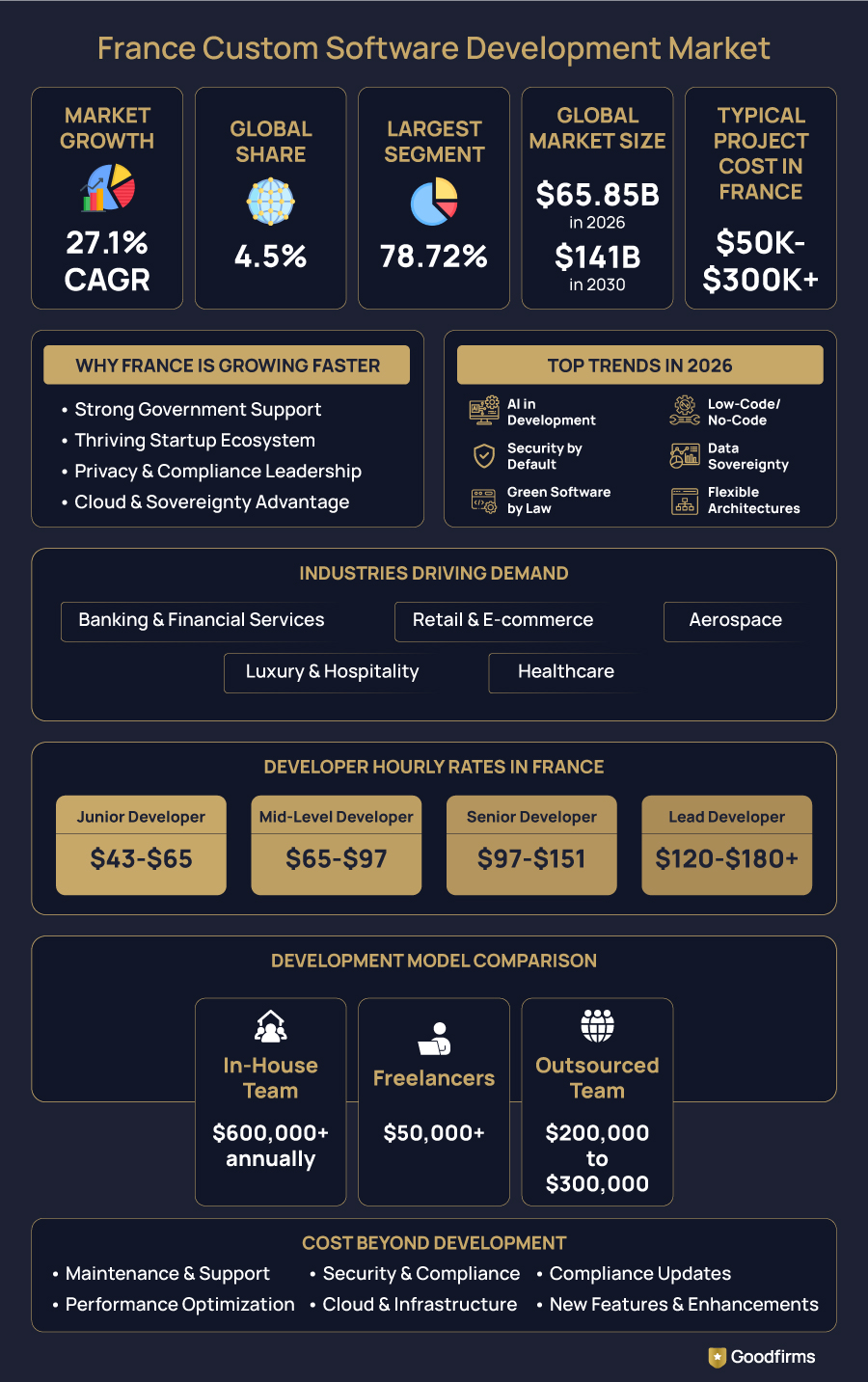
- France custom software development market is currently one of the fastest-growing in Europe, with a 27.1% CAGR.
- Government-backed initiatives such as France 2030, La French Tech, and Station F have helped create a mature ecosystem of startups, development firms, cloud infrastructure providers, and technology talent.
- Banking, healthcare, aerospace, retail, and luxury brands are driving significant demand for custom software as organizations modernize legacy systems and invest in digital experiences.
- Custom software development costs in France range from $50,000 for simple applications to $300,000+ for complex enterprise platforms.
When I say France, the first things that probably come to mind are the Eiffel Tower, fashion, luxury brands, and world-class wine. Software is usually not on that list, somewhere between a croissant and a designer handbag.
Most business owners don't think about France when they think about software. They think about Silicon Valley. France does not exactly have the image of a market producing enterprise-grade custom software at scale.
That gap between perception and reality is exactly why this is worth paying attention to.
France's custom software market is growing at 27.1% annually. The government has been pouring money into the sector for a decade. They have built actual infrastructure: Station F, France 2030, sovereign cloud mandates, and one of the most active data privacy regulatory environments in the world. The talent is there. The legal groundwork is there. And the demand is compounding.
This blog discusses growth drivers, trends, industries spending the most, what development actually costs, and how to find a partner who knows what they're doing. Just what you need to make an informed decision.
Browse Goodfirms' curated list of top custom software development companies in France to compare providers based on verified client reviews, project experience, technical expertise, pricing models, and team size.
No Jargon, Only Numbers that Matter
France custom software development market holds 4.5% of the global market. That is the sixth largest in the world for IT services overall.
Enterprise software is the biggest segment, accounting for nearly 78.72% of total revenue. That number tells you that established companies are replacing systems that no longer scale.
Zoom out to the European picture, and France is actually the fastest-growing market in the region, ahead of Germany and the UK.
Germany still leads in absolute revenue, but France is closing the gap faster than most analysts expected five years ago.
Global context matters too. The worldwide custom software market is sitting at $65.85 billion in 2026 and headed for $141 billion by 2030.
France's 27.1% CAGR comfortably outpaces the global average of 22.6%. Smart money is going into European tech, that is for sure.
Why France Custom Software Development Market?
Growth at 27% shows four things in particular that explain why France is moving faster than the rest of Europe right now.
- The France 2030 program and the broader La French Tech initiative represent a decade of sustained, deliberate investment in building a domestic tech ecosystem. Station F, the world's largest startup campus, is the most visible result. The government actively pitched France as a destination for tech talent and capital. That groundwork created the conditions for a market to grow. The market is now growing.
- Paris startups grew 5.3x between 2017 and 2024, versus 4.2x for London. Brexit accelerated the shift, but France's deliberate competitive positioning did more of the work. Companies choosing their European headquarters are increasingly picking Paris, and that concentration of tech activity pulls software development demand with it.
- France's data regulator, the CNIL, publishes specific developer guidance requiring privacy-by-design at the architecture stage. French development firms have been building GDPR-compliant systems as standard practice for years. Because getting compliance retrofitted into a finished product is expensive.
- Capgemini and Orange's joint venture, Bleu, is specifically built to migrate public and private institutions to SecNumCloud-certified platforms that satisfy French regulatory requirements. With that infrastructure in place, the adoption floodgates opened. France's cloud market is now the fastest-growing in Europe.
France Custom Software Development Market Trends in 2026
Three trends are actively shaping how software gets built in France right now.
AI-Assisted Development is Reshaping Software Delivery
According to Goodfirms research, 91% of software companies now use AI in their development processes, while 61% believe AI can reduce software project costs by 10–25%. AI-powered coding assistants, automated testing tools, and intelligent debugging solutions are helping development teams accelerate delivery and improve efficiency.
Security and Compliance are Becoming Core Project Requirements
France's software market is heavily influenced by European regulations. Companies are increasingly embedding security reviews, compliance checks, identity management, and secure development practices into projects from the planning stage. As cyber threats are increasing, organizations expect software vendors to deliver secure-by-design solutions.
Sustainable Software Development is Gaining Importance
France remains one of Europe's strongest advocates for sustainability initiatives. Businesses are paying closer attention to software efficiency, infrastructure usage, and cloud resource consumption. Development teams are increasingly optimizing applications to improve performance.
Digital Sovereignty is Influencing Technology Decisions
Across France and the wider European market, concerns around data sovereignty are increasingly shaping software development projects. Businesses want greater control over where their data is stored, processed, and accessed, particularly in regulated sectors such as finance, healthcare, government, and critical infrastructure. This has increased demand for European cloud providers and sovereign cloud initiatives that give organizations more control over sensitive information.
Who's Actually Spending? Industries Driving Demand
Banking and financial services
Leading the pack, driven by compliance requirements, automation of back-office processes, and customer-facing digital portals. French banks have been under pressure to modernize legacy infrastructure for years, and that pressure is finally translating into serious custom development budgets.
Healthcare
COVID has made everyone realize the importance of tech, and that wave is still on. Healthcare institutions are investing in Patient management platforms, telemedicine infrastructure, and more.
Aerospace
Represents some of the most technically demanding custom development work in the country. Engineering simulation software, IoT integration, supply chain tooling. This is not commodity development work.
Retail and luxury
France's luxury sector has been investing heavily in bespoke digital experiences that generic SaaS tools simply can't deliver. This is a sector where differentiated technology is genuinely tied to brand value. Retail more broadly is spending on personalization engines and inventory systems.
What Does Custom Software Development Cost in France?
The cost of custom software development in France can vary dramatically depending on what you're building. Before setting a budget, it helps to understand how software pricing compares globally. According to Goodfirms' latest custom software development cost survey, most software projects fall between $30,000 and $100,000, while enterprise-grade systems can exceed $200,000 depending on complexity, integrations, and AI requirements. This provides a useful benchmark when evaluating software development costs in France.
Cost by Project Complexity
Project scope remains the biggest pricing factor.
Applications with limited functionality, straightforward workflows, and minimal integrations typically require smaller teams and shorter development cycles. On the other hand, enterprise-grade systems often involve multiple integrations, advanced security requirements, cloud infrastructure, large databases, and ongoing scalability planning.
|
Complexity Level |
Features |
Estimated Cost |
Development Timeline |
|---|---|---|---|
|
Low Complexity |
Basic functionality, minimal integrations, simple UI |
$50,000-$80,000 |
1-3 months |
|
Medium Complexity |
Moderate integrations, more advanced UI, mobile compatibility |
$90,000-$150,000 |
3-6 months |
|
High Complexity |
AI capabilities, multiple integrations, advanced security, enterprise architecture |
$150,000-$300,000+ |
9 months to 1+ year |
How Developer Rates Influence Project Costs
Developer rates in France vary based on experience, specialization, and responsibility.
At first glance, hiring junior developers may seem like the most economical option. In practice, experienced professionals often deliver better value because they work more efficiently, solve problems faster, and require less oversight. Here is the software developer hourly cost in France:
|
Seniority Level |
Hourly Rate |
Responsibilities |
|---|---|---|
|
Junior Developer |
$43–$65 |
Task-specific development, bug fixes, routine coding tasks |
|
Mid-Level Developer |
$65–$97 |
Feature development, integrations, day-to-day |
|
Senior Developer |
$97–$151 |
System architecture, critical features, technical leadership |
|
Lead Developer |
$120–$180+ |
Project strategy, team leadership, technical decision-making |
If you want to compare hourly rates of developers in France with those of developers from Germany, Switzerland, and the Netherlands, read the blog linked. It covers software development costs in Germany.
In-House Teams vs Freelancers vs Outsourcing
Once project requirements are clear, businesses face another decision: who should build the software?
The answer depends on budget, timeline, internal capabilities, and long-term objectives.
|
Development Model |
Cost Range |
Best For |
|---|---|---|
|
In-House Team |
$600,000+ annually |
Organizations with ongoing software needs and dedicated technology roadmaps |
|
Freelancers |
$50,000+ |
Small projects, short-term development work, specialized expertise |
|
Outsourced Development Team |
$200,000-$300,000 |
Businesses seeking scalability, diverse expertise, and predictable delivery |
Cost Beyond Development
One of the biggest mistakes organizations make is treating software development as a one-time expense.
Launching the application is only part of the journey.
Maintenance, security updates, cloud hosting, performance optimization, compliance updates, and feature enhancements all contribute to the total cost of ownership. Businesses that plan for these ongoing investments tend to achieve better long-term results than those focused solely on the initial development budget.
Ready to Build? Start With the Right Partner
The market case for France is clear. The harder part is finding the right firm, one that actually understands your industry and the compliance requirements.
That's where Goodfirms comes in. It's one of the most reliable places to find and vet custom software development companies in France with verified reviews, detailed company profiles, and filters that let you narrow by industry, tech stack, team size, and budget. Businesses exploring global delivery options can also compare providers from other leading development hubs through Goodfirms' directory of top software development companies.
If 2026 is the year you stop bending your business to fit off-the-shelf software, don't spend months searching blindly. Head to Goodfirms, filter for France, and start conversations with firms that have already proven they can deliver.
FAQs - France Custom Software Development Market
How long does a custom software project in France take from kick-off to launch?
Honestly, it depends more on how prepared you are than on the development firm. If you come in with clear requirements, a defined scope, and quick internal decision-making, a mid-complexity project can ship in 4–6 months. If the scope keeps shifting, add 30–50% to whatever timeline you are quoted. The firms that are worth working with will tell you this upfront.
Is France a good option if my business is outside Europe?
France can be a great choice even if your business is based outside Europe, especially if you plan to serve customers in the EU. French software development companies have extensive experience building GDPR-compliant applications and handling strict data privacy requirements. That expertise can save significant time and effort if European expansion is part of your roadmap.
What should I actually bring to a first conversation with a development firm?
At minimum: a description of the problem you are solving, who the users are, what systems it needs to connect with, and a rough sense of your budget range. But showing up with nothing wastes everyone's time and usually results in a quote that bears no resemblance to what you will actually spend.
How do I know if a quoted price is reasonable?
Get at least three quotes for the same scope. If one is dramatically lower than the others, find out why. The answer is usually offshore subcontracting without disclosure, a stripped-down scope, or a team without the seniority the project actually needs. The cheapest quote rarely stays cheap. Look at what's included post-launch: maintenance, bug fixes, and support terms are where the real cost gap tends to show up.
What happens if my requirements change mid-project?
Every project has scope changes. The question is how your contract handles them. Fixed-price contracts treat changes as formal amendments. Expect delays and additional costs each time. Time-and-materials contracts absorb change more naturally but require you to stay closely involved to avoid budget creep. Most experienced firms will recommend a hybrid: a fixed price for the agreed scope with a T&M arrangement for anything outside it. That tends to be the most honest structure for both sides.