Key takeaways
- Software development in Germany costs $15,000–$1,500,000+, with most custom applications landing between $50,000–$250,000.
- Munich leads on rates — junior engineers bill $48–$81/hr, lead architects reach $216+/hr — while Berlin starts lower at $38/hr for juniors.
- Freelancers appear cheaper at $94–$129/hr, but hidden costs push their effective rate to $106–$155/hr, nearly matching agency pricing.
- A $160,000 project typically invoices at $220,000–$260,000 — a 30–60% gap driven by integrations, QA, and post-launch support alone.
- Annual maintenance runs 15–25% of the initial build cost — rarely included in the original quote.
- Routing QA and implementation to CEE markets saves 40–55% on hourly rates while keeping German technical leadership intact.
Software development cost in Germany ranges from $15,000 for a basic MVP to over $1,500,000 for AI-powered enterprise platforms in 2026. Most custom business applications — particularly those built by top software development companies in Germany — fall in the $50,000–$250,000 range, depending on scope, team location, and technology stack.
Germany sits at the premium end of Europe’s software development market, with 900,000+ developers, strong GDPR compliance, and enterprise-grade engineering standards. That premium is justified—but only when you know how your budget is being utilized, what trade-offs you’re making, and how to make the most of your investment.
This guide breaks down software development cost in Germany using verified 2026 data—covering project pricing, hourly rates by city, engagement models, and market comparisons with France, the Netherlands, and Switzerland.
Looking for a trusted software development company in Germany that fits your budget and tech requirements? Compare Goodfirms' vetted list — real rates, verified reviews, zero guesswork.
Let’s start with knowing how much a software development project can cost based on its type and scale.
How Much Does Software Development Cost In Germany In 2026: Pricing Structure Based on Project Type and Scale
Costs vary significantly depending on what you're building — here's how German software development projects break down by type and scale in 2026.
|
|
|
|
|
|---|---|---|---|
|
|
|
|
|
|
|
|
|
|
|
|
|
|
|
|
|
|
|
|
|
|
|
|
|
|
|
|
|
|
These project cost ranges give you the big picture — but to understand what drives them, you need to look at what sits underneath every budget estimate: the hourly rate of the developer building your product.
That clarity directly influences how efficiently those hours are spent. The hourly rate of software developers varies significantly depending on where your developer is based and their level of experience.
Germany Software Engineer Hourly Rates in 2026 - By City and Experience Level
Germany remains one of Western Europe's most expensive markets for tech talent, driven by high living costs, strong enterprise demand, and a persistent skills shortage. The average hourly rate for hiring software engineers in Germany ranges from $25 to $70, depending on experience level and the city where the software developer is located. Below are the hourly rates of software engineers in different cities in Germany in 2026.
|
|
|
|
|
|
|---|---|---|---|---|
|
|
|
|
|
|
|
|
|
|
|
|
|
|
|
|
|
|
|
|
|
|
|
|
|
|
|
|
|
|
So, now if you are hiring a junior software engineer in Munich at a rate of $30/hr and your project timeline is 150 hours, then your project can cost you around $ 30 X 150 = $4500.
These hourly costs of hiring software developers in Germany can vary depending on the engagement model you choose. Hiring a freelance software engineer and partnering with a software development agency in Germany can differ in terms of cost. Whether that difference works in your favor depends on what each model actually includes — and what it quietly leaves out.
Freelance vs. Agency: Which Engagement Model Costs More in Germany?
When it comes to software development in Germany, the hourly rate of a freelancer appears to be lower than what professional agencies charge. Below is the clear cost comparison of freelancer software engineers and software development companies in Germany.
|
|
|
|
|---|---|---|
|
|
|
|
|
|
|
|
|
|
|
|
|
|
|
|
|
|
|
|
|
|
|
|
|
|
|
|
|
|
|
|
Software Developer Hourly Cost in 2026: Four Market Comparison Table - Germany, The Netherlands, France, Switzerland
Four markets, four very different cost structures — and the right choice depends entirely on what your project needs most. Use the table below to benchmark rates across Germany, the Netherlands, France, and Switzerland before committing to a hiring strategy.
|
|
|
|
|
|
|---|---|---|---|---|
|
|
|
|
|
|
|
|
|
|
|
|
|
|
|
|
|
|
|
|
|
|
|
|
Once you have settled on an engagement model, the next strategic question is location. Germany may be your default choice — but it is not the only viable Western European market for software development in 2026. The Netherlands, France, and Switzerland each offer a different balance of cost, talent depth, and regulatory alignment. Here is how the four markets compare at every seniority level.
Germany v/s. The Netherlands v/s. France v/s. Switzerland: Which Market Wins and Where?
No single market wins across every dimension—and any comparison that claims otherwise oversimplifies. France is cheaper on paper. Switzerland is of a higher quality on paper. Germany and the Netherlands sit between them — but for very different reasons and with very different trade-offs. Here is the honest breakdown of where each market actually wins
France is Budget-Friendly
Among these four markets, France stands out as the most budget-friendly at roughly $54/hour on average, making it an attractive option for cost-conscious projects. However, this advantage is partially offset by high employer contributions.
As per PayFit, French employer charges typically range 25%–42% of gross salary, depending on role and structure. which increases the true cost of hiring and narrows the gap with higher-priced markets like Germany and the Netherlands.
Still, hiring software developers in France typically remains the most economical choice in this comparison, especially for companies prioritizing upfront savings over premium engineering ecosystems.
Germany Has the Most Diverse Talent Pool
Germany clearly leads Europe with a developer talent pool of around 900,000 professionals, giving businesses unparalleled access to expertise across enterprise systems, automotive, AI, and cloud domains. This scale allows companies to build large, specialized teams and tackle complex projects with ease, making Germany the strongest choice for sourcing talent. In comparison, the Netherlands has about 320,000 professionals. While software developers in Netherlands are skilled and internationally oriented, the significantly smaller talent pool limits scalability. Ultimately, Germany’s sheer size, diversity, and industrial strength give it a decisive edge for companies seeking depth, flexibility, and long-term growth.
Switzerland is Known for Delivering Premium Quality
Hiring software developers in Switzerland can cost more, as Swiss developers’ salaries are benchmarked against Google Zurich and global financial institutions, producing some of Europe's highest-quality engineering talent in fintech, precision systems, and enterprise architecture. Germany is a strong second, offering the best quality at roughly half the cost of software development in Switzerland.
|
Overall Analysis of Four-Market Comparison
|
The four-market comparison makes Germany's positioning clear: best overall balance of rate, talent depth, GDPR compliance, and enterprise delivery track record. But knowing Germany wins on balance is different from knowing whether it wins for your specific project. That requires a more direct question — one that buyers working with real budgets and real deadlines cannot afford to get wrong: is the German premium actually worth paying in 2026?
Is Software Development in Germany Worth the Cost in 2026?
Germany is worth the cost for regulated, high-risk, and long-term systems.
For mission-critical systems, regulated industries, and EU-market products, German development talent consistently justifies its premium. Senior-heavy German teams with rigorous code reviews and test automation deliver measurable quality indicators — fewer post-release defects and faster mean time to resolution in production. That engineering discipline translates directly into lower long-term maintenance costs, fewer critical failures, and more predictable delivery timelines — all of which have real financial value that hourly rate comparisons alone fail to capture.
The compliance advantage is equally concrete. Software from Germany offers a competitive advantage through native GDPR compliance, direct communication without language barriers, legal certainty under German contract law, and an engineering culture focused on long-term maintainability rather than quick hacks. For any product processing EU citizen data, German teams deliver GDPR compliance as a default engineering assumption — not a retrofit. That eliminates a layer of legal and architectural risk that offshore alternatives routinely introduce in the final quarter of a project.
The cost of software development in India is lower than in Germany. Despite that, German software engineers attract EU and US buyers primarily on three grounds: IP protection under German contract law, regulatory compliance built into the development process rather than retrofitted, and low team attrition on long-horizon projects.
Where Germany is harder to justify is for early-stage MVPs, cost-sensitive projects with well-defined, low-complexity scopes, or products where speed of iteration matters more than architectural perfection. In those cases, a nearshore hybrid model — German technical leadership paired with CEE delivery teams — often provides high advantage to businesses in terms of cost and quality.
Bottom line: German software development rates are a premium worth paying when it is integral to avoid the cost of a production failure, reputational damage, or regulatory fine.
Knowing Germany is worth the cost isn’t enough. You also need to know what actually drives that cost — and where your budget is most likely to expand beyond the initial quote — is the more actionable intelligence. German hourly rates are well-documented. What is less understood is the six-factor gap between what a project is quoted and what it ultimately costs — a gap that catches even experienced buyers off guard in a market where software engineer hourly rates and salaries are among Europe's highest.
The 6 Cost Drivers Model: What factors affect software development cost in Germany?
Whether you go for a fixed price or hourly cost for your software development project, it is certain that there are factors that will impact the overall cost. Here’s a list of factors that affect software development costs in Germany.
1. Project Complexity
Project complexity is the single largest cost driver. Hiring a senior software engineer in Germany working on a standard CRUD application costs roughly the same per hour as one building a distributed, event-driven microservices platform. The difference is not the rate — it is the number of hours that complexity silently adds to the total.
As per Goodfirms’ survey data, 95.3% of the surveyed companies reported that the more complex the project, the higher the software development cost.
2. Tech Stack Choices
A classic stack like React + Node.js + PostgreSQL is universal but not always efficient for specific tasks, while niche or emerging technologies command premium developer rates due to smaller talent pools. Java developers in Germany are more expensive than Python or PHP developers at equivalent seniority levels — reflecting Java's enterprise dominance in German banking, automotive, and ERP sectors, which drives premium demand for the skill.
3. Project Management Overhead
The software development cost quoted by professional companies not only includes the development team’s cost but also the time spent by project managers. These are costs that don't disappear if you hire a freelancer; they simply transfer to your in-house team.
4. QA and Testing - Scales Steeply With Complexity
Enterprise-grade platforms require comprehensive QA rounds, infrastructure planning, and long-term maintenance, which significantly increases total project cost beyond the development phase alone. For regulated industries — fintech, healthtech, automotive software — Germany's compliance expectations make QA non-negotiable.
5. Third-Party Integrations - A Common Source Of Scope Creep
Each third-party API integration — ERP, payment provider, accounting software, or shipping — typically adds $6,000-$30,000, depending on API quality and data complexity. Real-time features such as WebSockets or live collaboration layers add a further 20–40% to relevant module costs.
6. Post-Launch Support - The Cost Most Clients Forget
Annual maintenance costs typically amount to 15–25% of the initial development budget, covering bug fixes, dependency updates, security patches, OS compatibility, and feature enhancements. In Germany, where software is expected to run at enterprise reliability standards, skipping a post-launch support while planning a budget for software development can be a big mistake.
These six factors that influence the cost can also create a cost reality gap. Now you must be wondering what is the cost reality gap? Every software development project in Germany has two prices: the one you're quoted, and the one you actually pay. The Cost Reality Gap is the distance between them — and it's almost always these six drivers closing that gap.
The Cost Reality Gap: What You're Quoted vs. What You Pay
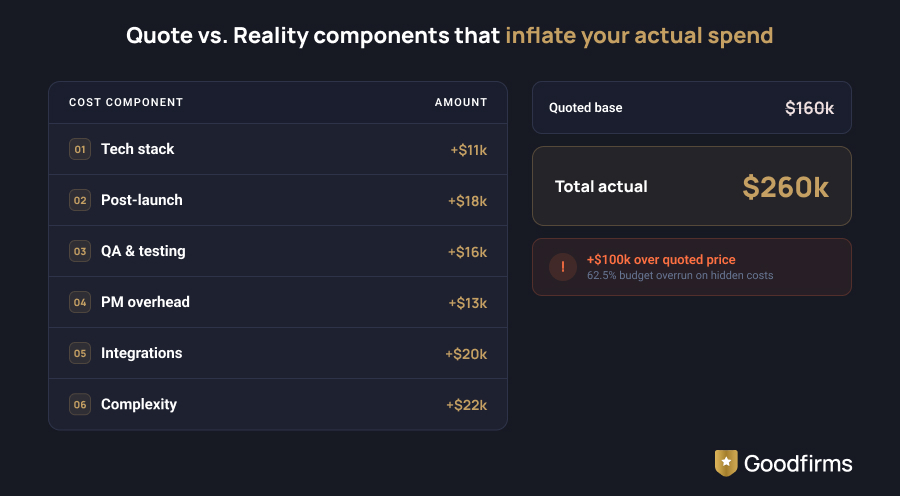
In Germany, the gap between a project quote and the final invoice is predictable — not an exception. For example, a project quoted at $160,000 routinely lands between $220,000–$260,000. The difference isn't fraud or mismanagement. It's six undisclosed cost drivers: complexity growth, third-party integrations, project management, QA, tech stack choices, and post-launch support. A $160K project turning into $250K isn’t unusual in Germany—it’s predictable. Let’s have a look at how this cost reality gap emerges.
Understanding cost drivers is step one. Controlling software development costs without affecting quality is where most teams struggle. Let’s have a look at how to cut down on software development costs in Germany without compromising quality.
How to Reduce Software Development Costs in Germany Without Compromising Quality?
Paying German rates for every role on your project is rarely necessary — and in 2026, it is increasingly uncommon among smart buyers. The most effective cost reduction strategies preserve German engineering quality where it matters most while optimizing spend everywhere else.
Consider Implementing a Nearshore Hybrid Model
The nearshore hybrid model is the most widely adopted approach. Organizations increasingly mix onshore product owners and architects with nearshore engineering squads, creating a distributed yet cohesive delivery framework — keeping architecture decisions in Germany while routing implementation and QA to CEE teams that deliver their services at lower hourly rates. For German projects specifically, this means keeping technical leadership, architecture decisions, and client-facing roles in Germany while routing implementation, QA, and testing to Poland, Romania, or the Czech Republic — markets that deliver comparable engineering quality at 40–55% lower hourly rates.
Extend Software Development Team With Staff Augmentation
Staff augmentation offers a more targeted version of the same principle. Rather than replacing your German team, you extend it with vetted specialists for defined phases — avoiding the overhead of full-time hiring while maintaining direct management control over delivery quality and timelines.
Start with an MVP
Phased delivery is equally powerful. Starting with an MVP to focus on core features and validate the idea before scaling — while mixing senior and mid-level software engineers and clearly defining project scope — can significantly lower costs over time without compromising standards.
Choose Fixed Pricing Model
Fixed-price contracts work well for clearly scoped phases — discovery, UI/UX design, and individual feature modules — where requirements are stable and change orders can be contractually controlled. They transfer delivery risk to the vendor and create budget certainty that time-and-materials engagements rarely provide.
According to Deloitte's Global Outsourcing Survey 2024, cost reduction remains the primary driver of outsourcing decisions for the fourth consecutive year, with talent access ranked second.
Cost optimization only works when the right partner is executing it. The strategies above mean little if the company you choose can't match your project's scope, compliance needs, or delivery standards. Let’s have a look at how to choose the right software development company in Germany.
How to Choose the Right Software Development Company in Germany
Choosing a software development company in Germany comes down to one thing: alignment between your project needs and the vendor’s capabilities. A higher hourly rate doesn’t guarantee better results—fit does.
Here’s how to evaluate vendors without overpaying or taking unnecessary risks:
Match Expertise With Your Project Type
Not every German agency is built for every project.
- Startups and MVPs need lean, fast-moving teams
- Enterprise platforms require compliance-heavy, process-driven vendors
Ask for relevant case studies, not generic portfolios. A company experienced in fintech or healthcare, for example, will already understand regulatory constraints that directly impact your cost and timeline.
Evaluate Team Structure — Not Just Hourly Rate
A $120/hour developer working alone is not the same as a structured team at the same rate.
Look for:
- Dedicated project manager
- QA and testing support
- Scalable team availability
This directly affects delivery speed, quality, and your total project cost.
Assess Cost Transparency and Scope Clarity
Unclear requirements are the biggest cause of budget overruns in Germany.
Before signing:
- Ensure the proposal includes feature-level cost breakdowns
- Clarify what’s included vs excluded (QA, integrations, maintenance)
- Ask how change requests are priced
This is where most projects fall into the Cost Reality Gap.
Check Communication and Collaboration Fit
Germany-based teams typically offer strong documentation and structured workflows—but that only works if it matches your style.
Evaluate:
- Response times
- English communication clarity
- Timezone overlap
Poor communication leads to rework—which increases cost faster than hourly rates ever will.
Verify Compliance and Legal Readiness
For EU-facing products, compliance is not optional—it’s built into the development process.
Ensure the vendor:
- Understands GDPR requirements
- Offers secure data handling practices
- Works with clear contractual frameworks
This reduces legal and architectural risks that can become expensive later.
Look Beyond Price: Focus on Long-Term Value
Ask vendors for their average deviation between the initial quote and the final invoice on their last five projects. Agencies that track this number — and share it — are the ones worth shortlisting.
Compare the Best Software Development Companies in Germany
Shortlisting vendors manually can take weeks—and still leave gaps in verification.
Instead, use trusted platforms with verified reviews, real pricing insights, and company comparisons to make faster, more confident decisions.
Compare top-rated software development companies in Germany on Goodfirms to evaluate:
- Hourly rates
- Client reviews
- Industry expertise
- Project portfolios
This helps you move from research to decision without guesswork.
Partnering with the right software development company in Germany, you get cost-effective services leading to improved revenue generation and growth. To further clarify key concerns and decision-making factors, here are answers to some of the most frequently asked questions about software development costs in Germany.
Software Development Costs in Germany - Frequently Asked Questions
Beyond pricing structures, a few practical questions tend to come up repeatedly when working with software development firms in Germany — here's what to know.
How long does a typical software development project in Germany take?
Timelines vary by scope — MVPs typically take 2–4 months, mid-size applications 4–6 months, and enterprise platforms 8–18 months. Regulatory approval cycles in fintech or healthtech can extend these further.
Do German software development companies work with international clients?
Yes. Most established German agencies are experienced working with US, UK, and broader EU clients, offering English-language communication, timezone-compatible working hours, and contracts under internationally recognized legal frameworks.
What language are software development contracts written in Germany?
Contracts can be drafted in English or German. For legal enforceability, many international buyers request bilingual agreements. German contract law governs disputes by default unless another jurisdiction is explicitly specified.
Is it possible to hire a single software engineer from a German agency rather than a full team?
Yes, through staff augmentation arrangements. Most mid-to-large German agencies offer individual developer placements for defined project phases without requiring full-team engagement.
How much do German software development projects typically go over budget, and how can I prevent it?
Projects in Germany are routinely quoted at one price and invoiced at another. A project quoted at $160,000 will typically land between $220,000–$260,000 once all costs are accounted for — a gap of 30–60%. This is not fraud or mismanagement. It is caused by six predictable cost drivers that most initial quotes do not fully capture: complexity growth, third-party integrations, project management overhead, QA and testing, tech stack choices, and post-launch support.
The most effective way to prevent it is to demand a feature-level cost breakdown — not just a total — before signing. Ask the vendor how they price change requests, what is excluded from the quote, and what their average deviation between initial quote and final invoice has been across their last five projects. Vendors who track and openly share that number are the ones worth shortlisting.
With these frequently asked questions clarified, you’re now better equipped to evaluate your options — so let’s wrap up with a final perspective on software development costs in Germany and how to make the right investment decision in 2026.
Software Development Costs in Germany (2026): Make the Right Call for Your Project
Germany's developer market is the largest in Western Europe — 900,000 professionals, native GDPR compliance, and an engineering culture built around long-term reliability over quick delivery. In 2026, that combination makes it the most defensible choice for regulated, mission-critical, and EU-facing products.
The rate benchmarks follow a clear hierarchy, with junior engineers at the lower end, and reaching the highest range for lead architects. Depending on the city and engagement model, these variations shape overall project costs and directly influence your app development cost. In practice, this translates into budgets that can start from a lean MVP level and scale up to large, AI-powered enterprise platforms, while most custom business applications fall within a moderate mid-range.
Before you budget for your next software development project, use Goodfirms' curated list of software development companies in Germany and compare them by hourly rate, client reviews, and industry specialization — filtered to your project type and get exact quotes without any guesswork or overspending issues.