Key takeaways
- The Cybersecurity ROI Inversion: businesses treating security as a growth asset generate 7x+ returns — not just avoided losses
- 60% of small businesses shut down within 6 months of a cyberattack — yet most remain measurably underprepared
- AI has changed both sides of the battlefield simultaneously — businesses without AI-powered security are already operating at a structural disadvantage
- Managed cybersecurity services now deliver enterprise-grade protection at SMB-accessible cost — the build-vs-buy decision has permanently shifted
The Real Risk Is Not Attacks—It Is Underestimating Cybersecurity
Most businesses treat cybersecurity as a cost — money spent to prevent bad things from happening. Like insurance. Necessary, but not exciting. That is the wrong way to look at it. The fastest-growing businesses in 2026 are not just using security to avoid breaches. They are using it to win customers, close deals, and access contracts their competitors cannot even bid for.
Most businesses ask: "How much will cybersecurity cost us?"
The smart ones ask: "How much revenue are we losing without it?"
That shift in thinking is the Cybersecurity ROI Inversion — and it is what this article is about. — and by the time you reach Benefit 6, you will understand why it is the most important reframe in this article.
Here’s what the data shows:
- 60% of small businesses shut down within 6 months of a cyberattack.
- The average cost of a data breach reached $4.45 million globally.
- 43% of cyberattacks target small businesses, yet most remain under-protected.
Cybersecurity benefits for business start with one simple reality: prevention is cheaper than recovery.
Partner with a Goodfirms-verified top CyberSecurity Companies to become enterprise-ready.
How Cybersecurity Drives Revenue, Trust, and Competitive Advantage
The benefits of cybersecurity for business extend well beyond preventing data breaches. In 2026, robust cybersecurity directly protects revenue, enables regulatory compliance, builds customer trust, reduces operational costs, and creates competitive differentiation. For businesses of all sizes, cybersecurity investment, often supported by experienced IT service providers, now generates measurable returns across financial, reputational, and operational dimensions.
Key Insights Box: The Cybersecurity ROI Inversion
Most businesses ask, "How much will cybersecurity cost us?"
The businesses growing fastest ask, "How much revenue are we leaving on the table without it?"
In 2026, cybersecurity is no longer a cost center. It is a business development asset — one that wins enterprise contracts, lowers insurance premiums, reduces breach exposure, and builds the customer trust that drives lifetime value. The organizations that have made this reframe are compounding advantages their competitors do not yet understand.
Security is no longer protection. It is permission to grow.
What Is the Real Cost of Ignoring Cybersecurity in 2026?
Before the benefits, the cost of inaction needs to be precise — because vague fear does not drive good business decisions. Specific numbers do.
- The average data breach in the US now costs $10.22 million:
The IBM/Ponemon Cost of a Data Breach Report found that the average cost of a breach in 2025 for U.S. companies is $10.22 million. That is not a fine or a penalty. That is the all-in cost: detection, response, remediation, legal fees, regulatory penalties, and lost business.
- Small businesses are the primary target, not an afterthought:
Small businesses experience approximately four times as many confirmed breaches as large organizations. 80% of small businesses experienced at least one cyberattack in 2025, and 41% of those incidents were AI-driven. The belief that hackers only target large enterprises is the most expensive myth in business.
- The closure rate is existential:
As highlighted earlier, cyber incidents have compounding financial and operational consequences that many businesses underestimate. Not because the attack was fatal, but because the recovery costs, reputational damage, and lost customers accumulated faster than the business could absorb.
- Downtime costs more than the ransom:
Downtime costs small businesses approximately 50 times as much as the ransom itself. Lost productivity, recovery time, and reputational damage almost always eclipse the direct financial damage from attackers.
This is not the landscape for minimum viable security. This is the landscape for strategic security investment — and the businesses that understand that difference are the ones surviving and growing.
“Here’s how cybersecurity translates into measurable business outcomes:”
The Cybersecurity ROI Inversion: From Cost Center to Growth Engine
Most frameworks show what cybersecurity prevents. This one shows what it generates.
|
Business Outcome |
What Cybersecurity Delivers |
Measurable Impact |
|---|---|---|
|
Revenue protection |
Prevents operational shutdowns and data loss events |
Avg. breach costs $10.22M (IBM, 2025) |
|
Customer acquisition |
Trust signals that close enterprise deals |
43% of buyers lost after a breach (Hiscox) |
|
Contract eligibility |
Compliance certifications unlock regulated-sector contracts |
CMMC, SOC 2, ISO 27001 requirements |
|
Insurance cost reduction |
Strong posture reduces premiums and ensures coverage |
63% of SMBs saw 200%+ premium increases without adequate controls |
|
Operational efficiency |
AI-powered security reduces incident volume and response time |
40% fewer incidents with integrated AI (Gartner) |
|
Enterprise valuation |
Security posture is now a due diligence factor in M&A |
Breached companies sell at 15–20% lower multiples |
|
Competitive differentiation |
Security certifications win bids where competitors cannot qualify |
Growing mandatory requirements in government, healthcare, and finance |
Every row in this table is a positive business outcome — not just an avoided loss. That is the inversion most companies have not made yet.
Cybersecurity is not just preventing loss — it is actively generating revenue, reducing costs, and enabling growth.
Cybersecurity vs No Cybersecurity: What Changes for Your Business?
|
Factor |
Without Cybersecurity |
With Cybersecurity |
|---|---|---|
|
Revenue Risk |
High |
Controlled |
|
Customer Trust |
Fragile |
Strong |
|
Compliance |
Limited |
Eligible |
|
Growth |
Restricted |
Scalable |
|
Insurance |
Expensive or unavailable |
Lower premiums |
Proven Cybersecurity Benefits That Directly Impact Business Growth - Explained With Evidence
Here is what most articles skip: the sixth benefit in this list is the one that surprises every business owner — and it is the one with the most direct, recurring financial return. Read through it.
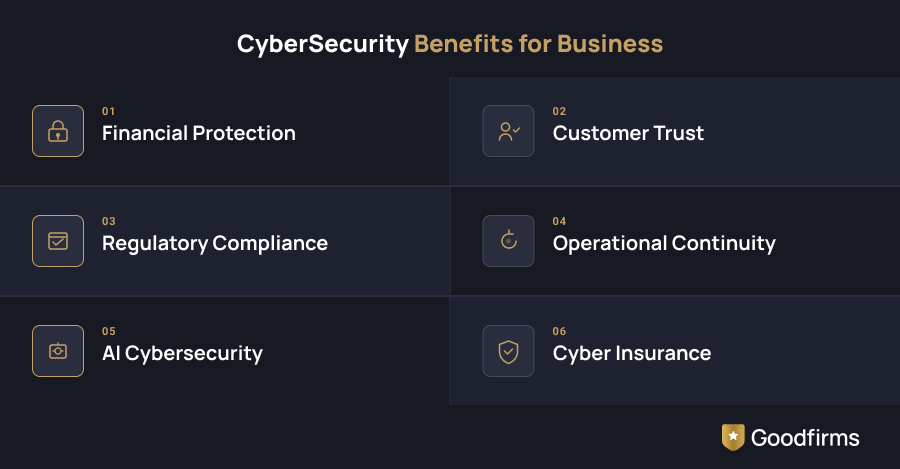
1: Financial Protection That Pays for Itself Multiple Times Over
The most direct cybersecurity benefit for business is financial, and the ROI case is without any persuasion.
Prevention investment ROI consistently exceeds 7x across all threat categories, with supply chain security showing the highest return at 8.5x. Employee training delivers the highest ROI at 425%, with security awareness programs preventing 92% of malware infections through reduced human error, providing exceptional returns with payback periods under 9 months.
In practical terms:
Cybersecurity ROI in practice:
Without cybersecurity:
- 20% annual breach probability × $500,000 impact = $100,000 expected loss
With cybersecurity:
- $30,000 annual investment
- Risk reduced to 5% → $25,000 expected loss
Net financial gain: $45,000 per year
Every $1 invested in cybersecurity can return $7 in avoided breach costs—making it one of the highest-performing business investments.
Incident response readiness further amplifies value. Companies with structured response plans reduce breach containment time from 287 days to 73 days, delivering up to 750% ROI through faster mitigation and lower damage costs.
The bottom line:
Cybersecurity is not just protection—it is a high-impact financial strategy that directly reduces risk and preserves revenue.
2: Customer Trust That Directly Drives Revenue
Customer trust is now a revenue line, not a soft value.
Insight:"Cybersecurity is no longer just an IT issue — it is a brand issue, a revenue issue, and increasingly a competitive positioning issue. The companies that understand this are winning deals their competitors cannot even qualify for." — CISO, Fortune 500 financial services firm.
The Hiscox Cyber Readiness Report reveals that 43% of businesses lost existing customers because of cyberattacks. That is not a statistic about IT systems. It is a statistic about customer lifetime value being destroyed by a preventable event.
The inverse is equally true and more important for growth-focused businesses. A demonstrable security posture — SOC 2 certification, ISO 27001 compliance, and clear data-handling policies — is now a direct competitive advantage in enterprise sales cycles.
Businesses with proven cybersecurity:
- Build trust faster
- Pass security reviews easily
- Close deals that competitors cannot
Real World Example:
A mid-sized SaaS company lost a six-figure enterprise deal during the final-stage security review due to a lack of SOC 2 certification. After investing in compliance and endpoint security, the same company closed multiple enterprise contracts within two quarters — directly attributing over $1M in new revenue to improved security posture.
Security builds trust — and trust closes deals.
3: Regulatory Compliance That Unlocks Market Access
Compliance is where cybersecurity benefits for small businesses become most tangible and most urgent.
Many organizations partner with specialized IT consulting companies to navigate complex frameworks like SOC 2, ISO 27001, and CMMC efficiently.
In 2026, industries like healthcare, finance, legal, and government contracting mandate cybersecurity standards as a condition for doing business.
- CMMC 2.0 is now embedded in DoD contracts, making compliance mandatory for defense vendors
- HIPAA fines can reach $1.5M+ per violation category annually
- SOC 2 Type II has become a baseline requirement for enterprise buyers
What this means:
Every compliance standard your competitors fail to meet is a contract you can win.
The takeaway:
Compliance is no longer defensive—it is strategic market expansion. Businesses investing in cybersecurity are not just reducing risk; they are unlocking new revenue opportunities and entering markets others cannot access.
Compliance is no longer overhead. It is market access.
Insight : By 2026, "Secure by Design" principles and frameworks like CMMC 2.0 and evolving NIST guidelines are creating new compliance requirements that will fundamentally reshape how U.S. companies approach cybersecurity — and which companies can compete for certain contracts.
4: Operational Continuity — The Invisible Revenue Line
Operational downtime is often overlooked—until it happens. But its financial impact is significant.
The average ransomware attack takes a business offline for 21 days. For a company earning $500,000 annually, that’s around $29,000 in lost revenue—excluding recovery costs, customer churn, and reputational damage. For a $5 million business, downtime alone can cost more than $290,000.
Proactive cybersecurity—regular patching, endpoint protection, reliable backups, and tested incident response plans—directly protects this revenue stream.
What this means:
Every day of downtime prevented is revenue preserved. Every prepared recovery reduces disruption and avoids escalation.
The takeaway:
Cybersecurity is not just about stopping attacks—it ensures business continuity. Companies that invest early operate with fewer disruptions, recover faster, and avoid turning incidents into long-term financial losses.
Every day of prevented downtime is protected revenue.
5: AI Cybersecurity for Business — The Efficiency Multiplier
AI cybersecurity for business is redefining how companies protect themselves—especially those without large security teams.
According to Gartner, businesses using AI with integrated security platforms will see 40% fewer employee-driven incidents by 2026. Since human error is the leading cause of breaches, this is a major structural advantage.
IBM reports that AI-powered security helps detect and contain breaches 108 days faster—often the difference between a minor incident and a major financial loss.
At the same time, attackers are already using AI. Phishing attacks have increased 1,200% since 2022 (McKinsey), using automation, deepfakes, and rapid vulnerability detection.
What this means:
Without AI, businesses are not competing on equal terms.
Managed cybersecurity services and modern cybersecurity software solutions now make AI-driven protection accessible—offering 24/7 monitoring, threat detection, and response at a fraction of in-house costs.
The takeaway:
AI is no longer optional—it is indispensable for security efficiency and resilience.
6: Cyber Insurance Positioning — Lower Costs, Better Coverage
Cyber insurance is no longer just about buying a policy—it depends on your security posture.
According to Spacelift (2025), 27% of small businesses cannot secure cyber insurance at any price due to weak security controls. For these companies, a single cyber incident is completely uninsured, creating serious financial risk.
The upside is clear. Businesses with strong controls—MFA, endpoint protection, employee training, and tested incident response plans—qualify for lower premiums and better coverage.
What this means:
Cybersecurity is not a one-time cost—it delivers recurring financial benefits.
- Lower insurance premiums
- Continued eligibility as requirements tighten
- Higher chances of successful claims
The takeaway:
- Cybersecurity directly impacts your insurability.
- Companies with strong security not only reduce risk—they pay less for protection and ensure they are covered when it matters most.
Strong security reduces both risk and insurance costs simultaneously.
“This ROI becomes even more asymmetric when you look at small businesses — where a single incident can determine survival.”
Why Cybersecurity Matters More for Small Businesses
Here is the counterintuitive truth about cybersecurity for small businesses: the stakes are proportionally higher, not lower, than they are for large enterprises.
Large enterprises can absorb a breach. They have legal teams, crisis communications agencies, cyber insurance policies, and reserve capital to manage recovery. The average breach cost of $4.88 million is painful for a Fortune 500 company. It is essential for a business with $2 million in annual revenue.
Prevention investment ROI consistently exceeds 7x across all threat categories. Small businesses experienced a 46% cyberattack rate in 2025, with incidents occurring every 11 seconds. Average losses reach $120,000 per breach, and 60% of companies attacked close within six months.
The importance of cybersecurity for small businesses in 2026 is not hypothetical risk management. It is business survival arithmetic. An investment of $15,000-$ 30,000 annually in managed cybersecurity, with a 60% probability of business closure. That is the simplest positive ROI case in business - and most small businesses have not made it.
Why Cybersecurity Risk Has Increased in 2026
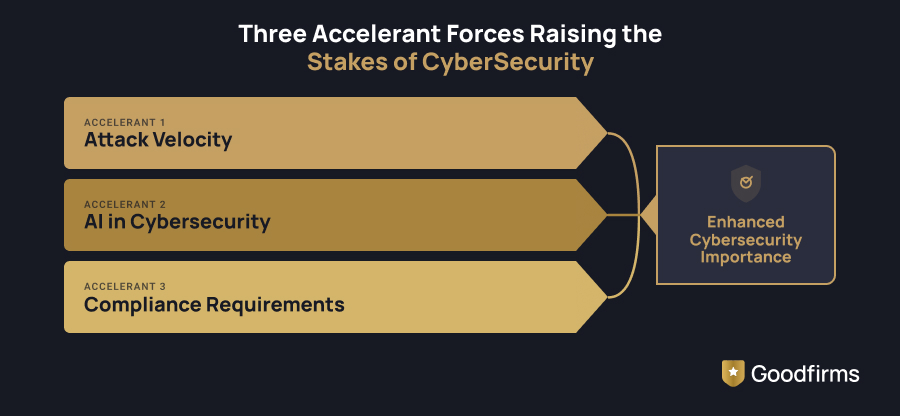
Three accelerating forces have converged in 2026 to make the importance of cybersecurity for business higher than at any previous point.
-
Accelerant 1 — Attack velocity has increased exponentially.
Businesses now face an attempted cyberattack every 39 seconds on average (University of Maryland research). Ransomware incidents increased over 90% year-over-year in 2024 (Cybersecurity Ventures). The attack surface — remote work, cloud adoption, connected devices, AI-generated content — has expanded faster than most security programs have adapted.
-
Accelerant 2 — AI has made attacks and defenses simultaneously more powerful.
Attackers now use AI to automate phishing at scale, generate realistic deepfake social engineering, and identify exploitable vulnerabilities faster than human security teams can patch them. Defenders using AI-powered security tools reduce detection and containment times by up to 108 days. Businesses that have adopted AI defenses have a structural advantage over those that have not — and that gap is widening, not closing.
-
Accelerant 3 — Compliance requirements have multiplied into market access filters.
GDPR fines now reach up to $22 million or 4% of global annual revenue. CMMC 2.0 eliminates unqualified vendors from federal contract eligibility. SOC 2 Type II is now a standard requirement in enterprise procurement. Every new compliance requirement that competitors cannot meet is a market access door that opens exclusively for businesses that have invested in the security posture to meet it.
The 5-Step Cybersecurity Investment Framework for Business Leaders
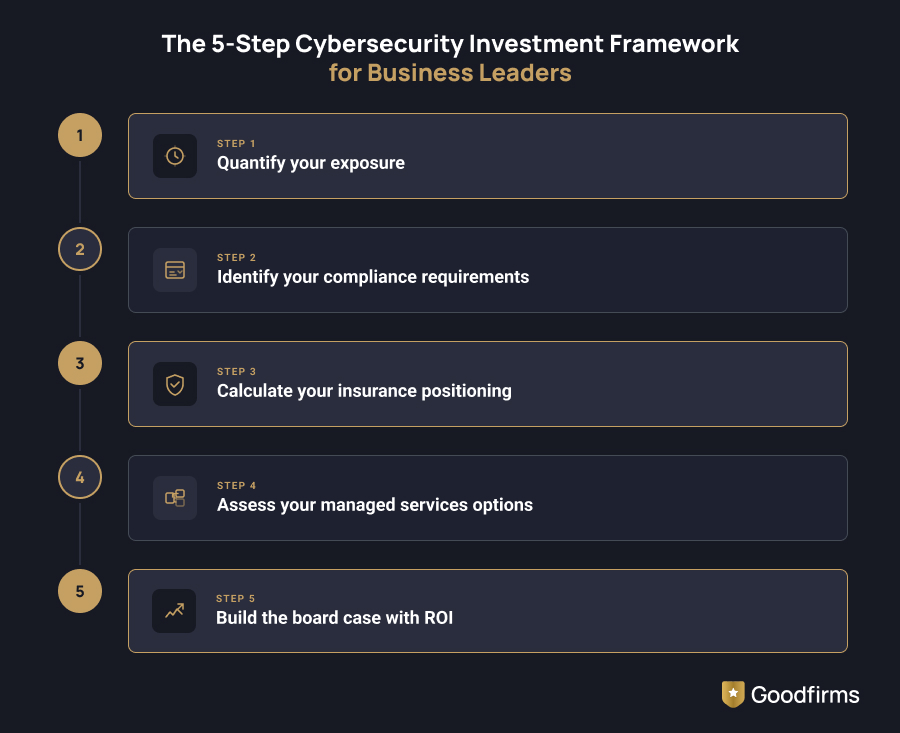
This is not a technical checklist. It is a business decision framework for leaders who need to make the case internally for cybersecurity investment and make it in terms that resonate with finance, operations, and the board.
Step 1 — Quantify your exposure:
Calculate the potential financial impact of a breach using your revenue, customer data volume, and operational dependencies.
Step 2 — Identify your compliance requirements:
Determine which frameworks apply to your industry and customer base — SOC 2, CMMC, HIPAA, GDPR, ISO 27001. Each one you meet is a market access door you can open.
Step 3 — Calculate your insurance positioning:
Get quotes for cyber insurance at your current security posture. Then model what improved controls would do to your premiums. The difference is a direct annual financial return on your security investment.
Step 4 — Assess your managed services options:
For most businesses with under 500 employees, managed cybersecurity services deliver better protection at a lower cost than building internal capability. Get competitive quotes from two to three managed security service providers and compare against your breach exposure number.
If you’d like to evaluate an endpoint security and patching tool in-house first, ManageEngine Endpoint Central offers a free trial that gives you a baseline to compare against managed service quotes.
Step 5 — Build the board case with ROI:
Present cybersecurity investment as: (a) avoided breach cost × probability, plus (b) insurance premium reduction, plus (c) new contract revenue enabled by compliance certification, minus (d) annual security investment. The resulting number is your net cybersecurity ROI — and it is almost always strongly positive.
Cybersecurity ROI Quick Reference
What ROI can businesses expect from cybersecurity investment?
Prevention investment delivers an average ROI of 7x across all threat categories (Total Assure, 2025). Employee security training generates 425% ROI with a payback period under nine months. Incident response capability generates 750% ROI by reducing containment time from 287 days to 73 days. Cyber insurance premium reductions and compliance certifications that unlock new contract revenue add further compounding financial return beyond avoided breach costs.
FAQ — Cybersecurity Benefits for Business
What are the main benefits of cybersecurity for business?
The main cybersecurity benefits for business include financial loss prevention, customer trust preservation, regulatory compliance that unlocks market access, operational continuity protection, competitive differentiation in enterprise sales, and cyber insurance cost reduction. In 2026, strong cybersecurity also enables AI-powered efficiency gains that reduce incident volume by up to 40%.
Why is cybersecurity important for small businesses specifically?
Small businesses face approximately four times as many confirmed breaches as large organizations, yet have proportionally less capacity to absorb the $120,000–$1.24 million average breach cost. 60% of attacked small businesses close within six months. The importance of cybersecurity for small businesses is not theoretical risk management — it is business survival.
What ROI can businesses expect from cybersecurity investment?
Prevention investment delivers an average ROI of 7x across all threat categories. Employee security training generates 425% ROI with payback under nine months. Incident response capability generates 750% ROI by reducing containment time from 287 to 73 days. Strong security posture also reduces cyber insurance premiums and enables compliance certifications that unlock new contract opportunities.
What are managed cybersecurity services, and who should use them?
Managed cybersecurity services provide outsourced security monitoring, threat detection, and incident response — typically including 24/7 SOC coverage — without requiring internal security staff. They are the optimal choice for businesses under 500 employees that cannot justify hiring full-time security engineers. Managed services deliver 285% average ROI through continuous threat monitoring and expert response capabilities.
How does AI cybersecurity for business work?
AI cybersecurity for business uses machine learning to detect anomalies, predict threats, automate responses, and reduce alert volume across an organization's network, endpoints, and cloud environments. Gartner projects 40% fewer employee-driven incidents for businesses using an integrated AI security architecture. IBM data shows AI-powered security reduces breach containment time by 108 days compared to organizations without AI security tools.
Does cybersecurity affect business reputation and customer trust?
Directly, 43% of businesses lost existing customers following a publicly known cyberattack. Conversely, demonstrated security posture — certifications, transparent data policies, security disclosures — is increasingly a positive purchase signal for enterprise buyers and a contract requirement in regulated sectors.
How much should a business spend on cybersecurity in 2026?
Industry benchmarks suggest allocating 10–15% of IT budget to cybersecurity, or approximately 0.2 - 0.9% of annual revenue, depending on industry and risk profile. For small businesses, managed cybersecurity services typically range from $15,000–$30,000 annually for comprehensive coverage. The most useful calculation: compare the annual investment against your maximum breach exposure ($120,000–$1.24 million for SMBs) and the 7x average prevention ROI. The business case closes clearly at almost any investment level.
Conclusion: The Businesses That Win in 2026 Treat Security as Strategy
The importance of cybersecurity for business in 2026 is not the threat landscape — though that has never been more serious. It is the opportunity that a strong security posture creates.
The businesses leading their markets in 2026 are not just avoiding breaches:
- They are using their security posture to win contracts that their competitors cannot qualify for.
- They are using compliance certifications to access regulated markets that are locked to underprepared competitors.
- They are using documented security controls to reduce insurance premiums and attract institutional capital.
- They are using AI-powered security platforms to operate with lower risk and higher efficiency simultaneously.
The question is whether your investment in cybersecurity services is generating the full range of business benefits it is capable of delivering — or whether you are treating it as a defensive cost when it could be a strategic asset.
The Cybersecurity ROI Inversion is available to every business reading this. The ones that make it will compound the advantage. The ones that do not will keep paying for it — one way or another.