Key takeaways
- Fintech IT services help financial institutions to modernize legacy systems, automate compliance, and provide amazing digital banking solutions.
- Core financial IT solutions include services like cloud banking platforms, AI-powered fraud detection, open banking API development, RegTech, and cybersecurity in financial services.
- Choosing the right fintech IT service provider with BFSI expertise is a strategic differentiator, not just a technical upgrade.
- According to Fintech Business Insights, the global fintech market is projected to hit $460.76 billion by 2026, growing at a CAGR of 18.2%, making fintech software development one of the fastest-scaling technology investments worldwide.
The financial services industry is no longer driven solely by capital; it is powered by technology.
There is a growing pressure on traditional banks, wealth management companies, insurance companies, and credit unions to modernize their whole processes and offer new-age digital banking services. It is important for them to keep up with this rapidly changing, increasingly complex regulatory environment.
In this context, Fintech IT services serve as the foundation of the contemporary financial ecosystem.
These services span a wide range from cloud-native infrastructure and open banking API development to real-time payment processing and AI-driven fraud detection, giving financial institutions the technical edge they need to compete in a market where consumers demand speed, personalization, and security for every transaction.
Finding the perfect fintech IT partner is a huge task. It can make the difference between market leadership and digital irrelevance. But first, let's understand what fintech IT services are.
Build the future of finance with trusted fintech software development companies on Goodfirms.
What Are Fintech IT Services? Understanding Their Role in Modern Finance
Fintech IT services are the specialized tech solutions and managed services used to design, build, and maintain digital financial infrastructure.
While generic IT services keep a business running, Fintech IT is laser-focused on the high-stakes demands of the financial world. It ensures that systems are not only fast and user-friendly but also "bulletproof" when it comes to financial regulatory compliance (RegTech), data security, and 24/7 system availability.
Today, the right financial technology solutions do more than just "keep the lights on"; they are a primary engine for competitive advantage.
Fintech IT isn’t a single tool; it’s a toolkit. Each service is designed to solve a specific pressure point that modern institutions face. Understanding these categories is your first step toward identifying exactly where your institution needs to evolve and what kind of fintech software development partner can get you there.
Types of Fintech IT Services Powering Modern Financial Institutions
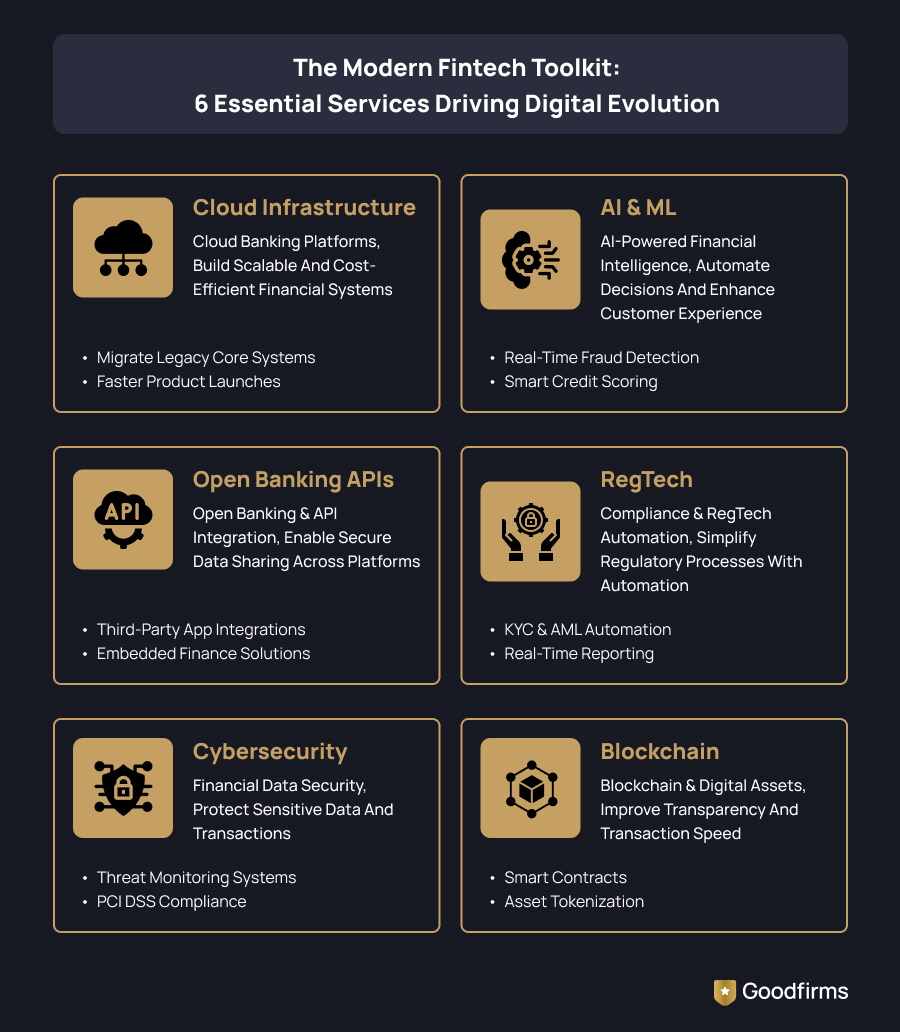
From cloud-based financial technology services and AI-powered automation to open banking APIs and blockchain, these six categories are the building blocks of a modern, resilient, and competitive financial institution.
1. Cloud Infrastructure & Migration for Banking
Cloud-based fintech solutions form the foundation of modern financial infrastructure. It helps institutions move away from rigid, "old-school" servers and adopt flexible environments that support fast innovation. Cloud adoption in banking has been shown to reduce infrastructure costs by nearly 30–50%.
Key Capabilities:
- Moving legacy core systems to scalable cloud environments.
- Deploying new financial products without a massive upfront investment.
- Improving system uptime and disaster recovery.
Top Tech: AWS, Microsoft Azure, Google Cloud, and Hybrid Cloud models.
2. AI & Machine Learning in Financial Services
AI is changing how institutions analyze data and talk to customers. These tools allow for instant decision-making and highly personalized banking experiences at a massive scale. AI-driven fintech systems can reduce fraud detection time by up to 90% compared to traditional rule-based systems.
Key Capabilities:
- Automated Credit Scoring: Faster loan approvals using smart data models.
- Fraud Detection: Spotting suspicious patterns in real-time.
- Personalized Insights: Offering products based on how a customer actually spends.
- AI Chatbots: Providing 24/7 support without the wait times.
3. Open Banking & API Development
Open banking is what makes the modern financial ecosystem "connected." By using secure APIs, banks can share data safely with third-party apps, unlocking new services like "Buy Now, Pay Later" or integrated investment tools.
Key Capabilities:
- Building secure APIs for safe data exchange.
- Integrating with popular fintech platforms and apps.
Compliance Support: Meeting standards like PSD2 (Europe) and UPI (India).
4. RegTech & Compliance Automation
Regulatory Technology, or RegTech, helps firms handle the "boring but critical" paperwork and rules. Automation is the only way to keep up with shifting global laws while minimizing human error and expensive fines.
Key Capabilities:
- Automated KYC & AML: Speeding up "Know Your Customer" and Anti-Money Laundering checks.
- Real-time Reporting: Generating audit trails instantly for regulators.
- Global Standards: Staying compliant with GDPR, DORA, and Basel III.
5. Cybersecurity & Data Protection in Finance
In finance, security is the top priority. Financial institutions face cyberattacks 300% more frequently than other industries. Cybersecurity in financial services provides the high-tech shields needed to protect sensitive data and keep transactions safe from hackers.
Key Capabilities:
- Zero-Trust Models: Verifying every single login attempt, every time.
- Threat Detection: Constant monitoring for digital intruders.
Protection Standards: Ensuring PCI DSS compliance and end-to-end encryption.
6. Blockchain & Digital Asset Infrastructure
Blockchain is redefining transparency and speed. By using decentralized ledgers, institutions can settle transactions faster and create entirely new types of digital assets.
Key Capabilities:
- Smart Contracts: Agreements that execute themselves once conditions are met.
- Asset Tokenization: Turning real-world assets (like real estate) into digital tokens.
- Digital Wallets: Building secure infrastructure for stablecoins and digital currency.
Goodfirms Research Insight:According to industry analysis, nearly 70%+ of fintech failures are linked to regulatory and compliance challenges rather than technology gaps. This makes vendor selection critical; partners with proven BFSI expertise ensure faster execution, reduced risk, and better long-term scalability.
Why Financial Institutions Need Fintech IT Services
In the past, technology was a department; today, technology is the business. For modern financial institutions, sticking with "the way we’ve always done it" isn’t just slow, it’s risky.
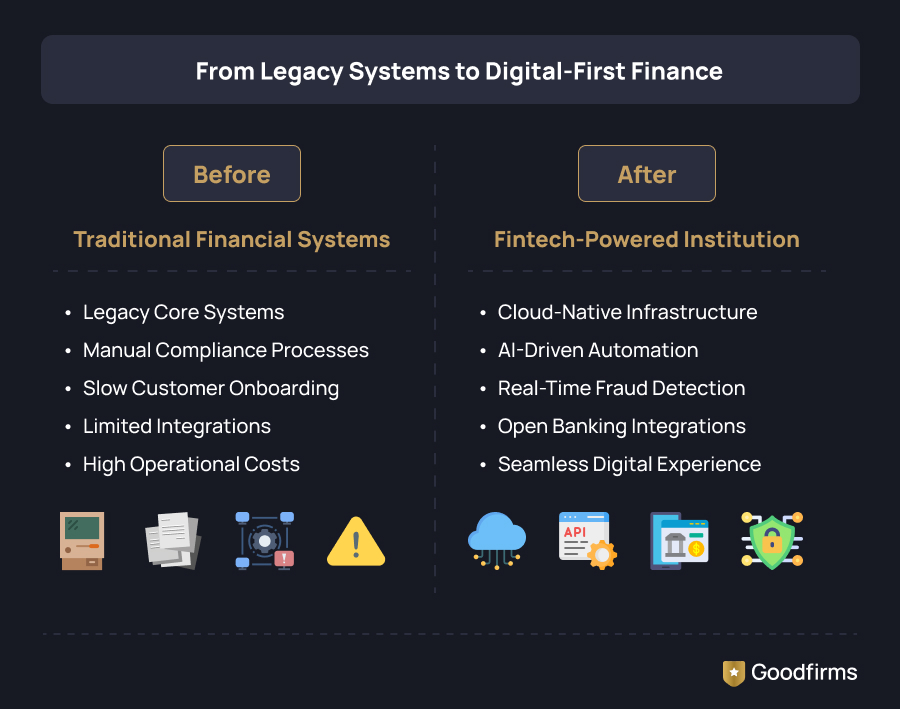
Here is why investing in financial IT services has become a survival requirement.
1. Legacy Systems Are a Strategic Liability
Most traditional banks still rely on core systems built decades ago. These "monolithic" architectures are like trying to run a modern app on a 90s computer; they are expensive to maintain, slow to update, and simply don't play well with the cloud.
Financial IT services specialize in legacy system modernization. They help migrate institutions to microservices and cloud platforms. This shift allows for faster product launches and significantly lower operational costs, turning a technical burden into a competitive engine.
2. Customers Demand Digital-First Financial Experiences
Today’s customers don’t compare their bank to other banks; they compare it to the seamless experience of Netflix, Amazon, or Uber. They have zero patience for paperwork and expect:
- Instant Onboarding: Opening an account via mobile in minutes.
- Live Updates: Real-time transaction notifications.
- Personalization: Offers based on their actual spending habits.
- Zero Waiting: 24/7 self-service without the dreaded phone queues.
To drive adoption and engagement, many institutions also collaborate with fintech digital marketing agencies to reach and retain digital-first users.
3. Regulatory Complexity Is Accelerating
Staying compliant is getting harder and more expensive. With the EU’s Digital Operational Resilience Act (DORA) taking effect in early 2025, the bar for cybersecurity and operational stability has never been higher.
By using KYC/AML automation and RegTech solutions embedded within digital banking technology services, institutions can handle the heavy lifting of compliance automatically. This reduces the burden on internal teams and slashes the risk of multi-million dollar fines.
4. Fraud and Cyberthreats Are Escalating
With online payment fraud losses projected to top $362 billion by 2028, security is now a boardroom priority, not just an IT one. Cybersecurity in finance has evolved.
Modern providers now deploy AI in fintech, specifically fraud detection systems that scan millions of transactions per second to catch "red flags" before a breach even happens.
5. Competitive Pressure from Neobanks and Big Tech
The neobank development wave is relentless. Companies like Revolut and NuBank are winning over millions of users with slick apps and zero legacy overhead.
For traditional institutions, Fintech IT services are the fastest shortcut to closing this gap. It allows you to compete with the "disruptors" without the massive cost or time-sink of building everything from scratch in-house.
Cost of Fintech IT Services (2026)
The cost of fintech IT services varies widely based on complexity, compliance requirements, and scale. From early-stage MVPs to enterprise-grade platforms, understanding pricing benchmarks helps institutions plan budgets and choose the right technology partner.
Estimated Cost Breakdown of Fintech IT Services
|
Fintech IT Service Category |
Typical Cost Range (USD) |
What’s Included |
|
Cloud Infrastructure & Migration |
$20,000 – $150,000+ |
Legacy system migration, cloud setup, scalability architecture |
|
AI & Machine Learning Solutions |
$30,000 – $200,000+ |
Fraud detection systems, credit scoring models, chatbots |
|
Open Banking & API Development |
$25,000 – $120,000+ |
API creation, third-party integrations, compliance support |
|
RegTech & Compliance Automation |
$15,000 – $100,000+ |
KYC/AML automation, reporting tools, audit trails |
|
Cybersecurity Solutions |
$20,000 – $150,000+ |
Threat monitoring, encryption, compliance (PCI DSS, ISO) |
|
Blockchain & Digital Asset Solutions |
$40,000 – $250,000+ |
Smart contracts, tokenization, and wallet development |
Now that we are aware of the types of Fintech IT services, their importance, and their costs, it is also essential to see them in real-world scenarios.
Fintech IT Services in Action: Real-World Use Cases
Fintech technology solutions are not just theoretical concepts; they are solving real-world bottlenecks for diverse financial players. The following table illustrates how tailored technology solutions address the specific pain points of modern institutions.
|
Financial Institution |
Core Challenge |
Fintech IT Solution |
|
Regional Bank |
Aging core banking system |
Cloud migration + microservices modernization |
|
Insurance Company |
Manual claims processing |
AI-powered automation + digital workflow |
|
Wealth Manager |
Compliance reporting burden |
RegTech + automated audit trails |
|
Credit Union |
Limited digital product range |
Open banking API + mobile app development |
|
Payment Processor |
Rising fraud rates |
Real-time ML fraud detection engine |
|
Neobank Startup |
Time-to-market pressure |
BaaS (Banking-as-a-Service) platform |
These examples highlight how choosing the right fintech IT services directly impacts scalability, compliance, and customer experience, and how important it is to choose the right service provider.
How to Choose the Right Fintech IT Service Provider
Choosing a specialized partner is vital in high-stakes finance. When evaluating top software development companies, prioritize these five quality markers:
-
Domain Expertise: They must understand BFSI nuances like ledger accounting, not just basic coding.
-
Compliance Knowledge: Expertise in regional frameworks like GDPR is essential for legal safety.
-
Modern Tech Stack: Their strengths in cloud banking or AI in fintech must align with your roadmap.
-
Proven Security: Look for non-negotiable certifications like ISO 27001, SOC 2, and PCI DSS.
-
True Scalability: Ensure their architecture can grow from a pilot to an enterprise system supporting millions.
Find Verified Fintech IT Partners on Goodfirms
When the stakes are this high, finding the right financial technology services partner requires more than a Google search.
Why Goodfirms Stands Out for Fintech Sourcing:
-
80,000+ verified client reviews across technology service categories
-
Dedicated Finance Software Development directory with filtered search by expertise, geography, and company size
-
Technology-specific developer listings, filter by stack relevant to your fintech project
-
Transparent ratings based on quality, reliability, and ability to deliver
-
No pay-to-rank manipulation, every listing is earned through verified performance
-
Research-backed insights on emerging digital banking trends and fintech cybersecurity
Final Words: Invest in Fintech IT Services to Stay Ahead
The financial services industry is undergoing the most significant technology transformation in its history. Customers are more digital than ever. Regulations are more complex than ever. And competitors, from nimble neobanks to trillion-dollar tech giants, are more aggressive than ever.
Fintech IT services are not a nice-to-have. They are the operating systems of the modern financial institution.
The question is no longer whether to invest in financial technology services; it's who to trust to build and manage them. A partner with verified BFSI domain expertise, deep compliance knowledge, and a proven delivery track record is the single most important technology decision your institution will make.
Frequently Asked Questions
1. What are fintech IT services?
Fintech IT services are specialized technology solutions designed for financial institutions — covering everything from cloud infrastructure and AI-powered fraud detection to open banking APIs and regulatory compliance automation. Unlike generic IT services, they are built around the strict security, compliance, and uptime demands of the financial industry.
2. How are fintech IT services different from regular IT services?
Regular IT services focus on general business operations like networking, helpdesk, and software support. Fintech IT services are purpose-built for BFSI environments — they account for financial regulatory frameworks (GDPR, PCI DSS, Basel III), real-time transaction processing, and the high security standards that banks and financial institutions must meet.
3. How much do fintech IT services typically cost?
Costs vary widely by service type and complexity. Cloud migration projects typically range from $20,000–$150,000, while AI and ML solutions can run $30,000–$200,000+. Blockchain and digital asset infrastructure tends to be the most expensive, starting around $40,000 and going up to $250,000 or more for enterprise-grade builds.
4. How long does it take to implement fintech IT solutions?
Implementation timelines depend on scope. A focused solution like KYC/AML automation may take 6–12 weeks, while a full legacy core banking migration can take 6–18 months. Working with a provider that has proven BFSI experience significantly reduces delivery risk and time-to-market.
5. What should I look for when choosing a fintech IT service provider?
Prioritize domain expertise in BFSI, familiarity with regional compliance frameworks, a modern tech stack (cloud-native, AI-ready), and security certifications like ISO 27001, SOC 2, and PCI DSS. Verified client reviews and proven scalability from pilot to enterprise are also strong indicators of a reliable partner.
6. Are fintech IT services only for large banks?
No. Credit unions, insurance companies, wealth managers, payment processors, and fintech startups all actively use these services. In fact, many solutions — like Banking-as-a-Service (BaaS) platforms — are specifically designed to help smaller institutions and neobank startups compete without the overhead of building infrastructure from scratch.