Key takeaways
-
Check a WooCommerce developer's experience with custom themes, plugins, checkout features, and third-party integrations before hiring.
-
Use practical tests to assess coding skills, debugging methods, security knowledge, and performance optimization.
-
Compare in-house, offshore, and nearshore hiring models based on project requirements, communication needs, and total costs.
WooCommerce has over 4.1 million live installations worldwide. That scale makes WooCommerce an established choice for businesses building and expanding their online stores.
However, the right setup depends on what a business wants to sell, the features it needs, and how its store must connect with other systems. Hiring the right WooCommerce developer can help turn those requirements into a store that works for both customers and the business. This guide explains how to hire WooCommerce developers, evaluate their skills, ask the right questions, and avoid costly hiring mistakes.
If you prefer to work with an experienced team, make your search easy by comparing the top WooCommerce development companies on Goodfirms based on their expertise, client reviews, and hourly rates.
What Can a WooCommerce Developer Help You Build?
WooCommerce gives businesses a foundation for selling online, but the work doesn't always stop at installing the plugin and choosing a theme. A store may need custom checkout fields, subscription billing, ERP integration, or a product configurator that standard plugins cannot handle on their own.
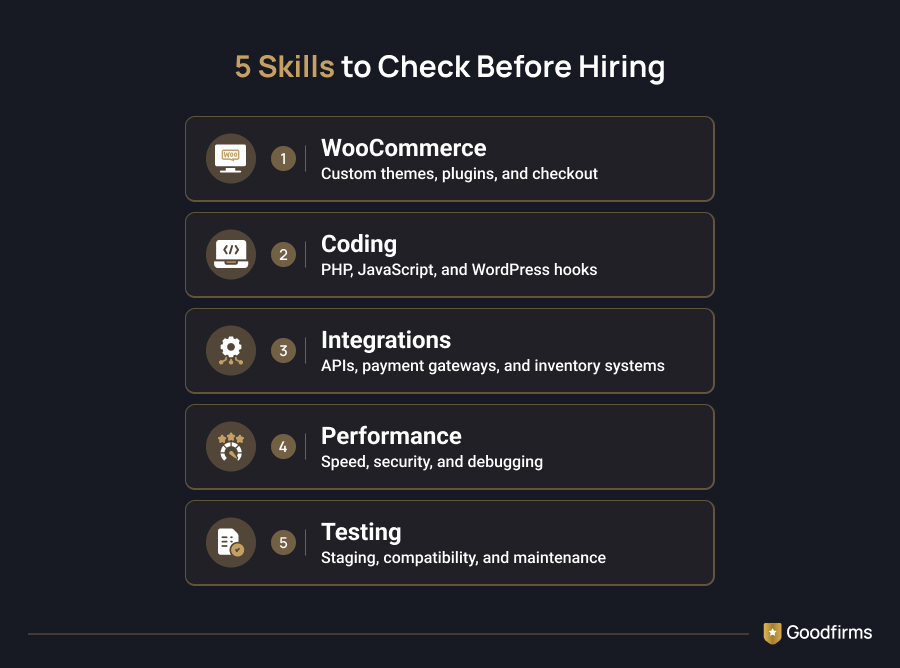
A WooCommerce developer can help with tasks such as:
- Custom store development: Build a storefront, product pages, and shopping experience around your business requirements.
- Theme and plugin customization: Adapt existing features or develop custom functionality without compromising the store's maintainability.
- Third-party integrations: Connect WooCommerce with payment gateways, shipping providers, inventory systems, CRMs, and accounting software.
- Performance optimization: Investigate slow pages, database queries, plugin conflicts, and checkout delays.
- Security and maintenance: Manage updates, backups, compatibility checks, and technical fixes to keep the store running reliably.
The type of expertise you need depends on your project. A store using standard WooCommerce features may require a developer for setup and customization, while a store with complex integrations or high order volumes may need deeper experience with PHP, APIs, database performance, and WooCommerce architecture. Defining these requirements first will make it easier to assess candidates and choose the right hiring model.
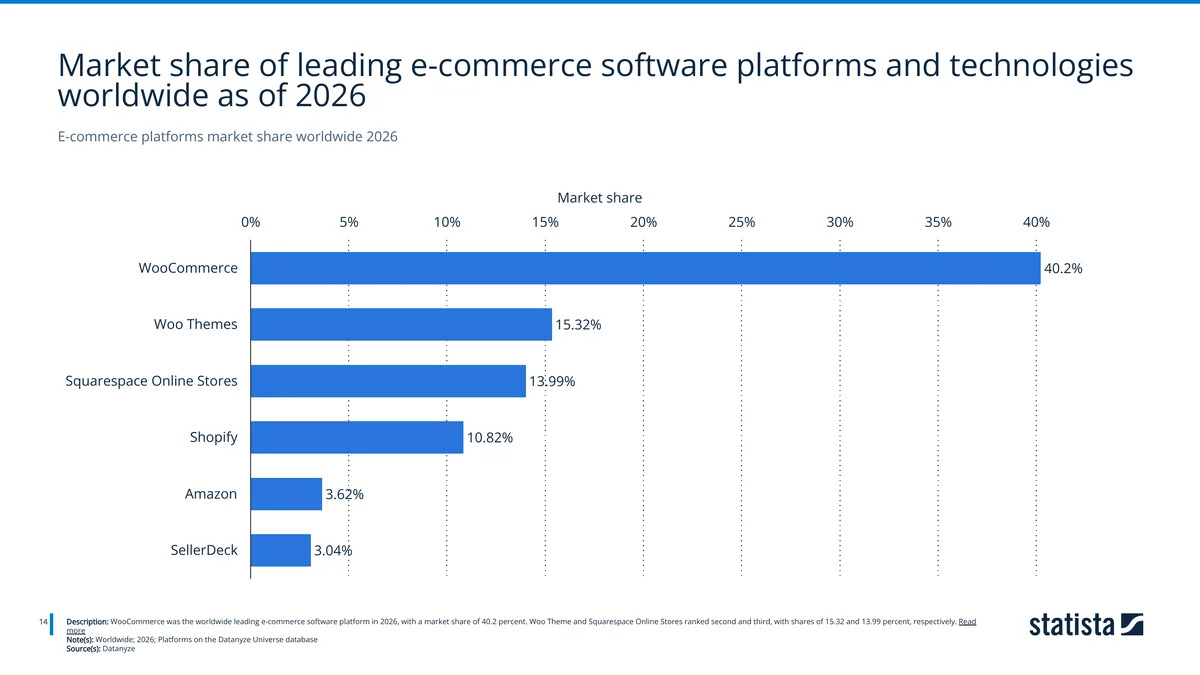
WooCommerce is the top eCommerce software platform in 2026, with a market share of 40.2%. Woo Themes and Squarespace Online Stores ranked second and third with shares of 15.32% and 13.99%, respectively
So, if you are still wondering and are still deciding which plugin to opt for running your eCommerce store, be assured no other plugin can give you a considerable leg-up but WooCommerce.
Hopefully, the above figures are convincing enough for you to take the leap and hire WooCommerce developers for your ongoing or upcoming eCommerce projects.
However, here, an important caveat must be sounded out: Given WooCommerce's growing popularity, there are a dime a dozen WooCommerce developers out there who might promise you the moon in terms of sales and profits. So, you have to be very, very careful when you hire WooCommerce developers, as your eCommerce business may come a cropper if you recruit them without performing a thorough background check.
If your project involves building a complete online store with custom features, payment processing, and third-party integrations, explore eCommerce development companies that can handle your project requirements.
Here is all you need to know before hiring.
Blunder #1: Hiring WooCommerce Developers Without Assessing Their Technical Knowledge
Instead of asking questions that test basic definitions, focus on how candidates approach actual development problems. Here are five questions worth including in your interview.
1. How would you add custom functionality without modifying WooCommerce core files?
Look for an understanding of WordPress hooks, actions, filters, child themes, and custom plugins. Developers should explain how they would extend existing functionality while keeping changes easier to maintain through future updates. WooCommerce's official documentation on hooks is a useful reference for evaluating their answers.
2. How would you troubleshoot a plugin conflict affecting checkout?
A good candidate should describe a structured debugging process. This could include reproducing the issue, reviewing error logs, testing plugins in a staging environment, and checking theme or JavaScript conflicts. They should also explain how they would protect live orders and customer transactions while investigating the problem.
3. How would you integrate WooCommerce with an external inventory or CRM system?
Look for practical knowledge of REST APIs, authentication, webhooks, and data synchronization. Ask how the developer would handle failed requests, duplicate updates, and differences between inventory or order records across systems. WooCommerce provides REST API documentation that can help you assess the technical depth of their answers.
4. How would you customize the cart and checkout experience?
The answer should reflect your project's requirements. For a store using block-based checkout, the developer should understand WooCommerce Blocks and the relevant extension APIs. For other setups, they should explain the appropriate customization approach and how they would test payment flows, validation, and compatibility with existing extensions.
5. How would you investigate a WooCommerce store that slows down as its order volume grows?
Look for an ability to investigate database queries, hosting resources, plugin overhead, caching, and third-party requests before recommending changes. For stores using High-Performance Order Storage (HPOS), ask whether the developer understands its implications for order-data access and extension compatibility.
The best answers will explain not just what a developer would do, but why they would choose that approach, how they would test it, and what risks they would consider.
Blunder #2: Hiring WooCommerce Developers Without Testing Their Practical Skills
A practical assessment before hiring is a must. The test should reflect the work you expect the developer to handle.
You don't need a lengthy assignment. A focused exercise based on a realistic business problem can reveal how a candidate approaches technical challenges, explains decisions, and tests their work.
Test 1: Custom functionality
Ask the candidate to add a custom field or modify a product display using a small WooCommerce development task.
Assess: PHP, WordPress hooks, code organization, and whether the solution avoids editing core files.
Test 2: Debug a checkout issue
Provide a sample scenario in which a plugin update causes checkout errors. Ask the candidate to explain how they would reproduce, investigate, and fix the problem.
Assess: Debugging methods, log analysis, staging practices, and payment-flow testing.
Test 3: Integrate an external service
Ask the candidate to outline or build a small integration that sends WooCommerce order data to an external system using an API or webhook.
Assess: API knowledge, authentication, error handling, and protection against duplicate processing.
Test 4: Diagnose a slow WooCommerce store
Give the candidate a sample performance report or a staging store with a known issue. Ask them to identify likely bottlenecks and recommend fixes.
Assess: Performance analysis, database queries, caching, image optimization, and the ability to justify recommendations.
Test 5: Review code for security and maintainability
Share a short code sample with potential problems and ask the candidate to identify what should change.
Assess: Input validation, permission checks, data sanitization, escaping, and maintainable coding practices.
Blunder #3: Hiring WooCommerce Developers In-House Without Exploring Offshore or Nearshore Alternatives
Hiring a WooCommerce developer is not just a question of finding the right technical skills. Businesses also need to decide how they want to hire, how much they can spend, and whether they need a permanent employee or external development support.
An in-house developer can be a good fit for businesses that need continuous technical support and close collaboration with internal teams. However, the total cost goes beyond the developer's salary. Recruitment, employee benefits, equipment, training, and other employment expenses can add to the budget.
For businesses that need specialized WooCommerce expertise without building an internal team, offshore and nearshore developers offer another option. The right choice depends on the project scope, budget, communication requirements, and expected duration of the engagement.
In-House vs. Offshore vs. Nearshore WooCommerce Developers
Each hiring model has its own advantages. Before making a decision, compare the costs, level of control, and flexibility each option offers.
|
Factor |
In-House Developers |
Offshore Developers |
Nearshore Developers |
|---|---|---|---|
|
Location |
Same office or local market |
A distant country or region |
A nearby country or region |
|
Hiring costs |
Recruitment and employment expenses |
Vendor selection or remote recruitment costs |
Vendor selection or remote recruitment costs |
|
Hourly rates |
Depend on local salaries and employment costs |
Often lower than rates in the hiring country |
May offer lower rates with a closer time-zone overlap |
|
Communication |
Direct, face-to-face collaboration is possible |
Time-zone differences may affect meetings |
Working hours are often easier to align |
|
Project control |
Direct day-to-day management |
Depends on the contract and engagement model |
Depends on the contract and engagement model |
|
Best suited for |
Ongoing work requiring close internal coordination |
Projects seeking access to global talent and flexible costs |
Projects requiring external expertise and convenient collaboration |
Before finalizing your hiring budget, review the latest website development cost estimates for 2026 to understand how project scope, integrations, and development requirements can affect the overall cost.
How Much Does It Cost to Hire WooCommerce Developers in Different Locations?
WooCommerce development rates vary by location, experience, project complexity, and hiring model. Goodfirms' puts the median hourly rate for WooCommerce development companies at $37 per hour. This provides a useful market reference, although individual developers and agencies may charge more or less depending on their expertise and services.
For initial budgeting, businesses can use the following indicative hourly ranges for WooCommerce development services.
Woocommerce development companies in USA are 75 to 150+ USD per hour. Whereas Woocommerce development companies in India is around 15 to 50 USD per hour depending on experience.
|
Location |
Indicative Hourly Rate (USD) |
|---|---|
|
United States |
75–150+ |
|
Western Europe |
60–140 |
|
Eastern Europe |
30–80 |
|
India |
15–50 |
|
Philippines |
15–45 |
|
Latin America |
25–70 |
What Should You Consider Beyond Hourly Rates?
A lower hourly rate does not always mean a lower final project cost. A developer who needs extensive supervision or delivers code that requires repeated fixes may increase the total expense. Compare candidates on their relevant experience, project estimates, communication practices, and ability to deliver the required work.
Before choosing a hiring model, consider these factors:
- Project duration: A short customization may not justify a permanent hire, while ongoing development may require dedicated support.
- Technical complexity: Custom checkout features, payment integrations, and connections with ERP or inventory systems may require specialized experience.
- Communication and time zones: Consider how quickly the developer can respond to questions, attend meetings, and resolve urgent issues.
- Maintenance requirements: Find out who will handle updates, security patches, bug fixes, and performance improvements after launch.
- Contract terms: Clarify ownership of the source code, confidentiality, deliverables, payment terms, and post-launch support before work begins.
The best hiring model is the one that fits your project's requirements and gives you the right level of technical expertise at a reasonable total cost. Compare the full engagement rather than choosing a developer solely because their hourly rate is lower.
Make the Right Hire for Your WooCommerce Store
Hiring the right WooCommerce developer takes more than reviewing a portfolio or comparing hourly rates. You need to assess technical knowledge, test practical skills, and choose a hiring model that fits your project's scope and budget.
Before making a decision, review the developer's experience with similar WooCommerce projects, ask how they approach technical challenges, and clarify the deliverables, timelines, and post-launch support on Goodfirms. If you're considering an offshore or nearshore team, evaluate communication practices and code quality alongside cost.
The right developer should understand your business requirements and have the technical skills to turn them into a reliable WooCommerce store. Take the time to assess your options before hiring, and you'll be better prepared to choose a development partner who fits your needs.