Key takeaways
- Global iGaming operators generated $115 billion in gross gaming revenue (GGR) in 2026, with regulated iGaming markets now making up 59% of that total.
- Flutter Entertainment, Entain, and Betsson sit among the top iGaming operators by GGR worldwide, and each has built a different iGaming operator strategy to get there.
- Licensing first, localized payments, and a compliance-ready tech stack are the three moves every successful multi-jurisdictional iGaming operator makes early.
- Operators that treat iGaming licensing and compliance as a growth lever instead of a cost center tend to expand faster and hold their position longer.
Ever wondered how top iGaming operators scale across regulated markets while others struggle to get a single new region off the ground? It usually comes down to strategy, not luck.
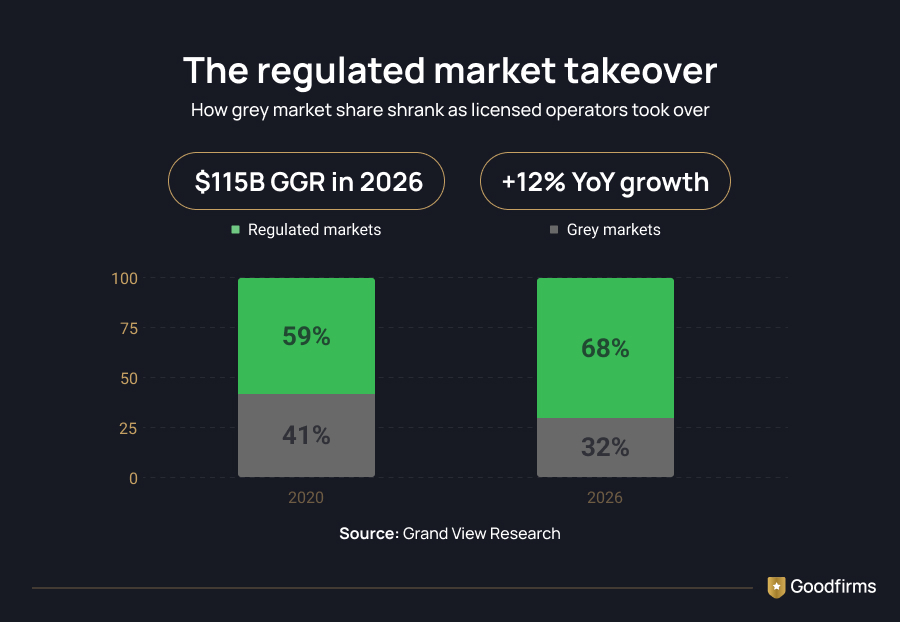
Global iGaming operators generated $115 billion in gross gaming revenue in 2026, up 12% year on year, and online gambling market growth is increasingly coming from regulated iGaming markets, which now hold 59% of total revenue, the highest share on record.
Betsson, Flutter Entertainment, and Entain built three very different playbooks to get there. This blog breaks down each iGaming operator's strategy and what other operators scaling an iGaming business internationally can borrow from it.
Looking to build or scale your own iGaming operation across regulated markets? Explore top iGaming & Casino Platforms built to support multi-market compliance, localization, and growth from day one.
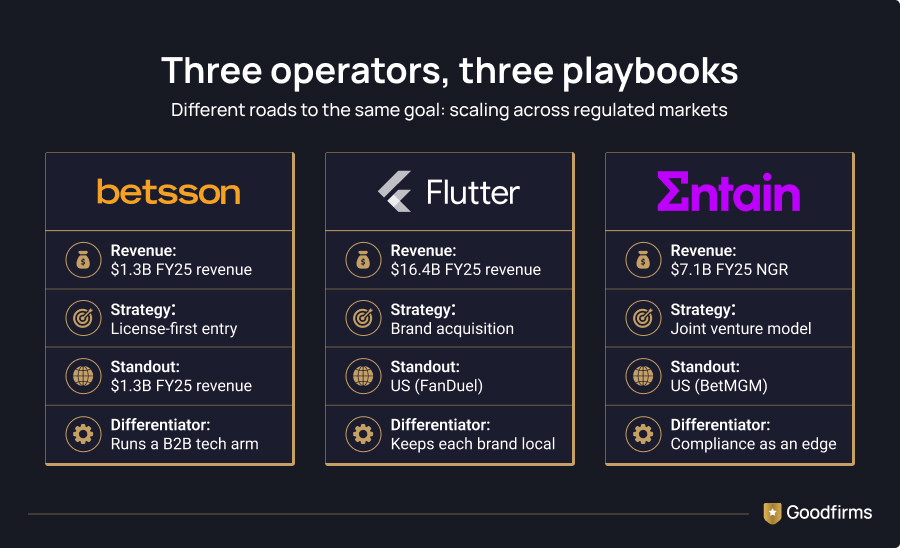
How Betsson, Flutter, and Entain Compare
Before getting into the detailed lessons, here's how the three operators stack up on the moves that actually drove their growth.
|
Dimension |
Betsson |
Flutter Entertainment |
Entain |
|---|---|---|---|
|
Core growth model |
Multi-license coverage + B2B revenue |
Brand acquisition + local identity |
Joint ventures + compliance investment |
|
Entry approach in new markets |
Organic license-first entry |
Acquire an existing local leader |
Partner with a local/land-based player |
|
Standout market |
Latin America |
United States (via FanDuel) |
United States (via BetMGM) |
|
What sets them apart |
Runs a second revenue stream by licensing tech to other operators |
Let's local brands keep their identity instead of one global brand |
Uses player protection investment as a regulatory advantage |
Each of these approaches solves the same problem, scaling across regulated markets, in a completely different way. Here's how each one actually plays out. But first, let's understand the market and the new playbook.
Why Regulated Market Expansion is the New Growth Playbook
For years, iGaming market expansion meant entering a region fast, before regulation caught up. That approach is losing ground, as grey market revenue shrinks against regulated iGaming markets. In 2020, regulated markets held 59% of global iGaming revenue; today, per Grand View Research, that number sits at 59%, with online gambling market growth tilting toward regulated iGaming markets as more regions roll out formal iGaming regulatory frameworks.
Smarter operators now build an iGaming operator strategy around entering a market properly from day one: getting licensed, setting up payment rails, and meeting KYC and AML requirements before launch. Working through iGaming Licensing requirements early saves costly delays, and most firms sort out iGaming licensing and compliance before picking their next market.
There is also a trust factor. A visible license from the UKGC, MGA, GGL, or ADM signals real oversight, driving deposit volume and retention. Different iGaming regulatory frameworks demand different things, so a multi-jurisdiction iGaming operator needs local legal expertise, not a copy-paste checklist.
What It Actually Costs to Get Licensed
Licensing costs vary sharply by jurisdiction, and that gap shapes which markets operators enter first.
|
Jurisdiction |
Application Fee |
Annual Fee |
Approx. First-Year Cost |
|---|---|---|---|
|
Malta (MGA) |
~€5,000 |
~€25,000 |
€50,000–€100,000 |
|
UK (UKGC) |
£4,224–£91,596 (revenue-based) |
£4,199–£793,729 (revenue-based) |
£30,000–£500,000+ |
|
Curaçao |
~€4,592–€17,828 |
€2,000–€15,000 |
€22,000–€80,000 |
This cost spread explains a lot about the strategies covered in this blog. Betsson's steady, multi-market approach works partly because mid-tier licenses are affordable enough to expand into several regions in parallel. Flutter and Entain, by contrast, lean on acquisitions and joint ventures in part because entering a Tier-1 market like the UK carries a cost and compliance load that's often easier to absorb by buying an established local operator than building compliance infrastructure from zero.
How Global iGaming Operators Expand Into New Markets
Most operators expand into a new region using one of three models:
- Organic expansion: Applying for a license and building operations directly in a new market. Slower, but keeps full control over brand and compliance.
- Acquisition-led expansion: Buying an already-established local brand for instant market access, an existing player base, and local regulatory relationships.
- Joint-venture expansion: Partnering with a local or land-based player to split the cost and regulatory weight of entering a high-barrier market.
Who Are the Largest Global iGaming Operators in 2026?
- Flutter Entertainment: Leads global operators by revenue at $16.4 billion, driven largely by FanDuel in the US alongside PokerStars, Betfair, and Paddy Power.
- Entain: $7.1 billion in NGR across bwin, Coral, Ladbrokes, and its BetMGM joint venture in the US.
- Betsson: $1.3 billion in revenue, smaller than Flutter and Entain but with one of the widest license footprints among mid-sized operators.
- Evolution: Primarily a B2B live casino and games supplier rather than a consumer-facing operator, Evolution still ranks among the largest companies in the industry, reporting over €2.4 billion in 2025 revenue and powering 800+ operators worldwide.
- Kindred: Owner of Unibet and 32Red, Kindred is no longer an independent operator. Following its 2024 acquisition by FDJ, it now runs as FDJ United's online betting and gaming segment, which generated roughly €908 million in 2025.
Lessons from Betsson: Steady Expansion Through Multi-License Coverage
Betsson has built its name on being present in more regulated iGaming markets than almost any other mid-sized operator, without the aggressive acquisition spree that defines Flutter or Entain.
1. Licensing as a Foundation, Not an Afterthought
Betsson holds licenses across several European and Latin American jurisdictions and treats iGaming operator licensing requirements by region as something it needs before entering a market, not a formality to sort out later. This approach lets the company move into places like the Netherlands and grow its LatAm expansion without the regulatory scrambles that trip up faster-moving competitors. It's a clear example of an iGaming operator strategy built around patience rather than speed.
2. B2B as a Second Growth Engine
Betsson doesn't only run its own consumer brands. It also licenses its sportsbook technology to other operators, turning its regulatory and platform investment into a second revenue stream. This means Betsson's regulatory groundwork pays off twice, once for its own brands and once for the operators it powers behind the scenes.
This model also gives Betsson a buffer against slowdowns in any single market. If growth in one region cools off, the B2B side keeps generating revenue independent of consumer-facing performance there. Fewer operators build this kind of dual revenue structure, and it's part of why Betsson has stayed profitable and stable even in years when broader online gambling market growth slowed down.
Lessons from Flutter Entertainment: Scaling Through Acquisition and Brand Portfolio
Flutter took a completely different path to iGaming market expansion. Instead of building one global brand, it bought and scaled market-leading local brands in each region it wanted to lead, both in sportsbook and online casino verticals.
1. Brand Localization Over Brand Consolidation
FanDuel in the US, Betfair and Paddy Power in the UK, and PokerStars worldwide each run as separate brands with their own local identity. Flutter never tried forcing one brand name across every market. It let each brand keep the recognition it had already earned, then layered shared technology and compliance systems underneath, a structure built for a genuine multi-jurisdiction iGaming operator rather than a single-market business.
2.US Expansion Through FanDuel
FanDuel alone brought in over $6 billion in total revenue in 2025, making it the largest single sportsbook brand in the world by revenue. Flutter's early bet on US state-by-state legalization, paired with fast entry the moment a state went live, is a big reason the company now ranks among the top iGaming operators by GGR globally.
3. Emerging Market Entry Through Acquisition
Flutter's move into Brazil happened through a majority stake in a leading local sportsbook brand rather than launching from scratch, a textbook iGaming market entry strategy for new regions. That gave the company an existing user base and local market knowledge from day one, cutting down the ramp-up time a brand-new regulated market usually demands.
This approach has become something of a template for Flutter's iGaming market expansion whenever a new region opens up for regulated betting. Instead of running a slow organic build-up, the company looks for a local brand that already has traction, then applies its own technology, compliance systems, and marketing budget on top. It's a faster route to scale, though it does mean paying a premium upfront for a business that's already proven itself in that market.
Lessons from Entain: Multi-Brand Strategy Backed by Compliance Investment
Entain runs one of the widest brand portfolios in the industry, spanning bwin, Coral, Ladbrokes, and partypoker, alongside its BetMGM joint venture in the US with MGM Resorts, built around joint ventures instead of outright acquisition.
1. Joint Ventures to Enter High-Barrier Markets
Rather than entering the US alone, Entain partnered with MGM Resorts to launch BetMGM. This joint venture gave Entain a land-based licensing anchor in states where online-only operators often struggle to get approved, while splitting the cost and regulatory weight of entry, an approach that fits Entain's broader multi-jurisdiction iGaming operator model.
2. Responsible Gambling as Part of the Product
Entain has put real money into AI-driven risk management tools built to flag problem gambling behavior before it escalates. This isn't just a box to tick. Regulators across the UK and Europe, working under some of the strictest iGaming regulatory frameworks anywhere, increasingly expect operators to show proactive player protection, and Entain's early work here has made regulatory conversations easier as it enters new territories.
Regulators are far more willing to approve a new license for an operator with a working track record on player protection. Entain has used this credibility when negotiating entry into stricter iGaming regulatory frameworks, turning a compliance cost into something closer to a competitive edge.
3. Consistent Backend, Localized Frontend
Across its brand portfolio, Entain keeps core systems like Player Account Management consistent while letting each brand's player-facing experience reflect local preferences. This balance lets the company scale operational efficiency without losing the local feel each brand needs to compete.
Key Factors Behind Successful Multi-Jurisdiction iGaming Expansion
Despite taking different paths, Betsson, Flutter, and Entain converge on a similar iGaming operator strategy when it comes to scaling across regulated markets. Looking at the Betsson, Flutter, and Entain expansion strategy side by side, a few shared principles stand out clearly.
|
Playbook Move |
Who Does It Best |
Why It Works |
|---|---|---|
|
Licensing before growth targets |
Betsson |
Treats every new license as a prerequisite, not a formality |
|
Brand-led market entry |
Flutter Entertainment |
Acquires and scales local brands instead of forcing one global identity |
|
Compliance as a regulatory advantage |
Entain |
Uses proactive player protection to speed up approvals in new markets |
|
Localized payments and risk systems |
All three |
None of them runs on a single global payment or fraud model |
That's the short version. The sections below unpack exactly how each of these moves plays out in practice.
1. Licensing and Compliance Come Before Growth Targets
All three operators treat iGaming licensing and compliance as the starting point for expansion planning, not a hurdle they deal with once a market decision is already made. Handling iGaming compliance across multiple jurisdictions at once takes real coordination, but it cuts the risk of shutdowns, fines, or forced product changes right after launch.
2. Payments Are Localized From Day One
None of these operators runs on a single global payment stack. Local payment methods, PIX in Brazil, card-based systems across Europe, and region-specific rails elsewhere get built into launch plans from the start. Picking the right iGaming Payment Solutions Providers for each region tends to directly affect how many players actually convert and stick around.
A player who has to fight through an unfamiliar checkout flow or wait days for a withdrawal is far more likely to churn, no matter how good the actual product is. Affiliate and payment localization working together tend to move retention numbers more than either one does on its own.
3. Fraud and Risk Systems Scale With the Business
As operators expand into markets with different fraud patterns and payment habits, their fraud detection needs to keep up. Operators researching Fraud Detection Software for cross-border expansion usually look for platforms that can adapt rules by region instead of applying one static model everywhere. What flags as suspicious activity in one market might be completely normal player behavior in another, so a rigid, one-size-fits-all fraud model tends to either miss real risk or block legitimate players by mistake.
4. Mergers and Acquisitions Speed Up Market Entry
Both Flutter and Entain have used acquisitions to enter new regions faster than an organic launch would allow, a pattern that shows up again and again in how iGaming operators scale across regulated markets. Buying an established local brand comes with an existing player base, regulatory relationships, and market knowledge that would otherwise take years to build from scratch.
Challenges Operators Face When Scaling Globally
Scaling internationally isn't without friction, even for operators with a strong playbook behind them.
- Regulatory fragmentation: Every region runs its own iGaming regulatory framework, with different licensing bodies like the UKGC, MGA, GGL, and ADM, its own tax rate, and its own compliance requirements, so no single playbook works everywhere.
- Grey market pressure: Regions like Asia-Pacific still carry a large grey market share, and the gap between grey market vs regulated market access makes it harder for licensed operators to compete on price.
- Payment friction: Card decline rates and payment trust vary a lot by region, and operators that ignore this see lower conversion despite a strong product.
- Player protection expectations: Regulators in mature markets like the UK keep tightening affordability checks and advertising limits, which can slow growth even for well-established brands.
- Operational scaling: Running iGaming compliance across multiple jurisdictions at once, alongside support and marketing, takes operational depth that smaller operators often underestimate going in.
None of these are dealbreakers alone, but they stack up fast without enough runway between launches. Betsson, Flutter, and Entain all took a staggered approach to iGaming market expansion rather than launching everywhere at once, and that pacing is often the difference between a launch that sticks and one that fizzles out.
What This Means for Operators Planning Global Expansion
For operators looking to follow a similar path, a few practical steps stand out from these three case studies on scaling an iGaming business internationally.
Start with an iGaming market entry strategy for new regions that puts licensing research ahead of product or marketing budget. Build payment localization into the initial launch plan instead of adding it after go-live. Invest in fraud and risk systems that can flex by region rather than relying on one global ruleset. And where speed matters more than organic growth, look at partnerships or acquisitions to shortcut the usual market entry timeline.
Operators that keep player retention strong across markets also tend to invest early in the right Affiliate Software, since affiliate and payment localization together remain one of the most consistent acquisition drivers across regulated and newly regulated regions alike.
It also helps to sequence expansion rather than solving everything at once. Most operators that scale successfully pick one or two markets a year, giving compliance and support teams time to actually learn each region instead of guessing.
Where Global iGaming Operators Go From Here
So what's the real takeaway here? Betsson, Flutter, and Entain show three different ways to answer the same question: how iGaming operators scale across regulated markets while staying profitable along the way. Betsson leaned into steady, license-first expansion with a B2B layer underneath it. Flutter scaled through brand acquisition and let local identities lead the way. Entain used joint ventures and compliance investments to unlock high-barrier markets like the US.
What ties all three together is simple: none of them treated iGaming licensing and compliance as separate from growth. If there's one lesson worth carrying forward for any global iGaming operators eyeing their next region, it's that mindset shift, compliance as something that fuels growth instead of slowing it down.
FAQs - Global iGaming Operators
1. What makes a market "regulated" in the iGaming industry?
A regulated iGaming market is one where a government body issues formal licenses to operators and sets clear rules around player protection, taxation, advertising, and anti-money laundering compliance. The UK, Germany, and Brazil are good examples of this. Operators entering these markets need to meet local iGaming regulatory frameworks before they can accept a single player, which is very different from grey markets where oversight is loose or non-existent
2. Which iGaming operator has the largest global market share?
Flutter Entertainment currently ranks among the top iGaming operators by GGR, driven largely by its FanDuel brand in the US alongside PokerStars, Betfair, and Paddy Power internationally. Its strategy of acquiring and scaling market-leading local brands, rather than pushing one global brand everywhere, is a big part of why it holds that position today. Entain and Betsson follow with different but equally deliberate strategies, so the gap at the top isn't as wide as total revenue numbers alone might suggest.
3. Why do iGaming operators prioritize licensing before launching in a new market?
Operating without a license in a regulated market can lead to shutdowns, fines, or a permanent block on future licensing applications in that region. Getting iGaming licensing and compliance sorted first also builds trust with local payment providers and banking partners, who are often hesitant to work with operators that haven't secured proper regulatory approval yet.
4. How important are payment options when entering a new iGaming market?
Very important, more than most operators expect going in. Players are far more likely to deposit and stay active on platforms that support payment methods they already trust and use daily. That's why operators localize their payment stack by region instead of relying on one global system that works fine in one market and falls flat in another.
5. What role do acquisitions play in iGaming market expansion?
Acquisitions let operators enter new regions faster by gaining an established brand, an existing player base, and local regulatory relationships instead of building all three from the ground up. Flutter's entry into Brazil and Entain's BetMGM joint venture both show how much time this approach can save compared to launching cold in a brand-new market. The tradeoff is cost, since acquiring an established brand or entering a joint venture usually requires a much larger upfront investment than a slow organic launch would.