Key takeaways
- A partner without direct OT (operational technology) experience is a red flag. General IT credentials do not translate to the production floor.
- Staff augmentation, dedicated teams, and project-based engagements solve different problems. Matching the model to the need matters more than the size of the vendor.
- Credible partners propose a pilot before committing you to a multi-month program.
Measure success in operational terms, such as uptime and cost per downtime hour, rather than just delivery velocity.
Picking the wrong software development company shows up on the floor, in the migration that stalls a production line, or in the integration that quietly breaks a machine's data feed. A support gap can turn a two-hour fault into a two-shift one, and that cost lands in operations. In automotive plants, an idle line can cost up to $2.3 million an hour, according to Siemens' True Cost of Downtime research. The number varies by sector, but the pattern holds everywhere: when a plant stops, the losses land immediately and cannot be recovered.
That makes choosing a manufacturing software development partner an operational decision. The partner you select will touch systems that were never built to be interrupted, on timelines set by production. This guide walks through how to make that choice in 2026. It covers how to define your actual problem, match it to the right engagement model, test for genuine OT experience, verify cybersecurity posture, and insist on proof before you sign a multi-month program.
Ready to shortlist? Check Goodfirms' list of manufacturing software development companies curated based on verified reviews and portfolios.
How to Choose the Right Manufacturing Software Development Firm (Quick answer)
To choose a manufacturing software development partner in 2026, start by defining the problem you have: OT modernization, a new IIoT build, or ongoing support. Match the engagement model to that problem, whether staff augmentation, a dedicated team, or a project-based contract. Verify direct OT experience rather than general IT credentials alone. Confirm the partner can implement without disrupting live production, and check their cybersecurity posture for OT systems specifically. Ask for a pilot before committing to any multi-month program and agree on how success will be measured in operational terms.
Step-by-step guide to Selecting the Best Manufacturing Software Development Agency
Below are the steps to follow to choose an appropriate manufacturing software development company
1. Define your problem type
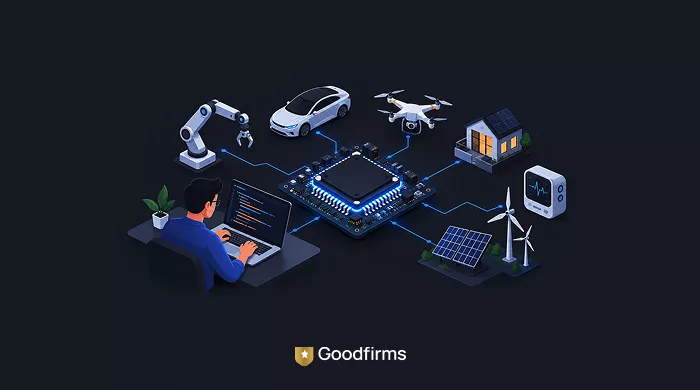
The right partner depends entirely on what you are solving, so the first step happens before you contact anyone. Three problem types dominate manufacturing software work. OT modernization means updating or re-architecting the systems that run production: programmable logic controllers (PLCs), supervisory control and data acquisition (SCADA) systems, and manufacturing execution systems (MES), often decades old and never designed to connect to anything outside the factory. A new IIoT build means adding a capability you do not have yet, such as real-time machine monitoring or a shop-floor data platform that gives operations visibility. Ongoing support means keeping existing systems running, patched, and steadily improving without a single defined endpoint.
Write down which of these describes your situation and be honest about the scope. Many manufacturers describe their need as a new build when the real work is untangling legacy OT first. A vendor suited to a greenfield IIoT project may be the wrong choice for delicate modernization on a 20-year-old line, and a firm that excels at careful legacy work may be slow and expensive for a clean-slate build. Getting this wrong at the start cascades into every decision that follows, because it sets the engagement model, the skills you screen for, and the questions you ask.
2. Match the engagement model to the problem
Once the problem is clear, the engagement model follows from it, as the table below lays out. A defined build with a fixed endpoint suits a project-based contract, where cost certainly matters more than day-to-day control. Multi-year, evolving work suits a dedicated team that retains context over time, because the accumulated knowledge is the point. A specific skills gap in a team that already owns direction suits staff augmentation, where you keep the roadmap and add capacity.
The common mistake is choosing the model by vendor size or existing relationship rather than by the shape of the work. Despite the reputation, when what you need is an embedded software development company, a large firm selling a fixed-price project is a mismatch. So, if a boutique offering is to augment your team when the work is a self-contained build, they should own end-to-end. Decide on the model you need before vendors start steering you toward the one they prefer to sell.
|
Category |
Staff Augmentation |
Dedicated Team |
Project-Based Engagement |
|---|---|---|---|
|
Best for |
Filling a skill gap |
Long-term, ongoing work |
Fixed-scope projects |
|
Time to start |
2–4 weeks |
4–8 weeks |
Slower to scope, fast once started |
|
Control level |
High |
Shared |
Lower, partner-led |
|
Manufacturing use case |
Short-term PLC integration |
Shop-floor data platform |
SCADA modernization project |
3. Evaluate specifically for OT fluency
This is where most selection processes go wrong. An IT services firm can have an impressive portfolio of web apps, cloud migrations, and enterprise asset management software, and still have never touched a production floor. OT is a different discipline with different failure modes and different stakes. Ask concrete questions and listen for specifics rather than reassurance. Have they worked with PLCs, SCADA, or distributed control systems (DCS) directly? Do they understand industrial protocols such as OPC UA, Modbus, or PROFINET? Can they name a plant environment they have integrated with, describe what broke, and explain how they handled it under production pressure?
General IT experience does not transfer to OT, where a wrong configuration does not throw an error; it stops a line. A candidate who talks fluently about cloud computing services but goes vague when you ask about a historian or a control system has not done this work. Treat the absence of direct OT experience as a red flag rather than a gap you can coach them through. The learning curve is real, and you do not want it running on your production floor at your expense.
4. Test their approach to zero-disruption implementation
Production lines run on schedules that do not pause for software rollouts, so how a vendor implements matters as much as what they build. Ask each candidate how they deploy changes on a live line without stopping it, and press for the mechanics. Strong answers include staged rollouts that touch one asset before the whole line, testing against a digital replica or sandbox before going near real equipment, working strictly inside planned maintenance windows, and keeping a tested rollback ready for the moment something behaves unexpectedly.
Weak answers treat the production environment like a staging server that can absorb a bad deployment. A team that assumes downtime is available for their convenience, or that cannot describe how they contain the blast radius of a change, will interrupt output sooner or later. If they cannot explain specifically how they protect production during implementation, assume the risk transfers to you.
5. Check their cybersecurity posture for OT systems specifically
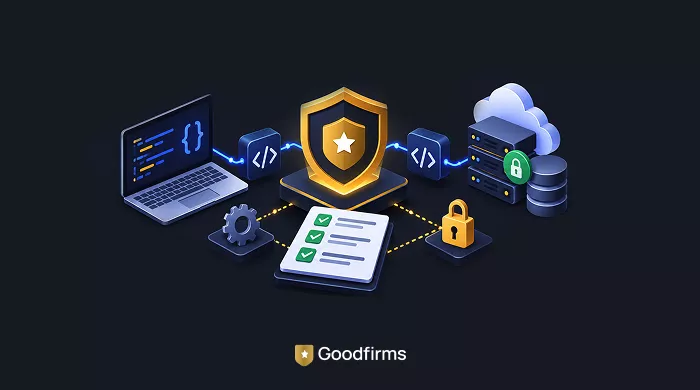
IT security practices do not map cleanly onto OT, and a vendor who does not know the difference is a liability. Legacy OT systems were built to be isolated, and connecting them to a network exposes equipment that was never designed to defend itself. Ask how cybersecurity companies secure the IT/OT boundary, how they segment networks so that a compromise on the business side cannot reach the shop floor, and how they patch systems that cannot simply be taken offline for updates.
For automotive supply chain work, ask whether they are familiar with TISAX, the sector's security assessment standard, and whether they can operate within its requirements. Where relevant, ask how they approach emerging regulations such as the EU Cyber Resilience Act. A company that answers OT security questions with generic IT talking points, or that treats security as a phase to add later rather than a constraint on every design decision, has not worked in this environment.
6. Ask for a pilot before full commitment
A pilot is a small, time-boxed first engagement that proves the partner can deliver in your environment before you commit to a multi-month program. It might be connecting a single machine to a live dashboard or standing up one predictive-maintenance use case on one critical asset, with a clear result you can judge. An eight-to-twelve-week pilot tells you what a sales deck cannot: whether they understand your OT, whether they integrate without breaking anything, and whether the working relationship holds up under real conditions.
Credible partners propose this themselves, because a pilot lowers the risk for both sides and lets them prove value rather than promise it. A firm pushing straight into a long fixed-scope contract, skipping the trial, is either overconfident or protecting revenue before you can evaluate them. In the Nordics, a pilot-first approach is often expected as standard practice. In the US, it is less automatic, so you may need to insist on it, and a good manufacturing software development company will welcome the request.
7. Clarify how they will measure success
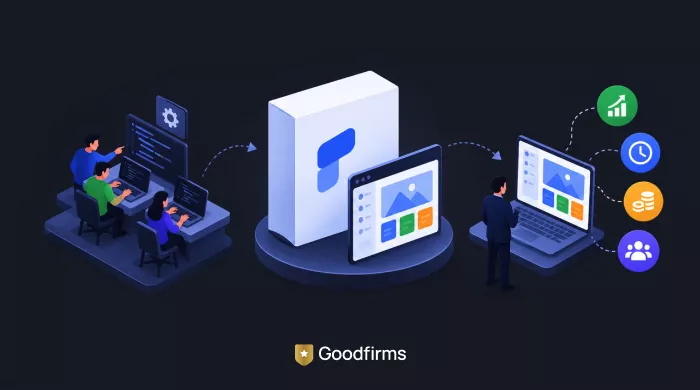
Delivery velocity is not the same as operational impact. A partner can ship every milestone on schedule and still leave your uptime exactly where it was. Agree upfront on the metrics that matter uptime, mean time to repair, cost per downtime hour, throughput, or scrap rate. Tie the engagement and its reviews to those numbers alongside feature completion, so that progress is measured where it counts.
If a vendor resists operational metrics and wants to be judged solely on deliverables shipped, that tells you where their accountability ends. The firms worth hiring are comfortable being measured based on outcomes because they expect to move them.
8. Confirm staffing continuity
Find out who you are working with day-to-day, and whether those people stay for the duration. OT knowledge is cumulative, and it lives in the engineers who have learned your plant's quirks rather than in the vendor's brand. Someone who has spent three months absorbing how your line behaves is worth far more than a fresh replacement, however well credentialed, because the replacement starts the learning curve over.
Ask about team stability and typical turnover, how handovers are documented and managed, and whether the specialists in the sales meeting are the ones who will do the work. High turnover on an OT engagement means relearning your environment repeatedly, and every relearning cycle carries the same risk you were trying to avoid when you hired a partner in the first place.
Once you know what to screen for, it helps to see how the established manufacturing software development companies compare against these criteria.
What Does Manufacturing Software Development Cost in 2026?
Custom software development cost in 2026 depends less on a single hourly figure than on how the engagement is priced, because the three models bill differently. You can hire dedicated teams from Staff augmentation companies, which are priced per engineer, so the headline number is a rate. Project-based work is priced against scope, so the number is a quote. One caution runs through all three: the hourly rate is not the real cost. Industry guidance suggests budgeting 1.4 to 1.8 times the headline rate to cover management, ramp-up, and attrition. Manufacturing and OT expertise is a specialized skill set, so expect rates at or above the general software development ranges below.
|
Engagement Model |
Headline Number |
Real Cost Rule of Thumb |
|---|---|---|
|
Staff Augmentation |
An hourly rate, scales with headcount |
Add 40–80% for management, ramp-up, and attrition |
|
Dedicated Team |
A fixed monthly cost, per engineer |
Add 40–80% for management, ramp-up, and attrition |
|
Project-Based |
A quote against defined scope |
Already reflects full delivery cost |
Red Flags to Watch For
-
No direct OT experience. A portfolio of web and enterprise software only.
-
No pilot on offer. Straight to a long fixed-scope contract.
-
Generic IT answers to OT security questions.
-
Downtime assumed to be available. No staged deployment, no rollback.
-
The experts in the sales meeting vanish after signing. Ask who is actually assigned.
-
Success defined only as features shipped.
Key Challenges When Switching or Choosing a New Partner
Even a well-chosen partner comes with switching costs, and it helps to price them in first. Changing partners mid-project is the most expensive moment; to move work in flight has to be paused, documented, and handed over, and any gap shows up later as a defect. Knowledge transfer is the underlying risk, because on OT work, much of what matters lives in the engineers who learned your plant rather than in documentation. Plan and pay for transfer as part of any exit rather than assuming it happens for free. Vendor lock-in is the quieter cost: proprietary tooling, undocumented integrations, or partner-owned hosting make the next transition harder by design, so confirm who owns the code, data, and infrastructure in the contract. The hardest challenge is often internal, justifying the budget against capital projects with faster returns. Framing the case in operational terms, avoiding downtime and its cost per hour, is what gets it approved.
FAQs About Selecting a Manufacturing Software Development Firm
How long does it take to onboard a manufacturing software development partner?
Staff augmentation can place a specialist in days to a few weeks, while a dedicated team usually needs a few weeks to align on context and access. On OT work, expect the longer end regardless of the model, because the partner has to learn your specific production environment before touching it. A short pilot of eight to twelve weeks is the safest way to absorb that context before a larger commitment.
What is the difference between an IT vendor and an OT-aware vendor?
An IT vendor builds software. Аn OT-aware vendor understands the systems that run production. OT-aware partners have worked directly with PLCs, SCADA, or DCS systems and know industrial protocols such as OPC UA or Modbus. The practical difference shows up in risk. An IT vendor tends to treat production like a staging server, where a bad deployment can be rolled back without much cost. An OT-aware vendor designs around not stopping the line, because on the floor, a wrong configuration halts the output.
What are the signs my current software development partner is not working out?
The clearest signs are operational rather than contractual. Uptime or throughput has not improved despite delivered milestones and every change to a live line still risks a stoppage. If results are only reported as features shipped and never as operational impact, the relationship has drifted from the outcome you were paying for.
Choose a Manufacturing Software Development Partner with Confidence
Choosing a manufacturing software development company is a decision you make with incomplete information, and the goal is to reduce that gap before you commit real money and production risk. Define the problem before you shortlist. Match the engagement model to the work rather than to the vendor's preference. Screen for genuine OT experience, test how they protect a live line, and check how they secure systems that were never built to be connected. Then ask for a pilot and judge it on operational results rather than milestones delivered. A partner worth keeping will welcome being measured that way, because the same discipline that protects your uptime is what protects the engagement.