Today, the IT market offers a lot of proposals to develop a wide range of software products which have similar functionalities and structure but which are very often different at their price. The ever-changing market situation shows the need for the development of new methodologies for estimating the software cost.
Insurance software costs vary widely because every project is different. A basic policy portal can start in the tens of thousands of dollars, while a full platform with automated premium calculations, claims management, and multiple dashboards can climb well past six figures.
This guide covers the 10 factors behind that cost so you can budget realistically and understand what’s driving a vendor’s quote. Before we get to those factors, it helps to know how software cost is estimated in the first place.
Need an insurance software partner? Browse top insurance software development companies on Goodfirms and compare reviews and rates.
Methods of Software Cost Estimation
Software cost is calculated in several ways, and each method rests on different data and assumptions. Here are the seven most common.
Method of expert estimations is based on multiple interviews with experts in software development having extensive knowledge in a particular industry or business domain.
Method of analogy is used to estimate the project cost if similar projects have been already realized. It is based on the comparison of the planned project with the previously accomplished projects having the same characteristics.
Empirical method is based on specially conducted researches and investigations with further statistical analysis. They are different in their sets of the factors included in the cost formula.
Structural-algorithmic method is based on the analysis of the statistics data on the previously accomplished projects.
Software Life-Cycle Model (SLIM) is based on the estimating time and work needed to estimate the software product of a certain scope.
Neural networks - self-learning systems simulating human activities; a tool to look for patterns, forecasting, and analyzing data.
Constructive Cost Model (COCOMO) establishes the dependency between the program code scope and labor input.
Although there are many methods for calculating software costs, none outperforms the others. To estimate project cost accurately, vendors may combine methods or use several to compare results.
Whichever method a vendor uses, the estimate is only as good as the inputs behind it. For insurance software, these are the 10 factors that most influence those inputs.
10 Factors That Influence Insurance Software Cost
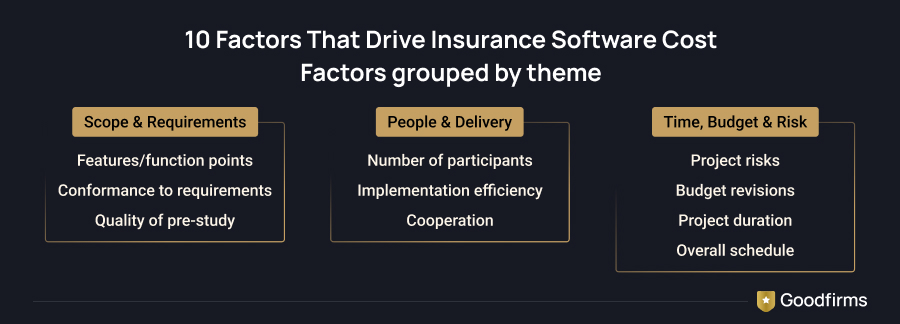
Since insurance software products are usually complex multi-modular systems, it’s quite difficult to estimate their cost accurately. Let's figure out which factors influence the price of insurance IT products across three themes.
Scope and Requirements
1. Number of Features/Function Points
As we know, insurance software has many useful features, such as claims management, policy administration, data compliance, and utilization. Each feature is characterized by multiple functionalities. Developing these system modules requires effort and a lot of time. The number of system features affects the cost of the end product. To estimate the cost, developers use special measurement units called "function points" that express the number of functionalities.
Customer-facing features such as self-service portals and agent dashboards add front-end work, so it helps to compare insurance web development companies and see how providers approach them.
2. Conformance to Requirements
Insurance agencies and companies handle different types of insurance programs like professional liability, property, life, business, etc. Depending on the type of insurance the company offers, it needs the software that corresponds to the functionalities necessary to provide relevant services. Before starting to develop a project, customers must provide developers with their needs, wants, and initial requirements. Developers, on the other hand, should conduct in-depth business analysis to find out the key needs and peculiarities of the business for which they will build a system.
3. Cost and Length of Pre-Study
It is presumed that large and long-lasting projects have more expensive pre-study phases than small projects. Note, that a well-conducted pre-study is a good investment of time and money. It is the quality of the pre-study rather than the length or cost of the pre-study that influence the project cost where a thoroughly performed pre-study reduces the total price of the end product. Thus, customers should take the quality of the business analysis and pre-study into consideration as these could increase the accuracy of the development cost estimation models.
People and Delivery
1. Number of Project Participants
Among the major project variables are the number of participants and the team composition. Every added project participant will definitely result in an added cost to the project. The same team composition influences the total cost of the software because employees' skills, knowledge, and even personality traits affect productivity and performance.
2. Implementation Efficiency
Implementation takes significant time and resources, and delays at this stage increase costs. It is rarely the biggest cost driver, but it is one of the most controllable. Plan end-user training early, and keep your SRS (software requirements specification) documentation accurate, since unclear documentation leads to rework. Implementation efficiency also depends on how well the software matches your requirements, which the next factor covers.
If your requirements are fairly standard, off-the-shelf insurance agency software may cover them at a lower cost than a custom build, so compare both options before you commit.
3. Cooperation
Cooperation between your team and the vendor affects cost mainly through estimation accuracy. Clear communication, named decision-makers, and regular reviews catch misunderstandings early, before they turn into rework. Experts disagree on whether cooperation directly changes cost, but effective management, communication, and collaboration improve estimation accuracy.
Time, Budget, and Risk
1. Risks
Risks usually begin with an uncertain event or a condition that could occur. If uncertainty arises, it may negatively affect project implementation. Thus, there's a strong correlation between the software cost and the assessed project risks. The higher the project risks, the higher the costs for development services.
Technology choices carry risk, too, and legacy systems are a common example. Vineet Bansal, chief information and technology officer at The Mutual Group, says maintenance is only part of the bill. He points to lost business and legacy-specific talent, which is harder to find and costlier to retain, as the other costs carriers often overlook. (Source: Insurance Business, August 2026)

Older technology is inherently more expensive to maintain, but that’s not the whole story.
2. Budget Revisions
The project budget is the money allocated for the software development for a certain period of time. The budget should be managed efficiently to reach the project objectives. When it comes to budget revisions, however, stakeholders forget that it may affect the total cost. It is considered that projects with many budget revisions are much more expensive than those with few revisions.
3. Project Duration
Project costs and the number of workdays are interrelated since every added workday provides additional costs. Thus, the project duration should also be estimated properly. For this, developers follow an established procedure which may include estimation of the productive hours per day, multitasking productivity loss, delays calculation, available workdays, etc. All these factors influence the overall duration of the insurance software project.
4. Existence of Overall Schedule
The existence of an overall schedule is often thought of as a key to keeping costs low. A schedule is a list of all the activities, milestones, and deliverables which typically have the start and end dates. Any changes in the schedule will more likely cause an increased backlog in software product delivery.
Final Thoughts
Insurance software is complex, which makes development costs hard to estimate. Across the factors covered here, the ones with the most direct impact on cost are feature scope (function points), team size and composition, and the clarity of your requirements. Accounting for project risk in your estimate can also make it more reliable.
If you want customized insurance software without overspending, compare providers among the top software development companies listed on Goodfirms.
FAQs- 10 Factors That Drive Insurance Software Cost
1. How long does it take to build insurance software?
A single-module MVP usually takes 3 to 6 months. A full platform with policy administration, claims, and underwriting can run 9 to 15 months or more, especially if it has to connect to legacy systems. Compliance checks and data migration tend to stretch the schedule further, so build time for both in from day one.
2. Is custom or off-the-shelf insurance software cheaper?
Usually, off-the-shelf insurance software costs less. However, custom software may be a better investment for businesses with specific workflows. Packaged tools often charge monthly or per user, so you have to put in extra costs to adapt them to your processes. Though custom software requires a larger initial investment, you can tailor it to your needs. Compare the total cost over three to five years, including licenses, customization, maintenance, and support, before deciding.
3. Is it cheaper to start with an MVP?
Yes, it is cheaper to start with an MVP as it lowers the upfront cost. You can also test the product before you commit to a full platform. Start with the modules users need first, like policy management or claims intake, and add underwriting, analytics, or mobile later. Just plan the architecture for those later modules now, or you’ll pay for rework.
4. Why does legacy system integration raise insurance software cost?
Legacy systems do not integrate seamlessly with new software. So, developers have to build custom middleware, migrate data, and run additional rounds of testing, which raises both the budget and the timeline. Many legacy platforms lack modern APIs, so connectors must be in place before any new feature can access existing policy and claims data. Ask vendors to price integration as a separate line item so it doesn’t get buried in the total.
5. Which compliance requirements affect insurance software cost?
Data privacy rules such as the GDPR, health data rules like HIPAA, and local insurance regulations affect insurance software costs. Which ones apply depends on your lines of business and where you operate. In the U.S., state rules such as rate filings and licensing can also shape the design. Each requirement adds design, testing, and audit work, so settle your target markets before asking for quotes.