Key takeaways
- In the Node.js vs Django decision, Node.js is a strong choice for real-time features, I/O-heavy APIs, and teams working primarily with JavaScript. Django suits projects that benefit from built-in admin tools, authentication, structured data models, and Python’s ecosystem.
- Django can speed up MVP development by providing many common web features. Node.js offers flexibility, but the tools and frameworks you choose affect how quickly you can build.
- Performance depends on the workload, implementation, database, and infrastructure. Neither option is universally faster or more scalable.
- Your team's existing skills, hiring options, budget, and long-term maintenance needs should guide the decision.
Every new web project has to settle the Node.js vs Django question early on. Both are solid options, but each has its own strengths. Node.js offers flexibility for real-time applications and I/O-heavy APIs, while Django provides built-in tools that can speed up development. The better fit depends on your project’s needs, your team’s experience, and how soon you want to get it up and running.
This guide compares Node.js and Django across performance, scalability, security, and hiring to help you decide which one fits your project.
Already leaning one way? Explore Node.js development companies for the JavaScript route, or Django development companies if Python is your pick.
Node.js vs Django: Which Should You Choose?
|
If your priority is… |
Consider |
Why |
|---|---|---|
|
Chat, live updates, or persistent connections |
Node.js |
Its event-driven model suits concurrent I/O-heavy workloads |
|
Built-in admin and authentication tools |
Django |
Common web development features are included |
|
Data science or Python-based AI integration |
Django |
It works naturally with Python's data ecosystem. |
|
JavaScript across frontend and backend |
Node.js |
Your team can use one primary language across the stack |
|
Fast delivery with an experienced existing team |
Either |
Familiarity can reduce ramp-up time and implementation risk. |
What Developers are Using
Based on responses from roughly 49,000 developers.
- Node.js: 48.7% of respondents use it.
- Django: 12.6% of respondents use it.
- Python’s use rose 7 percentage points year over year to 57.9%, coinciding with growth, while JavaScript remains first at 66%.
The usage numbers offer some context, but popularity alone won't tell you which option is right for your project. Here's how Node.js and Django compare on the features that matter most.
Node.js vs Django at a Glance
Node.js is a JavaScript runtime that lets you run JavaScript on the server, often paired with a framework such as Express or NestJS. Django is a Python web framework that comes with most of the tools needed to build a web application. Node.js gives you flexibility, and you assemble the pieces. Django gives you structure, and the pieces come included.
|
Factor |
Node.js |
Django |
|---|---|---|
|
Language |
JavaScript or TypeScript |
Python |
|
What it is |
JavaScript runtime |
Python web framework |
|
Approach |
Flexible; add frameworks and packages |
Batteries included; established conventions |
|
Concurrency |
Event-driven, non-blocking I/O |
Supports synchronous and asynchronous views |
|
Structure |
Depends on the framework and team conventions |
Model-View-Template (MVT) architecture |
|
Best suited to |
I/O-heavy APIs, real-time features, microservices |
Content-driven sites, admin-heavy apps, data-oriented products |
|
Ecosystem |
npm |
PyPI |
|
Security |
Depends on implementation and chosen dependencies |
Built-in protections for common web vulnerabilities |
|
Scaling |
Multiple processes, instances, and service-based architectures |
Multiple application instances, caching, and database optimization |
The best backend isn't necessarily the fastest one on paper. It's the one your team can build, operate, and maintain effectively. A JavaScript team may deliver an API faster with Node.js, while a Python team may ship an admin-heavy application sooner with Django. If your project has demanding real-time requirements, those may outweigh language familiarity. Start with the workload and your team's existing skills, then compare the trade-offs.
Where Node.js shines
Node.js is an open-source, cross-platform runtime that lets developers run JavaScript outside the browser. It is built on Chrome's V8 engine and uses an event-driven, non-blocking I/O model to manage operations without waiting for each one to finish.
This makes Node.js a popular choice for applications that need to handle many simultaneous connections, such as chat apps, live dashboards, streaming services, and API gateways.
Node.js creator Ryan Dahl said in an early interview with InfoWorld.

Ideally, it’s for servers where you’re juggling many connections, with a lot of I/O happening in the server.
One of Node.js's biggest advantages is that teams can use JavaScript across the entire stack, from the front end to the back end. This makes it easier for developers to work across different parts of an application without having to learn another language. Plus, with npm's extensive collection of packages and tools, developers can reuse existing solutions rather than building everything from scratch.
The catch is that Node.js offers a lot of freedom but little structure. Teams must choose their own framework, ORMs, and coding conventions. Without clear standards, a codebase can get messy fast. If you’d like a team already experienced with that setup, you can compare Express.js development companies on Goodfirms.
Also, if you're looking for external expertise, you can explore Node.js development companies on Goodfirms and compare teams by reviews and ratings.
Where Django shines
Django is a high-level Python web framework built around a “batteries-included” approach. It comes with many of the tools developers need to build secure, feature-rich web applications without having to piece everything together themselves. Django's tagline, “the web framework for perfectionists with deadlines,” sums up its focus on helping developers build and ship reliable applications faster.
Authentication, an admin panel, an ORM, form handling, and a templating system all come in the box, so you spend less time wiring things together and more time building features.
Security is another strength. Django ships with protections against common attacks such as cross-site scripting, cross-site request forgery, SQL injection, and clickjacking.
Python also gives Django an edge for data-heavy and AI-driven products. Teams can integrate widely used machine learning and data processing libraries into their Django backend, making it easier to build applications that work with data and AI models.
On the downside, Django is opinionated due to its structured approach. If you like to pick every component yourself, or you need heavy real-time features out of the box, it can feel restrictive.
Teams that want an extra pair of hands can look at Django development companies on Goodfirms to see who has the right framework experience.
The differences become more noticeable when you look at how each technology handles traffic, concurrent requests, and growing workloads.
Node.js vs Django: Performance and Scalability
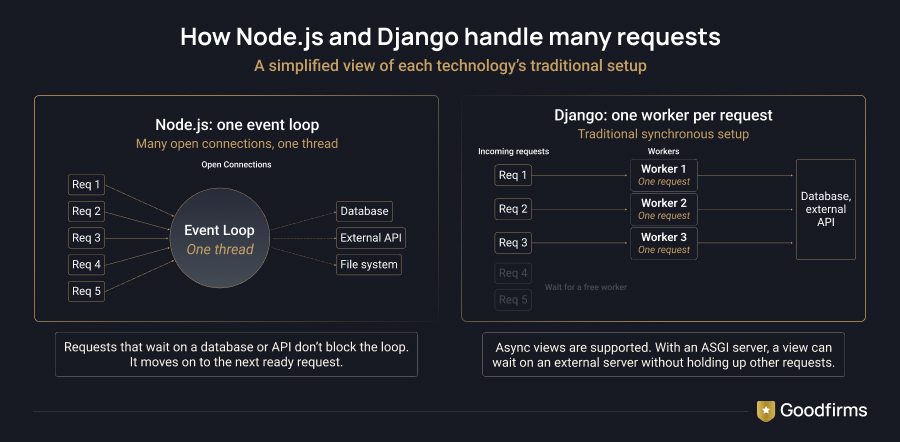
Node.js usually has the edge when many users connect at once because its event loop handles numerous concurrent connections with low overhead. Django is well-suited for structured, data-heavy workloads.
Traditionally, Django relied on synchronous request handling, which can be less efficient for thousands of long-lived connections. Recent versions support async views, which help with operations that wait on external services, though they don’t make every application faster by default. How many requests Django handles at once also depends on the application server and worker setup.
However, in most real-world projects, the framework isn’t the main problem. Slow database queries, poor caching, and weak architecture slow an application down far more than the choice between Node.js and Django. Database indexing, load balancing, and proper scaling usually matter more than the runtime.
To compare actual performance numbers, you can check independent framework benchmarks and look at how the tests were run before concluding. Results vary with hardware, configuration, and workload, so you need to consider benchmarks as a guide, not a verdict.
Scalability: Microservices vs a Monolithic Architecture
Both Node.js and Django can scale to support growing applications. The right approach depends on your traffic patterns, architecture, infrastructure, and how your team manages the system.
Node.js is well-suited to microservices that handle frequent network requests, real-time updates, or other I/O-heavy workloads. Its asynchronous non-blocking approach lets a service handle many connections at once without getting held up by each request. When demand increases, teams can scale specific services as needed, provided the architecture supports it.
Django can scale horizontally, too. Running multiple application instances behind a load balancer, adding caching with tools such as Redis, and optimizing database queries can help support increasing traffic. Django can also be used to build microservices when separating an application into smaller services makes sense.
However, it doesn’t mean that microservices are the right choice for every project. They can complicate deployment, monitoring, and maintenance, especially as the number of services grows. So, it's practical to start with a well-structured application and scale to microservices only when the project grows.
Beyond performance and scalability, the choice also affects how quickly your team can build, how security is managed, and which tools and libraries are available.
Development Speed, Security, and Ecosystem
Day-to-day factors like speed to market, built-in security, and ecosystem maturity shape how smoothly your project moves from idea to launch.
1. Speed to market
Django speeds up MVP development with its built-in features. Node.js relies on frameworks and packages to provide similar features, requiring initial setup and integration. Once your team establishes a standard toolkit, the speed difference mostly closes.
2. Security
Django includes protections against common attacks by default, so you start in a safer position. With Node.js, your security depends on the add-on packages from npm, so check them carefully and keep them up to date. Vulnerable or compromised dependencies can introduce security risks.
3. Ecosystem and community
This is about how much help and tooling there is for each technology: tutorials, answered questions, libraries, and available developers. Both have large, active communities.
Once you've compared the technical differences, it's worth considering the people and budget required to build and maintain the application.
Cost and Hiring Considerations
What affects development costs more than the technology itself is a team’s existing skills. A team fluent in JavaScript that switches to Python, or the reverse, may need time to adjust. This can slow delivery and lead to more mistakes early on. That’s why it’s practical to start with teams' existing skills, unless there's a strong reason to switch.
Other factors also affect the budget, including developer availability in your region, development time, and ongoing maintenance. Licensing isn’t one of them, since both Node.js and Django are free, open-source tools, so your spending goes to people and building time.
Infrastructure costs depend on the workload and architecture. One enterprise dashboard comparison estimated hosting at $147/month for Node.js and $220/month for Django for 5,000 daily users. It also estimated 120 development hours for Django, compared with 200 for Node.js. These are scenario-specific estimates, not guaranteed savings.
Goodfirms’ insights. Goodfirms data points the same way. The median hourly rate is $37 for both Node.js development companies (as of October 2026) and Django development companies (as of October 2026), so the stack barely moves the price. Location matters more: among the four countries with 100 or more Django firms, average rates range from $39 per hour in India to $65 per hour in the United States. Goodfirms has also reviewed more than four times as many Node.js firms (11,129) as Django firms (2,702), which gives Node.js buyers a wider pool to compare
Maintenance is becoming easier to plan on both sides. Node.js moves to one major release a year, starting with version 27, and Django will do the same from January 2028, with each release supported for roughly three years. Django’s announcement describes the benefit as the ability to upgrade one year at a time within the support window.
Outsourcing can make sense when you need specialized skills quickly or don't want to build an in-house team from scratch. Platforms like Goodfirms can help you compare development partners based on their experience, client feedback, and ratings before deciding whom to contact. For a closer look at the Node.js route, read Node.js Development Outsourcing: Costs, Risks & Hiring Tips.
How to Choose Between Node.js and Django
This flowchart gives you a quick starting point for the Node.js vs. Django decision before you get into the details.
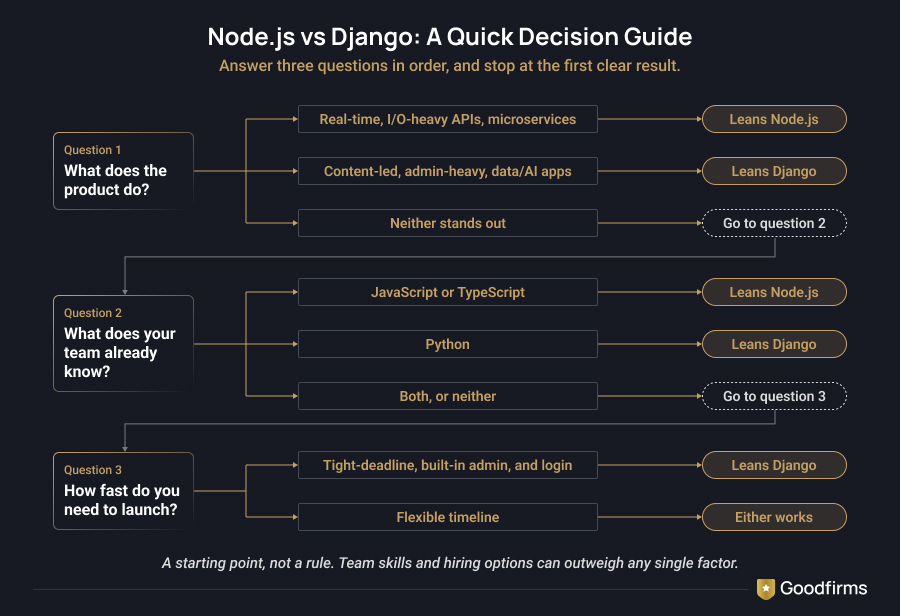
The Node.js vs Django decision comes down to three questions: What does the product do? What does your team already know? How fast do you need to launch? The two lists below show the situations where each option usually comes out ahead.
Choose Node.js if:
Node.js tends to come out ahead in these situations:
- Real-time features: Chat, live tracking, collaborative editing, and notifications all keep connections open for long stretches. Node.js can serve many of them at once without giving each one a dedicated worker.
- Single-Language Stack: If your frontend is built with React, Vue, or Angular, choosing Node.js lets your team use JavaScript across the entire stack, reducing context-switching costs. If you need helping hands, you can compare JavaScript development companies on Goodfirms.
- Microservices Architecture: Node.js is lightweight and well-suited to API Gateways, making it a good fit for decentralized, cloud-native microservices.
Choose Django if:
Django tends to come out ahead in these situations:
- Data-heavy and AI-driven apps: Django runs on Python, so it works easily with data science, machine learning, and generative AI libraries. You can add predictions or analytics to your product without switching stacks. If your team needs extra Python expertise, you can compare Python development companies on Goodfirms.
- Rapid Prototyping (SaaS & Startups): Since Django comes with a built-in admin panel, ORM, user authentication, and database migration tools, it cuts down initial development time for custom web development, making it a strong choice for startups.
- Security-sensitive applications: Django provides built-in protections against common web vulnerabilities, including SQL injection, cross-site scripting (XSS), and cross-site request forgery (CSRF). These features give developers a strong starting point, but secure applications still require proper configuration, careful authentication design, dependency updates, and sound development practices.
FAQs- Node.js vs Django: Choosing the Right Backend
Is Node.js faster than Django?
Node.js often performs well in applications that handle many concurrent connections, such as chat apps and real-time dashboards. Django can perform just as well for many web applications, depending on how the app is built. In practice, things like database queries, caching, and server configuration can have a bigger impact on speed than the framework itself. Django also supports asynchronous views, which can help with tasks that involve waiting for external services.
Which is better for beginners, Node.js or Django?
The choice between Node.js and Django depends on which programming language you're comfortable with. If you know JavaScript, Node.js is a natural starting point for backend development. If you prefer Python, Django is a good option because it comes with built-in features such as authentication and an admin panel. Both are useful for learning backend development, so start with the one that feels more familiar or matches your learning goals.
Can Django handle real-time applications?
Yes, Django can handle real-time features. It supports async views. With tools like Django Channels, developers can add WebSockets for chat apps, notifications, and live updates. But Node.js is a better fit for applications that rely heavily on persistent connections, thanks to its event-driven design. For projects where real-time communication is a major part, some teams use Node.js for those features and use Django for the main application.
Is Node.js or Django better for startups?
Both Node.js and Django can work well for startups, but the right choice depends on what you're building and what your team already knows. Django can save time when launching a first version thanks to built-in features such as authentication, an admin panel, and database tools. Node.js makes sense for teams familiar with JavaScript, especially if the product relies heavily on APIs or real-time features. If your developers already know one of these technologies, sticking with it can help you get the product out the door sooner.
Is Django still worth using in 2026?
Yes. Django is still a good choice for content-based websites, applications that rely heavily on admin tools, and products that work with large amounts of data. The project has also outlined plans for long-term support, with annual feature releases starting in January 2028, each receiving 3 years of support. For teams already working with Python's data science and AI libraries, Django remains a practical option.
Can Node.js and Django be used together?
Yes, Node.js and Django can run side by side in the same project. A common setup uses Django for the core product, including the admin panel, data models, and business logic, while a Node.js service handles real-time features such as chat or live notifications. The services communicate through APIs. Splitting a product this way adds operational complexity, so it makes most sense when real-time features are important enough to justify a separate service.
Final Thoughts
The Node.js vs Django question doesn't have a universal winner. Node.js rewards teams that want flexibility and real-time performance. Django rewards teams that want structure, security defaults, and speed to launch.
Before choosing, consider three factors: what your application needs to do, what your team already knows, and what you can maintain over time. A technology that looks faster in a benchmark may not be the fastest route to launch if your team has to learn an unfamiliar stack.
Choose the technology that best fits your product and your team rather than following the latest trend. Both Node.js and Django can serve you well in the long run when used for the right project. If you’d rather not build in-house, you can compare verified software development companies on Goodfirms and shortlist a partner with proven experience in either stack.


.jpg)