Key takeaways:
- 63% of employers cite skills gaps as the biggest barrier to business transformation, making outsourcing a practical way to access specialized talent.
- The median time-to-hire for senior backend developers now exceeds 90 days, while outsourcing teams can often start within a few weeks.
- Hourly rates range from $15–$120+ for freelance Node.js developers and $18–$180/hour for outsourced teams.
According to the World Economic Forum’s “New Economy Skills: Building AI, Data and Digital Capabilities for Growth” report, 63% of employers identify skills gaps as the biggest barrier to business transformation over the next five years.
And so companies are under hiring pressure. This is pushing many companies to outsource Node.js development instead of expanding backend teams entirely in-house.
For businesses building APIs, SaaS platforms, and real-time applications, outsourcing has become a faster way to access experienced Node.js developers without slowing product delivery.
This guide covers how to evaluate Node.js outsourcing partners, compare pricing models, reduce backend risks, and choose a company that can support long-term scalability.
Use Goodfirms to discover top-rated Node.js development companies, review real client feedback, compare service offerings, and connect with teams experienced in SaaS platforms, APIs, enterprise applications, and real-time systems.
Why Node.js Outsourcing Demand Has Changed in 2026
Node.js outsourcing volumes are not new. What has changed is who is outsourcing and why.
Earlier, most companies outsourced Node.js work because development costs were high domestically. Today, the primary driver is hiring speed and specialization depth rather than cost reduction, as the median time-to-hire for a senior backend developer across North America and Western Europe now exceeds 90 days.
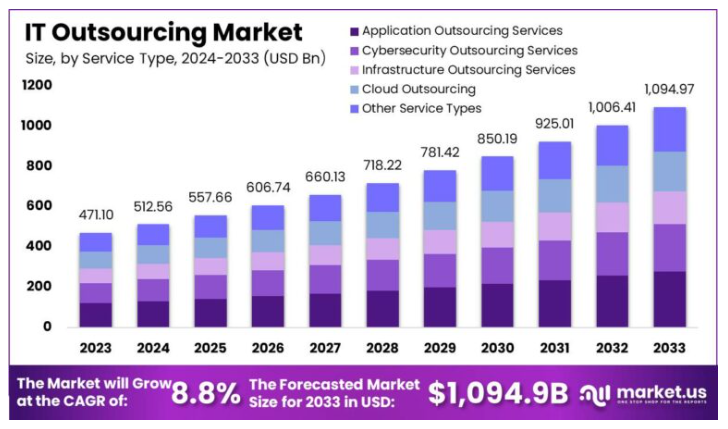
This shift is happening alongside broader growth in the outsourcing market. According to Market.us, the global IT outsourcing market is projected to reach USD 1,094.9 billion by 2033, highlighting how businesses increasingly rely on external technology partners to access specialized skills and accelerate delivery.
Employers have a lot of expectations while hiring a senior Node.js developer in 2026. They must have a working knowledge across cloud-native deployment, distributed systems, event-driven queue management, WebSocket performance tuning, and CI/CD pipeline configuration. Recruiting for that combination internally, then onboarding, typically consumes four to six months before the engineer is producing confident backend output.
SaaS companies scaling through funding rounds cannot absorb that delay. Outsourcing Node.js development addresses the gap directly. You get structured delivery teams within weeks.
When to Outsource Node.js Development
It is important to understand when to outsource and when not to.
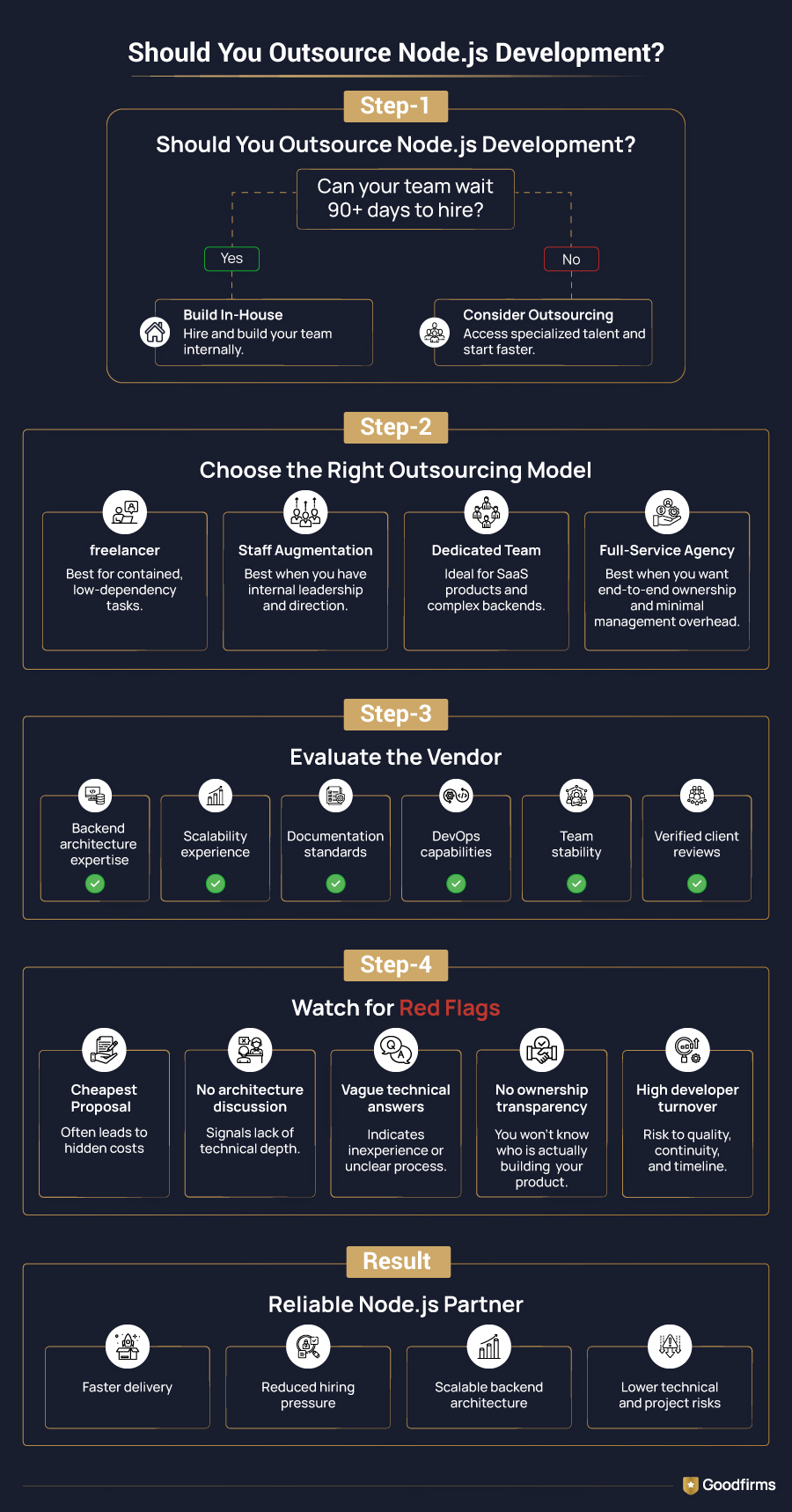
Outsourcing Node.js development works well under specific conditions:
- Your engineering leadership owns architecture decisions and can review backend output critically.
- Requirements are stable enough to plan two to three sprints ahead. The project has a defined scope.
- You are scaling delivery speed against a clear technical brief, not asking the vendor to define what to build.
Outsourcing Node.js development conditions where outsourcing reliably fails:
- Requirements change week to week with no internal decision-maker owning the scope.
- Nobody internally can assess backend code quality or catch architectural shortcuts early.
- The vendor is expected to define a strategy alongside executing it.
- The selection was driven entirely by the lowest proposal in the inbox.
Outsourcing Models: Which Structure Fits Your Project
Choosing the wrong outsourcing structure creates management friction, even before a single technical decision is made.
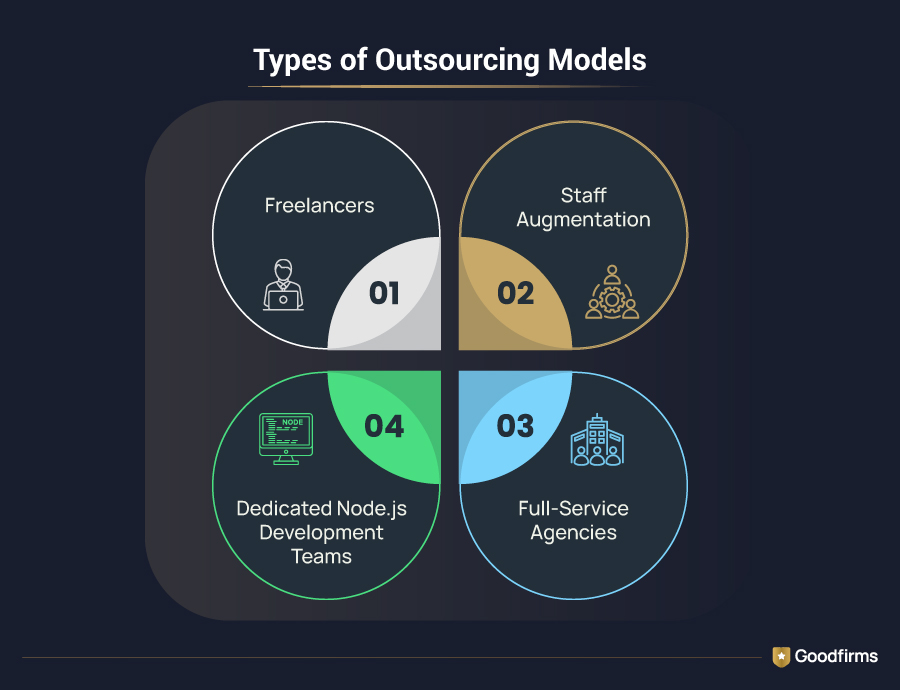
Freelancers
Freelancers work well for contained, low-dependency backend tasks: API integrations, maintenance fixes, lightweight MVPs where one person can own the full scope.
The limitations appear quickly when production systems require monitoring, DevOps support, QA processes, and documentation ownership. These responsibilities cannot reliably be sustained across an evolving product by a single freelancer.
Staff Augmentation
Augmentation adds external Node.js developers to an existing engineering team. This model produces strong results when internal technical leadership can direct, review, and integrate external work.
Without that internal ownership, augmented developers frequently lack the domain context needed to make sound architectural decisions independently.
Dedicated Node.js Development Teams
Dedicated teams provide a pre-structured delivery unit that includes developers, QA, project management, and sometimes DevOps. This is now the dominant model for outsource Node.js development services among growing SaaS companies because it reduces management overhead while maintaining delivery continuity.
Team stability is the critical variable here. Ask how long the proposed team members have worked together.
Full-Service Agencies
Full-service agencies handle everything from architecture planning to deployment. Accountability is centralized and sprint structures are typically more predictable.
The meaningful risk is subcontracting: some agencies maintain strong senior backend architects internally, while others act as staffing intermediaries and hand work downstream.
How Much Does It Cost to Outsource Node.js Development in 2026?
Pricing for node js development outsourcing varies significantly by region, seniority, and backend specialization.
Here is how much a freelance node js developer charges in 2026:
| Region | Junior Developer | Senior Developer |
|---|---|---|
| North America | 41-60 | 80-120 |
| Western Europe | 61-80 | 81-100 |
| Australia | 61-80 | 81-100 |
| Eastern Europe | 41-60 | 41-80 |
| Asia | 41-60 | 61-80 |
| India | 15-25 | 15-25 |
Developers with demonstrated experience in Kubernetes, event streaming, distributed transaction management, or serverless architecture command rates toward the top of each regional range regardless of geography.
Now lets see how much outsourcing teams charges for nodejs development:
| Region | Junior Developer |
|---|---|
| North America | 120-180 |
| Western Europe | 100-180 |
| Australia | 51-100 |
| Eastern Europe | 30-42 |
| Asia | 25-50 |
| India | 18-40 |
Project-based pricing follows a wide range based on system complexity:
| Project Type | Estimated Cost |
|---|---|
| MVP Backend | $8,000–$25,000 |
| SaaS Platform Backend | $30,000–$100,000 |
| Enterprise Migration | $150,000–$500,000 |
The Hidden Costs That Make Cheap Proposals Expensive
The invoice is not the budget. Buyers who have been through Node.js development outsourcing before budget for costs that proposals rarely mention:
- Onboarding and ramp time
- Infrastructure configuration
- Technical debt correction
- Developer replacement cycles
Goodfirms Insight
One pattern appears consistently across backend outsourcing engagements: the lowest-cost Node.js vendor is rarely the lowest-cost long-term decision. Teams that prioritize speed and low pricing over architecture quality often create backend systems that become expensive to scale, maintain, and optimize later.
A vendor charging $25/hour who delivers unstable architecture routinely costs more across eighteen months than a $70/hour team that builds maintainable systems from the start. The comparison point should be the total cost of ownership, not just the hourly rate.
Biggest Risks in Node.js Development Outsourcing
The risks that derail outsourcing projects are mostly operational. Code problems are fixable. Ownership ambiguity and communication breakdown are significantly harder to recover from.
Architectural Shortcuts That Hide Until Scale
- The most expensive long-term risk in node js development outsourcing is backend architecture that performs well in development and degrades under production load.
- Vendors optimizing for sprint velocity systematically underinvest in architectural sustainability. The tradeoff is invisible in the first two months and painful in the sixth.
- Ask vendors specifically: How do you approach database indexing during early development? What monitoring setup do you deploy before production launch? How do you handle API versioning when clients depend on existing contracts?
Teams with genuine backend depth have immediate, specific answers.
Ownership Gaps That Create Vendor Lock-In
Backend systems handling business-critical data require clear ownership from day one. Clients should maintain direct control of:
- Git repository access (not a fork owned by the vendor)
- Cloud account credentials and billing
- CI/CD pipeline configuration
- Infrastructure-as-code files
- Deployment credentials for all environments
Vendors who frame this as "we manage that for you" create lock-in that becomes expensive at contract renewal. Establish ownership controls in the contract.
Developer Turnover Mid-Project
High developer turnover is among the most underrated risks in node js development outsourcing. When the backend engineer who built a service leaves mid-project, the architectural context for undocumented decisions leaves with them.
Quality vendors maintain documentation standards that reduce dependency on individual knowledge. Ask to see examples of internal documentation from a past project.
How to Choose the Right Outsource Node.js Development Company
A good Node.js vendor usually reveals itself in the first few conversations. Because strong teams talk clearly about the backend challenges they have solved before.
It is important to pay attention to how they discuss scalability, performance issues, deployment processes, and long-term maintenance. Don’t just focus on delivery timelines or hourly rates. The best outsourcing partners should sound more like engineering teams than sales teams.
Assess Technical Depth Through Conversation
Technical depth to probe directly in vendor conversations:
- Database query optimization strategy: connection pooling, index design, N+1 problem handling
- Queue architecture choices: when they recommend Kafka vs. RabbitMQ vs. BullMQ and the reasoning
- Caching strategy decisions: Redis configuration, cache invalidation approaches
- Microservices communication patterns: REST vs. gRPC vs. event-driven for different scenarios
- Deployment and rollback processes under production failure
Specific, confident answers signal genuine experience.
Look for Backend Work Samples
Frontend-heavy portfolios with polished UI screenshots are common from agencies that outsource their backend implementation. Request backend-specific work samples: architecture diagrams, infrastructure configuration examples, scalability metrics from production systems, or API design documentation.
Red Flags in Sales Conversations
These patterns during vendor conversations correlate with delivery problems later:
- Immediate agreement with every technical requirement without pushing back
- Pricing significantly below market with no explanation of the trade-off
- Inability to name specific technologies in the proposed stack unprompted
- References that are unavailable or describe the vendor in general terms only
- Contract language that retains repository or deployment access with the vendor
Vendor Evaluation Checklist Before Signing
Technical: Backend architecture experience at your expected scale. Scalability planning process. Security practices, including secret management and dependency auditing. Cloud deployment expertise.
Operational: Sprint communication cadence and format. Documentation standards. Team stability and replacement policy. QA process maturity and ownership.
Ownership: Source code ownership confirmed in contract. Infrastructure access controls. Deployment transparency. Exit transition process, including knowledge transfer obligations.
How Goodfirms Helps Reduce Node.js Vendor Selection Risk
Every outsourced Node.js development company describes itself as experienced, scalable, and communicative.
The Goodfirms' Node.js development companies directory aggregates verified client reviews, service focus breakdowns, hourly rate ranges, company size, and geographic information.
Buyers can use the Goodfirms curated list of software development companies to evaluate broader engineering capabilities alongside backend specialization and the IT services companies' listings to assess operational and support capacity beyond core development delivery.
A vendor with no verified reviews or exclusively generic five-word testimonials is itself a data point worth weighing during evaluation.
In-House vs. Outsourced Node.js Development
The comparison between in-house and outsourced Node.js development is no longer a way to determine which is best. Most growing software organizations use both, with different structures for different parts of the product.
Core product architecture decisions, security policy, and data model ownership carry compounding long-term risk when delegated entirely to an external team. Keep those internal. Building features against a stable architecture, implementing infrastructure changes, and scaling specific backend capabilities are where outsourcing creates genuine and measurable leverage.
| Factor | In-House | Outsourced |
|---|---|---|
| Hiring speed | Slow (3–6 months) | Faster (4–8 weeks to team start) |
| Cost flexibility | Lower ceiling, harder to scale down | Higher flexibility in both directions |
| Architecture continuity | Higher | Dependent on vendor stability |
| Specialized expertise access | Limited by hiring market | Broader access |
| Operational overhead | Higher internal | Lower internal, higher vendor management |
Organizations that get the most from outsourcing define what the vendor is accountable for before the contract is signed. Architecture ownership stays internal.
Delivery execution goes to the vendor. When those boundaries are clear, the engagement produces consistent output. When they are unclear, both sides lose time establishing them under pressure.
What Reliable Node.js Outsourcing Actually Looks Like
The companies that consistently get strong results from outsource Node.js development services are the ones that evaluated engineering maturity before hourly rates, established ownership controls before writing contracts, and maintained active technical oversight throughout delivery.
The Cheap Backend Trap — a pattern where an affordable early engagement becomes an expensive long-term maintenance liability is avoidable. Backend architecture decisions made in the first three sprints determine production performance for the next three years. That compounding effect is what makes the vendor evaluation stage disproportionately important compared to how much time most buyers spend on it.
The right outsource Node.js development company pushes back on architectural shortcuts, documents its decisions, and treats your infrastructure credentials as yours from day one. Those qualities are not visible in proposals. They surface in reference conversations, technical discussions, and the documentation culture you observe before signing.
Buyers evaluating vendors can use the Goodfirms Node.js development companies directory to compare verified options by specialization, client review, and pricing structure before committing to a long-term backend engagement.
FAQs
What does it mean to outsource Node.js development?
To outsource Node.js development means hiring an external company or dedicated team to build, maintain, or scale your backend application instead of handling everything in-house. Businesses often choose outsource Node.js development services when they need experienced backend developers quickly, want to accelerate product delivery, or require expertise in areas such as API development, microservices, cloud infrastructure, and real-time applications.
How much does it cost to hire a Node.js developer?
The cost to hire Node.js developers through an outsourcing partner ranges from $15 to $120+ per hour, with senior developers charging more for expertise in cloud-native architecture, distributed systems, and performance optimization.
Is outsourcing custom Node.js app development cheaper than building an in-house team?
In many cases, yes. Outsourcing custom Node.js app development eliminates recruitment costs, employee benefits, onboarding expenses, and lengthy hiring cycles. However, the cheapest vendor is not always the most economical choice. Businesses should compare the total cost of ownership, including code quality, maintenance requirements, scalability, and long-term support, rather than focusing solely on hourly rates.
Should I outsource a Node.js developer or hire a dedicated development team?
The right choice depends on the scope of your project. If you need help with bug fixes, API integrations, or short-term backend work, it may make sense to outsource a Node.js developer individually. For SaaS products, enterprise platforms, or long-term development roadmaps, a dedicated team usually delivers better continuity, faster collaboration, and access to additional expertise in QA, DevOps, and project management.
How do I choose the right outsource Node.js development company?
Look beyond pricing and portfolio screenshots. A reliable outsource Node.js development company should be able to explain its approach to backend scalability, security, deployment, and long-term maintenance. Review case studies, verify client feedback, ask about developer retention, and confirm ownership of source code and infrastructure before signing a contract. Platforms like Goodfirms can help compare vendors based on reviews, expertise, pricing, and service focus.
What are the biggest risks of Node.js development outsourcing?
The most common risks in node js development outsourcing include poor backend architecture, weak documentation, communication gaps, and vendor lock-in. Teams that prioritize speed over engineering quality can create systems that become difficult and expensive to scale later. Clear ownership agreements, regular code reviews, and strong technical oversight help reduce these risks significantly.
What services are included in outsource Node.js development services?
Most outsource Node.js development services go beyond coding. Depending on the provider, services may include backend architecture design, API development, cloud deployment, database optimization, microservices implementation, DevOps support, testing, maintenance, and ongoing performance monitoring. Some agencies also provide dedicated development teams that handle the entire project lifecycle from planning through post-launch support.