Key takeaways:
- Java development in USA continues to power large-scale enterprise and backend platforms that demand reliability and long-term support.
- Modern Java systems in the US rely heavily on microservices, cloud platforms, and containerized deployments.
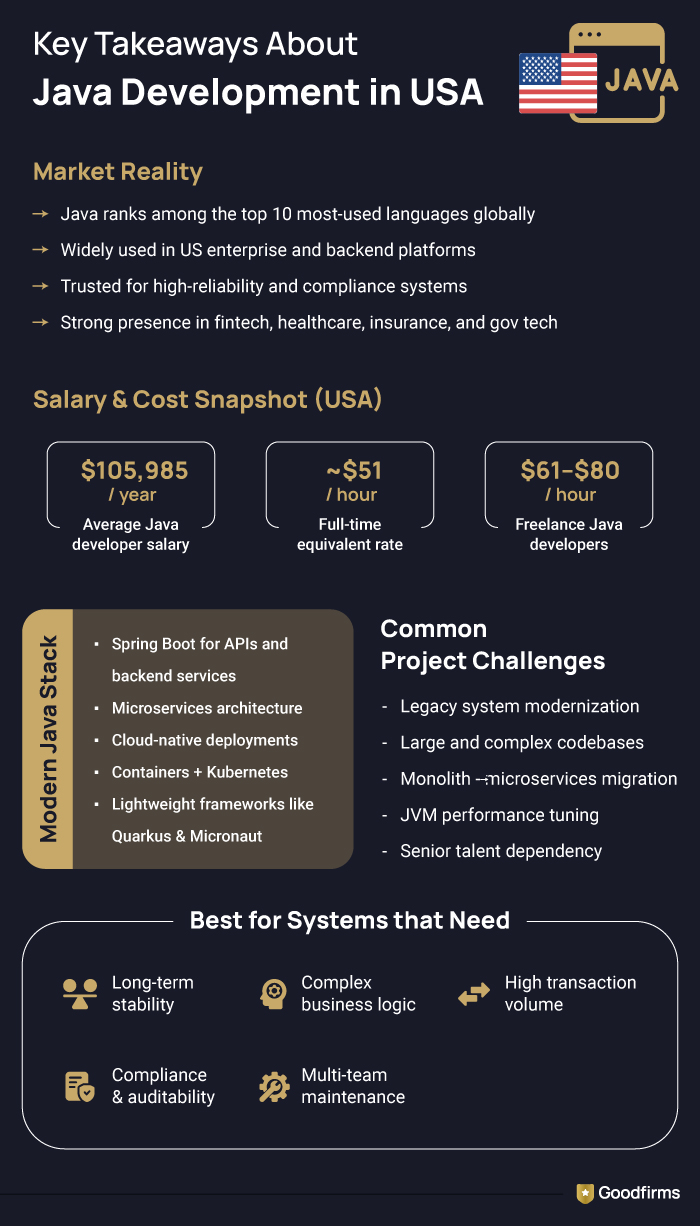
- Java development in USA costs an average salary of around $105,985 per year, equivalent to about $51 per hour, while freelance rates typically range between $61 and $80 per hour.
- Java remains a long-term technology investment as most US companies modernize existing systems instead of replacing them.
As per the Stack Overflow Developer Survey, Java ranks among the top 10 most-used programming languages worldwide, with 29.6% professional developers using it. This means Java is still preferred by developers because it is more mature and stable compared to other programming languages.
This steady adoption is clearly visible across the enterprise landscape, especially when you look at Java development in USA, where the language continues to power large-scale backend platforms, cloud services, and mission-critical business applications. Let’s look at how the ecosystem is evolving, what technologies teams prefer today, and where things are heading next.
Compare leading Java development companies in USA and choose the right technology partner for your next project.
Current State of Java Development in USA
Java is a mature tech. Large organizations continue to invest in Java because their core systems run on it. Rewriting everything into a new stack is expensive and risky. So instead, companies modernize Java applications using cloud, containers, and microservices.
Hiring demand also stays steady. Many US job listings still ask for Java with Spring Boot, cloud knowledge, and API development experience. Product companies and enterprise IT teams both look for experienced Java engineers who can handle scale and complexity.
Another noticeable shift is modernization. Teams are not just maintaining legacy Java anymore. They are upgrading runtimes, refactoring monoliths, and moving workloads to cloud platforms.
Why Java Development Remains Strong in the US Market
Java has stayed relevant in the US because it reduces operational risk. Java development companies building high-responsibility systems tend to prefer technologies that are predictable under pressure, well supported, and widely understood across the hiring market.
A few practical factors keep Java development in USA consistently strong:
- Most backend problems already have stable Java libraries, frameworks, and design patterns available. Teams rarely have to invent solutions from scratch.
- US enterprises often run systems for many years. Java’s compatibility model allows upgrades without constant rewrites, which lowers long-term cost.
- Java’s runtime behavior is well studied. For high-traffic systems, predictability often matters more than raw benchmark speed.
- Security scanning, dependency auditing, and policy controls are more mature in the Java ecosystem than in many newer stacks.
- Hiring Java developers in USA is still easier than hiring for many niche backend languages, especially at mid and senior levels.
Put simply, Java stays because it behaves well in production, and production reality tends to win over trend cycles.
Java Tools and Frameworks US Teams Lean On Today
Modern Java development in USA does not look like the heavyweight enterprise setups people remember from years ago. The tooling has shifted toward faster startup, cleaner configuration, and cloud-ready deployment. Most active teams use a fairly consistent stack, with a few variations based on performance and scale needs.
Spring Boot
Spring Boot remains the default starting point for many Java backend and API projects. It removes a lot of configuration overhead and helps teams ship production-ready services faster. Security, database access, and cloud connectors are already well supported inside the Spring ecosystem, which reduces integration effort.
Microservices Framework Patterns
Large Java systems are rarely shipped as one giant unit now. Teams break functionality into smaller services that can be deployed and scaled independently. Java fits this model well because its testing tools, monitoring integrations, and service frameworks are mature and widely documented.
Cloud-Native Java
Cloud-native Java is now standard practice across many US engineering teams. Services are designed assuming container deployment, autoscaling, and distributed logging from day one. This design-first approach avoids painful retrofitting later.
Containers and Kubernetes
Kubernetes orchestration is common in mid-sized and large US organizations running multiple Java services. Earlier concerns around Java container size and slow startup have been reduced through JVM tuning and lightweight frameworks.
Lightweight JVM Frameworks
Frameworks like Quarkus and Micronaut are gaining ground where startup time and memory usage matter. Teams building high-density container workloads often evaluate these instead of traditional stacks.
API-First Java Development
Many Java backend teams now design APIs first and build services around those contracts. This keeps frontend, mobile, and partner integrations cleaner and reduces downstream rework.
Cost of Java Development in USA
Cost is one of the first practical questions that comes up when planning Java development in USA. The numbers can vary based on experience level, hiring model, and specialization, but there are some reliable benchmarks you can use for planning. Here’s a clearer breakdown with sourced figures.
Average Java Developer Salaries
Average annual Java developer salary: $105,985 per year
Equivalent average hourly wage (full-time): $51 per hour
Freelance & Contract Java Developer Rates
Typical freelance Java developer rates: $61 to $80 per hour
Senior and niche specialists often charge higher than this band
What Pushes Java Development Costs Higher
- Seniority and architecture experience
- Cloud and microservices expertise
- Security and compliance requirements
- Performance tuning and large-scale systems
- Industry domain knowledge
Java development in USA sits in the premium talent bracket, but teams usually pay for depth, reliability, long-term maintainability, and not just coding hours. For real project cost comparisons from service providers, check Goodfirms’ Java development cost-benefit coverage.
Common Challenges in Java Development Projects
Java projects are known for stability and scale, but that doesn’t mean they are always easy to execute. Most challenges stem from the scale of the systems being built and the expectations for reliability, performance, and long-term maintenance. Here are the issues teams most often run into.
Legacy code that refuses to retire
Many Java systems have been running for years. They work, but the architecture feels dated. Updating or breaking them into smaller services takes planning, testing, and patience. Quick rewrites are rarely safe.
Large codebases that grow heavy over time
Enterprise Java projects can become massive. Build times increase, dependencies pile up, and even small changes require wide regression testing. Without strict code discipline, things slow down.
Monolith to microservices migration
Splitting a big Java application into microservices sounds clean on paper. In practice, it introduces service communication, data consistency, and deployment complexity. Teams often underestimate this transition.
Performance tuning is not always straightforward
JVM tuning, memory behavior, and thread management need real experience. Defaults work fine at a small scale, but high-load systems need careful optimization and monitoring.
Testing depth is higher than expected
Java enterprise systems usually demand layered testing, like unit, integration, contract, and sometimes compliance testing. That adds time, as skipping it is risky.
Senior Java talent is harder to replace
There are many Java developers, but fewer with deep architecture and scaling experience. When key senior engineers leave, projects can feel the gap quickly.
These challenges are manageable, but they reward teams that plan ahead and treat Java projects as long-term engineering investments.
Java Development Trends in USA for the Next Few Years
Over the next few years, Java and its ecosystem will be shaped by cloud adoption, performance improvements, and evolving developer workflows. Here’s what’s gaining real traction:
Cloud-first thinking
Java applications are no longer just moved to the cloud after the fact. Teams design with containers, managed services, and scalable infrastructure in mind from the start. Cloud design principles are part of the architecture conversation, not an afterthought.
Lighter, faster runtimes are going mainstream
Traditional JVM deployments are still widespread, but newer frameworks and runtimes like Quarkus and Micronaut are carving out space where performance and efficiency matter. Developers want apps that start fast, use less memory, and fit containerized environments better.
AI tools are becoming part of everyday coding
More Java developers are using AI-assisted tools for code suggestions, documentation generation, and even test creation. These tools won’t replace developers, but they are speeding up common tasks and reducing friction in repetitive work.
Concurrency and performance improvements move forward
Features like virtual threads and updates to the JVM are making it easier to build responsive, high-throughput services. It won’t make Java magically faster than all languages, but it will make high-performance concurrency patterns simpler to implement.
Internal platforms are rising inside US engineering teams
As companies scale, they build internal tooling and platform layers to support Java services with standardized templates, automated pipelines, and shared libraries. This reduces onboarding time and improves overall quality.
Check out broader software development trends surveyed by Goodfirms for additional context.
Future Outlook of Java Development in USA
The future of Java development in USA remains the dependable backbone for systems that cannot afford failure. That shifts how companies invest in it for more strategic use.
What we’ll likely see ahead:
- Most US organizations won’t replace Java stacks. They will refactor, wrap, and extend them. Expect gradual modernization projects instead of full platform rewrites.
- Many newer products may use trendier languages at the edge, while Java continues to run core transaction engines and backend processing layers quietly underneath.
- Industries that value auditability, predictability, and long support windows will keep leaning on Java-based platforms.
- Faster builds, better observability, and smarter automation around Java pipelines are becoming a bigger focus than language changes themselves.
- US tech teams increasingly mix Java with other languages in the same architecture. They use Java where stability matters and lighter stacks where speed of iteration matters.
Before You Start a Java Project in the USA
If you are considering Java for a new system, the smarter question is whether your project actually benefits from what Java is best at.
Java makes the most sense when your application is expected to grow, handle complex business rules, or run for many years with multiple teams maintaining it. It also fits well when auditability, structured architecture, and predictable performance matter more than rapid prototype speed.
On the other hand, if you are building a lightweight experimental product, a short-lived campaign platform, or a very small service, a lighter stack might reduce overhead and time to market.
Many teams now decide stack choices workload by workload. It is not a company-wide thing anymore. Core systems run on Java. Edge services may not. That blended approach often delivers the best balance between speed and stability.