Hiring Vue.js developers is more than a tech choice. It’s a business decision that directly affects your project speed, cost, and scalability. Startups use it for MVPs, and enterprises for scalable front-end systems.
A recent survey shows that 15.4% of developers globally use Vue.js. It is among the top three front-end frameworks.
As more businesses adopt Vue.js, the challenge is finding the right people to build with it. Hiring decisions vary widely depending on skills, location, and whether you go in-house or outsource. And all of these factors affect cost. Let’s find out why and how much you must put aside while budgeting for Vue.js developers.
Why Hire Vue js Developers – Key Reasons That Matter
Vue.js is one of the most loved frameworks for building modern web apps. Here’s why companies invest in Vue.js development services:
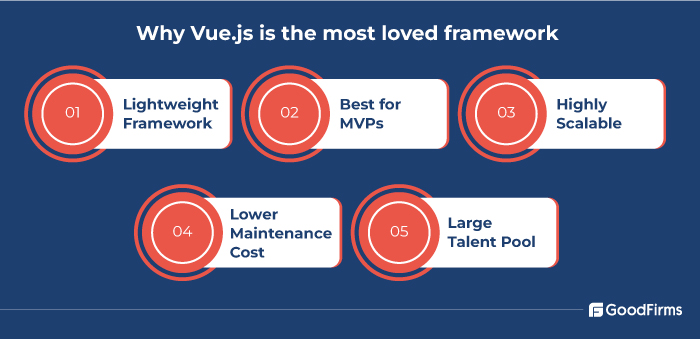
1. Lightweight framework
Vue apps load faster because the framework is small and efficient. That means less infrastructure cost on hosting and better performance for users. You will save a lot from high-traffic apps.
2. Faster delivery of MVPs and features
Vue has a gentle learning curve and a rich set of tools. Developers can quickly build prototypes, test ideas with customers, and launch features faster. For startups racing to market, Vue.js is the perfect choice.
3. Flexibility for any stage of growth
Vue works well for small apps but also scales to enterprise-level systems. That makes it a safe bet if you are unsure how big your project might grow. You won’t need to switch frameworks halfway through.
4. Lower long-term maintenance costs
Vue code is generally cleaner and easier to maintain. This reduces bugs, minimizes technical debt, and cuts down on future developer hours. For businesses, that is fewer surprise costs after launch.
5. Access to a growing global talent pool
Vue is now one of the top three front-end frameworks. This means you are not limited to a small pool of specialists. Whether you want to hire vuejs developer locally or outsource, you will find developers across regions and price ranges.
Vue.js Developer Hourly Rates by Experience Level
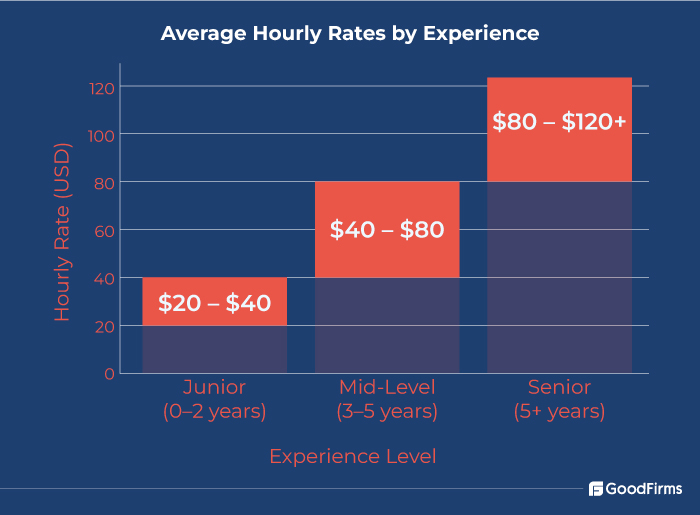
One of the first questions businesses ask when budgeting is: how much does experience level really change the rate? The short answer is quite a lot. Let’s break this down.
|
Experience Level |
Skills & Responsibilities |
Best Fit For |
|
|
Junior (0–2 years) |
$20 – $40 |
|
|
|
Mid-Level (3–5 years) |
$40 – $80 |
|
|
|
Senior (5+ years) |
$80 – $120+ |
|
|
Think of this difference in hourly rates as a productivity curve. While senior developers charge higher, their ability to solve complex problems will be faster. This may result in lower total project costs than hiring multiple juniors. On the flip side, if your project is simple, going with juniors or mid-level talent may keep things cost-effective without overpaying for skills you don’t need.
Vue.js Developer Hourly Rates by Country and Region
Where your developer is located plays a massive role in how much you will end up paying. A junior Vue.js developer in India might cost under $40 per hour, while a senior developer in the US can charge well over $150. That gap comes down to cost of living, local salary benchmarks, and market demand.
To give you a clearer picture, we have taken references from talent.com, ziprecruiter.com, and flexiple.com. Here’s the average range of how rates usually look across regions.
|
Region |
Average Hourly Rate (USD) |
What to Expect |
|
North America (US, Canada) |
$60 – $120+ |
The highest rates worldwide. Strong demand and high living costs increase salaries. Especially in cities like San Francisco or New York. |
|
Western Europe (UK, Germany, France) |
$50 – $100 |
Mature tech ecosystems with higher wage standards. Rates vary depending on the city and country. |
|
Eastern Europe (Poland, Ukraine, Romania) |
$30 – $60 |
Affordable rates combined with strong technical talent make this a popular outsourcing destination. |
|
Australia & New Zealand |
$60 – $120 |
Similar to Western Europe, though major cities like Sydney often fall on the higher side. |
|
Asia (India, Philippines, Vietnam) |
$15 – $40 |
Among the most cost-effective regions. Huge talent pool. But quality depends heavily on experience and vendor selection. |
|
Japan |
$40 – $80 |
Sits in the mid-range. Japanese developers are known for quality and reliability, especially in enterprise settings. |
|
Latin America (Brazil, Mexico, Argentina) |
$25 – $60 |
A fast-growing outsourcing hub. Attractive for North American companies due to overlapping time zones. |
Key Takeaways
- North America and Western Europe are the costliest options, but they often provide closer cultural alignment and easier communication for Western companies.
- Eastern Europe and Latin America strike a balance of reasonable rates without compromising too much on quality.
- Asia, especially India and Vietnam, remains the go-to region for cost-conscious businesses. Just make sure you vet for skills and communication.
- Japan falls in the middle. Rates are higher than in other Asian countries, but you are paying for precision and reliability.
Vue.js Developer Annual Salaries by Country
In-house hiring comes with a fixed annual salary, plus additional expenses like benefits, taxes, and training. These costs vary a lot from country to country, depending on local wage standards and the strength of the tech industry.
Here’s what the average yearly salary for a Vue.js developer looks like across popular hiring destinations:
|
Country |
Average Annual Salary (USD) |
Notes |
|
United States |
Highest global salaries, especially in tech hubs like California and New York. |
|
|
United Kingdom |
Strong demand for frontend developers, with London leading the pack. |
|
|
Canada |
Slightly lower than the US, but still on the higher side due to the cost of living in cities like Toronto and Vancouver. |
|
|
Australia |
Salaries are similar to the UK, with higher costs in Sydney and Melbourne. |
|
|
Germany |
Competitive salaries for skilled Vue.js programmers, particularly in Berlin and Munich. |
|
|
India |
Most affordable region for in-house vue.js developer, though salaries vary significantly by city and experience level. |
|
|
Japan |
Mid-range salaries with a focus on quality and enterprise-level development. |
Hiring in-house gives you greater control and long-term commitment. But it also means higher overheads beyond just salaries. Office costs, employee benefits, and ongoing training all add up. So it’s worth factoring those in when comparing with outsourcing or freelance models.
Vue.js Developer Outsourcing Costs: Freelancers vs Agencies
Not every project needs a full-time in-house developer. For many businesses, outsourcing either to freelancers or specialized agencies offers flexibility and cost savings.
The cost here varies depending on whether you hire an independent freelancer or work with an agency that provides a team. Freelancers are generally more affordable, while agencies charge a premium for added reliability, project management, and access to a broader skill set.
Freelancers
- Hourly Rate (Junior): $15 – $30
- Hourly Rate (Mid-Level): $30 – $60
- Hourly Rate (Senior): $60 – $100+
Best For: Short-term projects, prototypes, or when you need to fill skill gaps quickly.
Freelancers are cost-effective but come with risks like availability, communication, and consistency.
Agencies
- Hourly Rate (Junior Team Member): $25 – $50
- Hourly Rate (Mid-Level Developer): $50 – $90
- Hourly Rate (Senior Developer / Lead): $90 – $150+
Best For: Larger, complex projects that need structured workflows, scalability, and guaranteed delivery timelines.
Agencies cost more, but you get professional project management that handles unexpected changes without slowing down delivery.
When deciding between freelancers and agencies, it often comes down to project complexity and risk tolerance. If you are building an MVP or handling a small feature update, a freelancer may be the budget-friendly option. For enterprise apps or long-term maintenance, agencies can justify the higher cost with stability and scalability.
Cost Breakdown Example
Numbers often make more sense when you see them in context. Let’s look at a simple comparison between hiring a freelancer and working with an agency for a Vue.js project.
Imagine you are building a mid-sized web application that takes around 400 hours of development work.
|
Hiring Model |
Developer Level |
Hourly Rate (USD) |
Estimated Cost (400 hrs) |
Notes |
|
Freelancer |
Mid-Level |
$40 |
$16,000 |
Budget-friendly. Works well if you are comfortable managing timelines and quality. |
|
Freelancer |
Senior |
$80 |
$32,000 |
Higher cost, but more efficient. A senior might complete tasks faster, saving hidden costs. |
|
Agency |
Mid-Level Developer + PM Support |
$70 |
$28,000 |
Costs more, but includes project management, structured workflows, and QA. |
|
Agency |
Senior Developer + Team Support |
$110 |
$44,000 |
Premium option, ideal for enterprises needing reliability, scalability, and long-term support. |
This example shows how costs can scale quickly depending on the hiring route. A freelancer may cut your budget in half compared to an agency, but you take on more risk regarding quality, deadlines, and long-term availability. Agencies cost more but bring stability, oversight, and the ability to expand if your project grows.
What Questions to Ask While Hiring Vue.js Developers
Hiring a Vue.js developer isn’t just about asking if they know the framework. The right questions help you understand how they think and solve problems. Here are a few to keep in your back pocket.
1. How do you decide between the Options API and the Composition API in Vue 3?
A junior might tell you one is better. A stronger candidate will talk about context. They should compare both to decide which to choose. If they bring up TypeScript support or cleaner logic separation, they have worked with both.
2. Can you share when you had to fix performance issues in a Vue project?
This is where you separate the doers from the talkers. They should tell you about a slow app, maybe caused by heavy bundle sizes or components re-rendering too often. They should mention Vue DevTools, code splitting, lazy loading, and explain how the changes improved load time or user experience. Real examples are what you want here.
3. What’s your approach to testing and keeping code clean?
Good developers don’t treat testing as an afterthought. They should mention writing unit tests with tools like Jest, maybe using Vue Test Utils for components. Some might talk about setting up CI/CD pipelines, running lint checks, or using code reviews to catch issues early.
4. Can you tell me about when you worked with backend developers or designers on a Vue project?
This one digs into teamwork. They should explain how they handled it. Did they suggest a workaround? Did they communicate with the team before deadlines slipped? How they tell the story will show you how they handle real-world challenges.
5. How do you handle routing in Vue, especially for larger applications?
Candidates who have worked on complex apps will talk about Vue Router, dynamic routing, and lazy loading. They may also explain how they structure routes for scalability.
6. What’s your process when debugging issues in Vue?
Strong answers go beyond “console.log.” They might mention Vue DevTools, browser profiling tools, or error tracking settings. Some will also describe how they reproduce bugs or document fixes for the team. That kind of detail shows maturity.
The Future of Hiring Vue.js Developers
Vue.js has steadily moved from a lightweight alternative to one of the most trusted JavaScript frameworks for building modern applications. And with companies doubling down on digital products, the demand for skilled Vue.js developers will only grow.
Looking ahead, a few things stand out:
- Rates will continue to rise in mature markets. As competition for talent increases in the US, UK, and Western Europe, salaries and hourly rates can be expected to stay on the higher side.
- Outsourcing hubs will become more attractive. Countries like India, Vietnam, and Poland are already strong outsourcing destinations. Businesses will be more open to blending onshore and offshore teams.
- Hybrid hiring models will dominate. Instead of choosing between freelancers or agencies, many companies will adopt a mix. Leaning on an in-house core team while extending capacity with freelancers or offshore partners.
- Value will matter more than cost. It is tempting to pick the cheapest option, but companies that think long-term know that reliability, speed, and quality can actually save money. The total cost of ownership of your development team is far more critical than the sticker price.
So, how much does it cost to hire Vuejs developers? The answer will always vary depending on who, where, and how you hire. But the real question you should be asking is: what’s the right balance of cost, skill, and reliability for your project?
If you approach it with that mindset, you won’t just hire Vuejs developers, you will build a team that drives your product forward, sustainably and effectively.
Frequently Asked Questions
1. How much does it cost to hire a Vue.js developer in 2025?
The cost to hire a Vue.js developer in 2025 ranges from $20–$40 per hour for juniors, $40–$80 for mid-level, and $80–$120+ for seniors. Rates vary depending on region, skills, and project complexity.
2. What factors affect the cost of hiring Vue.js developers?
The factors influencing Vue.js developer cost are:
- Developer’s experience level (junior, mid, senior)
- Location or country of hiring
- Hiring model (in-house, freelance, or agency)
- Project size and complexity (MVP vs enterprise app)
- Tech stack requirements (Nuxt.js, TypeScript, SSR, CI/CD)
3. What is the average annual salary of a Vue.js developer?
In 2025, the average Vue.js developer salary is around $110,000 in the US, £60,000 in the UK, and ₹11 Lakhs in India. Salaries vary widely depending on region and experience.
4. Is it cheaper to hire Vue.js developers offshore?
Yes. Offshore regions like India, Vietnam, and Eastern Europe offer Vue.js developer rates as low as $15–$40 per hour, compared to $60–$120+ in the US and Western Europe. This makes outsourcing a cost-effective option for many businesses.
5. Should I hire a Vue.js freelancer or go with an agency?
Freelancers are cost-effective for short-term projects, MVPs, or filling skill gaps. Agencies are better for enterprise apps, long-term projects, and when you need structured workflows, project management, and scalability.
6. How do Vue.js developer costs compare with React developers?
React developers generally charge slightly higher rates in North America and Western Europe. Globally, Vue.js developers are often more affordable in outsourcing destinations, making Vue a cost-effective choice for many businesses.
7. Can hiring senior Vue.js developers save costs in the long run?
Yes. While seniors charge higher hourly rates, they deliver faster, cleaner, and more scalable code. This often reduces long-term costs compared to managing multiple junior developers.