Key takeaways
- Vue wins on learning curve, built-in reactivity, and incremental adoption over React and Angular.
- React still leads on hiring pool and ecosystem depth, so the trade-off is real.
- Companies like GitLab, Adobe, and Xiaomi prove Vue holds up at production scale.
For years, the conversation about choosing a frontend framework revolved around React or Angular - Vue got a lukewarm mention and not much else. By 2026, that has changed. Vue has spent the last few release cycles closing the gaps that once kept it out of serious enterprise conversations, and teams that tried it on a side project are now shipping production apps with it.
Rather than presenting another generic list of the benefits of building a website with Vue.js, this blog addresses a more practical question: what does Vue.js actually offer over React or Angular when judged against a team's specific project or constraint?
Ready to build with Vue? Explore verified Vue.js development companies on Goodfirms.
What makes Vue.js different from React and Angular?
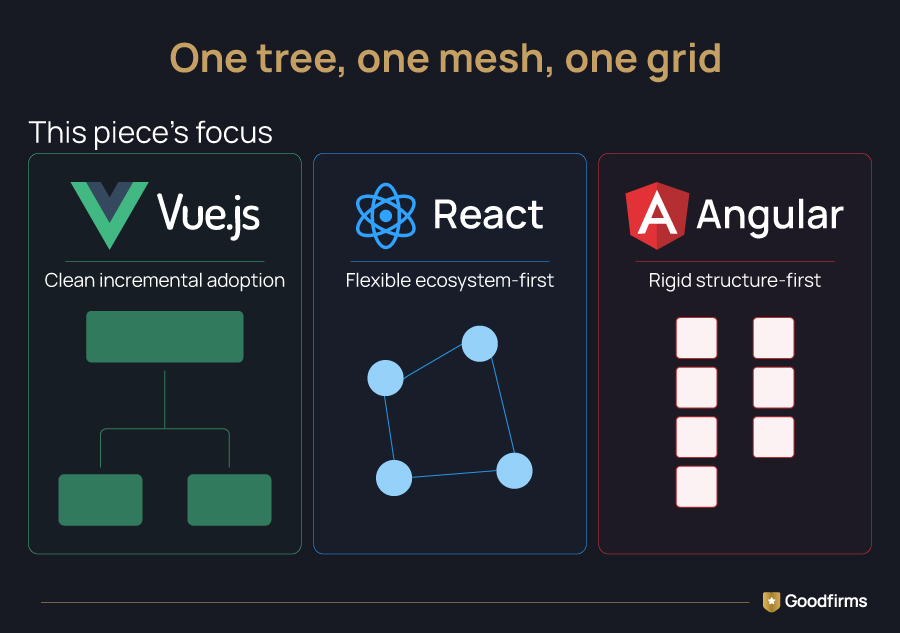
Vue describes itself as a progressive framework — you can use as much or as little of it as a project needs, from sprinkling it into a single page to building a full single-page application. That flexibility is one of the core benefits of building a website with Vue.js instead of committing to a heavier, more opinionated framework from day one.
If your mental model of Vue is still the Options API — data, methods, computed, watch, as separate object properties — that model is outdated. The Composition API, paired with the <script setup> syntax, is the 2026 standard: logic is organized by feature rather than by option type, and TypeScript inference works out of the box rather than requiring workarounds. Most professional Vue projects, and nearly all new ones, are written this way now.
The current stack worth knowing is Vue 3.5, Vite as the build tool, and Pinia — the official state management library that replaced Vuex. For a deeper walkthrough, including UI libraries and testing tools, check out this guide to the best tools for Vue.js web development before you lock in a stack.
The 2026 release cycle also narrowed the performance gap between all three frameworks. Angular introduced Signals, a state management model inspired by Solid.js, along with automatic route param mapping. React 19.2 added concurrent mode, server components, and automatic batching to make apps more responsive. Vue answered with Vapor Mode, an optional compilation path that skips the virtual DOM entirely for near-native performance. None of these changes flips the comparison above, but if performance benchmarks are part of your decision, they're worth knowing before you commit.
Here's where those design choices actually translate into an edge over React and Angular, and the section below shows how.
What are the Benefits of Building a Website with Vue.js?
These aren't standalone strengths — they only matter next to the alternative.
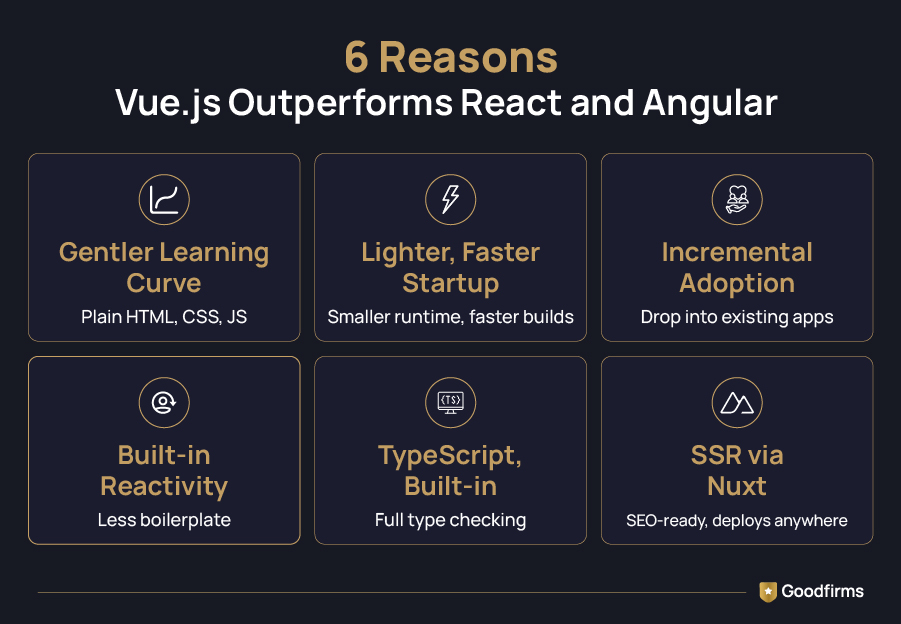
Here's where Vue actually has the edge over React and Angular, and why.
1. Gentler Learning Curve
Angular expects a lot before you can write your first real feature: TypeScript, a whole separate way of handling async code (RxJS), and a stricter setup for organizing and connecting pieces of the app. Even experienced JavaScript developers need a real ramp-up time. Vue sticks closer to plain HTML, CSS, and JavaScript so that a new team member can read and edit components within a day or two. That difference adds up fast for any team that hires often or brings in contractors for short stretches.
2. Lighter, Faster Startup
Angular applications tend to ship more framework code by default, which shows up in initial load time, especially on projects that haven't been carefully optimized to cut unused code. Vue's runtime is smaller, and combined with Vite's dev server and build pipeline, both cold starts and hot-reload cycles are noticeably faster during development — a difference developers feel every day, not just at deployment time.
3. Flexible, Incremental Adoption
Vue separates itself from both alternatives. You can mount Vue on a single page of a legacy jQuery or server-rendered app and expand from there — no rewrite required. Angular doesn't really allow that; it expects to own the application shell from the start. React sits in the middle, but Vue's single-file components make partial adoption especially low-friction, which matters a lot for teams modernizing an old codebase piece by piece rather than all at once.
4. Built-in Reactivity
React's state model is intentionally minimal, which means most non-trivial apps end up reaching for Redux, Zustand, or a similar library just to manage state cleanly. Vue's reactivity is built into the core — refs and computed values update the UI automatically, without extra dependencies or the pitfalls of React's useEffect dependency array. That built-in reactivity also makes dependency tracking more predictable, so less glue code means less to maintain and fewer places for bugs to hide.
5. TypeScript, Built-in
Older Vue write-ups tend to skip this one, because it used to be a genuine weak spot. Not anymore. The Composition API was built with TypeScript inference in mind, so most components get full type checking without needing manual type hints or augmentation boilerplate — a real shift for teams that treat TypeScript as non-negotiable in 2026.
6. Nuxt- Vue's Answer to Next.js.
For server-side rendering and SEO, Vue's answer is Nuxt — file-based routing, auto-imports, and a rendering engine that deploys cleanly to Cloudflare Workers, Vercel, or Railway. It's a legitimate alternative to Next.js, not a lesser one, and it's the piece that makes Vue a realistic choice for content- and SEO-sensitive sites, not just internal dashboards.
Here's how those benefits actually stack up against React and Angular, and the comparison below makes that clearer.
Vue.js vs React vs Angular at a Glance
A quick recap of the comparison above, side by side.
|
Aspect |
Vue.js |
React |
Angular |
|---|---|---|---|
|
Learning curve |
Gentle — plain HTML/CSS/JS |
Moderate — JSX + ecosystem choices |
Steep — TS, RxJS, DI required |
|
Runtime footprint |
Lightweight |
Lightweight (core), grows with libraries |
Heavier by default |
|
State management |
Built-in reactivity |
Needs Redux/Zustand for complex apps |
tyty Built-in (services + RxJS) |
|
TypeScript support |
Strong, built into Composition API |
Strong, community-driven |
Strong, built-in by design |
|
SSR / SEO framework |
Nuxt |
Next.js |
Angular Universal |
|
Adoption model |
Incremental — drop into existing apps |
Incremental, moderate effort |
All-or-nothing |
|
Ecosystem/hiring pool |
Smaller than React |
Largest |
Large, enterprise-heavy |
|
Best for |
SPAs, incremental modernization |
Large apps needing max hiring flexibility |
Large teams want a strict structure |
A table can only say so much, though. The trade-offs below are where the real decision usually gets made.
Where Vue.js falls short?
None of this makes Vue the automatic right choice — and a comparison that only lists the upsides isn't much use to anyone.
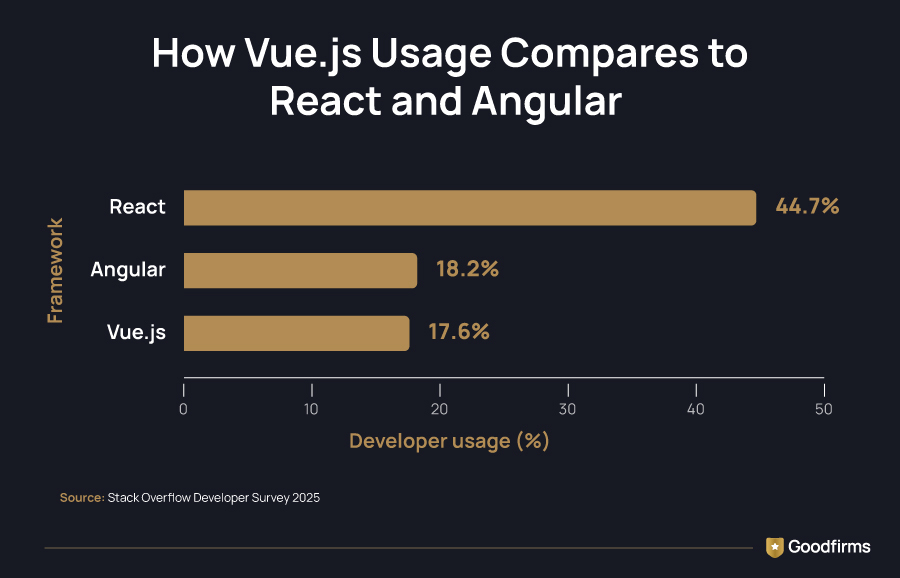
- React's ecosystem and job market are still bigger by a wide margin, which matters for teams that need to scale hiring quickly. The Stack Overflow 2025 Developer Survey shows React at 44.7%, Angular at 18.2%, and Vue at 17.6% — React's lead is real, not marginal. As of 17 July 2026, W3Techs' live tracking shows Vue.js running on just 0.6% of all websites, with a much larger installed base for React. Whichever angle you look from, developer usage or live deployment, the hiring pool is smaller for Vue than for React.
- For most everyday needs, Vue's ecosystem covers you fine. But for specific enterprise cases — like a data grid handling 100,000+ rows with inline editing, or a real-time financial charting library — the most mature options were usually built React-first. Vue often has an equivalent, but it's frequently a community wrapper around the React version rather than a purpose-built library. For that kind of heavyweight, specialized component, React's depth still wins.
- Angular's structure can be a feature, not a bug, for large teams that want a single opinionated way of doing things and less room for architectural drift — and it's exactly what most Angular development companies are built around delivering.
- React also has a stronger mobile story through React Native, letting teams share code between web and mobile — Vue's equivalents (NativeScript-Vue, Quasar) work, but have smaller ecosystems.
Vue is the better fit for teams that value structure and long-term maintainability without wanting Angular's level of rigidity. It's not the right fit for teams whose main constraint is finding as many available developers as quickly as possible.
Here's who's actually betting on Vue at scale.
Real-World Examples of Well-known Platforms running on Vue.js
Vue isn't just a framework for solo projects and startups. Several large, well-known platforms run on it in production:
- GitLab uses Vue.js as the primary frontend framework across its entire platform.
- Adobe built Behance, its creative-portfolio platform, on Vue.
- Nintendo runs Vue on several of its official regional websites, including My Nintendo.
- Xiaomi uses Vue across its consumer electronics website and several applications.
These aren't edge cases — they are large, high-traffic products where frontend performance directly affects the business, which is a reasonable proxy for whether a framework holds up under real production load.
GitLab's scale and your project's scale are two different things, though — the next section shows how to size Vue relative to your own.
When to Choose Vue.js?
Vue is a strong fit when you are building a single-page application, modernizing a legacy app incrementally rather than rewriting it from scratch, or your team values clarity and a gentle learning curve over the widest possible ecosystem to draw from. If your search is India-specific, it's worth browsing Vue.js development companies in India directly, since rates and talent depth vary a lot by region.
Consider alternatives when: you're building a large enterprise app and need the maximum hiring flexibility that React.js development companies offer (React or Next.js is the safer bet), your site is primarily content-driven (Astro is worth a look), or you're optimizing for instant resume on very performance-critical apps (Qwik specializes in exactly that).
Once you've settled on Vue, the next practical question is budget. You can see the full breakdown of the cost to hire Vue.js developersby experience level and region.
Take away the framework names, and that's how any tech decision should get made.
Closing Thoughts
Vue.js has quietly grown up. It's no longer the third-choice framework in 2026; it's mature, production-ready, backed by a modern toolchain, and used by real companies at scale. It won't be the right call for every team, particularly ones that need the biggest possible hiring pool or the deepest enterprise library ecosystem.
But for teams looking for a gentler learning curve, easier incremental adoption, and noticeably less boilerplate than React or Angular, Vue.js is worth considering — not as a fallback option, but as the framework that genuinely fits the job. If you're still weighing your options, it's worth talking to web development companies that work across all three frameworks and can help you figure out what's right for your specific project.
That's the full case for Vue.js in 2026—a few quick answers to the questions that tend to come up next.
FAQs - Benefits of Building a Website with Vue.js
Is Vue.js better than React?
Neither is universally better — they solve similar problems in different ways. Vue tends to win on learning curve, built-in reactivity, and incremental adoption; React tends to win on ecosystem size and hiring pool. The right choice ultimately comes down to which of those factors matters most for your project.
Is Vue.js good for large-scale enterprise apps?
Yes. Vue 3 was designed with larger codebases in mind — that's clear from the Composition API, solid TypeScript support, and Pinia's handling of state management. This isn't just on paper either: GitLab and Xiaomi both run Vue in production at enterprise scale.
Should I choose Vue over Angular for a new project?
If your team values an easier onboarding curve and more flexibility in how much of the framework you adopt, Vue is usually the better starting point. But if you'd rather enforce one strict, opinionated structure across a large team, Angular's rigidity actually works for you, not against you.
Is Vue.js worth learning in 2026?
Yes. Vue 3.5 and the Composition API are the current standard now, and the tooling around them — Vite, Pinia, Nuxt — has matured into something genuinely solid and well-maintained. It's also proven in production, with companies like GitLab and Adobe running it at scale. For teams building SPAs, working on incremental modernization, or simply prioritizing a gentler learning curve over the biggest possible ecosystem, Vue remains a genuinely practical skill to have.
Can I migrate an existing React or Angular app to Vue?
Yes, it depends on the app. Vue's incremental adoption model lets you bring it into an existing React or Angular codebase one page at a time, rather than tearing everything down and starting over. A full migration makes sense when the current app has become genuinely hard to maintain or hard to hire for. But if it's stable and getting the job done, a rewrite rarely justifies the risk on its own.