Key takeaways
- India remains the most budget-friendly web development market globally, with fixed-price projects starting as low as ₹10,000 ($100) and hourly rates as low as ₹700 - ₹6,000+ ($7–$60+).
- AI has sped up routine, templated work but hasn't meaningfully lowered pricing on complex custom builds — and it's introduced new post-launch costs like inference and maintenance.
- Hourly rates vary sharply by city and experience, so geography and developer seniority matter as much as the "India discount" itself.
- Fixed-price, hourly, retainer, and hybrid models all coexist in the market — the right choice depends on how well-defined your project scope is.
- Tech stack choice is one of the biggest hidden cost drivers, shaping not just build costs but long-term maintenance costs in year two and beyond.
In 2026, the website development costs in India start from ₹10,000 ($100), and the hourly rate for hiring web developers in India ranges from ₹700 - ₹6,000+ ($7–$60+).
India has a developer talent pool that has grown steadily for two decades, an industry that operates natively in English across time zones, and a cost structure that delivers meaningful savings against Western equivalents without a corresponding drop in technical output on well-scoped projects.
Explore Goodfirms' vetted list of web development companies in India — filter by budget, tech stack, and industry experience to find the right fit.
Moving on to the web development costs in India, here is what Indian agencies typically quote across eight project types — from a basic 5-page site to an enterprise SaaS platform.
How Much Does a Website Cost in India? Estimates by Project Type
The table below reflects quoted ranges and timelines from Indian web development agencies, sourced directly from Goodfirms' 2026 web development cost survey
|
Website Type |
Estimated Costs (INR) |
Estimated Costs (USD) |
Timeline |
|---|---|---|---|
|
Basic Website / MVP (5–10 pages) |
₹10,000 – ₹30,000 |
$100 – $300 |
1–3 Weeks |
|
Mid-Sized Website (custom design, 10–100 pages) |
₹30,000 – ₹80,000 |
$300 – $800 |
3–6 Weeks |
|
CMS-Based Website (WordPress, Webflow, etc.) |
₹80,000 – ₹200,000 |
$800 – $2,000 |
6–10 Weeks |
|
Enterprise-Level Website (100+ pages) |
₹200,000 – ₹400,000+ |
$2,000 – $4,000+ |
10–24 Weeks |
|
Custom Web Application |
₹400,000 – ₹2,500,000 |
$4,000 – $26,000+ |
24–48 Weeks |
|
Web Portal |
₹2,500,000 – ₹10,000,000+ |
$26,000 - $100,000+ |
4-12 Months |
After looking into the costs, you might wonder is India still worth it in 2026 for outsourcing web development services? The short answer is yes — and the detailed explanation is in the three advantages below.
Why Web Development Companies in India Remain the Global Outsourcing Preference in 2026?
India's web development outsourcing dominance in 2026 comes down to three structural advantages that no other market currently matches at scale:
- Massive Talent Pool - India's tech workforce crossed the 6 million mark in FY2026, with 135,000 new positions added over the course of the year. (NASSCOM's Annual Strategic Review 2026).
- Communication — English is the working language of India's tech industry; two decades of experience managing US and European time zone projects
- Cost — An Indian web developer costs $10-$15/hour, whereas a U.S. web developer charges $50-$100, resulting in 40-70% savings when outsourcing to India. (Goodfirms’ Survey)
Precisely, this combination of talent depth and cost efficiency adds up to something more strategic than savings alone — as Tom Bukevicius, CEO & Founder of Scube Marketing, puts it:

One of the biggest reasons we outsource web development projects to India is that it helps us take on larger and longer-term projects without constantly expanding our in-house team.
Now about web development costs, these numbers only tell part of the story. AI is changing how Indian agencies work and quote for web development projects these days.
How Indian Agencies Are Using AI in Web Development — and What It Actually Means for Your Budget
The idea that AI has made web development dramatically cheaper is one of the most persistent myths in 2026. According to survey data from web development cost research conducted by Goodfirms in April–May 2026, 98.3% of Indian web development companies use AI in some capacity.
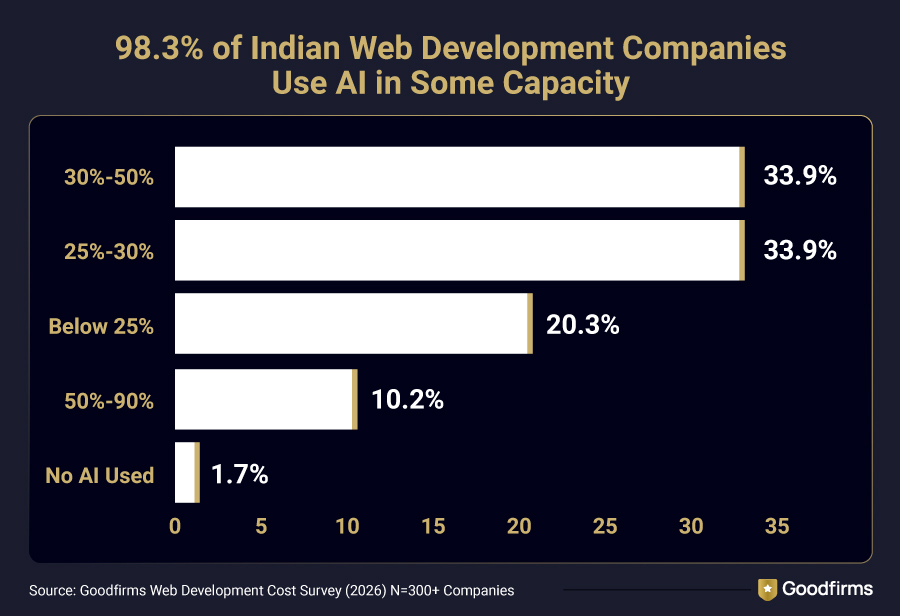
Key Insight: The 67.8% majority has embedded AI meaningfully without yet crossing the midpoint of their overall workflow — using it to accelerate defined tasks like code generation, boilerplate scaffolding, and automated testing, while keeping architecture decisions and client-facing quality control in human hands.
Now, how is AI impacting the web development cost in India?
The practical implication: AI in web development has made Indian agencies measurably faster on routine deliverables — basic site builds, templated CMS projects, standard front-end components. It has not fundamentally altered the cost curve on complex custom work, and it has introduced new post-launch cost centers (inference costs, model maintenance, technical debt from AI-generated code) that savvy buyers are starting to budget for from day one.
Ask the agencies themselves, and the answer is more grounded than the hype:

AI has reduced the cost of basic website work in 2026, especially for wireframing, content drafting, coding support, and faster bug fixing. But for serious business websites, pricing has not dropped in the same way, because strategy, UX thinking, custom features, QA, and human judgment still matter a lot.
With that context in place, here's what building an AI-powered website in India actually costs.
Web Development Cost in India (Using AI Tools)
|
Complexity Level |
Estimated Costs (INR) |
Estimated Costs (USD) |
Description |
|---|---|---|---|
|
Basic (Entry-level) |
₹1,000 – ₹2,000/ month |
$12-$20/month |
Core features, platform branding, limited storage (5GB) |
|
Standard (Mid-tier) |
₹2,000 – ₹4,000/ month |
$20-$35/month |
CRM, invoicing, scheduling, no branding, priority support |
|
Premium |
₹4,000 – ₹5,000/ month |
$35-$50/month |
White-label, advanced integrations, expanded storage, custom code |
|
Enterprise |
₹5,000 – ₹15,000+/ month |
$50-$150+/month |
Multiple sites, advanced security, dedicated support, custom builds |
As per a recent survey by Goodfirms: 91% of Software Companies Use AI to Cut Development Costs in 2026— but cutting hours is not the same as cutting rates. The hourly rate is still set by the market, and in India, it varies significantly depending on city, role, and experience. Here is what agencies and developers actually charge per hour in 2026.
How Much is the Hourly Cost of Web Developers in India in 2026?
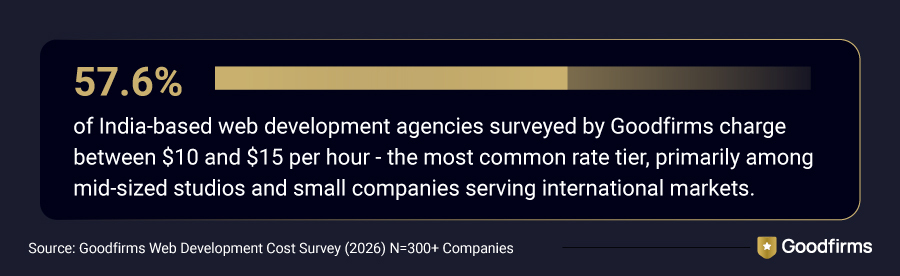
India's web development hourly rates are split into two distinct tiers, and the Goodfirms survey makes that divide impossible to miss. 57.6% of web development companies in India charge between $10 - $15/per hour which accounts to approximately ₹1,000 - ₹1,500/per hour. This is the competitive anchor that has driven offshore hiring to India for years, concentrated among mid-sized and smaller studios serving international clients on volume.
For businesses, the practical implication is significant. "Web development companies in India" do not describe a single price point; it describes two fundamentally different categories of service. An agency at ₹1,000/hour - and one at ₹5,000/hour are not competing for the same projects, and treating them as equivalent options because they share the same geography is one of the most common procurement mistakes in web development outsourcing. The rate tier a prospective partner occupies reflects its team structure, its quality assurance depth, geographical location within the country, and what they actually deliver on a complex build.
Below are the hourly costs of web developers in India based on their experience level and geographical location within the country.
|
Indian City |
Junior Developer (1-3 Years) in INR and USD |
Mid-Level Developer (4-6 Years) |
Senior Developer (7-10+) |
|---|---|---|---|
|
Bangalore |
₹1,000-₹1,800 ($10 – $18) |
₹1,800-₹3,500 ($18 – $35) |
₹3,500-₹6,000+ ($35 – $60+) |
|
Mumbai |
₹1,000-₹1,800 ($10 – $18) |
₹1,800-₹3,500 ($18 – $35) | ₹3,500-₹6,000+ ($35 – $60+) |
|
Delhi / NCR |
₹1,000-₹1,600 ($10 – $16) |
₹1,600-₹3,200 ($16 – $32) |
₹3,200-₹5,500+ ($32 – $55+) |
|
Hyderabad |
₹900-₹1,500 ($9 – $15) |
₹1,500-₹2,800 ($15 – $28) |
₹2,800-₹5,000+ ($28 – $55+) |
|
Pune |
₹800-₹1,400 ($8 – $14) |
₹1,400-₹2,500 ($14 – $25) |
₹2,500-₹4,500+ ($25 – $45+) |
|
Chennai |
₹800-₹1,400 ($8 – $14) |
₹1,400-₹2,500 ($14 – $25) | ₹2,500-₹4,500+ ($25 – $45+) |
|
Ahmedabad |
₹700-₹1,200 ($7 – $12) |
₹1,200-₹2,200 ($12 – $22) |
₹2,200-₹4,000+ ($22 – $40+) |
Bangalore and Mumbai sit at the top of India's hourly rate market — web developers in Mumbai and their Bangalore counterparts both charge ₹1,000-₹1,800/hour at junior level and ₹3,500-₹6,000/hour at senior level, the highest ceilings in the country. Web developers in Hyderabad offer a noticeable step down at ₹900-₹5,000/hour across levels, while web developers in Chennai match Pune at ₹800-₹4,500/hour — making both cities the mid-market sweet spot for buyers who want experienced talent without the metro price premium.
Geography sets the range. The role determines where within that range your project actually lands. A senior full-stack developer in Bangalore and a DevOps engineer in Hyderabad are both "Indian developers" — but they sit at very different points on the rate spectrum below.
Website Development Costs in India (2026): Hourly Rates By Developers’ Role (Freelancer vs. Agency)
|
Developer Role |
Freelancer Rate (INR & USD/hr) |
Agency Rate (INR & USD/hr) |
Experience Level |
|---|---|---|---|
|
Frontend Developer |
₹800-₹2,000 ($8 – $20) |
₹1,500-₹3,500 ($15 – $35) |
Mid to Senior |
|
Backend Developer |
₹1,000-₹2,000 ($10 – $25) |
₹1,800-₹4,000 ($18 – $40) |
Mid to Senior |
|
Full Stack Developer |
₹1,200-₹3,000 ($12 – $30) |
₹2,000-₹4,500 ($20 – $45) |
Mid to Senior |
|
UI/UX Designer |
₹800-₹1,800 ($8 – $18) |
₹1,500-₹3,000 ($15 – $30) |
Mid to Senior |
|
DevOps / Cloud Engineer |
₹1,500-₹3,500 ($15 – $35) |
₹2,500-₹5,500 ($25 – $55) |
Senior |
|
Project Manager / Tech Lead |
₹1,500-₹3,500 ($15 – $35) |
₹3,000-₹6,000 ($30 – $60) |
Senior |
So, now how do you calculate the total cost of your web development project based on an hourly pricing model? Let’s have a look at it based on a real-world example.
How to Calculate Total Web Development Cost Based on an Hourly Pricing Model? (A Real-World Example)
The formula itself is straightforward: HOURLY RATE × ESTIMATED HOURS = PROJECT COST.
What makes it complicated in practice is that most clients underestimate the hours, and most agencies estimate conservatively to win the project.
Here is how it works with a real scope.
For example, a mid-sized eCommerce company based in the U.S. wants to build a product catalog website with a custom checkout, a CMS for managing inventory, and a basic admin dashboard. They approached a mid-sized web development company in India, billing at $25/hour. This is how the total cost of a web development project is calculated.
The agency breaks the project into phases and estimates hours and costs for each:
|
Phase |
Estimated Hours |
Rate (INR & USD/hr) |
Phase Cost |
|---|---|---|---|
|
Discovery & Planning |
20 hrs |
₹2,500 ($25) |
₹50,000 ($500) |
|
UI/UX Design |
40 hrs |
₹2,500 ($25) |
₹100,000 ($1,000) |
|
Front-End Development |
80 hrs |
₹2,500 ($25) |
₹200,000 ($2,000) |
|
Back-End Development |
100 hrs |
₹2,500 ($25) | ₹250,000 ($2,500) |
|
CMS Integration |
30 hrs |
₹2,500 ($25) |
₹75,000 ($750) |
|
Payment Gateway Setup |
20 hrs |
₹2,500 ($25) |
₹50,000 ($500) |
|
QA & Testing |
40 hrs |
₹2,500 ($25) | ₹100,000 ($1,000) |
|
Project Management |
20 hrs |
₹2,500 ($25) | ₹50,000 ($500) |
|
Total |
350 hrs |
₹2,500 ($25) |
₹875,000 ($8,750) |
The quoted project cost comes to ₹875,000 at a flat ₹2,500/hour across the team. In practice, many agencies apply tiered rates — a senior developer at ₹3,500/hour, a junior at ₹1,500/hour — which changes the final number but not the calculation method.
eCommerce builds have their own cost logic — this dedicated guide to eCommerce website development cost breaks down exactly what goes into this ₹875,000 range.
Take the agency's hour estimate, add 20% as a contingency buffer, multiply by the hourly rate, and treat that number as your realistic budget — not the quoted figure.
For the example above: 350 hrs + 20% buffer = 420 hrs × ₹2,500 = ₹1,050,000That is the number worth putting in your budget spreadsheet before the project starts
Hourly and fixed-price models work well for defined builds — but not every project has a finish line. Here’s what web development companies in India charge as monthly retainers for ongoing projects.
Web Development Cost in India 2026: Monthly Retainers for Ongoing Projects
For clients who need continuous development support rather than one-time projects, the monthly retainer pricing model suits them well.
The web development cost in India, as per the monthly retainer model, is majorly influenced by web developers’ salaries. Below are the details about the monthly salaries of web developers in located in different cities in India.
Web Developers’ Salaries in India (Monthly in INR & USD)
|
Junior (1-3 Years) |
Mid-Level (4-6 Years) |
Senior (7-10+ Years) |
|
|---|---|---|---|
|
Bangalore |
₹25,000 - ₹50,000 ($300–$600) |
₹40,000 - ₹80,000 ($500–$1,000) |
₹50,000 - ₹100,000 ($600–$1,280) |
|
Delhi/NCR |
₹25,000 - ₹50,000 ($300–$600) | ₹40,000 - ₹70,000 ($400–$800) | ₹40,000 - ₹130,000 ($500–$1,600) |
|
Mumbai |
₹25,000 - ₹40,000 ($300–$500) |
₹30,000 - ₹70,000 ($400–$800) |
₹40,000 - ₹130,000 ($500–$1,550) |
|
Hyderabad |
₹25,000 - ₹40,000 ($300–$500) |
₹40,000 - ₹80,000 ($500–$1,000) |
₹40,000 - ₹125,000 ($500–$1,500) |
|
Pune |
₹25,000 - ₹40,000 ($300–$500) | ₹40,000 - ₹75,000 ($400–$900) | ₹40,000 - ₹125,000 ($500–$1,500) |
|
Chennai |
₹25,000 - ₹40,000 ($300–$500) |
₹30,000 - ₹80,000 ($400–$1,000) |
₹40,000 - ₹80,000 ($500–$1,000) |
|
Ahmedabad |
₹25,000 - ₹30,000 ($200–$400) | ₹30,000 - ₹58,000 ($300–$700) | ₹40,000 - ₹125,000 ($500–$1,650) |
Hiring web developers in Bangalore costs the most at the junior and mid-level — ₹25,000–₹100,000/month — reflecting the city's position as India's most competitive tech talent market. Web developers in Delhi/NCR offer the widest salary ceiling at the senior level, reaching ₹130,000, while web developers in Ahmedabad remain the most affordable entry point across all experience levels at ₹25,000 - ₹30,000/month for juniors.
With retainer rates varying this widely, the pricing model you choose matters as much as the agency you pick.
Which Pricing Model Do Web Development Firms in India Use — and Which Should You Choose?
As per Goodfirms' Survey Indian web development agencies are considerably more flexible on pricing structure than their reputation for fixed-price offshore contracts suggests. Fixed price leads at 71.2%, but time and material (66.1%) and hybrid models (64.4%) follow within striking distance. Monthly retainers are offered by nearly half the market — 49.2% of respondents.
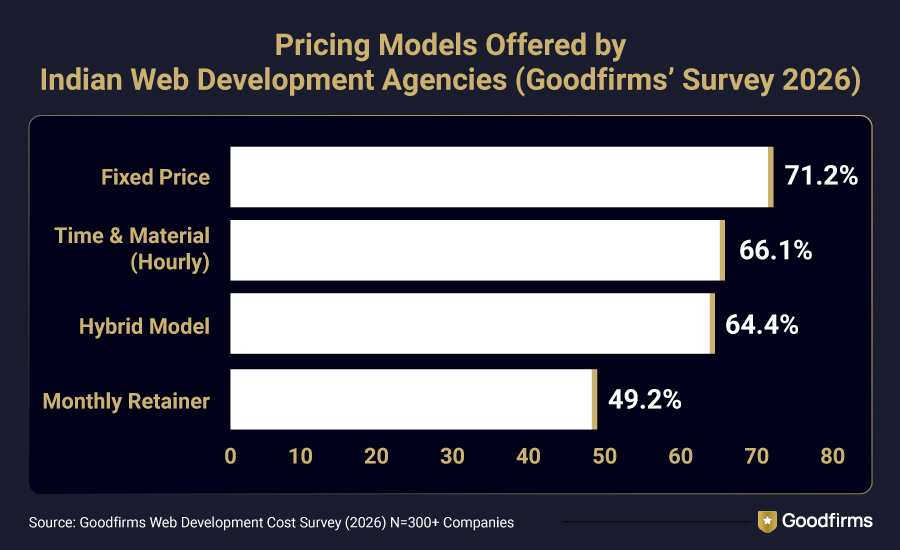
The pricing model you choose depends on the project requirements, budget, and team size. Here’s the clear explanation of each pricing model that can help you make the right decision.
Fixed price works when scope is clearly defined before work begins — a marketing site with a known page count, a CMS build with documented features, or an MVP with a locked spec. The risk sits with the agency; any scope drift comes out of their margin. That keeps client invoices predictable, but it only works if the brief is genuinely tight.
Hourly (Time and material) is the right call for iterative builds, discovery-heavy projects, or long-horizon platforms where requirements will evolve as the work progresses. Clients pay for actual hours consumed, which means they retain flexibility — but also accept that the final invoice reflects real scope rather than an estimate made before anyone understood the problem fully.
Monthly retainer works when the work does not end at launch. Rather than scoping deliverables upfront, you are buying a set amount of an agency's time each month — for updates, new features, maintenance, or all three. The risk sits with the client; unused hours rarely roll over. It suits businesses with a steady, predictable stream of work rather than a one-time build.
Hybrid models — fixed for defined phases, T&M or retainer for open-ended ones — are the pragmatist's answer. The near-identical adoption rates of hybrid and T&M in the survey suggest that a large share of India's market has quietly moved away from rigid fixed-price arrangements toward structures that accommodate how projects actually unfold in practice.
Once you've settled on a pricing structure, the hiring model is what determines how that budget gets spent.
In-House, Freelancer, or Agency — Which Hiring Model Fits Your Budget?
Hiring web developers in India comes down to three choices.
In-house teams carry employment overhead and high attrition — in practice, replacing a mid-level engineer typically costs the equivalent of several months' salary once recruitment, onboarding, and productivity loss are factored in.
Freelancers are affordable but limited to defined, short-scope tasks.
Professional Web Development Agencies in India bring structured delivery, full-stack coverage, and accountability.
The choice of hiring model depends on your project complexity and requirements, budget, and current infrastructure. Below is the comparison between different hiring models you can consider before making the right decision.
|
Hiring Model |
Typical Cost |
Best For |
Main Risks |
|---|---|---|---|
|
In-House Developer |
₹25,000 - ₹140,000 ($300–$1650)/Month salary + overheads |
Long-term product teams |
Attrition, overhead |
|
Freelancer |
₹1,000 - ₹4,000 ($10–$40)/hr |
Short, defined tasks |
Continuity, capacity |
|
Small Agency (2–10) |
₹1,000 - ₹5,000 ($10–$50)/hr |
Standard builds, CMS |
Bandwidth limits |
|
Mid-Sized Agency (11–50) |
₹1,000 - ₹8,000 ($15–$80)/hr |
Custom apps, portals, and eCommerce |
Communication overhead |
|
Large Enterprise (51–200) |
₹5,000 - ₹10,000 ($50–$100)/hr |
Enterprise, regulated industries |
Cost, less agility |
Hiring model chosen, pricing structure set — what actually impacts the final invoice comes down to these factors.
What Factors Drive Up Web Development Costs in India?
The hourly rate is the number clients focus on. The cost drivers are the numbers that actually determine what they pay. Technology choices, custom development depth, third-party integrations, and scope clarity shape the final invoice far more than the opening quote suggests. As per data extracted from the GoodFirms survey, below are the key cost drivers cited by web development agencies in India.
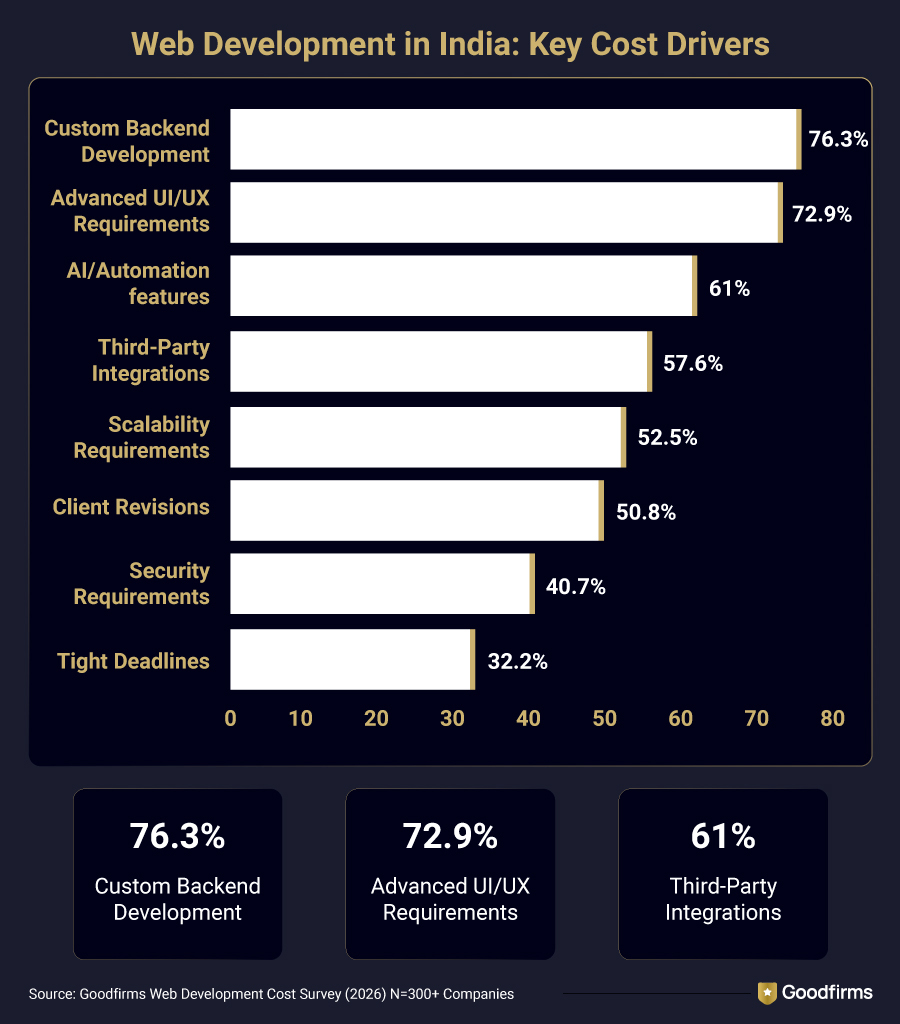
With the full cost picture in place, one question remains worth asking: where does India stand when it comes to web development costs on a global scale.
India vs. the Global Market: What the Rate Gap Actually Means
As per Goodfirms’ global survey on web development costs, below are the most common fixed-price ranges, hourly rates, and monthly retainers that web development companies across India, the U.S., Australia, and Europe typically charge for their services.
|
Country |
Fixed Price Range |
Hourly Rate |
Senior Developer Annual Salary |
|---|---|---|---|
|
India |
₹10,000 – ₹400,000+ ($100-$4,000+) | ₹700 - ₹6,000+ ($7 - $60+) | ₹5,00,000 – ₹16,50,000+ ($5,000-$20,000+) |
|
U.S. |
$3,000 – $20,000+ | $54 - $70 | $90,000 – $150,000+ |
|
Australia |
AU$4,000 – AU$18,000 ($3,000-$13,000) | AU$30 - AU$36 ($20 - $26) | AU$90,000 – AU$140,000+ ($65,000 - $100,000) |
|
United Kingdom |
£3,000 – £15,000 ($4,000-$20,000) | £15 - £120+ ($20-$160) | £45,000 – £90,000+ ($60,000 - $120,000+) |
Web Development Companies in the U.S. and Australia typically charge between $3,000–$20,000+ for fixed-price projects, $20–$70/hour, and $65,000–$150,000 annually. Web development companies in the UK follow similar price ranges, while Indian firms remain the most budget-friendly across all three pricing models.
Hence, a project that a web development agency in Australia or the UK would price at $10,000 may come in at $2,000–$4,000 from a reputable Indian mid-sized studio at $10–$15 per hour, with comparable technical output on the deliverables that can be thoroughly scoped and tested.
Now when you have all the details ready, before you reach out to an agency, these are the questions that you might need answers to while you budget for your next web development project.
FAQs: Web Development Cost in India (2026)
What payment structure do Indian web development agencies typically follow?
Most Indian agencies split payments into milestones — commonly 30% upfront, 40% at mid-project delivery, and 30% on final handover. Some request 50% advance for smaller fixed-price builds. Avoid agencies asking for full payment before work begins; milestone-based structures protect both sides.
What hidden costs should I budget for beyond the quoted price?
Domain registration, SSL certificates, third-party API licences, hosting, and post-launch bug fixes often sit outside the core quote. Ongoing maintenance, content updates, and performance monitoring add further recurring costs that most clients under budget in their initial planning.
Who owns the code and IP after a project is delivered?
IP ownership is not automatic — it must be explicitly stated in the contract. Always confirm that full source code, design assets, and documentation transfer to you upon final payment. Reputable Indian agencies include IP assignment clauses as standard; absence of one is a red flag.
What typically causes web development projects in India to run over timeline?
Delayed client feedback, mid-project scope additions, and third-party integration issues are the three most common causes. Agencies cannot absorb delays caused by the client's side without timeline adjustments. Agreeing on feedback turnaround windows upfront reduces this risk considerably.
How do I evaluate a web development agency in India before signing a contract?
Look for agencies that provide a phase-by-phase estimate (not a single project number), can name past clients in your industry or at your project complexity level, and include IP assignment and change-control clauses in their standard contract. Goodfirms reviews and ratings give you verified client feedback before you engage — filter by specialization and budget to shortlist agencies matched to your brief.
Final Verdict: How to Budget Right in 2026 and Hire the Best Web Development Companies in India?
Most web development projects go over budget for familiar reasons: loosely defined scope, deferred technology decisions, and revision cycles no one accounted for. The below four decisions consistently separate projects that stay on budget from those that don't.
1. Define scope before collecting quotes
A brief describing outcomes — "users should book appointments without calling us" — produces sharper estimates than one describing aesthetics. Agencies pricing vague briefs add contingency margins; those pricing detailed specs compete on skill instead.
2. Let the technology recommendation come with a justification, not just a label
Tech stack choice is a high-to-very-high cost driver, meaning the framework decision made in week one shapes the entire budget ceiling. Ask why a prospective agency recommends their chosen stack — and what it means for maintenance costs in year two, not just build costs in month one.
For instance, Shopify, is a stack decision that comes with its own pricing logic — worth understanding in detail. If your web development company in India suggests you to pick Shopify for your eCommerce store, this article can be worth reading - Shopify Store Development Cost in India: A Realistic Breakdown for 2026.
3. Budget for the ongoing relationship, not the one-time build
With 49.2% of Indian agencies offering monthly retainers, the market has a strong infrastructure for long-term partnerships. Treating a website as a one-time purchase consistently underfunds the iteration, maintenance, and performance work that determines whether it actually delivers value.
4. Match the agency tier to the project honestly
A $10–$15/hour agency and a $50–$100/hour agency are not interchangeable. If your project requires regulatory compliance, multi-system integration, or production-grade security, the premium tier is the appropriate choice — not a luxury. Choosing on rate alone and expecting enterprise-grade output is where most outsourcing decisions go wrong.
India's web development market has the depth to handle almost any project scope. The difference between a good outcome and a costly one comes down to one decision made before any quote is requested: which tier does your project actually belong to? Match that honestly, then use the Goodfirms directory to shortlist web development companies whose rate, specialization, and verified client reviews align with your answer.
Note: All USD figures in this article are approximate. They have been rounded after converting from INR at prevailing exchange rates and are subject to change as currency rates fluctuate. For precise, up-to-date figures, please confirm current conversion rates before budgeting.