ReactJS or NodeJS, which one to choose for your development project, is a common question. Well, the answer is, it depends completely on your project requirement.
However, to begin with, although both are open-source JavaScript technologies, they are poles apart.
So, let’s dig deep into both technologies to make your choice easier.
What is NodeJS?
It is a cross-platform runtime environment for executing JavaScript Code outside a browser. Although JavaScript was mostly used for client-side scripting, scripts written in JavaScript run on the client's browser and make web pages interactive.

NodeJS developers, on the other hand, use JavaScript for server-side scripting.
Advantages of NodeJS
Now you know what NodeJS is and where it is used. Let’s have a look at its advantages so that you can make your choice.
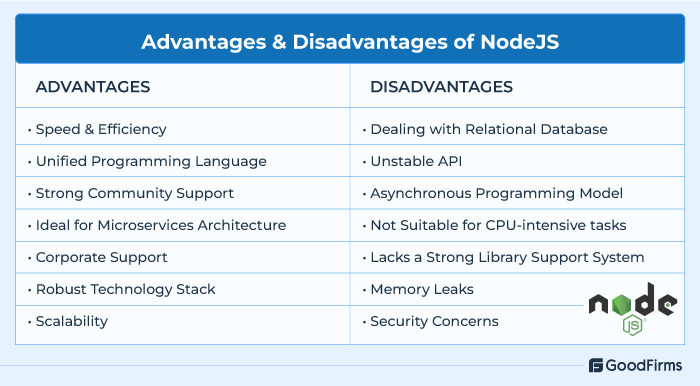
1. Speed & Efficiency
NodeJS makes use of V8 JavaScript Engine from Google that compiles JavaScript directly into native machine code. This enables faster execution of applications. It has event-driven architecture and non-blocking I/O operations that enhance its speed and efficiency.
It can therefore handle data-intensive real-time applications.
2. Unified Programming Language
NodeJS uses JavaScript, a client-side programming language that allows developers to use a single language for both client-side and server-side scripts. This advantage streamlines the development process, allowing the same team to manage the entire code base.
3. Strong Community Support
It has a vast and active community that provides access to countless modules and tools via Node Package Manager. This ecosystem ensures that developers find tools and libraries for nearly any functionality they want to create.
4. Ideal for Microservices Architecture
NodeJS is suitable for a microservices architecture due to its modular and lightweight nature. Firms that want to break down their applications into smaller but interconnected services find it ideal.
This is due to its ability to handle asynchronous calls and efficiency with input and output operations.
5. Corporate Support
This technology has also got very strong corporate support and giants like Google, Microsoft and IBM ensure its continuous development. As a result, other businesses can be sure of adopting NodeJS and its long-term viability.
6. Robust Technology Stack
NodeJS is a vital part of many stacks, including MEAN stack, which stands for MongoDB, ExpressJS, AngularJS, and NodeJS. This allows developers to build powerful and dynamic web apps.
This simplifies the development process and speeds up the delivery of applications.
7. Scalability
Scalability is one of the core strengths of NodeJS. As compared to traditional threading, the event loop allows NodeJS to perform non-blocking input/output operations.
As a result, NodeJS can handle many connections simultaneously, making it a preferred choice for live chat apps, collaboration tools, and online gaming.
Disadvantages of NodeJS
We have seen advantages of using NodeJS but it has some disadvantages too. Let’s have a look at the same.
1. Dealing With Relational Database
A relational database stores data in tables that are related to each other, whereas in non-relational databases, there is no relation between tables.
NodeJS is a JavaScript runtime that is suitable for working with relational databases. It also has a module, the MySQL module, that allows connection with a MySQL database and performs database operations.
However, this can also be a disadvantage as some libraries are more difficult to use than others.
2. Unstable API
An unstable API is one that can change at any time, and it can be a headache for developers who want the API to remain constant to maintain their own software.
An unstable API can lead to software that is difficult to maintain and upgrade.
If you are using NodeJS, be aware that the API is unstable. This means that it can change at any time, and you can potentially break your code. So, keep up to date with the latest changes.
3. Asynchronous Programming Model
In this programming model, program execution proceeds without waiting for all program elements to be processed.
In asynchronous programming, program elements that can run independently of other elements are processed in parallel. Program elements that can run independently are processed sequentially.
4. Not Suitable for CPU-intensive Tasks
NodeJS applications are single-threaded, which means they can use only one CPU core at a time. This can be a drawback for CPU-intensive applications.
NodeJS is a runtime environment that executes JavaScript on the server side. JavaScript is a front-end programming language that uses a single thread to process tasks fast. As a result, threading is not required for it to work, as these tasks are lightweight.
5. Lacks a Strong Library Support System
NodeJS is relatively new and has fewer high-quality libraries available compared to other programming languages. As a result, it is tough to find the right library for a given task.
Along with that, libraries for NodeJS have fewer features than those of other languages. This makes the software development challenging and can lead to more bugs in the code.
6. Memory Leaks
A web application that is not coded well is vulnerable to memory leaks. A memory leak is a situation wherein a piece of code allocates memory but does not free it. As a result, the NodeJS process can run out of memory and crash.
Memory leaks can be prevented, but it is difficult to do so in a complex application.
7. Security Concerns
As there is reliance on third-party packages, there is an increased risk of security vulnerabilities. This makes it necessary for developers to regularly update dependencies and conduct security audits to reduce risks.
What is ReactJS?
React or ReactJS is an open source JavaScript library that is designed by Facebook for building user interfaces or UI components.
It simplifies the creation of single-page applications, focusing on maintainability and performance. It operates by creating an in-memory virtual DOM rather than directly manipulating the browser’s DOM.

ReactJS performs necessary manipulations on these virtual representations ahead of applying changes to the actual browser DOM.
Advantages of ReactJS
ReactJS developers offer many advantages for modern web development. Let’s have a look at some of the major advantages of using ReactJS.
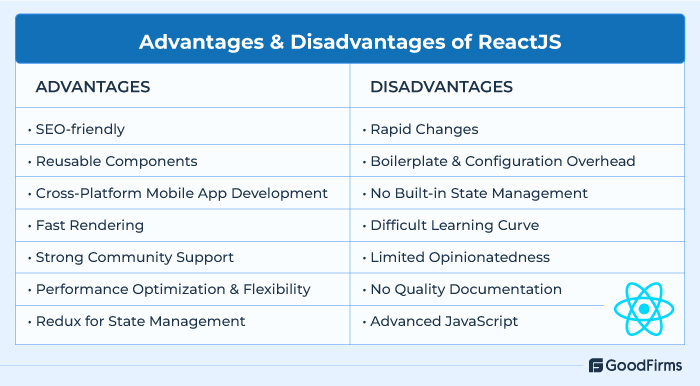
1. SEO-friendly
ReactJS creates applications that are SEO-friendly by making use of features like Server Side Rendering(SSR) and Static Site Generation(SSG). React generates content that is very easy for search engines to crawl and index.
As a result, you get better search rankings and improve user experience and SEO by reducing load times.
2. Reusable Components
React offers a component-based architecture where developers can break the User Interface into smaller components. These self-contained units of code are reusable, making the development process easy and efficient.
Due to isolated components, updates or bug fixes are much easier. This allows faster development as ReactJS saves time on elements that are being repeated.
3. Cross-platform Mobile App Development
React Native allows the development of native mobile apps, both for iOS and Android, with a single code base. As a result, there is faster development and the option of code reuse across platforms.
ReactJS offers near native app performance.
4. Fast Rendering
React provides fast rendering by making use of the Virtual DOM and the Reconciliation Algorithm. This minimizes unnecessary re-renders and improves the responsiveness of the application.
Reconciliation Algorithm is needed for comparing the previous Virtual DOM with the new one to find out what changed. React makes use of an optimized diffing algorithm to minimize the number of changes needed to apply real DOM.
5. Strong Community Support
ReactJS has a large community that is active and backed by Meta. It provides an extensive ecosystem of libraries, resources and tools for developers.
React has plenty of documentation, tutorials and third-party libraries. It has easy access to solutions and support via forums, GitHub.
6. Performance Optimization & Flexibility
ReactJS is known for offering flexibility due to its component-based architecture. It supports different rendering methods and is performance optimized with features like React. memo, code-splitting, and lazy loading.
7. Redux for State Management
In the case of large apps, managing application state becomes complex. Redux helps manage the state in a predictable way by maintaining the entire state in a single store.
There is easier tracking and management of applications due to ca entralized state. Changes can be made only through dispatched actions.
Disadvantages of ReactJS
Everything has its pros and cons, and ReactJS is no different. Let’s have a look at its disadvantages.
1. Rapid Changes
React is continuously updated with new changes, features, and deprecated methods. This keeps React modern and efficient, but developers also need to continuously learn the new updates.
This may lead to maintenance challenges in long-term projects. Although React is becoming more modern and efficient, it is also becoming challenging for developers to keep up with the pace.
2. Boilerplate & Configuration Overhead
When you start a React project, it requires setting up a lot of boiler plate code and configuration. This is more so when you are integrating additional tools and libraries.
This type of setup is time-consuming and requires a deeper understanding of the overall development environment, including bundlers.
3. No Built-in State Management
React focuses on the view layer only,, meaning it does not provide built-in solutions for state management for larger applications. Developers are supposed to integrate external libraries like Redux, Context API, or MobX.
This adds an extra layer of complexity and learning requirements.
4. Difficult Learning Curve
Although React has several benefits, it is difficult to learn for many beginners. This is more so with developers who are new to JavaScript.
It requires time and practice to learn concepts like state management, JSX, and component lifecycle. This can be challenging for inexperienced developers.
5. Limited Opinionated Ness
In terms of ReactJS, limited opinionated Ness refers to the characteristic of React as a library and not a framework.
ReactJS does not provide a specific way to structure a project, handle routing, or manage data. This flexibility allows customization but can also result in varying project structures and practices with different development teams.
6. No Quality Documentation
Although React's primary website has decent documentation, some developers are of the view that it lacks depth and detail. React’s community provides additional articles but they are scattered and do not provide easy learning.
7. Advanced JavaScript
Although React's core concepts are simple and straightforward, advanced concepts require understanding of complex aspects of JavaScript.
These advanced concepts, which are high in number, pose challenges to developers who are seeking mastery.
Use Cases of ReactJS & NodeJS
We have seen both ReactJS and NodeJS, as well as their advantages and disadvantages. Now, let’s have a look at the use cases of both to get a better understanding of their features.
ReactJS Use Cases
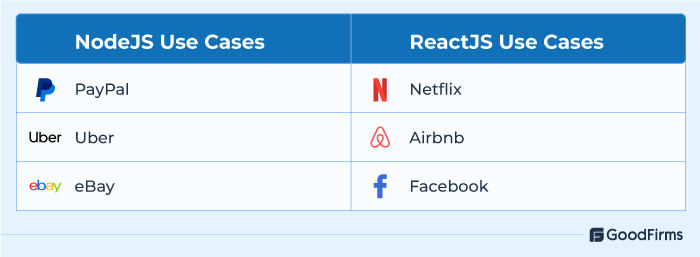
1. Netflix
Netflix uses ReactJS to optimize its web interfaces' performance, specifically for low-performance devices. Due to its ability to handle complex user interactions, Netflix has been able to provide a consistent and fast user experience.
Netflix is capable of providing a good user experience irrespective of the device or network conditions. This advantage has been vital in maintaining satisfaction and user engagement.
2. Airbnb
Airbnb has made use of ReactJS to make changes to its front-end architecture. This has helped improve performance and developer efficiency.
Airbnb has been able to achieve faster rendering time and a modular codebase by making use of React. As a result, Airbnb can have easier updates and feature additions. As a result, user experience has been improved both on mobile and web platforms.
3. Facebook
Facebook created ReactJS, which is used extensively throughout the company. React's component-based architecture allows Facebook to create both responsive and dynamic user interfaces.
As a result, Facebook provides a seamless experience to its vast user base. This set up enables efficient updates, maintenance, performance and scalability.
NodeJS Use Cases
Let’s look at the major use case of NodeJS. This will help you in making your choice.
(1) PayPal
PayPal is an online payment platform, and it faced challenges due to its dual codebase architecture. PayPal had used Java for server-side development and JavaScript for client-side scripting.
This resulted in a complex and inefficient development process. In order to streamline development, PayPal went for NodeJS for server-side operations. NodeJS’s asynchronous nature allowed PayPal to handle more transactions simultaneously.
(2) Uber
Uber is a travel solutions app which operates in many countries. They required a real-time, scalable solution to handle thousands of simultaneous requests from drivers and riders.
Their existing system was built using Python and was facing performance bottlenecks. Uber chose NodeJS as a replacement due to its features of real-time data streaming and ability to handle asynchronous operations.
Uber’s platform is now able to handle millions of requests simultaneously. There is improved error handling and increased system reliability.
(3) eBay
eBay is an eCommerce giant which has adopted NodeJS for its live monitoring feature and event-driven architecture.
NodeJS was used to develop a real-time monitoring system providing instant insights into issues and system performances. Automated maintenance scripts improved system reliability and reduced downtime.
This scalable infrastructure enabled monitoring of increasing loads.
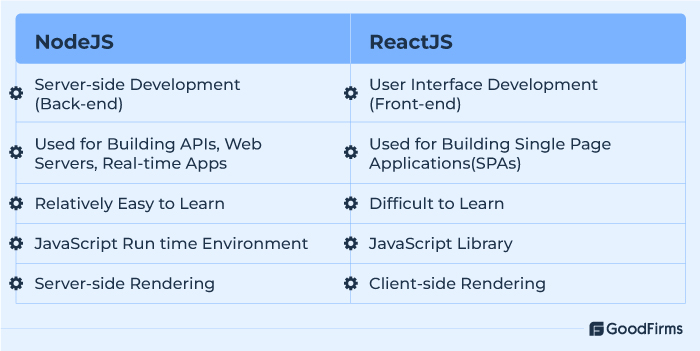
Finally, let's compare NodejS & ReactJS via a comparison chart.
Wrapping Up…
So, now you have a very good idea about what ReactJS and NodeJS are. You know what the advantages and disadvantages of both are.
You should go for ReactJS if you want to create real-time apps, web servers, or APIs. However, if you are building single-page applications (SPAs), go for NodeJS. So, take your pick depending on your project requirement.
FAQs for NodeJS vs. ReactJS
1. What are ReactJS & NodeJS?
React.js and Node.js are both widely used JavaScript technologies in web development, but they serve distinct purposes.
2. What are the applications of ReactJS & NodeJS?
ReactJS is used for front-end development, whereas NodeJS is used for back-end development.
3. Can both NodeJS and ReactJS be used together for the same application?
Yes, it is possible to use both frameworks together, and they make a powerful combination.
4. Which databases are commonly used with NodeJS & ReactJS?
SQL: MySQL, PostgreSQL
NoSQL: MongoDB, Firebase, DynamoDB