Key takeaways
- A payment gateway captures and encrypts customer payment data; it moves information, not money
- A payment processor actually moves the money between banks, and it handles authorization and settlement
- Most businesses confuse the two because modern Payment Service Providers (PSPs) like Stripe bundle both into one product
- The gateway vs processor distinction matters most at high transaction volume, in regulated industries, and when building embedded payments
- The PayFac model is the most practical middle ground for SaaS platforms and marketplaces
Most online businesses think they're using one payment system. Well, under the hood, they're actually using two, and the confusion costs them time and money.
When you use Stripe, Square, or PayPal, you're using two separate systems stacked together: a payment gateway and a payment processor. But they're bundled so cleanly that you don't see the seam, until something breaks and you don't know which layer to debug.
Most founders don't realize these are two different things doing two different jobs. One handles your customer's card data. The other moves the actual money. When payments fail, you'll waste time fixing the wrong layer if you don't know which does what.
This guide covers the real differences, how the two work together, why they get bundled by PSPs like Stripe, and when building your own actually makes more sense than renting someone else's infrastructure.
Looking for vetted development partners to build your payment infrastructure? Browse top payment gateway development companies and compare verified reviews before you engage anyone.
Here's how a payment gateway vs payment processor actually compares before we go deeper into each:
Payment Gateway vs Payment Processor: Quick Comparison
|
Dimension |
Payment Gateway |
Payment Processor |
|---|---|---|
|
Primary role |
Capture, encrypt, and route payment data |
Authorize and settle transactions |
|
Handles customer data |
Yes, direct point of data capture |
No, receives encrypted data only |
|
Connects to banks |
No |
Yes, talks to issuing and acquiring banks |
|
Security responsibility |
Encryption, tokenization, fraud scoring |
Authorization, chargeback handling |
|
Settlement involvement |
None |
Core function |
|
Customization level |
High, checkout UX, routing logic |
Lower, mostly backend config |
|
Examples |
Authorize.Net, Stripe gateway layer |
Fiserv, Worldpay, Adyen processor |
|
Can work independently? |
No, needs a processor downstream. |
Yes, works without a separate gateway. |
What Is a Payment Gateway?
A payment gateway is the layer that sits between your customer and the rest of the payment chain. Its job is to capture payment data, secure it, and pass it downstream to the processor. That's all it does; it never moves money.
The moment a customer hits "Pay Now," the gateway tokenizes the card number, encrypts the full payload, and sends it to the processor. Once it hands that off, its job is done. Everything after authorization, bank communication, and settlement belongs to the processor.
What it actually does:
- Captures card or wallet data at checkout
- Tokenizes the card number, so raw data is never exposed
- Encrypts the payload before it leaves your environment
- Routes the encrypted request to the payment processor
- Returns the approval or decline back to your checkout page
- Logs transaction records for reporting
What Is a Payment Processor?
A payment processor is the back-end engine that actually moves money. It takes the encrypted request from the gateway, talks to card networks (Visa, Mastercard, Amex), checks with the customer's bank, and either approves or declines the transaction. For approved transactions, it settles funds into your merchant account, usually within T+1 to T+3 business days.
Settlement is the key distinction. Gateways never touch it. Processors own it entirely.
What it actually does:
- Receives the encrypted request from the gateway
- Routes it to the right card network -Visa, Mastercard, Amex, Discover
- Checks with the issuing bank for funds and fraud signals
- Returns an approval or a specific decline reason
- Batches approved transactions and settles funds to your acquiring bank
- Handles chargebacks and dispute resolution
Why This Gets Confusing: Most Tools Are Both
Here's the part that trips people up. Stripe, Square, PayPal, Braintree, these aren't gateways or processors. They're Payment Service Providers (PSPs), and a PSP's entire value proposition is bundling the gateway and processor into one product so you never have to think about the seam.
When you integrate Stripe, you're not choosing a gateway and then a processor separately. You're using one system that captures the card data and moves the money, end to end. The same goes for Square and PayPal's core products.
This is fine, and it's the right setup for most businesses. But it means the gateway/processor distinction won't appear in your dashboard. It only becomes visible when something fails, or when you outgrow the bundle entirely and start asking whether to build your own gateway, move to a PayFac model, or stay on a PSP, which is exactly the decision this guide walks through.
Key Differences Between a Payment Gateway vs Payment Processor
This is where the real clarity lives, even inside a bundled PSP. These aren't just two names for similar things; they differ in what they own, what breaks when they fail, what compliance they carry, and how their costs scale, whether you're using one bundled tool or two separate vendors.
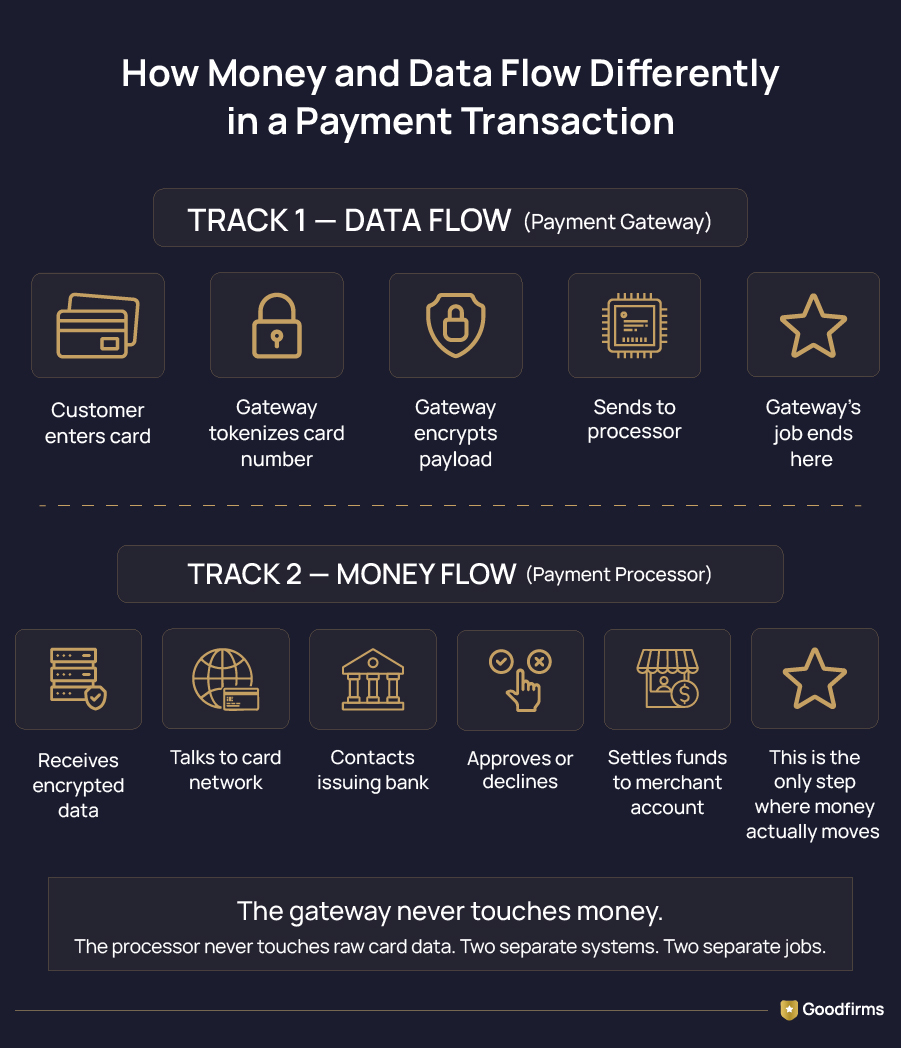
1. One Handles Your Data, the Other Handles Your Money
The gateway is a data handler. Every piece of payment info your customer types, like card number, expiry, and CVV, goes through the gateway first. It tokenizes the card number immediately, encrypts everything, and passes it forward. It never does anything commercial with that data. It just secures and transmits it.
The processor is the money handler. It never even sees raw card data. It gets a tokenized, encrypted package and uses it to talk to banks and card networks. Its only job is to verify funds, apply fraud rules, and move money.
Why this matters in practice: When a transaction fails, it's almost always a processor issue, insufficient funds, fraud flags, or bank rules. But businesses that don't understand this distinction spend hours troubleshooting their gateway when the problem is entirely downstream.
2. They Sit at Opposite Ends of the Transaction Chain
The flow is completely linear:
|
Customer checkout → [GATEWAY] → Encrypted payload → [PROCESSOR] → Card networks → Issuing bank ↓ Settlement into the merchant account |
The gateway is at the front; it touches the customer's experience directly. The processor is at the back, invisible to the customer, but responsible for every financial outcome.
This matters architecturally. Your gateway controls your checkout UX, your PCI scope, your tokenization approach, and when fraud signals are applied. Your processor controls your authorization rates, interchange costs, chargeback handling, and when money hits your account.
3. Their Security Responsibilities Don't Overlap
They each own a completely separate piece of security, and neither overlaps with the other.
Gateway security is about protecting data at the point of capture: SSL/TLS encryption in transit, PCI-compliant tokenization, hosted fields that keep raw card data off your servers entirely, and fraud scoring applied before the data even reaches the processor.
Processor security is about financial transaction integrity: authorization logic, velocity checks, card network fraud rules (Visa Advanced Authorization, Mastercard Safety Net), chargeback management, and reserve requirements.
A common mistake: assuming that because your processor has fraud tools, you don't need fraud tools at the gateway level. They catch different things at different points. Gateway fraud scoring catches bad signals before authorization is even attempted. Processor fraud rules catch what slips through. You need both.
4. Their Compliance Burden Is Completely Different
Gateways fall under PCI DSS primarily for data capture and storage. Use a hosted payment page or hosted fields, and your gateway vendor carries most of that compliance weight. Build your own, and you inherit PCI DSS Level 1, the most intensive audit tier, with annual on-site assessments by a Qualified Security Assessor (QSA) and quarterly network scans.
Processors carry compliance at the financial infrastructure level, like card network rules, AML/KYC requirements, and, depending on what you're building, money transmitter licensing. If you go the PayFac route, you take on processor-level compliance, too, which is why the PayFac path costs significantly more than a custom gateway alone.
This is the part that surprises most teams. Engineering costs are plannable. PCI Level 1 audits ($50K–$200K/year), HSM integration, and state-by-state licensing are the line items that blow budgets.
5. They Fail in Completely Different Ways
When a gateway fails, Customers can't submit payment info at all. Checkout forms don't load, tokenization calls time out, or the encrypted payload never reaches the processor.
Usually, it's a connectivity or availability issue on your end.
When a processor fails: Payment data arrives, but nothing happens. Authorizations don't return, settlements stall, and funds don't move. From the customer's view, it looks like a checkout failure, but the problem is entirely downstream of the gateway.
Knowing which layer failed tells you which vendor to call, which logs to pull, and which team to escalate to. Without this distinction, you're debugging in the dark.
6. One Is Built for Flexibility, the Other Isn't
Gateways are designed to be customized. Checkout UX is a conversion lever; you can A/B test your payment form, add local payment methods dynamically, build custom fraud rules, and optimize for specific markets. Building your own gateway means complete control over all of this.
Processors are backend infrastructure; they're built for reliability and speed, not flexibility. You can negotiate rates, configure settlement windows, and set up retry logic, but you're not customizing a processor the way you customize a gateway.
7. Their Costs Scale in Completely Different Ways
Third-party gateways charge $0.05–$0.30 per transaction. Small volume? Barely noticeable. High volume? It's a real P&L line. Processors charge interchange-plus or flat-rate markups on top of the base interchange set by card networks, non-negotiable. At high volume, the processor markup is negotiable. And with a PayFac model, you capture a portion of that spread rather than paying it entirely to someone else.
Build vs. Buy: What Does It Actually Cost in 2026?
|
Costing |
Third-Party PSP |
Custom Gateway |
PayFac Model |
|---|---|---|---|
|
Development cost |
$0–$5K integration |
$150K–$500K+ |
$200K–$800K |
|
Compliance cost |
Covered by the vendor |
$50K–$200K/year (PCI L1) |
$100K–$300K/year |
|
Maintenance |
Vendor-managed |
$100K+/year |
$150K+/year |
|
Time to launch |
Days to weeks |
12–24 months |
12–18 months |
|
Per-transaction fees |
0.05%–0.30% + interchange |
Eliminated |
Reduced significantly |
|
Scalability ceiling |
Hits limits at volume |
None |
High |
|
Best for |
Startups to $10M volume |
$50M+ processors |
SaaS platforms, marketplaces |
Source: Stripe,Authorize.Net, audit documentation,Visa , Mastercard, Levels.fyi, andGlenbrook Partners
The number most teams underestimate is the compliance column. Engineering costs are visible; you can plan for them. PCI DSS Level 1 audits, ongoing penetration testing, HSM integration, and regulatory licensing across jurisdictions are the costs that actually blow timelines and budgets.
When to Build Your Own Payment Infrastructure
Most guides get vague here. Let's be direct.
The decision isn't only about volume. It's about what you're building, what you need to control, and what you're willing to own long-term.
The 4 Questions to Answer Before You Decide
1. Are your per-transaction fees a real cost on your P&L?
At 100,000 monthly transactions, third-party gateway fees run $5K–$30K/month, up to $360K/year for a function you could own. The build math becomes compelling somewhere between $10M and $50M in annual processing volume, depending on your margins. Below $10M, the overhead rarely justifies it.
2. Is checkout conversion something you actively optimize?
On a third-party hosted payment page, you can't A/B test the form, add local payment methods dynamically, or build custom fraud rules. If checkout conversion is a metric you track and work to improve, you've already hit the ceiling of rented infrastructure.
3. Do you need transaction-level data for something beyond basic reporting?
When your gateway is in-house, every transaction signal flows through your own infrastructure, enabling proprietary fraud models, customer lifetime value analysis tied to payment behavior, and personalization at the payment moment. None of that is possible when a third party owns the data layer.
4. Are payments a revenue stream for you, not just a cost?
If your platform connects buyers and sellers, payments aren't just plumbing. Owning the gateway and moving toward a PayFac model means you capture interchange spread, monetize processing for sub-merchants, and build defensibility. Routing that revenue to Stripe indefinitely means you're funding someone else's moat.
When to Build a Custom Gateway
Build your own when:
- Transaction volume exceeds $50M annually, and fees are a material cost. At that scale, the build cost and compliance overhead amortize fast.
- Checkout UX is a conversion lever you're actively testing and improving.
- You need transaction-level data for fraud models, personalization, or financial analytics, not just payment reports.
- Your compliance requirements are non-standard, HIPAA, regulated financial services, government contracts, or markets with data residency rules.
- You're building a platform where others accept payments. Owning the gateway means you control merchant onboarding, risk, and the economics of every transaction running through your product.
One thing to be realistic about: building a gateway is a 12–18 month engineering effort. PCI DSS Level 1 compliance, HSM integration, and tokenization architecture are not a sprint.
But for the right business at the right scale, it's the correct long-term call. Top software development companies that specialize in fintech have built this out repeatedly and can compress that timeline significantly.
When the PayFac Model Is the Right Move
The PayFac (Payment Facilitator) model is the most practical path for SaaS platforms and marketplaces that want payment ownership without building a full processor from scratch.
As a registered PayFac, you onboard sub-merchants under your own master merchant account. You control the onboarding experience, set pricing, manage risk, and capture a portion of interchange spread on every transaction. Your sponsoring processor handles the actual bank relationship and settlement; you don't need direct card network membership.
Go PayFac when:
- You run a vertical SaaS platform where payments are a natural product extension, restaurant management, healthcare scheduling, and field service apps. Embedded payments compound your software's switching cost.
- You're onboarding sub-merchants, and that onboarding experience is part of your product. Renting it from a PSP means your users leave your product every time they set up payments.
- You want to capture payment margin without the capital requirements of a full processor build.
- You have 18 months and the compliance capacity for KYC/AML programs, underwriting, and ongoing risk management.
Many e-commerce development companies with embedded payments experience have helped non-fintech SaaS platforms execute this transition cleanly.
When NOT to Build
- You're under $10M in annual processing volume. The economics don't work. You'll spend more on compliance than you save on fees.
- Your engineering team doesn't have dedicated ownership capacity. Payment infrastructure isn't a side project; it needs someone whose actual job it is.
- Payments are just plumbing for your business. If you're not monetizing it and you have no regulatory edge case, off-the-shelf tools exist for exactly this reason.
- Your compliance situation is simple. Standard e-commerce, no sub-merchants, no international complexity, a PSP is genuinely the right answer.
Signs You've Already Outgrown Your PSP
- Per-transaction fees show up on your monthly P&L review as a real number, not a rounding error.
- Your PSP's hosted checkout limits what you can test, so conversion rate optimization has stalled.
- You're facilitating transactions between other parties and need split payments, sub-merchant accounts, and payout controls that your PSP wasn't built for
- You've had account holds or reserve requirements that disrupted your cash flow, a direct consequence of being aggregated under someone else's merchant account.
- HIPAA, PSD2, or RBI data localization requirements are creating real friction with your current vendor
- You're watching payment margin flow to a third party that you could be capturing internally.
How to Choose the Right Development Partner
Payment infrastructure isn't a standard software project. The partner you pick needs specific depth, not just general engineering.
- PCI DSS expertise — Actual Level 1 certification history on payment projects. Ask which QSA they've worked with and get references from fintech builds specifically.
- Regulatory knowledge — They should know card network rules, money transmitter licensing, AML/KYC requirements, and regional rules like PSD2 or RBI guidelines.
- Security depth — End-to-end encryption, penetration testing, HSM integration, and tokenization architecture. Table stakes, not differentiators.
- Experience at your scale — A gateway built for 10,000 monthly transactions is architecturally different from one built for 10 million.
- Real payment references — Ask for clients they've built payment infrastructure for and speak to them directly. Payment projects overrun more than most.
More software companies are becoming payment companies, and the line between SaaS and fintech keeps narrowing. Mobile app development companies with fintech experience are building embedded payment modules directly into vertical SaaS products at a pace that wasn't happening two years ago.
Conclusion
The payment gateway vs payment processor distinction isn't a technical detail; it's a practical decision framework.
Get it wrong, and you debug the wrong system, optimize the wrong layer, and stay on third-party infrastructure well past the point where it makes sense. Get it right, then you know which part of the stack to own as you scale, which vendor to call when something breaks, and when the build vs. buy math actually tips in your favor.
For most businesses, a bundled PSP is still the right answer today. But it's a starting point, not a permanent position. Your transaction volume, compliance requirements, and product roadmap will tell you when that changes. The businesses that catch that moment early and engage the right payment gateway development partner to act on it are the ones that end up owning their infrastructure instead of renting it indefinitely.
FAQs on Payment Gateway vs Payment Processor
1. What is the main difference between a payment gateway and a payment processor?
A payment gateway captures and encrypts customer payment data at checkout, then routes it to the processor. The processor communicates with card networks and banks to authorize the transaction and settle funds. The gateway moves data. The processor moves money. Most businesses use a PSP like Stripe that handles both, which is why the two get confused so often.
2. Is Stripe a payment gateway or a payment processor?
Both. Stripe is a Payment Service Provider (PSP) that bundles gateway and processor functions into one product. When you integrate Stripe, you're not choosing between a gateway and a processor; you're using one system that handles the full transaction lifecycle from data capture to settlement.
3. Is PayPal a payment processor?
PayPal works as both a payment processor and a PSP. It also offers gateway functionality through Braintree, its developer-focused platform, which gives merchants more control over checkout while PayPal handles the processing back-end.
4. When does it make sense to build your own payment gateway?
When per-transaction fees are a real P&L cost, when checkout conversion is something you actively optimize, when you need transaction-level data for fraud models or analytics, or when your compliance requirements go beyond what third-party vendors support. The economics typically shift around $10M in annual processing volume, though platform and marketplace models can justify the build earlier.
5. What is the PayFac model, and who should use it?
A Payment Facilitator (PayFac) is a company registered under a sponsoring processor that onboards sub-merchants under its own master merchant account. You control merchant onboarding, pricing, and the payment experience. Your sponsoring bank handles settlement. It's the right model for vertical SaaS platforms, marketplaces, and any business where payments are a revenue stream rather than just cost infrastructure.
6. What is the difference between a payment processor and a card network?
A card network, such as Visa, Mastercard, or Amex, sets the rules and runs the rails that connect issuing and acquiring banks. A payment processor uses those rails, routing authorization requests through the network to the issuing bank. The network is the infrastructure. The processor is the service that runs on it.