Key takeaways
- The global call center outsourcing market is projected to grow from $121.48 billion in 2025 to $278.94 billion by 2035, growing at a CAGR of 9.18%.
- Conversational AI will reduce global contact center labor costs by $80 billion in 2026 — the hybrid model of AI plus human agents consistently outperforms either approach alone.
- Outsourcing costs vary significantly by location — offshore providers charge $5–$16/hour, nearshore $12–$24/hour, and onshore $28–$42/hour.
- Shared agent models are cheaper and faster to set up; dedicated models deliver higher brand consistency and deeper product knowledge at a higher cost.
- The best call center outsourcing companies today combine trained human agents with AI tools. They aren't choosing between people and technology.
The global call center outsourcing market was worth$121.48 billion in 2025 and is expected to reach nearly $278.94 billion by 2035, growing at a CAGR of 9.18% from 2026 to 2035.
Building an in-house customer support operation involves the full cost of hiring, training, infrastructure, and management. Outsourcing eliminates that overhead.
Call Center Outsourcing vs. In-House Support
Here's what that actually costs, side by side:
|
Factor |
In-House |
Outsourced |
|---|---|---|
|
Cost |
$25–$50/hr fully loaded (wages, benefits, overhead, recruiting, turnover) — roughly $66,000–$101,500/year per seat |
$5–$42/hr depending on region (offshore to onshore) |
|
Hiring & setup |
Internal recruiting, training, and infrastructure buildout |
Provider-managed, 4–12 week setup |
|
Scalability |
Can't scale up/down without significant disruption |
Add/reduce staff based on demand |
|
24/7 coverage |
Requires building and managing your own round-the-clock team |
Included; still requires an overnight premium vs. AI |
|
Brand/product knowledge |
Built in-house over time |
Strong with dedicated teams, weaker with shared teams |
In 2026, call center outsourcing looks very different from what it did a decade ago. Today's best providers combine trained teams with that technology to deliver faster, smarter customer experiences.
This guide helps you choose the right call center outsourcing provider. First, it is important to understand what call center outsourcing is and why businesses are shifting to it.
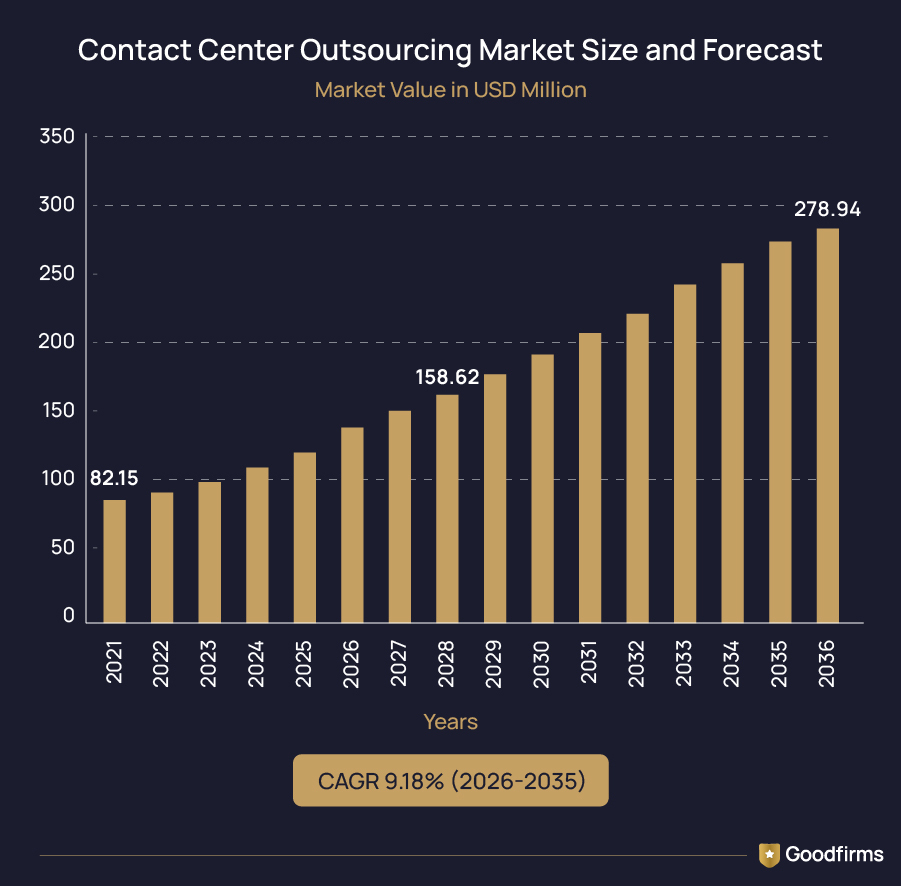
Source: Market Research Future.
Ready to shortlist? Browse verified call center providers on Goodfirms — filter by industry, location, and budget in one place.
What Is Call Center Outsourcing — And Why Are Businesses Still Choosing It?
Every customer conversation your business has — a billing question, a complaint, an order update — has to be handled by someone. Call center outsourcing is the practice of hiring a third-party company to manage customer service interactions, sales calls, technical support, or other customer communications on behalf of a business. It covers both inbound support (answering questions, resolving complaints, processing orders) and outbound work (lead generation, renewal reminders, customer surveys). Most modern providers cover both, often across voice, email, chat, SMS, and social channels.
Outsourcing lets businesses extend their service capacity without carrying the overhead of hiring, training, managing, and housing an internal team. What's changed is the quality ceiling. The best contact center providers today can genuinely match — and, in some cases, outperform — what an internal team would deliver, particularly when AI is part of their operations.
So why do businesses choose to outsource?
- Cost Optimization: Many organizations achieve significant cost savings by outsourcing support functions, especially when paired with AI, automation, and scalable staffing.
- Scalability: External providers can increase or decrease staff based on seasonal demand. Businesses cannot make changes to an internal team without causing significant disruption.
- Expertise: Easy access to trained agents, specialized compliance knowledge, and established QA systems that take years to build internally.
- Coverage: Access 24/7 customer support without building and managing an in-house team.
Next, let’s look at the different types of services businesses outsource.
What Types of Call Center Outsourcing Services are There?
Most businesses outsource for a single need first, then expand as requirements grow. Call center outsourcing services generally fall into three core types: inbound support, outbound sales, and technical support. Many providers also layer in omnichannel and multilingual capabilities across all three.
Customer Support (Inbound)
New businesses in the outsourcing space usually start with customer support (inbound). Agents look after customer inquiries, billing questions, order issues, returns, complaints, and account-related requests. Outsourcing delivers the fastest, most visible outcomes, particularly in ecommerce and subscription-based businesses. It reduces wait times, accelerates responses, and increases customer satisfaction scores.
Sales and Lead Generation (Outbound)
Outbound teams reach out to potential customers. They qualify leads, schedule appointments, and drive business growth. Many businesses outsource these teams — or work with virtual assistant companies — to grow their customer base without adding in-house staff. Common examples include SaaS lead generation, insurance renewal campaigns, real estate prospecting, and customer acquisition initiatives.
Technical Support
Technical support helps customer service resolve product and account-related problems. It also troubleshoots software and hardware issues. Most SaaS companies, telecoms, consumer electronics brands, and software vendors rely on help desk software to manage customer inquiries, track issues, and streamline technical support workflows. The quality of success depends on how agents are trained, how much knowledge they have about the product, and the provider's ability to keep teams up to date as products evolve.
Omnichannel and Multilingual Capabilities
Most established providers now offer these as standard across all service types. Omnichannel support gives agents access to a customer's full interaction history — often powered by CRM software, so customers never have to repeat themselves when switching channels.
Multilingual support extends this across language markets, giving businesses access to native-language agents without the cost of recruiting and managing them internally.
The type of service you outsource plays a major role in determining both the skills required and the overall cost. Before comparing providers, it helps to understand how pricing works.
How much does Call Center Outsourcing Cost in 2026?
The cost of call center outsourcing depends on several factors. These include the provider's location, the staffing model you choose, the complexity of the work, and the level of automation. Pricing structures vary from one provider to another, but location has the biggest impact on cost.
Top Countries for Call Center Outsourcing
Here's how hourly and per-minute rates compare by region.
|
Region |
Hourly Rate (Per Agent) |
Per-Minute Rate |
Best For |
|---|---|---|---|
|
U.S. / Canada |
$28-$42 |
$1.00-$1.75 |
Regulated industries, complex support |
|
Western Europe |
$30-$41 |
$1.10-$1.75 |
Multilingual EU coverage |
|
Eastern Europe |
$12-$22 |
$0.60-$1.00 |
Multilingual, mid-cost |
|
Latin America |
$12-$24 |
$0.55-$0.90 |
Nearshore, time-zone aligned |
|
Philippines |
$7-$16 |
$0.50-$0.80 |
High-volume, English-fluent |
|
India |
$5-$14 |
$0.45-$0.75 |
Cost-optimized, large talent pool |
Source: Retellai
The most cost-effective option is offshore providers, but they have cultural or language differences. Though onshore providers are more expensive, they understand your customers better, and compliance is easier to manage. Nearshore providers follow the middle path, balancing cost and proximity.
Region is only half the picture, though — how a provider structures its pricing matters just as much as where they're based.
Call Center Outsourcing Pricing Models
Providers typically price their services one of three ways — per minute, per agent, or per dedicated agent — and which one you land on depends on the type of support you're outsourcing and how much control you want over the team.
Per-Minute Pricing
This model charges based on actual talk time, and it's most common for inbound support. Rates typically range from $0.50 to $1.75 per minute, depending on the region and complexity. Most providers offer flat-rate minute packages rather than pure pay-as-you-go billing — a common structure looks like 1,000 minutes for $1,100, or roughly $1.10 per minute. The more minutes you commit to upfront, the lower that per-minute rate tends to drop.
Per-Agent Pricing
This model bills by the hour per agent, and it's where the region makes the biggest difference. Offshore providers in India and the Philippines charge $5–$16 per agent hour, nearshore options in Latin America and Eastern Europe charge $12–$24, and onshore providers in the U.S. and Canada charge $28–$42. Outbound sales and lead-gen work are usually priced separately from inbound support, typically $10 to $50 per hour depending on location and call complexity.
Dedicated Agent Pricing
Dedicated agents work exclusively for your business rather than splitting time across other clients' accounts — and that exclusivity costs more. Expect to pay 20% to 35% more than a shared-agent rate, since dedicated pricing covers deeper product training, brand-specific onboarding, and a team that functions more like an in-house extension than a pooled resource. It's usually worth the premium once your call volume grows or your product gets complex enough that shared agents can't keep up.
Pricing model aside, the type of work you're outsourcing also shapes costs.
What Type of Support Are You Outsourcing?
Not all outsourced call center work costs the same — and one of the biggest reasons is the type of support you're handing off.
An inbound technical support team needs agents who actually understand your product. An outbound team running sales calls needs people who know how to sell. That difference in skill requirement directly affects what providers charge.
Inbound Call Center Pricing
For inbound support, expect to pay between $0.50 and $1.75 per minute, depending on the country your provider operates in and the complexity of the service.
Most providers offer flat-rate minute packages rather than pure per-minute billing. A common structure looks something like 1,000 minutes for $1,100 — roughly $1.10 per minute. The pattern holds across most providers: the more minutes you commit, the lower your per-minute rate drops.
Outbound Call Center Pricing
Outbound work typically runs $10 to $50 per hour, again depending on location and the nature of the calls. Providers in offshore markets sit toward the lower end of that range; onshore teams with sales experience push toward the higher end.
The practical takeaway: if you're outsourcing both inbound and outbound, don't assume a single blended rate covers both. Most providers price them separately because the agent profile — and the training cost behind it — is genuinely different.
Location also plays a major role in determining quality, compliance, and customer experience.
Onshore, Nearshore, Offshore: Which Call Center Outsourcing Delivery Model Fits Your Business?
Each model is different in cost, quality, language fit, and time zone overlap. Here are the main call center outsourcing models:
Onshore
Your provider belongs to the same country. Cultural alignment is highest, language barriers are minimal, and compliance is straightforward. The downside here is the cost — U.S.-based agents, for example, are significantly more expensive than offshore alternatives. Onshore outsourcing makes the most sense for high-complexity, high-sensitivity interactions, regulated industries, emotionally charged customer situations, or high-value account management.
Nearshore
Your provider is in a neighboring or nearby country — Mexico or Colombia, for U.S. companies, for instance. You get overlapping time zones, lower cost than onshore, and reasonable cultural proximity. Nearshore has grown quickly as an alternative to purely offshore models, particularly for companies that need real-time supervisor access without paying onshore rates.
Offshore
According to NASSCOM 2024, both India and the Philippines account for over 60% of offshore call center labor. Cost savings are real and substantial. Before, language quality and cultural alignment were main considerations. Nowadays, providers have shifted their focus to training and quality standards. Teams receive training to handle a wide range of customer interactions effectively.
Many businesses now adopt a tiered approach: AI handles repetitive tier- 1 queries, offshore agents manage more complex issues, and onshore or nearshore agents are responsible for the most sensitive cases. This approach helps balance cost efficiency with service quality.
Next comes the structure of your outsourced team.
Shared vs Dedicated Teams: Which Staffing Model Fits Your Business?
This decision affects both costs and brand consistency, and it’s worth carefully considering.
Shared Model
Agents work across multiple client accounts. Your volume is pooled with other clients’ traffic. This brings lower cost and faster setup — useful for businesses with lower, more predictable call volumes where deep product knowledge is less critical.
Dedicated Model
This model assigns agents for your business only. They receive comprehensive training on products, learn your communication and escalation processes, and work as if they are part of your internal team. Thus, their service quality is higher, along with costs, and the onboarding process is longer.
Goodfirms' insight: Growing companies start with a shared model. They use a dedicated team when their product becomes more complex, and their call volume increases. Customers then want more accurate, consistent support.
At the same time, technology is now reshaping how outsourcing actually works.
How Conversational AI Is Reshaping Outsourced Call Centers
According to Gartner, conversational AI will reduce global contact center agent labor costs by up to $80 billion in 2026. That's not a prediction about the future — that's a reflection of decisions companies have already made. Chatbots, voice bots, real-time agent assist, and speech analytics have become standard features in modern contact center software. Providers who don't have them built into their core operation are already falling behind.
The table below compares AI voice agents and traditional call center outsourcing.
|
Factor |
Outsourced Call Center |
AI Voice Agent |
|---|---|---|
|
Cost per minute |
$0.50-$1.75 |
$0.07-$0.15 |
|
Cost per resolved call |
$3-$7 |
$0.28-$0.60 |
|
Setup time |
4-12 weeks |
Days |
|
24/7 coverage |
Requires overnight premium |
Included, no premium |
|
Scalability |
Weeks to add agents |
Instant (adjust concurrency) |
|
Agent turnover |
30-45% annually |
0% |
|
Training on product changes |
Weeks per update cycle |
Minutes (update knowledge base) |
|
Quality consistency |
Varies by agent, shift, and mood |
Identical on every call |
|
Languages |
Requires multilingual agents |
31+ languages from one agent |
|
Compliance |
Vendor-dependent, you remain liable |
SOC 2 Type II, HIPAA with BAA, GDPR |
|
Contracts |
6-24 month minimums are typical |
No minimums, no contracts |
|
Data control |
Third party holds customer data |
You control data storage settings |
Source: Retellai
What AI Actually Does in a Modern Call Center
It helps to be specific, because “AI-powered” has become a marketing term that covers a huge range of actual capability.
- Deflection: AI chatbots and voice bots handle routine queries — order status, password resets, FAQs — without involving a human agent. IBM Institute for Business Value research found that 71% of executives expect customer support inquiries to become touchless by 2027, highlighting the growing role of AI-powered self-service.
- Agent assist: Agent-assist tools help agents find information faster, reduce repetitive tasks, and handle customer interactions more efficiently. After implementation, many organizations report improvements in productivity, response times, and agent experience.
-
Sentiment analysis: AI monitors call tone in real time and alerts supervisors when a conversation is deteriorating. This allows intervention before a customer disengages entirely.
-
QA at scale: Traditionally, call center QA meant supervisors sampling a small percentage of calls. AI speech analytics can now automatically review every interaction for compliance, adherence to scripts, and quality flags.
-
Proactive outbound: AI analyzes customer behavior to identify who might leave, miss a payment, or need a follow-up — then reaches out at the right moment, rather than working from a fixed list.

The critical point for buyers: AI doesn’t replace the human workforce — it changes what the workforce does. The agents who remain are handling more complex, more consequential conversations. That’s actually a better experience for customers, and it’s what makes the hybrid model more effective than either a pure-automation or a pure-human approach.
As AI becomes more capable, many businesses are questioning whether outsourcing is still necessary.
Outsourcing vs. AI: Which One Does Your Business Actually Need?
AI-powered support tools have matured rapidly —chatbot software now handles FAQs, resolves simple queries, and automates ticket routing without human involvement. For some businesses, this raises an obvious question: why outsource at all?
The honest answer is that AI and outsourcing are not competing options. They solve different problems.
AI excels at speed, scale, and consistency. It handles high-volume, repetitive interactions — order status checks, password resets, after-hours routing — at a fraction of the cost of a human agent. But it struggles with complexity, emotion, and ambiguity. A frustrated customer, a sensitive billing dispute, or a technical issue with multiple variables — these are not problems a chatbot handles well.
Outsourced human agents bring what AI cannot: judgment, empathy, and adaptability. They handle edge cases, de-escalate tense situations, and represent your brand in conversations that matter to customers.
In practice, the most effective support operations use both. AI handles the volume. Humans handle the value.
|
Use Case |
AI |
Outsourcing |
|---|---|---|
|
High volume, simple queries |
Strong fit |
Overkill |
|
Complex or sensitive issues |
Poor fit |
Strong fit |
|
24/7 coverage on a tight budget |
Strong fit |
Higher cost |
|
Multilingual or specialized support |
Limited |
Strong fit |
For most growing businesses, the question is not AI or outsourcing — it is knowing which problems each solves, and building a support model that uses both where they perform best.
Different industries adopt outsourcing in different ways depending on customer volume, compliance needs, and the complexity of support.
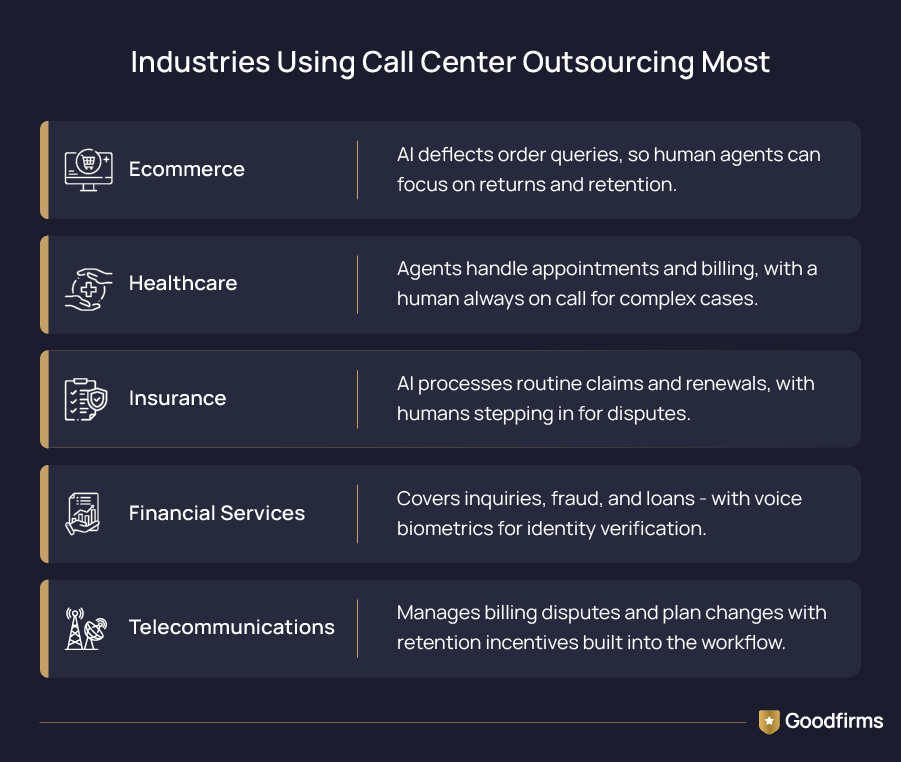
Which Industries Use Call Center Outsourcing Most?
Most industries outsource some part of their customer support. But a handful of them depend on it more than others.
Once you understand where outsourcing fits in your business, the next step is to identify the factors to evaluate when choosing the right provider.
What to Look for When Choosing a Call Center Outsourcing Company
The market is large, and the range of quality is wide. Here’s how to evaluate providers seriously:
1. Verify AI Capabilities
Most providers claim they use AI. But ask which tools they use, how they support agents during live calls, how often customer queries get resolved without a human, and whether they can show you QA data from AI speech analytics. A provider who knows their stuff will answer these questions confidently, without hesitation.
2. Check Compliance Credentials
Depending on your industry, you may need environments that are SOC 2, ISO 27001, PCI-DSS, or HIPAA-compliant. Confirm which certifications the provider holds and whether they apply to the specific delivery center your account would use — not just the company at a corporate level.
3. Understand QA Process
A mature provider has a systematic QA process. They do not just monitor calls occasionally. You need to find out how the percentage of calls they actually review, how they help them improve, and what they do when someone isn't performing well. AI-powered QA at 100% call coverage is now achievable. So if a provider cannot explain how they do it, that's a red flag.
4. Reporting and Real-time Visibility
You should have direct access to performance data — first call resolution rates, average handle time, CSAT scores, deflection rates, and sentiment trends. Many providers now offer client-facing dashboards with live data. If you don't know how your outsourced team is performing, you've lost control.
5. Run a Pilot/Phased Onboarding
Any reputable provider will offer a pilot or phased onboarding. When you use a 4–8 week pilot on a bounded scope — one queue, one channel, one product line, you will come to know whether the provider fits your needs. You need to compare your outsourced team's performance with your internal team's, based on CSAT, handle time, and escalation rates.
6. Evaluate Cultural and Brand Fit
It is equally important to listen to actual calls they've handled for businesses like yours. And then ask yourself, would my customers enjoy talking to these agents? If the agents don't sound warm and helpful, your customers won't enjoy interacting with them. Though you cannot measure this in numbers, it makes a huge difference.
Like any operational decision, outsourcing too comes with its fair share of limitations.
The Risks of Call Center Outsourcing — And How to Manage Them
Outsourcing isn’t without drawbacks. Going in with eyes open is the difference between a partnership that works and one that damages your brand.
Quality Control Gaps
External agents lack the same kind of instinctive product knowledge that your internal team has acquired over time. You can manage this structured onboarding, detailed knowledge base documentation, and regular QA review. By leveraging AI-powered speech analytics, you can achieve 100% call review.
Brand Misalignment
Shared-agent models work across multiple businesses. If keeping your brand's tone and style consistent matters to you, it's worth paying more for dedicated agents who work exclusively for you.
Data Security Exposure
When customer data moves outside your organization, there is an increased security risk. It is essential to confirm your provider’s data handling protocols, certifications, and what happens to customer data after interactions close. For regulated industries, this isn’t optional — it’s a contractual requirement.
Dependency and Lock-in
Signing a long, exclusive contract with one provider puts them in control — not you. Before you sign anything, make sure the contract includes clear performance expectations, a straightforward way to exit if things aren't working, and a guarantee that you can easily move your data out. It's entirely reasonable to request a 90-day exit clause in your first contract with a new provider.
The final step is to find and shortlist the right outsourcing partners.
Where to find the Right Call Center Outsourcing Partner?
Shortlisting providers the traditional way — RFPs, consultants, industry referrals — is slow and expensive. For most businesses, a better starting point is a platform that aggregates verified client reviews and provider information in one place.
Goodfirms maintains a thoroughly researched, regularly updated listing of BPO companies in the world and call center services companies. It has providers across onshore, nearshore, and offshore delivery models. Each listing includes verified client reviews, pricing transparency, service focus areas, company size, and industry specialization.
Best Call Center Outsourcing Companies in 2026
These leading call center outsourcing companies stand out for their service quality, industry expertise, and operational scalability.
|
Company |
Service Type |
Support Model |
|
Hugo |
Customer support + data operations |
Scalable CX teams |
|
Helpware |
BPO services |
Multi-function outsourcing |
|
AnswerConnect |
Answering service |
24/7 live support |
|
SupportYourApp |
Technical + customer support |
Omnichannel support |
|
AnswerForce |
Answering + receptionist services |
24/7 reception support |
|
Right Path Global Services Private Limited |
BPM/outsourcing services |
Operational support |
How Much Do These Providers Actually Cost?
Pricing varies widely across providers. Here's what each one charges, so you can compare before you shortlist.
Hugo- It offers dedicated customer support teams starting at $11/hour per agent, with month-to-month contracts, 24/7 omnichannel coverage in 60+ languages, and all management, QA, and training included in the rate.
Helpware-Iit offers three dedicated-agent pricing tiers — HW. Talent, HW.Team, and HW.Hub — hourly / subscription billing, billed hourly, and hourly / per transaction / outcome-based / gainsharing billing, respectively.
AnswerConnect- It offers minute-based monthly plans starting at $350/month for 200 minutes (Entry), $395/month for 300 minutes (Growth, no setup fee), and $575/month for 400 minutes (Standard), with 24/7 live answering included on all plans.
SupportYourApp — It offers four tiered plans — Essential (up to 4 agents, 40+ languages), Growth (up to 19 agents, 60+ languages, AI voice add-on), Enterprise (up to 99 agents), and Custom — all with AI tools built in by default, with pricing available on request.
AnswerForce- It offers 24/7 live answering plans priced by the minute, built specifically for home and field service businesses, with custom pricing available on their plans page based on call volume and service needs.
Right Path Global Solutions- It offers custom quotes via a free P2P assessment, covering back-office, front-office (customer service), and knowledge process outsourcing across North American and Indian operations.
You may be a startup looking for a flexible, low-commitment shared-agent arrangement, or an enterprise seeking a global partner with multilingual support. With Goodfirms’ reviews and ratings platform, you will find a simple way to compare your options without having to start from scratch.
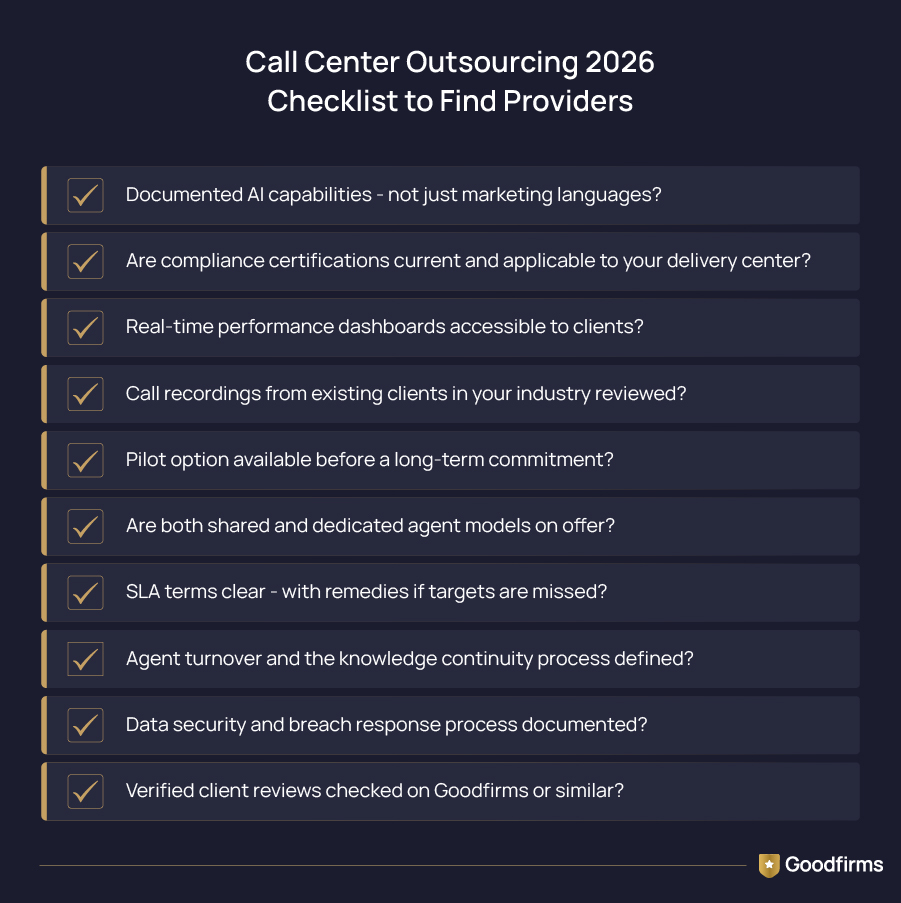
Call Center Outsourcing 2026 - Checklist to Find Providers
Before you commit to any call center outsourcing company, run through these:
In a nutshell, the future of call center outsourcing is being shaped by both AI and evolving customer expectations.
Final Thoughts
Call center outsourcing in 2026 is a more capable, technologically sophisticated option than ever. The quality ceiling has risen. The cost arguments are stronger. And the combination of trained human agents and AI tools means outsourcing no longer has to mean compromising customer experience.
Since the market is overcrowded, the challenge lies in selecting providers. But there is no need to rush in. You can start by running a pilot. You can take your time evaluating providers by asking the hard questions about AI, QA, and compliance. Besides this, you can use platforms like Goodfirms to build your shortlist from verified, reviewed providers rather than starting from a cold search.
The right outsourcing partner doesn’t just handle your calls — they protect and extend your brand with every interaction. That’s worth getting right.
FAQs - Call Center Outsourcing
What is call center outsourcing, and how does it work?
Call center outsourcing means contracting a third-party provider to manage customer interactions on your behalf across channels like phone, email, chat, and SMS. The provider supplies trained agents, technology, and operational management. You set the performance standards; they handle execution.
How much does call center outsourcing cost?
It depends on the delivery model and geography. Offshore providers such as India and the Philippines typically charge $5–$16 per agent hour, while onshore providers in the US and Canada charge $28–$42 per agent hour. Nearshore options such as Latin America and Eastern Europe fall in between at $12–$24 per hour. Dedicated agent models generally cost 20–35% more than shared agents, given the deeper training and exclusive focus on your account.
Is call center outsourcing cheaper than hiring in-house?
In most cases, yes. Building an in-house team means covering salaries, benefits, office space, hiring, training, and management overhead — costs that add up to roughly $25 to $50 per hour once fully loaded, or about $66,000 to $101,500 per year per seat. Outsourcing shifts most of that burden to the provider. Offshore outsourcing, at $5–$16 per agent hour, is typically the biggest saver, while onshore outsourcing at $28–$42 per hour narrows that gap but still usually costs less than a fully loaded in-house hire once benefits and infrastructure are factored in. The trade-off is control and brand consistency, which is why some businesses stick with in-house teams for high-sensitivity work despite the higher cost
What’s the difference between shared and dedicated call center agents?
Shared agents split their time across multiple client accounts. Dedicated agents work exclusively for your brand. Shared is cheaper and faster to set up; dedicated delivers greater brand consistency and deeper product knowledge at a higher cost.
Is conversational AI replacing human agents in outsourced call centers?
Not replacing — changing their role. IBM states that AI chatbots and virtual agents can handle routine inquiries such as order status, FAQs, and account-related questions without human intervention. Human agents focus on complex, sensitive, or high-value interactions. The hybrid model consistently outperforms either pure-automation or pure-human approaches.
Which industries benefit most from call center outsourcing?
Ecommerce, healthcare, insurance, financial services, and telecommunications are the most active users. These industries share high interaction volumes, seasonal demand spikes, complex compliance requirements, and a strong need for 24/7 coverage.
How do I evaluate a call center outsourcing company?
Ask specifically about their AI capabilities, compliance certifications, QA process, client reporting access, and whether they offer a pilot engagement. Request call recordings from existing clients in your industry. Check independent reviews on platforms like Goodfirms before shortlisting.
Where can I find vetted call center outsourcing companies?
Goodfirms maintains a verified listing of call center service providers with client reviews, pricing information, and service focus details. It’s a practical starting point for building a shortlist across all delivery models and industry specializations.