Key takeaways
- Whether it’s offline or online, every customer interaction contributes to the customer service experience.
- Studies show that customer service is as important as a company's products and services.
- Speed, empathy, personalization, industry knowledge, consistency, commitment, and human connection all contribute to a fantastic customer experience.
- Apple, Amazon, Starbucks, and many other blue-chip brands have a customer service philosophy that drives the examples of good customer service commonly shared online.
- You can measure your customer service experience through various metrics, including customer reviews and customer feedback.
- Studies show that the majority of people prefer to speak with a live representative when contacting a business.
“Your brand is what people say about you when you're not in the room.” – Jeff Bezos.
Customer expectations have fundamentally changed. Businesses are no longer judged solely on speed, empathy, or resolution. They are judged by how seamlessly they balance human connection with the efficiency of technology. Exceptional service is defined by how effectively humans and AI collaborate to solve complex problems and make customers feel understood and valued.
What has changed is not the importance of customer service, but the tension between what customers actually want vs. where businesses are investing their time and energy. Automation has become normal, but customer frustration has grown. AnswerConnect’s latest survey found that 85% of consumers still prefer speaking to a live personwhen contacting a business, despite years of investment in AI. Customer service is about trust as much as it is about efficiency.
A great experience builds loyalty and growth. A poor one does more than lose a sale. It damages confidence, increases churn, and encourages people to share negative feedback publicly. In this article, we examine what it takes to deliver an exceptional customer experience.
What is Customer Service Experience?
The customer service experience, or CSX, describes how customers feel after interacting with a business. It’s built through every phone call, email, in-store visit, and social media engagement. It all adds up.
Today’s typical CSX spans multiple offline and online channels, so businesses must make a conscious effort to create and maintain a successful one.
7 Factors That Contribute to a Great Customer Experience
The customer service experience varies across different industries. However, the factors that generally make an exceptional CSX are common.
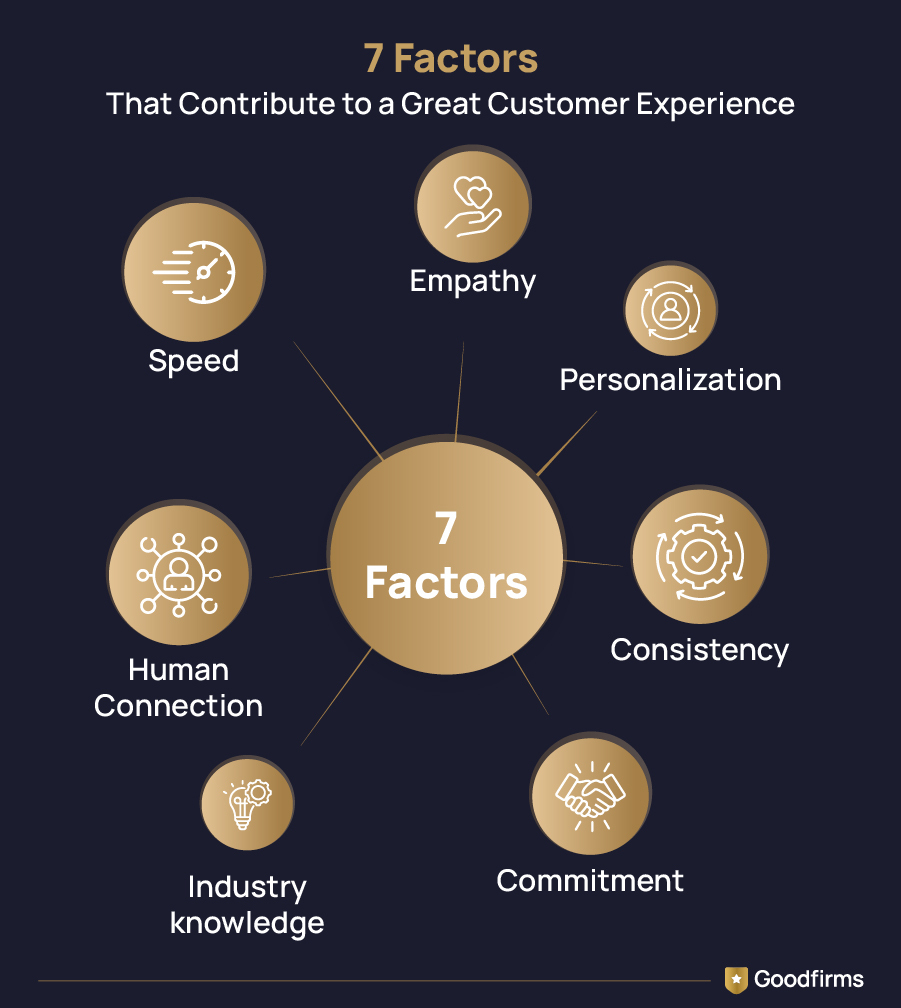
Speed
Customers don’t want to wait too long. They want phone calls, emails, and live chats to be responded to promptly.
Empathy
Customers want to feel that companies care about and understand their experiences. Empathy humanizes customer interactions and can ease frustrations.
Personalization
Customizing a service shows you’re paying attention to each customer. Using customers’ names and making suggestions based on their customer history creates a better experience.
Consistency
Always leaving the customer in a better place than they were before the interaction builds trust.
Commitment
Some queries are complex, and agents may need to speak with multiple people to resolve them. Customers appreciate it when they feel the agent fully commits to understanding their issues and finding the best fix.
Industry knowledge
Customers expect swift answers to their problems, so a high level of industry knowledge is necessary to deliver this consistently.
Human connection
AnswerConnect found that nearly two-thirds of consumers feel frustrated when they cannot reach a real person. Complex or emotional issues demand human attention, not endless menus or chat loops. Connecting with customers on a personal level fosters exceptional customer service.
Understandably, companies struggle to excel in every customer interaction. That’s why many businesses hire 24/7 answering services companies. These services answer every call and live chat, ensuring all your customers receive outstanding customer service.
Businesses with complex products and services may fear that fintech customer support outsourcing cannot help them. However, that’s rarely the case. Many industry-specific answering services are available.
Why is Customer Service Important?
Poor customer service costs US companies $75 billion per year (Amplifai.com). In a world dominated by automation, trust is becoming increasingly fragile. 57% of consumers say their trust in a business decreases when it relies heavily on AI, according to AnswerConnect’s latest customer service survey.
Excellent customer service gives you a competitive advantage:
80% of customers say a company's experience is as important as its products or services (Salesforce). That means people will walk a little further to buy coffee from the cafe, which always makes them smile.
They’re even willing to pay more for good service. A study found that 61% of consumers are willing to pay at least 5% more if they know they’ll receive a good customer experience (emplifi.io).
Customer retention is also more cost-effective than customer acquisition, so happy and loyal customers are vital.
Examples of Memorable Customer Service
There are nuances to every industry, but the fundamentals of excellent customer service are the same.
Chewy
Chewy is an online pet supplies retailer that’s passionate about and deeply understands the customer’s love for their pets. Chewy offers 24/7 customer service and a price-satisfaction guarantee, but is best known for its community.
Chewy has been known to reach out to customers during hardships after their pets have passed away. They understand the impact of human connection better than most. Maybe this level of human connection is too much for most industries, but Chewy knows its customers well, and their service is appreciated – as proven by their reviews.
Apple
Apple rewrote what it means to be a tech company and what exceptional customer service should look like. Apple has raving fans worldwide, yet it understands that its technology isn’t just for tech enthusiasts.
In fact, many Apple customers are not tech-savvy, and buying technology can be anxiety-inducing. That’s why Apple helps customers become familiar with its products by offering:
- In-store product testing
- Genius Bar support (help from an Apple expert)
- Free workshops
- Training sessions
These touchpoints support Apple customers long after they have made a purchase, and that creates loyalty.
Zappos
Zappos made headlines for its fierce commitment to “live and deliver WOW.” Staff training lasts for weeks before they’re able to speak to customers. Zappos even offers to pay new hires to quit at the end of the fourth week, as they only want staff who are truly committed to being there. Zappos offers 24/7 customer support and a 365-day returns policy, with a significant focus on building an emotional connection with its customers.
Trader Joe’s
Many people view buying groceries as a chore they have to do every week. Supermarkets aren’t particularly renowned for their customer service, but Trader Joe’s is. Staff are known for their warm and friendly customer service, which stems from their philosophy of creating value for customers.
Top Strategies to Improve Customer Service Experience
Let's look at the top 8 Strategies to improve the customer service experience.
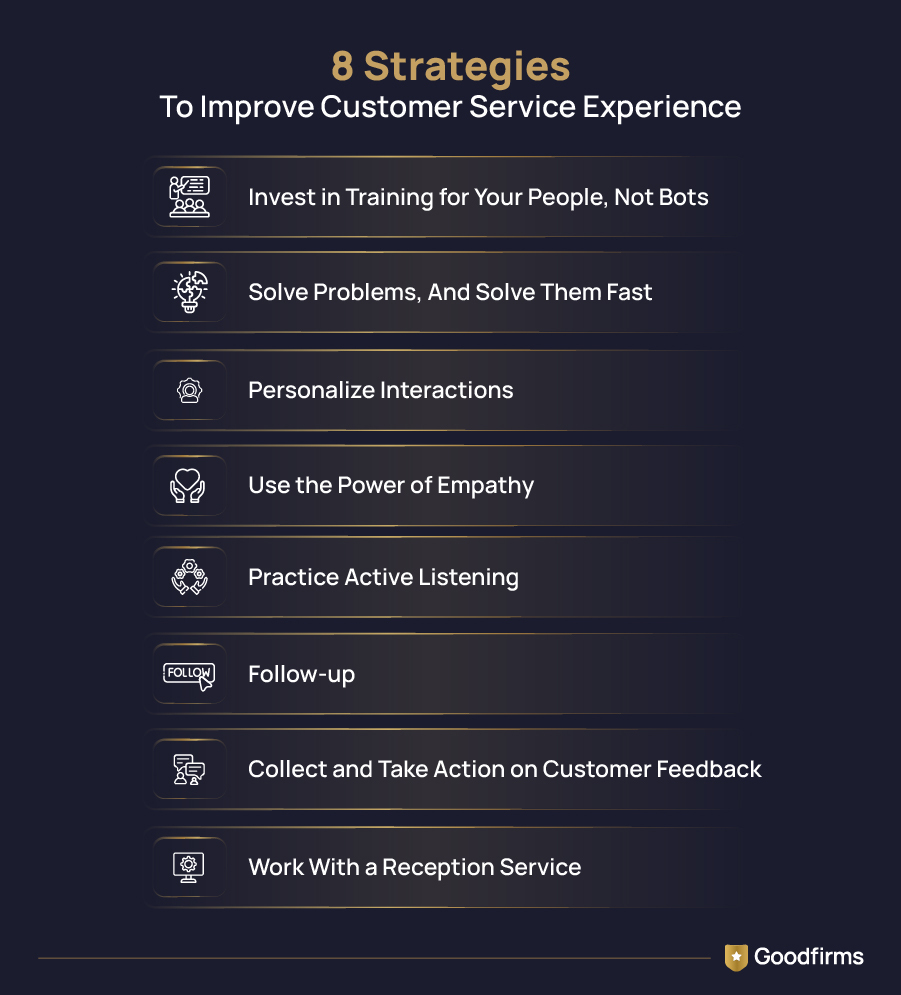
Invest in Training for Your People, Not Bots
Customer service teams are no longer just learning products and scripts; they are also learning to adapt to new technologies. They are learning how to manage emotionally complex conversations that often begin with AI friction or occur across multiple digital channels.
According to AnswerConnect’s research, 71% of people believe a real person offers more care and understanding than AI. Emotional intelligence is now one of the most in-demand skills in the service industry, because it matters to customers.
Solve Problems, And Solve Them Fast
Slow resolution times are frustrating. It also heightens the pressure on customer service agents when customers wait too long or are unable to get in contact with someone who can help. Finding ways to get to a resolution quicker can have a considerable impact on your customers’ overall perception of your brand.
Personalize Interactions
Every customer wants to feel valued. Simple things like remembering their names and preferences create a warmer experience. Customer information, purchase history, and account notes can help you develop more effective solutions.
Use the Power of Empathy
A lack of empathy makes customer interactions feel cold, but understanding and empathy make a stronger connection that helps you secure and retain customers.
Practice Active Listening
Being laser-focused on finding a solution can cause key details to go over your head. Active listening is a subtle skill that makes a stronger human connection. It’s the art of being fully present, whether that’s:
Follow-up
Checking in with customers after fixing an issue is a nice touch. It shows that you go above and beyond to ensure customers are happy. Providing customers with a follow-up can turn a neutral or even negative perception into a positive one.
Collect and Take Action on Customer Feedback
With many customer touchpoints to cover, you may find some aren’t as smooth as others. This is perfectly normal, and collecting feedback is crucial for this reason.
Create a system to collect feedback and identify ways to act on it to improve your customer service.
Work With a Reception Service
Some of the world’s largest companies make it incredibly difficult to reach their customer service agents. Instead, they direct customers to online help centers, AI assistants, and chatbots. However, 85% prefer speaking to a real person when they contact a company.
24/7 phone coverage can be provided by an answering service. Every call is answered fast, and all callers get 5-star customer service. No customer is left feeling ignored or frustrated.
Measuring Success: How to Evaluate Your Customer Service Experience
Popular metrics to evaluate your customer service experience:
Customer Satisfaction Score (CSAT)
This metric asks customers to rate their experience from 1-5 or 1-10. It’s based on one question, usually: “How satisfied were you with your customer experience today?”
Net Promoter Score (NPS)
An NPS is another simple metric that measures how likely customers are to recommend your business on a scale of 1-10. NPS scores the customers on a scale split into three categories: Detractors (0-6), Passives (7-8), and Promoters (9-10).
Customer reviews
Check out company review websites such as Yelp, Trustpilot, and Google Reviews to see how customers rate your service.
Customer feedback
Upset customers don’t always voice their frustrations. Sending out customer surveys using tools like SurveyMonkey and Google Forms is key to learning how your customer service experience is received.
Overcoming Challenges in Delivering a Great Customer Service Experience
Every company can produce exceptional customer experiences. The challenge is doing it consistently across various touchpoints. This can be difficult for many reasons:
No Customer Service Philosophy
It’s hard to sustain excellent customer service without a customer philosophy. World-leading brands have a customer service philosophy, and it’s a major driving force behind their success.
A customer philosophy helps agents feel more confident in customer interactions. They clearly understand the company’s principles and beliefs, and know how to convey this to the customers.
High Turnover Rate
Training staff to a level where they’re consistently delivering exceptional customer service takes time. So, if your turnover rate is high, it becomes hard to maintain high standards.
Consistency Across Touchpoints
The modern customer experience involves multiple digital and in-person touchpoints. Emails, phone lines, social media – there’s a lot to manage. Consistency becomes even more challenging if you’re in a ‘busy season’ and trying to manage a surge in call spikes.
Keeping Employees Motivated
Creating a great customer experience feels effortless when employees are engaged. It’s harder when team morale is low, and employees aren’t as motivated. Customers can sense when someone isn’t engaged, which impacts the customer experience.
Balancing Technology and the Human Touch
Technology plays an essential role in an efficient customer service experience across touchpoints. However, studies show the human touch in business is crucial. Too much automation, AI, and chatbots can create a cold customer experience. Prioritizing customer access to a real person could be the key to improving the experience.
Handling ‘Difficult’ Customers
Sometimes, customers call in a frustrated state, which can be difficult for agents to handle. While unpleasant, listening and resolving the situation is part of the job. Poorly managing customers who are already annoyed can exacerbate an already bad situation.
A skilled customer service agent, on the other hand, can turn a negative customer experience into a positive one. Or, at the very least, do not make the matter worse.
Language Barriers
There are over 37 million Spanish speakers in the US. If you don’t have bilingual customer service agents, producing 5-star customer service for all your callers can be challenging.
A bilingual virtual receptionist service helps you build connections with more people. Prospects and customers who prefer to communicate in their native language can do so comfortably.
The Future of Customer Service
There have been many developments in customer service in recent years. AI assistants, chatbots, and remote customer service teams, to name a few. Speed and convenience are always top of mind for business owners, but there’s more to customer service.
There are subtleties to consider for every industry.
For example, there has been a rise in slow checkouts in supermarkets. Self-checkouts are popular; they help supermarkets reduce customer wait times. However, some customers prefer not to prioritize speed. Some shoppers opt for the more pleasant and friendly slow lane. Why would they choose a slower service? Because people value human connection.
Technology is essential for speed and convenience, but your people are the most important part of your customer service.