Key takeaways
- Performance marketing means paying for measurable results. Set a target CPA, track ROAS and CLV, and start with 2–3 channels.
- Keep ad spend separate from agency fees. Agencies typically charge 10–20% of ad spend or a flat retainer, with flat monthly fees ranging from $2,500 to $12,000+.
- Set a target CPA before spending. Track CPA, ROAS, and CLV together to understand whether your campaigns are actually profitable.
Spending money on ads is easy; knowing whether those ads actually generated customers is harder. What matters most isn't clicks, impressions, or likes, but whether your advertising generates leads, sales, and revenue. This is where performance marketing comes into the picture.
This guide digs deeper into the strategies, channels, marketing costs, and factors to consider when choosing an agency. Before proceeding further, let’s take a glance at what performance marketing actually is.
Looking for a performance marketing agency? Don’t choose on promises alone. Explore top performance marketing agencies on Goodfirms, compare reviews and expertise, and find the right fit.
What Is Performance Marketing?
Performance marketing is a digital marketing strategy that focuses on measurable results. Businesses set specific goals for their campaigns and track the outcomes to evaluate performance. Depending on the campaign, they may pay for clicks, leads, conversions, sales, or other defined actions.
To put it simply, think about the difference between a billboard and an online performance campaign. With a billboard, you pay for the advertising space regardless of how many people take action. With performance marketing, the campaign is tied to measurable actions. For example, an online store might pay an affiliate when a referred customer makes a purchase.
Performance marketing is suitable for ecommerce brands, software companies, and any business that depends on leads. The market is sizable, too. Coherent Market Insights expects performance marketing services to grow from $27.25 billion in 2026 to $36.70 billion by 2033, growing at a CAGR of around 4.4% annually.
Next, let's look at how a campaign runs day-to-day and how you get charged for it.
How Does It Work? Pricing Models and Metrics
A typical performance marketing campaign follows this cycle:
- Set a measurable goal
- Choose the right channel
- Set your target CPA or ROAS
- Track conversions
- Optimize and scale
Let’s look at an example quickly that shows how. Say you sell running shoes online and decide a sale is worth paying up to $20 to win. You show search ads to people already hunting for shoes, track every purchase, and then shift money from the ads that don't sell to the ones that do. Then you repeat the cycle.
Now we will take a look at how you pay for the advertising itself. The model determines what action or exposure you pay for:
|
Model |
What you pay for |
Best for |
|---|---|---|
|
Cost per click (CPC) |
A click on your ad |
Search ads, traffic goals |
|
Cost per impression (CPM) |
1,000 ad impressions |
Brand awareness, display ads |
|
Cost per lead (CPL) |
A form fill or inquiry |
B2B and service businesses |
|
Cost per engagement (CPE) |
An interaction with your content |
Social media campaigns |
|
Cost per acquisition (CPA) |
A customer or conversion |
Ecommerce and SaaS |
|
Cost per sale (CPS) |
A completed sale |
Affiliate marketing, ecommerce |
Three numbers matter most. Cost per acquisition (CPA) is the amount you spend to acquire one customer. Return on ad spend (ROAS) is the revenue you earn for every dollar spent on ads. Customer lifetime value (CLV) is the total a customer spends with you over time. Together, they show whether growth is actually profitable.
Target ROAS is different from these payment models. It is an optimization goal that tells an advertising platform what return you want from your ad spend. It is typically used when scaling campaigns and when there is sufficient conversion data to guide automated bidding.
Benchmarks help, but you need to use them loosely. Across 28 industries, median ROAS sits around 3.31x on Google Ads and 2.19x on Meta, based on Varos data shared by Superscale. A separate study of 5,000+ Google Ads accounts by Focus Digital found about 3.52x for Google Ads and 2.21x for Meta Ads. Your own margins matter more than any average.
With the models and metrics clear, here's what you can expect to pay.
How Much Does Performance Marketing Cost?
Performance marketing costs typically include two main expenses: your ad budget and your agency fee. Your ad budget goes to platforms such as Google or Meta, while the agency fee covers campaign management. It’s important to keep these costs separate when planning your budget and account for additional costs such as creative production, landing pages, and tracking tools.
Agency pricing models
Now we're looking at something different: how the agency charges you for managing your campaigns. This fee is separate from what you pay the advertising platforms.
|
Pricing model |
How it works |
Typical cost |
|---|---|---|
|
Percentage of ad spend |
You pay the agency a percentage of your monthly advertising budget. |
Usually 10–20% of ad spend, about $1,000 to $2,000 on $10,000 of monthly spend |
|
Flat monthly retainer |
You pay a fixed monthly fee, regardless of how much you spend on ads. |
$2,500 to $12,000+ per month |
|
Hybrid |
You pay a base fee plus a percentage of ad spend or a performance-based bonus |
$3,000–$10,000 a month base plus a 10–30% bonus when KPIs are exceeded, or a $2,000–$5,000 base plus 8–15% of ad spend |
|
Revenue share |
The agency receives a percentage of the sales or revenue it generates. |
5–20% of attributed revenue |
One caution: percentage-of-spend pricing can reward an agency for raising your budget rather than improving your results (SaaS Hero). If you choose it, add efficiency targets to the contract.
Typical agency fees
Agency fees vary substantially by ad spend, scope, and agency. As a general guide:
|
Monthly ad spend |
Typical agency fee |
Common business types |
|---|---|---|
|
$1,000–$5,000 |
$500–$1,500/month |
Small businesses, local services |
|
$5,000–$25,000 |
$1,500–$4,000/month |
Ecommerce, SaaS, B2B |
|
$25,000+ |
$5,000–$15,000+/month |
Growing and enterprise businesses |
These are general ranges, not fixed prices. Your actual fee can vary based on the number of channels, campaign complexity, creative requirements, reporting, and strategic support.
A simple formula to estimate your budget
One useful starting point is:
Target CPA × Number of customers you want = Estimated ad budget
Then add your agency fee and any additional costs for creative production, landing pages work, tracking tools, or other services.
Once you know what you can afford to spend, the next question is where to put that budget.
What Are the Best Performance Marketing Channels?
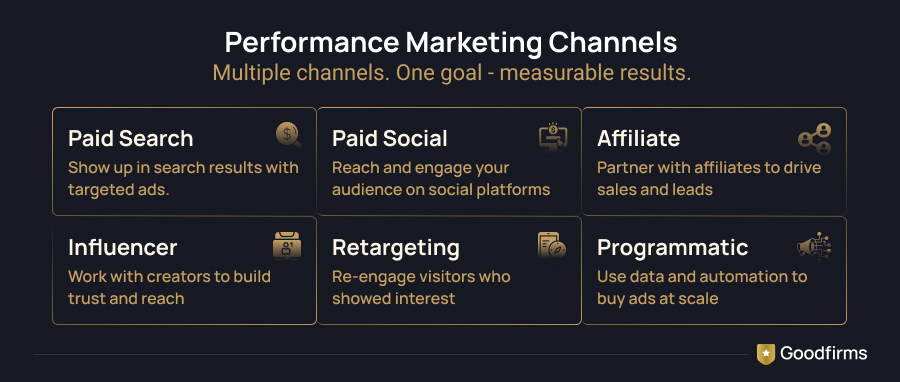
You don’t need every channel. Each channel has its strengths and drawbacks. The key is knowing which one makes the most sense for your business.
1. Paid search
Also called search engine marketing (SEM), paid search reaches people who are already looking to buy. Branded search is the trap: it often takes credit for sales that would have happened anyway. In Stella's benchmark of 225 direct-to-consumer geo tests, branded search returned a median incremental ROAS of just 0.70x, the lowest of any channel, against 2.31x across all tests. Businesses that want outside help can compare PPC agencies based on experience, reviews, rates, and services.
2. Paid social
These are ads on platforms like Instagram, Facebook, and TikTok that target a specific audience based on their interests, behaviors, and demographics. They're great for discovery and visual products. Creative fatigue is the main risk because audiences quickly tire of the same ad.
3. Affiliate marketing
Advertisers partner with affiliates such as bloggers, influencers, and review sites. They earn a commission for each sale or lead they generate. So, your risk is low since you pay per sale. Watch out for partners who mostly capture demand you already have. Businesses can also compare affiliate marketing companies when seeking external expertise.
4. Influencer partnerships
A recommendation from the right creator can carry more weight than a brand talking about itself. This can be especially useful when you're trying to get an unfamiliar product in front of the right audience. Look beyond follower count and check whether a creator's audience actually matches your target customers. For attribution, set up unique links or discount codes before the campaign starts. Brands that need help managing creator campaigns can also compare influencer marketing agencies.
5. Retargeting and display
These ads reach people who have already interacted with your brand, such as visiting your website, viewing a product, or adding something to their cart. Retargeting can bring those potential customers back. But you need to set a frequency cap and limit how long someone stays in the retargeting audience so they don't see the same ad for weeks.
6. Native and programmatic ads
Native ads accomodates into the surrounding content, such as a sponsored article or a recommendation. Programmatic advertising uses automated systems to buy and place ads across websites and apps. Both can help you reach a larger audience, but they can also drain your budget quickly. So, it is better to test with a smaller budget and regularly check where your ads are appearing.
|
Channel |
Best for |
Main advantage |
Main risk |
|---|---|---|---|
|
Paid search |
High-intent buyers |
Captures existing demand |
Expensive keywords |
|
Paid social |
Discovery |
Precise audience targeting |
Creative fatigue |
|
Affiliate |
Ecommerce |
Pay for tracked outcomes |
Attribution issues |
|
Influencer |
Product discovery |
Builds trust |
Audience mismatch |
|
Retargeting |
Returning visitors |
Re-engages prospects |
Ad fatigue |
|
Programmatic |
Scale |
Broad reach |
Budget waste |
The practical rule is to start with two or three channels, learn what works, and then expand. If you spread a small budget across six channels, you learn very little.
Once you've picked your first two or three channels, a handful of habits decides whether they deliver results.
Which Performance Marketing Strategies Actually Work?
Good performance marketing is less about secret tricks and more about steady habits.
1. Know Your Target CPA
Work out the most you can pay to win a customer before you spend a dollar. Without that ceiling, you can't tell a good result from an expensive one.
2. Give Each Channel a Clear Job
Search for sales, social for discovery, and retargeting for follow-up. When every channel has a clear role, it's easier to judge whether it's doing its part.
3. Test Creative Constantly
Change one thing at a time, such as the headline, image, or offer, so you know what moved the result. Keep notes on every test so you don't repeat what has already failed.
4. Fix Tracking Before Scaling
Use consistent conversion events and first-party data, so your reports can be trusted. Scaling on broken tracking just means spending more on bad information.
5. Measure Incrementality
Ask what would have happened without the ad. A simple way to start is to pause a campaign in one region and compare sales with the regions where it is still running.
6. Scale Gradually
Raise budgets gradually, not overnight. Small increases give you time to spot problems before they get expensive.
IAB's State of Data 2026 report found that 60% to 75% of U.S. brand and agency decision-makers see gaps in their attribution, incrementality, and MMM approaches, particularly around rigor, speed, trust, and efficiency.
Don’t rely on a single report. Cross-check platform numbers with your own sales data. This is what Zach Epstein, founder of measurement platform Haus, told The Drum.

Now everyone is sending their data back to the ad platform, who are all taking credit for the same conversions... it creates this huge issue of what is the signal, what is the noise.
Whether you run campaigns yourself or outsource them, choosing the right partner makes a big difference.
How to Choose a Performance Marketing Agency
A good agency should help you understand what your money is doing. When comparing agencies, ask for results from businesses similar to yours and find out how they report performance. You should have access to your ad accounts and know exactly what you're paying for.
Before signing, go through the contract, including notice periods, account ownership, and how your data is handled. Choose an agency that knows the channels your customers use and has a working style that suits your team. The important thing is that the fee should make sense for the work involved and your marketing goals.
Keep an eye out for any red flags. Guaranteed results are a tell-tale sign, since no one can promise outcomes in advertising. Similarly, if an agency doesn’t give you access to your own ad accounts, asks you to sign a long lock-in contract, or charges only a percentage of ad spend with no efficiency targets, it’s a warning sign.
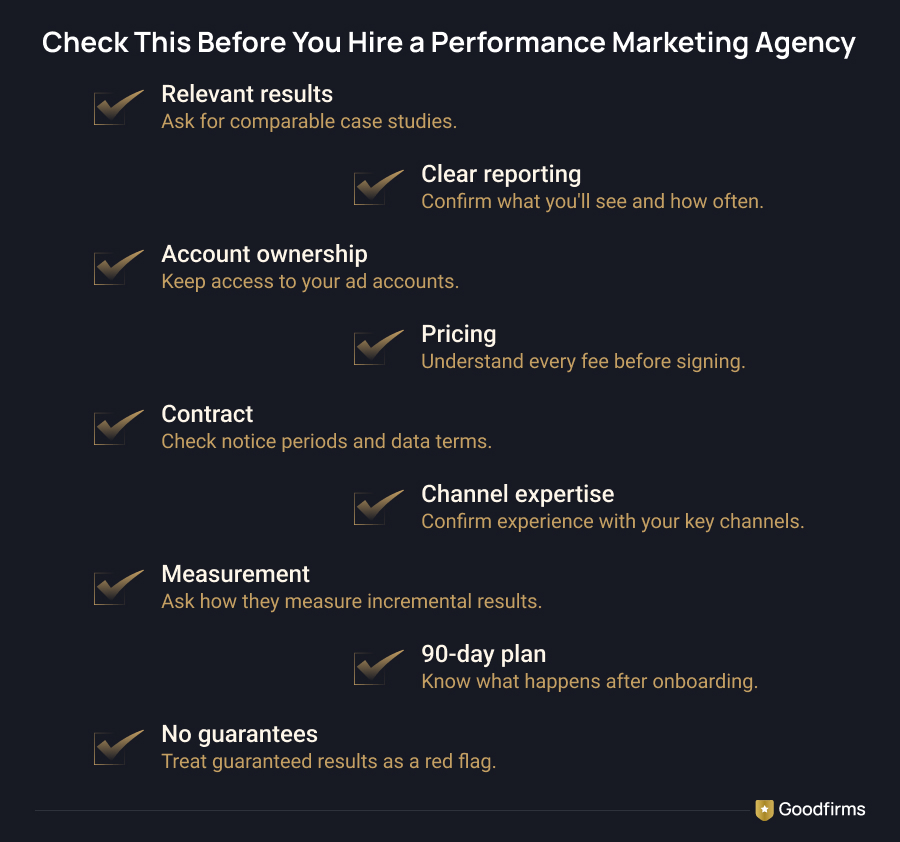
Once you have a shortlist, use the first call to ask a few direct questions. Ask which results they can show from businesses like yours, and how they measure what your ads truly cause. Find out what your reporting will look like and how often you'll get it, who will manage your account day to day, and what the first 90 days will involve.
Final Thoughts
The brands that win with performance marketing know what a customer is worth, and watch their results closely. They are agile enough to change course quickly when something stops working. If you're getting started, choose one or two channels, set clear targets, keep testing, and make sure your ads are driving sales—not just taking credit for them.
FAQs- Performance Marketing: Costs, Channels, and Strategies
What is performance marketing in simple terms?
Performance marketing is a type of advertising where businesses pay for measurable results, such as clicks, leads, sales, or sign-ups, rather than simply paying for exposure or views. Each action can be tracked, making it easier to see which campaigns generate results and which do not. For example, an ecommerce business might pay for advertising that drives purchases and then measure the cost of acquiring each customer against the revenue generated.
Is performance marketing the same as digital marketing?
Performance marketing is not the same as digital marketing. Digital marketing is a broad term encompassing online promotional activities, including advertising, content marketing, SEO, social media, and brand building. Performance marketing is a branch of digital marketing that focuses on measurable actions and outcomes. Its goal is to connect marketing spend with results such as clicks, leads, sales, or conversions, making campaign performance easier to track and evaluate.
How long does it take to see results from performance marketing?
The time it takes to see results from performance marketing varies depending on the channel, budget, audience, and campaign goals. Most campaigns need at least a few weeks to collect enough data for meaningful analysis, while results may take a few months of testing and optimization to stabilize. Some campaigns can generate quick wins, but businesses should avoid judging performance too early. Giving campaigns enough time to gather reliable data can lead to better decisions.
Is performance marketing worth it for small businesses?
Performance marketing can be worthwhile for small businesses because it allows them to start with a controlled budget and measure the results of their advertising. The key is knowing how much the business can afford to spend to acquire a customer. Small businesses can begin with one or two channels, set a clear cost-per-acquisition limit, and monitor the results closely. If the numbers remain profitable, they can gradually increase their advertising budget rather than scaling too quickly.
How do I know if my performance marketing is working?
You can evaluate performance marketing by looking at cost per acquisition (CPA), return on ad spend (ROAS), and customer lifetime value (CLV) together. CPA shows the cost to acquire a customer, ROAS measures revenue per advertising dollar, and CLV shows how valuable those customers are over time. To confirm your ads are driving sales, run an incrementality test: pause a campaign in one region and compare sales with regions where it still runs. Repeating that test keeps your performance marketing decisions grounded in real sales.


.jpg)