Key takeaways
- A fusion team merges business and tech into a single team, enabling mobile apps to be built faster and better aligned with what the business actually needs.
- Only 48% of digital initiatives achieve their business goals, largely because business and IT operate in silos. Fusion teams remove that silo.
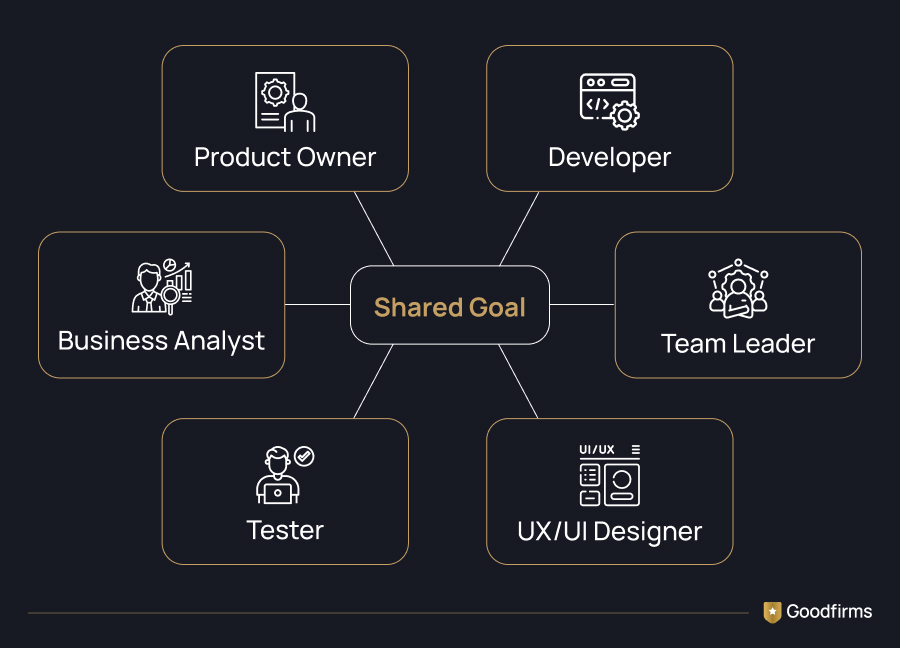
- A fusion team runs on six roles: Product Owner, Developer, Designer, Business Analyst, Tester, and Team Leader.
- Fusion teams cut approval delays, reduce rework, and keep apps aligned with real customer needs from day one.
- They're built for the middle ground: too complex for a citizen developer, not urgent enough for IT's backlog.
At a Glance: Role of Fusion Team in Mobile App Dev
Most mobile apps don't fail because of bad code. They fail because business teams and developers stay in separate silos.
A fusion team fixes that by merging both into one team from day one. Here's the difference it makes:
|
Fusion Team |
Traditional Dev Team |
|
|---|---|---|
|
Who’s on it |
Developers, business people, designers, and users are all working together |
Mostly developers and IT staff |
|
How work gets divided |
By business goal (e.g., "launch the loyalty feature") |
By department or skill (frontend, backend, and QA) |
|
Speed of Delivery |
Faster, since decisions happen inside the team |
Slower, since approvals often wait on other departments |
|
Who gives input |
Business teams shape the app early and often |
Business teams mostly give requirements upfront, then wait |
|
Best Suited for |
Apps tied closely to a specific business outcome |
Large, complex apps needing deep technical specialization |
As the table shows, the biggest difference is speed and ownership. A fusion team keeps everyone in the room from day one, so decisions happen fast, and nothing gets lost between departments. A traditional team still works well for large, highly technical builds, but it depends more on deliverables and decisions of the other team, which can slow things down.
Compare vetted mobile app development companies on Goodfirms to hire a fusion team verified based on reviews, real portfolios, and transparent pricing.
What Is a Fusion Team in Mobile App Development?
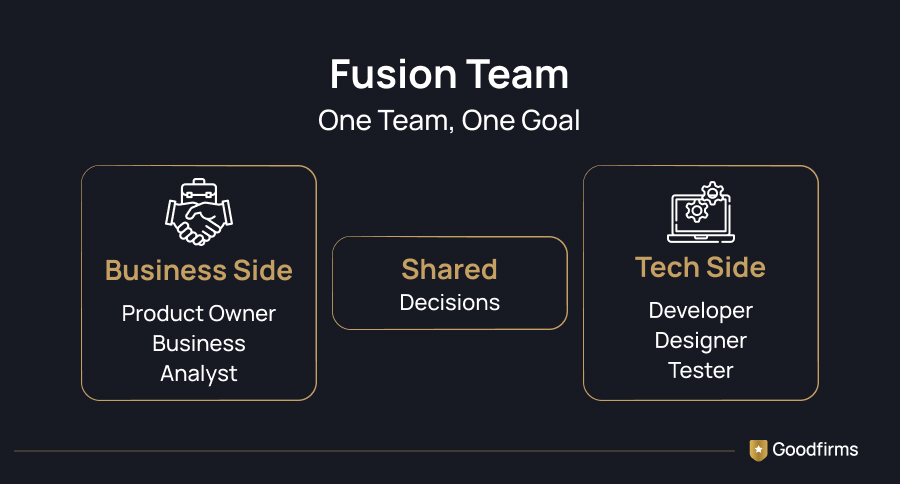
A fusion team is a cross-functional group of business and technical people who work together to build a mobile app, rather than working in separate departments. From the start, everyone, including project owners, designers, developers, testers, and business analysts, has an equal opportunity to contribute to both business and tech goals to improve decision-making.
How Do Fusion Teams Work?
- A fusion team doesn't organize around departments like "frontend" or "QA." It organizes around a single goal, such as launching a new checkout flow.
- Business experts don't join late just to approve things. They're part of the team from day one, working alongside developers and designers.
- Now, the fusion team has everyone in the same room, so decisions don't wait for approval from another department. The people who understand what's needed and the people who can build it talk directly.
- The team works in short cycles. They build a bit, test it, get feedback, and adjust, instead of waiting until the end to find out what's wrong.
- Success isn't measured by whether each person finished their own task. It's measured by whether the app actually works for the people using it. It is tracked based on app performance.
This approach has moved well beyond experimentation, with large enterprises and government organizations increasingly adopting fusion teams to accelerate collaboration and innovation.
Why Mobile App Projects Need Fusion Teams
These days, with multiple technologies available, most mobile app delays don't come from bad developers. Gartner reports that only 48% of digital initiatives meet their business goals, largely because business and IT still operate in silos. Here are the specific ways that plays out, and why fusion teams close the gap.
Long IT Backlogs
IT teams handle many projects at once, so whenever a new app request comes in, they often have to wait weeks or months in line before work even starts. The fusion team avoids such situations because the technical team is already part of the project team, enabling immediate app development.
Slow Launches
The longer a project takes, the more likely it is that customer needs shift before it even launches. A fusion team ensures building in short, fast cycles rather than a single long cycle, so the app stays closer to what customers actually want by the time it ships.
Shadow IT
When official channels are too slow, business teams sometimes build their own tools without oversight, creating security risks. A fusion team removes the reason this happens in the first place, since business people already have a seat on the real project team rather than having to work around it.
The mid-complexity gap
Simple apps can be handed to a citizen developer using low-code development platforms, but many mobile app projects are too complex for that, while still not urgent enough to reach the top of IT's queue. A fusion team is built exactly for this middle ground, since it has both the technical skill for complexity and the priority that comes from being its own dedicated team.
Need for speed and alignment
Business and technical teams often move at different speeds, which slows everything down. A fusion team puts both in the same team, moving at the same pace, so the app gets built faster and matches what the business actually needs.
Key Roles in a Mobile App Fusion Team
A fusion team works because it brings diverse expertise together. Here are the key roles that typically make up the fusion team.
Product Owner
The product owner represents the business side of the project. They decide what the app needs to do and set priorities based on what customers and the business actually need.
Developer
The developer builds the app itself, writing the code that turns the product owner's requirements into a working product. In a fusion team, they work closely with business members instead of just receiving a spec.
UX/UI Designer
The UI/UX design provider shapes how the app looks and feels to use. They ensure the app is easy to navigate and meets users' expectations, working alongside developers from the earliest stages.
Business Analyst
The business analyst studies how the app fits into the larger business process. They help translate business goals into clear, practical requirements that the rest of the team can act on.
Tester
The tester checks the app for bugs and issues before it reaches users. In a fusion team, testing happens throughout the project, not just at the very end.
Team Leader
The team leader keeps the group aligned and moving forward. They resolve roadblocks and rely on project management software to keep communication flowing between business and technical teams, and ensure the project stays on schedule.
Best Practices for Building a Successful Fusion Team
Getting a fusion team right isn't just about who's on it. It's about how the team works together day to day. Here's what actually makes the difference.
Pick the right team leader
Look for a leader who is comfortable with both business priorities and technical constraints, not just one or the other. As if the leader knows too much about one side, the team quietly slips back into old habits, like business waiting on tech or tech building without context. The right leader keeps both sides pulling in the same direction.
Set Clear Ownership Early
Before any work starts, make sure everyone knows exactly what they're responsible for. Teams that skip this step often end up with the same decision getting revisited three times because nobody was sure who actually owned it. A quick conversation at the start saves weeks of confusion later.
Agree on security standards upfront
Since business members may be building or configuring parts of the app themselves, security can't be an afterthought. Agree on the rules everyone needs to follow right at the start, so nobody accidentally introduces a risk simply because they didn't know better.
Choose the right tools and platform
Pick the development platform and tools the whole team will use before work begins, and get everyone comfortable with them. Switching tools halfway through a project, or discovering half the team uses something different, tends to cost far more time than the upfront decision would.
Constant Communication
The teams that succeed rely on effective team collaboration software and frequent communication, rather than waiting until the final review. Short, frequent conversations catch small misunderstandings while they're still easy to fix, instead of letting them turn into bigger problems later in the build.
Test Thoroughly
Build a little, test it using reliable mobile app testing software, fix what's broken, and move forward. This keeps issues small and manageable, rather than piling up into a stressful scramble right before launch.
Plan for Ongoing Support
A fusion team's job isn't done the moment the app is delivered. Plan from the very beginning who will handle updates, bug fixes, and ongoing support, so the app doesn't quietly become nobody's responsibility after launch.
Benefits of Fusion Teams in Mobile App Development
A fusion team doesn't just help businesses speed up mobile app development. It changes the quality of what actually gets built. Here's where the impact shows up most.
Faster time to launch
Since decisions are made within the team rather than waiting for approvals from other departments, projects move through each stage faster. Apps reach users sooner, which matters most in markets where competitors are shipping quickly too.
Better alignment with business goals
Because business people are part of the team from day one, the app stays closer to what the business actually needs. There's less chance of building something technically solid but disconnected from the original goal.
Fewer costly reworks
Catching a misunderstanding early, in a conversation, is far cheaper than discovering it after weeks of development. Fusion teams reduce the back-and-forth that often leads to late-stage rework.
More efficient use of skilled developers
With non-technical members handling simpler, low-code parts of the build, developers can focus on the complex work that actually requires their expertise. This stretches limited technical talent further.
Stronger shared understanding across the team
Working side by side means business and technical members naturally pick up context from each other over time. This shared understanding makes every future project a little smoother.
A more resilient way to handle change
Because the team is already used to adjusting together, changes in scope or priorities are easier to absorb mid-project than to require a formal, slow change-request process.
Challenges and How to Overcome Them
Fusion teams solve real problems, but they come with their own set of challenges. Here's what to watch for and how to handle it.
Communication gaps
Business and technical members don't always speak the same language, and terms that seem obvious to one side can confuse the other. This is best handled by setting up regular, informal check-ins where both sides can ask questions without it feeling like a formal status meeting.
A longer setup process
Bringing together people from different departments takes more upfront coordination than simply assigning a task to an existing dev team. Planning extra time at the start of the project, rather than assuming it'll assemble instantly, prevents this from becoming a bottleneck later.
Different working styles
Business members and developers often have different expectations regarding pace, documentation, and decision-making. Agreeing on a shared way of working, like a lightweight process everyone commits to, early on, helps prevent friction down the line.
Uneven knowledge across members
No single person on a fusion team knows everything about both business and technology, so gaps in understanding are normal. Encouraging members to ask questions openly, rather than assuming shared knowledge, keeps small misunderstandings from turning into bigger mistakes.
Unclear ownership without the right leader
Without someone actively managing the mix of business and technical priorities, a fusion team can drift, with decisions stalling or getting made inconsistently. Choosing a team leader who's comfortable working across both sides solves most of this before it starts.
Representative Real-World Scenario: Fusion Team for a Fitness App
Take a fitness app project, for example. The team could bring together a product owner who understands what gym members actually want, a developer, a UX/UI designer, a fitness specialist to guide workout content and accuracy, and a tester, all working together rather than in separate departments.
In a traditional setup, the fitness specialist would write up requirements, hand them off to a dev team, and wait weeks to see how the app turned out. In a fusion team, that specialist sits with the developer and designer throughout the project. If a workout-tracking feature needs to account for how real trainers structure a session, that conversation happens directly, on the spot, rather than getting lost in a requirements document.
This also means problems get caught early. If the designer builds a screen that looks great but doesn't match how a trainer actually walks someone through a workout, the fitness specialist can flag it immediately, preventing wasted development time. The result is an app that reflects how real workouts happen, built faster and with fewer rounds of rework.
FAQs - Role of Fusion Teams in Mobile App Development
Do I really need a fusion team for a small mobile app project?
Not always. Simple, low-risk apps can often be handled by a citizen developer using low-code tools alone. Fusion teams make the most sense once a project gets too complex or business-critical for that, but still isn't urgent enough to jump the queue for a full IT team.
Can a fusion team work with an outsourced or agency development team?
Yes. The core idea, business and technical people working together instead of in separate silos, applies whether the developers are in-house or from an outside agency, as long as they're integrated into the same team and decision-making process rather than just receiving a spec.
How big should a fusion team be?
There's no fixed number. It depends on the app's complexity, but most fusion teams stay small and focused, just enough people to cover the key roles, since adding more people usually adds coordination overhead rather than speed.
What happens if the business side and tech side disagree on priorities?
This is where the team leader matters most. A leader comfortable with both business goals and technical limits can mediate these disagreements early, before they turn into delays or a half-built feature nobody agreed on.
Is a fusion team the same as an Agile team?
Not exactly. Agile is a way of working, short sprints, regular feedback, while a fusion team is about who's on the team. In practice, most fusion teams use Agile or Scrum methods to structure their work, but the two concepts solve different problems.
Final Words
Fusion teams work because they close the gap between what a business needs and what gets built.
Instead of a project moving through separate departments, business and technical people share the same table, the same goals, and the same decisions from day one.
This matters more as mobile apps are built faster, using low-code platforms, app development software, and cross-functional collaboration to keep pace with user expectations.
Whether a project needs a full fusion team or just borrows a few of its principles, the core idea holds: mobile apps turn out better when the people who understand the business and the people who build the product aren't working in silos.