Key takeaways
- Anything not written down becomes a dispute, so usage rights, exclusivity, payment triggers, disclosure, AI training, and ownership all need specific terms.
- Wider rights should mean higher pay. Broader usage, longer exclusivity, work-for-hire ownership, and AI training should each be priced separately.
- Match protection to the deal. For a single collaboration, a simple written agreement is usually enough. But for recurring, high-value, or exclusive deals, it's worth having an attorney or a specialized agency look it over before you sign.
Let’s paint a picture. A brand asks a creator for one video in exchange for free product. Six months later, that clip is running as a paid ad on Instagram and YouTube, and the creator only finds out when a follower tags them. What was supposed to be a one-off collaboration has turned into an ongoing advertising campaign—with no clear limits on how long the brand can use their content, where it can appear, or how it can be repurposed. And because the original agreement never defined those boundaries, the creator may have little contractual leverage to push back. The problem isn't just content reuse. It's what happens when a creator gives a brand content without clearly defining the rights that come with it.
Or consider a creator who agrees to an “exclusivity” clause and posts content for a competing brand two weeks later. The brand claims a breach of contract, while the creator argues that the exclusivity terms were never clearly defined. Both sides are left disputing an agreement that failed to spell out the rules.
These two situations could have been avoided with a written agreement, and a TikTok creator contract attorney can spot these gaps before anyone signs. This post discusses the clauses that belong in TikTok creator contracts and when it's worth bringing in an attorney.
Signing creator deals on TikTok? Compare verified TikTok marketing agencies by reviews, pricing, and portfolios before you commit.
Key Clauses in TikTok Creator Contracts
Contracts can run to pages of legal terms, but six clauses do most of the work, and three more cover what happens when a deal goes wrong.
Six Clauses at a Glance
|
Clause |
The question is settled |
Red flag to watch for |
|---|---|---|
|
Usage rights and licensing scope |
Where, for how long, and in what formats can the brand use the content? |
"In perpetuity, worldwide, all platforms" for a flat fee with no separate usage rate |
|
Payment terms and triggers |
How much is the creator paid, and when? |
"Payment upon completion" with completion left undefined |
|
FTC disclosure |
Who adds the #ad label, and with what wording? |
Nothing in writing about who owns disclosure, or a request to skip the tag |
|
Exclusivity windows |
Which competitors are off-limits, and for how long? |
No end date, or a vague "similar brands" definition |
|
Approval and ownership |
Who signs off before posting, and who owns the final content? |
Unlimited revisions, or ownership transfer with no extra pay |
|
AI training and data use |
Can the content be used to train AI models? |
AI rights hidden in "any uses" language with no separate pay |
Now, let’s dig deeper into the clauses.
Usage rights and licensing scope
Usage rights decide where the brand can run your video, for how long, and who owns it afterward. A good usage rights clause should include:
- Platforms: Where can the brand run your video? Whether on TikTok, Instagram, YouTube, its own website, paid ads, and in-store screens?
- Third parties: Can the brand's social media marketing agencies or other partners post and promote your video on its behalf? If so, the contract should name them.
- Duration: For how long can the brand use it? Thirty days, six months, a single campaign, or in perpetuity (forever, with no end date)?
- Geography: Is usage limited to one local market, or can the brand run it worldwide?
- Format changes: Can the brand trim your video into shorter clips or crop it to a different aspect ratio?
- Work-for-hire: If the contract includes this, the brand owns the content outright and can edit, reuse, or relicense it as it sees fit, indefinitely. Since you're giving up all control, push for a higher fee than you'd ask for under a limited license.
- Repurposing rights: Are you allowed to post edited versions of the video on your own channel?
- Attribution: Does the brand have to credit you when it uses your content?
"Usage rights" and "licensing" sound like fine print, but this clause determines where your video can travel after it's posted and how long it can keep traveling. Broader usage generally warrants higher compensation because the brand receives more ways to use the creator's work.
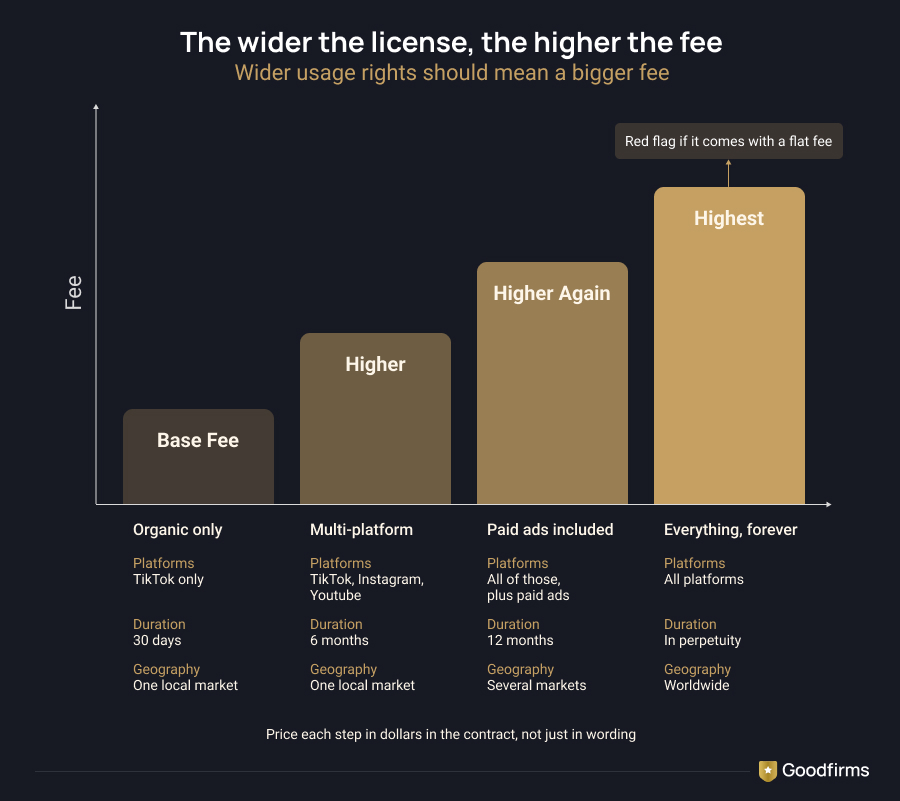
A video licensed for a year of paid advertising is worth far more than one that sits on a brand's own feed for four weeks, and the contract should show that gap in dollars, not just in wording.
TikTok-specific rights
TikTok features can create additional permissions, so spell them out in the usage-rights clause:
- Spark Ads: Define the post, authorization period, platforms, and any extra fees.
- TikTok Shop: Clarify product links, commissions, returns, and payment timing.
- Duet and Stitch: State whether these features can be enabled and who can reuse the resulting content.
- Downloads and reuse: Specify whether raw files can be edited or reused on other platforms.
Treat these as separate permissions rather than assuming they're included in the basic content license.
When broader rights should cost more
Every additional right expands what the brand can do with the content. As a practical rule:
- More platforms: Cross-platform use should cost more than TikTok-only use.
- Paid ads: Spark Ads and other paid advertising rights should be priced separately from organic use.
- More time: A 12-month license should cost more than a 30-day license.
- More markets: Worldwide usage is broader than a single-country license.
- Exclusivity: Longer or broader competitor restrictions should be accompanied by additional compensation.
- Ownership: Work-for-hire or full copyright transfer should cost more than a limited license.
- AI use: AI training or model use should be a separate permission, with compensation negotiated separately.
The contract should state each right, its duration, and any additional fees, rather than bundling everything into a single vague usage clause.
Payment terms and triggers
The payment clause decides how much you're paid and exactly when. It has to answer four fundamental questions clearly:
1. How you're paid, and for what, usually revolves around three structures:
- Flat fee: You get a fixed amount no matter how the video performs. This payment structure suits newer creators and brands that want guaranteed deliverables without taking on performance risk. Example: "$3,000 for two TikTok videos, delivered within 14 days."
- Performance-based: Your payout depends on metrics you and the brand agree on, such as views, engagement rate, or conversions. Example: "$1 per 1,000 views, capped at $5,000, measured over 30 days."
- Revenue share: You earn a percentage of the sales made through your unique link or discount code. E-commerce brands and TikTok Shop sellers use this model a lot. Example: "15% commission on every purchase made with your code."
Many deals mix these, such as a flat fee plus a performance bonus.
For budgeting context, Goodfirms' guide to TikTok marketing for brands lists micro-influencer partnerships at roughly $500 to $5,000 a month, as a planning range rather than a fixed rate.
2. Payment release
Payment may be made after the content is delivered, approved by the brand, and published. In some deals, the payment is split across different milestones. For performance-based or revenue-share deals, payment is usually made after the agreed-upon measurement period or as per the commission payout schedule.
3. Performance measurement
If the payment depends on performance, the contract should mention which metrics will be used, where the data will come from (such as TikTok Analytics or the brand’s tracking system), how long the results will be measured, and whether there is a maximum payment amount.
4. What happens if the deal changes?
If there are extra revisions, added deliverables, or a delayed post date, does the creator get more money, more time, or both?
"Payment upon completion" sounds airtight until five different people define "completion" five different ways. That's usually where the fight starts, often within hours of the deadline.
FTC guidelines
Disclosure rules vary by jurisdiction, but the basic principle is the same: audiences should know when a creator has a material connection with a brand.
FTC staff guidance defines a "material connection" to include a brand paying you or giving you free or discounted products, and says making the disclosure is the influencer's responsibility. Free product counts even when the brand never asked you to mention that specific item.
The FTC also says a platform's built-in disclosure tool may not be enough on its own, and that a disclosure in a video should appear in the video itself, not only in the caption or buried in a group of hashtags.
- Who adds the disclosure (the FTC puts this on the creator, but gets the brand's expectations confirmed in writing)
- The exact wording and where it appears, such as spoken or on-screen in the video, plus the caption
- Whether the brand's legal or compliance team needs to approve the wording
This makes the expectations clear for everyone. The creator knows exactly what disclosure is required, while the brand has written confirmation that the disclosure was part of the agreement.
Exclusivity windows
Exclusivity means the creator agrees not to promote competing brands for a set period. It protects the brand's campaign, but it also limits what the creator can earn elsewhere, so the contract should specify four things:
- Who counts as a competitor: One should use a specific list of brands or clearly define the category, such as “no other skincare brands.” Terms like “similar brands” puzzle. For example, does a lip balm count as skincare? Similarly, a beauty tool. Be clear about what is and isn’t included.
- How long it lasts: Give a start date and an end date. Exclusivity with no end date is a red flag for creators. Example wording: "Creator will not promote other skincare brands from 7 days before the video goes live until 14 days after."
- When it applies around the campaign: Does it cover only the posting period, or also the days before the video goes live and after the campaign ends? A longer window protects the brand more and costs the creator more.
- What it covers: The creator's whole account, or only campaign-related content?
A narrow clause covers one product category for a short window, so creators accept it more readily, and it still covers the riskiest period. A broad clause covers all competing brands for a longer period, making it harder to negotiate and likely to cost more.
Approval and ownership rights
These two issues get lumped together all the time, but they're separate.
- Approval: Does the brand review and request changes before anything is posted? How many revision rounds are included before extra fees kick in?
- Ownership: Does the creator keep the copyright and give the brand permission to use the content, or is it considered “work for hire,” meaning the brand owns the content outright?
Work for hire is a much bigger ask than a usage license. If a creator is signing away ownership entirely, the price should reflect that with a meaningful increase, not just a small additional fee.
AI training and data use
Some brands now ask for permission to use creator content to train or fine-tune AI models. That's a different kind of use from posting or advertising, so it needs its own clause.
Few brand deals address AI at all. Digiday reported in November 2025 that at least five creators it spoke with had no AI, intellectual property, or copyright clauses added to their brand deals that year. This is what Danielle Wiley told Digiday.

It’s strange to me how little my clients are talking about it. Especially now, all of this content is being fed into the models, and it’s so important for the search engine.
The contract should cover:
- Explicit consent: AI training is permitted only with the creator's written consent. General phrases like "any and all uses" shouldn't cover it.
- Separate pay: Training rights should come with their own fee, not be bundled into the posting rate.
- Scope and limits: Which models, which purposes, and for how long? Can the creator's face, voice, or likeness be used to generate new content?
- Opt-out or end date: What happens to the footage if the creator ends the relationship or the license expires?
If a brand won't price AI training separately, treat that as a signal to ask more questions before signing.
Termination, morality, and dispute clauses
Three more clauses decide what happens when a deal goes wrong.
- Termination and kill fee: The contract should specify who may cancel, how much notice is required, and what the creator is paid if the brand cancels after work has begun. That payment is called a kill fee, and it should cover the work already done.
- Morality clause: This allows a brand to terminate the deal if the creator does something that tarnishes its reputation. It’s better to clearly list what could trigger this clause, such as a criminal charge, rather than using vague terms like “objectionable behavior’ which gives brands an easy out.
- Dispute resolution: Decide in advance how disagreements get settled, for example, mediation first and arbitration if that fails, and which state's law applies. This is usually cheaper than going to court.
Why TikTok Creator Deals Need a Real Contract
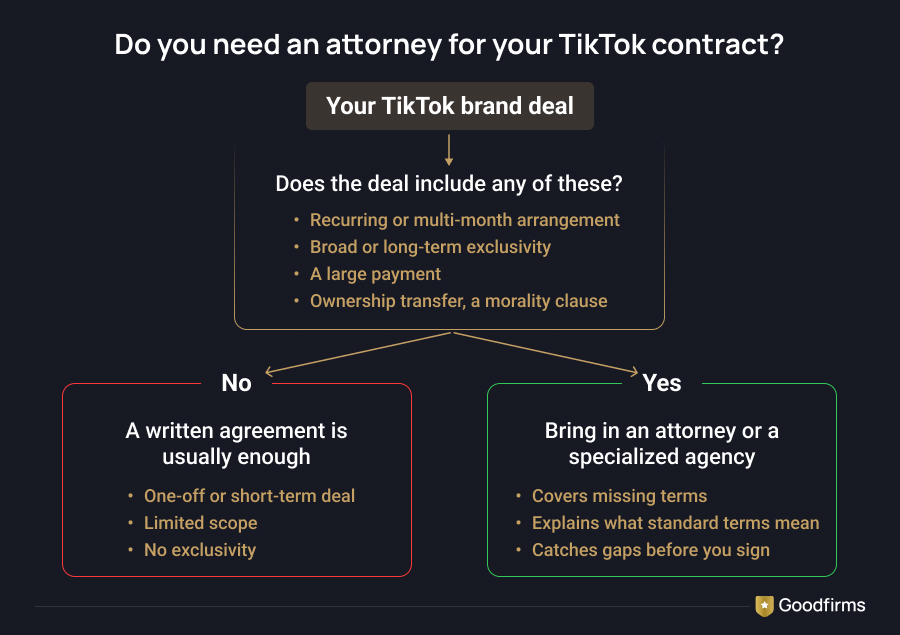
A DM thread is fine for a free product. It stops working once money, exclusivity, or extended usage enters the deal.
Gifting is a different story
Not every collab needs paperwork. Say a brand mails a free tube of skincare, and the creator posts one video on their own account. Nobody's paid, and nobody expects a follow-up. Since it’s a gift, there's no usage fight to have and no exclusivity clause to break. The creator can post about a rival serum the next morning, and nothing happens.
However, even a gifted post requires a disclosure, since the FTC considers free products a material connection.
What's at risk for each side
Once money, exclusivity, or extended use come into play, risks arise for both the creator and the brand. They lose in different ways and at different speeds.
|
Risk area |
Brand's exposure without a contract |
Creator's exposure without a contract |
|---|---|---|
|
Usage overreach |
No documented limit, so the brand may face claims for using content beyond what was actually agreed upon |
No proof of what usage was promised, so the creator can't stop or get paid for expanded use |
|
Exclusivity disputes |
Can't enforce a competitor restriction that was never defined in writing |
May unknowingly breach an "understood" exclusivity and get dropped, unpaid, or publicly called out |
|
Payment disagreements |
An undefined trigger can lead to disagreements over what “done” means and may also create reputational risks |
No guaranteed payment date or condition, so late or missing payment has no contractual remedy |
|
FTC/disclosure violations |
No written disclosure requirement, so no paper trail showing the brand asked for compliance |
The FTC treats disclosure as the creator's responsibility, so a missing tag is on them even if the brand didn't ask for it. |
|
Ownership/IP disputes |
Can't stop a creator from reusing brand-specific assets or disputing credit |
Can't prove they kept rights to their own content if the brand claims ownership |
A handshake deal isn’t enough to protect anyone. Brands may run into legal problems, while creators may end up chasing payments. Both discover the problem at the worst possible time — right in the middle of a campaign, when deadlines are already tight.
Four ways it usually breaks down
Problems occur when you never write down the one detail that matters most.
1. Reuse without permission
A brand pays for one TikTok video. It performs well, so someone on the marketing team reruns it as a paid ad on Instagram and YouTube. The creator never agreed to that, but nothing on paper says they didn't either. Now it's an argument about implied consent rather than a clean yes-or-no, and those arguments rarely end well.
2. Undefined exclusivity
A creator posts for a beverage brand, then two weeks later posts for a direct competitor. Brand one is furious because exclusivity was "understood." But there was no start date, no end date, and no defined competitor category. "Understood" falls apart the second someone asks for proof.
3. Unclear payment trigger
A creator delivers a video, but the brand says it “doesn’t feel right,” requests several rounds of revisions, and then stops responding. At what point was the payment actually due—when the video was delivered, after approval, or once the post went live? If the contract doesn’t clearly say so, both sides are left to interpret it differently. In practice, that uncertainty usually puts the creator at a disadvantage.
4. Missing disclosure
A brand asks a creator to skip the #ad tag "to keep it authentic." If a regulator or the platform catches it, both sides are exposed. The FTC tells influencers to make the disclosure themselves and not rely on anyone else, so a brand's request to skip it doesn't remove the creator's responsibility.
Most of these problems can be avoided with a simple written agreement. But when a deal gets more complicated, having a lawyer take a second look can save you from bigger headaches later.
When TikTok Creator Contracts Need an Attorney
A TikTok content creator does not always need an attorney. The need for an attorney depends on how complicated the deal is, not on the amount on the invoice.
A template or a straightforward written agreement is usually enough when:
- It's a one-time deal, a low-value gift, or a flat-fee post
- Usage rights are narrow (TikTok only, short window)
- There's no exclusivity requirement
- Payment is modest and happens in a single transaction
In these situations, even a simple signed agreement is better than relying on a screenshot of a DM. Most creators and small brands can draft or adapt one without hiring a lawyer.
Bringing in a TikTok content creator contracts attorney (or an agency that handles this daily) is worth the cost when:
- The deal is recurring, like a multi-month ambassador arrangement
- Exclusivity is involved, especially broad or long-term exclusivity
- The payment is big enough that a dispute would genuinely hurt
- The contract includes ownership transfer, morality clauses, or auto-renewal terms
- Either side has no real sense of what "standard" terms look like in this space
A lawyer spots what's missing from a contract. At first, a one-sided agreement can look fine to a first-time reader because a missing payment trigger, usage cap, or exit clause is easy to overlook. This is where an attorney comes into the picture. They know what a standard deal includes and can point out the gaps before you sign, while they're still easy to fix.
Brands managing several creator deals at once often hand this work to a specialized agency. These agencies have negotiated the same clauses many times, so they know which terms are standard and which favor one side.
Goodfirms’ Insight: Goodfirms, a research-backed reviews and ratings platform, has reviewed 2,643 influencer marketing agencies across 94 countries as of October 2026. The median hourly rate is $37, and the median client rating is 4.9. Only 16% of firms employ 50 or more people, so ask any agency up front who reviews the contract and whether that work is included in the fee.
How to Review TikTok Creator Contracts Before You Sign
It is crucial to understand the basics of contracts first before a first paid deal, because this is easier than fixing a bad agreement later. Three habits will help, whether you're a UGC content creator or an established TikTok creator.
1. Check what a rate card actually covers
A number on a rate card means nothing without context. "$400 per video" is vague until it specifies how many revisions are included, what usage rights are granted, whether exclusivity is included, and how long the brand can use the footage. It is necessary to match the price to the full scope, not just the video count.
2. Read the deliverables like a checklist
Before signing anything, get answers to these:
- How many videos and how long should they be?
- What's the posting timeline?
- Who signs off before it goes live?
- How many revision rounds are free before extra charges start?
3. Keep a copy of every contract
Content creators must keep a copy of every contract they sign, even the small ones, and record what they delivered and what they were paid. These records give real numbers for negotiations and proof of what each brand agreed to. This habit matters most when a brand's usage quietly outgrows the contract, for example, by running a TikTok-only video as a paid ad somewhere else. Without a record of the original terms, you have nothing to point to.
Treat each red flag in the table at the top of this guide as a point to negotiate, and raise it before work starts, when it's still easy to ask for.
Get the Terms in Writing Before Work Starts
The basics of a strong TikTok creator contract include usage rights, AI training, payment triggers, disclosure, exclusivity, and content ownership. If any of them are missing or vague, ask for them in writing. Brands that manage several creator deals on TikTok can also work with TikTok marketing agencies to settle terms before a dispute starts.
Final Checklist Before Signing a TikTok Creator Contract
Before you sign or start work, run through this checklist:
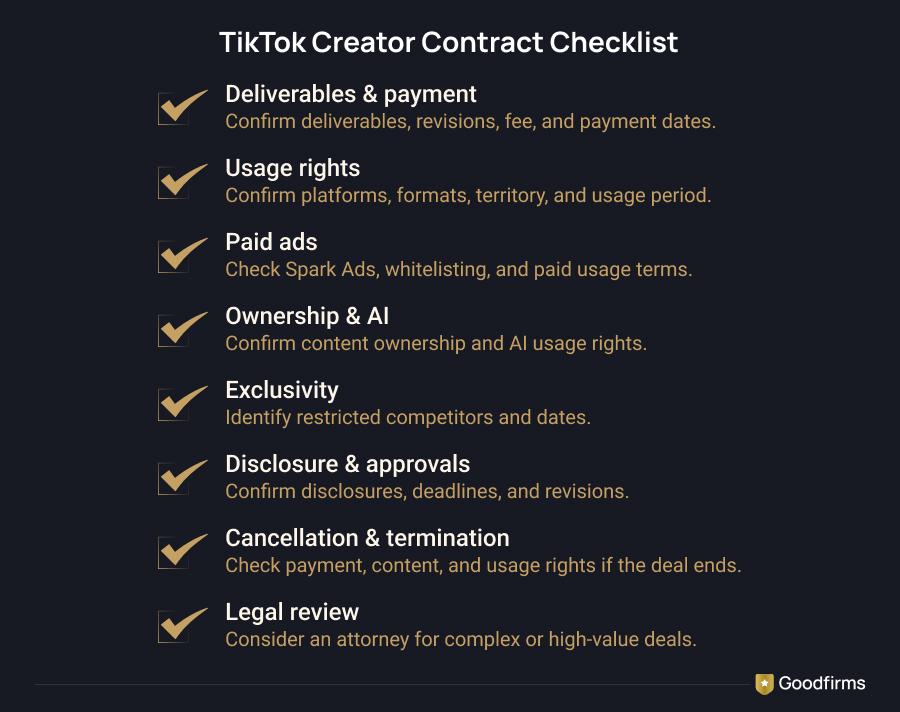
One final rule: If a term affects what you can create, who can use your content, how long they can use it, or when you get paid, don't leave it to a DM or verbal understanding. Get it in the contract before work begins.
FAQs- TikTok Creator Contract Clauses
Do I need a lawyer to sign a TikTok brand deal?
Not for every deal. A simple, low-value, single collaboration with narrow usage rights can usually be handled with a clear written agreement. A lawyer is required for recurring deals, exclusivity terms, high payment amounts, or ambassador-style arrangements with ongoing obligations. Legal review is also worth it when the contract includes ownership transfer, a morality clause, or auto-renewal terms.
What usage rights should a brand ask for in a creator contract?
A brand should ask for rights that match its actual plans: the platforms where the content will appear, the duration of the usage period, the regions it covers, whether paid advertising is included, and whether the brand can edit or repurpose the footage. Each addition widens the license, so broader usage should come with higher pay. If the brand wants to own the content outright, that's a work-for-hire arrangement and should be priced separately.
What happens if a creator doesn't disclose a paid partnership?
Undisclosed paid content can lead to platform enforcement, regulatory attention, and reputational damage. FTC staff guidance states that disclosing a brand relationship is the influencer's responsibility and warns influencers not to rely on others to do so. Free products count as a relationship that needs to be disclosed. The contract should state in writing who adds the disclosure, what it says, and where it appears before anything goes live.
Can a brand reuse creator content in paid ads without extra payment?
Only if the usage rights clause explicitly includes paid advertising. If the original deal covered organic posting on the creator's own account, repurposing that footage for paid ads generally requires additional payment and an updated usage agreement. Even when paid use is included, the fee should reflect it, since a video licensed for paid advertising is worth more than one that stays on the brand's own feed.
What is whitelisting in a TikTok creator contract?
Whitelisting, or paid-ad authorization, enables a brand to run a creator's post as an ad. On TikTok, this is usually done through Spark Ads: the creator generates an authorization code for a specific post and duration, and the brand enters it in TikTok Ads Manager. When the duration ends, the code stops working, and the brand must request a new one. The contract should state how long the authorization lasts and what the creator is paid for it.
What is a kill fee in a creator contract?
A kill fee is a payment the creator keeps if the brand cancels the deal after work has started. The amount can be a set percentage of the agreed fee or payment for the work already completed, and the contract should state which. Without one, a late cancellation can leave the creator unpaid for work already done.


.jpg)