Key takeaways
- Micro-influencers in Australia cost AUD $100 to 500 per post, compared with AUD $3,000 to 10,000 for macro-influencers.
- Micro-influencers can drive stronger engagement, with Instagram rates of 3.7% for 10K to 50K followers versus 3.5% for 100K to 500K followers.
- Micro-influencers suit niche, local, and engagement-focused campaigns, while macro-influencers offer greater reach for broad awareness.
- Brands can combine both tiers to build awareness with macro-influencers and drive targeted engagement through micro-influencers.
- The right micro vs macro influencers choice depends on your campaign goal, audience, budget, platform, and cost per result, not follower count alone.
More influencers' followers don’t always mean more impact. And spending more on an influencer doesn’t automatically mean getting more from your campaign.
For Australian brands, the choice between a micro and macro influencer comes down to more than follower count. A micro-influencer can put your brand in front of a smaller, highly relevant community, while a macro-influencer can deliver the reach needed to get a campaign noticed at scale. But which one gives you more value for your budget?
That’s where things get interesting. In this guide to micro vs. macro influencers in Australia, we compare engagement, costs, reach, and campaign goals to see when each strategy makes more sense and when combining both could be the smarter approach.
Need help putting the strategy into action? Goodfirms can help you find the best influencer marketing agencies that can support everything from influencer selection and campaign planning to execution and performance tracking
Micro vs. Macro Influencers in Australia: What Sets Them Apart?
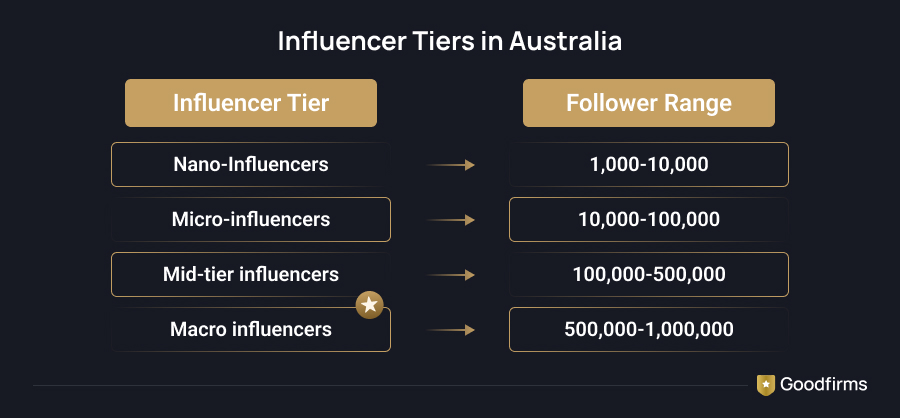
Micro vs. macro influencers in Australia differ in audience size, engagement, cost, and content style. Within the influencer tiers used by Australian agencies, micro-influencers have 10,000 to 100,000 followers, while macro-influencers have 500,000 to 1 million followers. Creators with 100,000 to 500,000 followers generally fall into the mid-tier category.
However, these influencer segments aren’t universal; they vary by country. Victoria-based agency Sticki notes that the US allows micro creators up to 100,000 followers, whereas Australia's smaller market caps the tier at 50,000. This shows why follower thresholds can differ across influencer marketing guides. Before moving further into the comparison, let's look at what micro and macro influencers actually mean.
What Is a Micro Influencer?
A micro-influencer in Australia is a niche creator with a relatively small but active audience. Think of a Brisbane fitness coach or a Perth home cook. They often reply to comments and interact closely with their communities, so their recommendations can feel more personal and relatable to followers.
What Is a Macro Influencer?
A macro influencer is an established creator with a broad audience, more polished content, and wider reach. Australian macro influencers have less personal connection with individual followers as their audience grows, which can contribute to lower engagement rates. Australian agencies also recognize a mid-tier band between micro and macro influencers, generally covering creators with 100,000 to 500,000 followers.
Micro vs. Macro Influencers: Key Differences
|
What matters |
Micro influencers |
Macro influencers |
|---|---|---|
|
Audience size |
Smaller, often niche-focused |
Larger, broader audience |
|
Reach |
Targeted reach |
Mass reach |
|
Audience connection |
Often closer to a specific community |
More diverse and widespread |
|
Engagement |
Can deliver stronger engagement rates |
Can generate greater total interactions through scale |
|
Cost |
Usually lower per collaboration |
Usually higher per collaboration |
|
Best Fit |
Niche, local, community-led campaigns |
Awareness, launches, broad-market campaigns |
|
Budget approach |
One budget can cover multiple creators |
A larger share of the budget may go to one creator |
By itself, this difference can’t help you make the real decision. So, do you need to reach more people or a more specific group? The answer becomes clearer when you compare engagement and costs across the two influencer tiers.
How Do Micro and Macro Influencers Compare on Engagement?
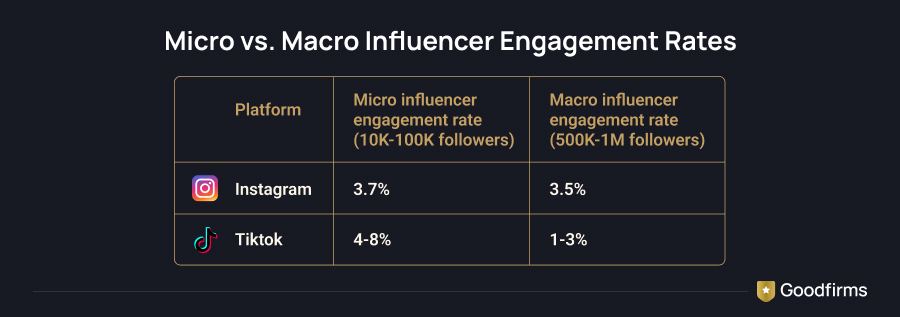
Micro-influencers usually get higher engagement than macro-influencers. On Instagram, the micro-influencer engagement rate is 3.7% for creators with 10K to 100K followers, compared with 3.5% for macro-influencers with 100K to 500K followers. This makes engagement an important consideration when planning Instagram influencer marketing, especially for brands focused on building interaction with a specific audience. On TikTok, the micro vs. macro engagement rate gap is wider, at 4 to 8% versus 1 to 3%.
So, why is there a difference between micro-influencer marketing and macro-influencers' engagement rates? Smaller audiences often feel closer to the creator and share similar interests, encouraging more likes, comments, and shares. Macro influencers, on the other hand, have large and more diverse audiences, which can result in lower engagement rates. Some followers may discover a creator through a viral post without becoming regular participants in the community.
However, a lower engagement rate doesn't mean less impact. One macro post can reach hundreds of thousands of people quickly, something a single micro creator may not match. In short, micro-influencers can deliver stronger engagement per follower, while macro-influencers often deliver greater reach due to their larger audiences.
For brands that want to turn influencer engagement into a broader social strategy, top social media marketing companies in Australia can provide support across content, social campaigns, audience engagement, and performance tracking.
If you're looking for influencer engagement rate benchmarks for Australia, most published figures are global rather than Australia-specific. The micro-influencer engagement rate that Australian brands actually see will depend on the niche, platform, audience quality, and campaign format. Ask each creator to share recent performance data before booking a collaboration.
How Much Does Each Influencer Tier Cost in Australia?
The cost of influencers in Australia depends on audience size, engagement rate, content format, and target audience, resulting in a wide price range from free barter posts to AUD $20,000 per celebrity post. At the lower end, micro-influencers' rates in Australia are AUD $100 to $500 per post, excluding GST. At the higher end, the cost of a macro influencer in Australia starts at about AUD $3,000 per post once a creator surpasses 500,000 followers. There is no official rate card, so use the figures given below as costs by influencer tier in Australia.
|
Tier |
Followers |
Estimated cost per post (excluding GST) |
|---|---|---|
|
Micro |
10,000 to 100,000 |
AUD $100 to 500 |
|
Mid-tier |
100,000 to 500,000 |
AUD $500 to 3,000 |
|
Macro |
500,000 to 1 million |
AUD $3,000 to 10,000 |
What Affects Influencer Rates in Australia?
- Engagement: a creator whose posts get real comments and saves can charge more than one with a bigger but quieter audience.
- Format: video takes more work than a photo, so Reels and TikToks usually cost more than static posts or Stories.
- Niche: categories where many brands compete for creators, such as beauty and fashion, tend to command higher rates.
What Are the Influencer Monetization Models?
- Gifting: the brand sends a free product in exchange for content. It's common at the nano and micro levels, so the cost of a micro influencer in Australia can drop to zero.
- Flat fee: a fixed price per post or video. It's standard for mid-tier and above, so macro influencer rates in Australia are often based on flat fees.
- Hybrid: a smaller fee plus free product, or an ongoing monthly retainer.
- Performance-based: The creator earns a commission or bonus tied to sales or views. This model can also apply when brands work with emerging formats such as AI influencers, depending on how the campaign is structured.
What Hidden Costs Should You Budget For?
The creator's fee is only part of your total influencer marketing cost in Australia.
- GST: most rates are quoted ex GST, so add 10% if the creator is registered.
- Usage rights: running the creator's content as your own ads is subject to a separate charge.
- Exclusivity: asking a creator to avoid rival brands adds to the fee.
- Product and shipping: if you're gifting, the product and postage are your cost.
- Agency or platform fees: these sit on top of what the creator charges.
When Does a Micro-Influencer Strategy Make More Sense?
A micro-influencer strategy makes more sense when you need trust, targeted reach, or time to test rather than mass awareness. It suits brands doing micro-influencer marketing in Australia on a limited budget, where working with several niche creators can provide broader targeted coverage than putting the entire budget behind one large creator. Micro-influencers in Australia work best in these situations:
- Your budget is limited: Micro-influencer costs in Australia are often under AUD $500 per post, compared with macro-influencer rates of around AUD $3,000 or more. Per post, at the lower end, the same budget could fund several micro-creators instead of one macro post.
- You sell to a specific niche: Creators who focus on one interest, such as sensitive-skin care or trail running, can reach people already interested in what you sell. Their smaller, focused audiences can also support stronger engagement.
- You need local reach: A new dental clinic in Brisbane may gain more from a creator with a Brisbane-based audience than from a national name. Australian micro-influencers often have audiences concentrated around a particular city, region, or interest.
- You want to test first: Book several creators with different content angles, see which posts perform, and then put more budget behind the strongest results. This approach can help brands test an influencer marketing strategy in Australia before scaling it.
- Trust drives the sale: For products people research before buying, such as skincare, supplements, or local services, a recommendation from a creator with an engaged community can provide a more personal connection than broad reach alone.
When Does a Macro-Influencer Strategy Make More Sense?
A macro-influencer strategy makes more sense when reach and speed matter more than precision. Australian macro influencers can put a brand in front of a very large audience in one campaign, which makes them useful for influencer marketing campaigns in Australia focused on launches and major promotions. Macro influencers in Australia work best in these situations:
- National awareness: A drinks brand launching in every state before summer may find it difficult to build national reach one micro creator at a time.
- Mass-market products: Everyday items such as snacks, sunscreen, or activewear suit a broad audience, so reaching a large number of people may matter more than tight targeting.
- Comfortable budget: Macro influencer rates in Australia start around AUD $3,000 per post at the 500,000-follower mark, so this approach makes more sense when one creator booking doesn't consume most of the campaign budget.
- Simple management: One contract, one brief, and one post can require less coordination than managing a dozen individual creators.
The trade-off is that macro influencers may have lower engagement rates and less-targeted audiences, so you are primarily paying for scale rather than a close-knit community. When weighing micro vs. macro influencers, consider macro creators when broad awareness or fast reach is a key campaign objective. If you want both scale and targeted engagement, the combined approach comes later in this guide.
What Does Your Influencer Budget Buy in Australia?
Every brand has a different influencer marketing budget in Australia. That budget determines how many Australian influencers you can work with, which can shape the scale and structure of your campaign. Based on the typical influencer marketing costs discussed above, here's an idea of what different budgets could buy:
- AUD 1,000: Could cover around 2-10 micro-influencer posts. This budget is generally better suited to smaller creators, particularly if your goal is to achieve targeted reach or to test different creators.
- AUD 5,000: Could cover around 10-50 micro-influencer posts or one macro post at the lower end of the macro pricing range. Spreading the budget across micro-creators gives you multiple opportunities to test different audiences and content approaches.
- AUD 10,000 and above: Could cover around 20-100 micro-influencer posts or 1-3 macro posts, depending on the creators and campaign requirements. At this level, brands can also consider combining tiers, using macro creators for broad reach and micro creators for targeted engagement.
Treat the higher post counts as a best-case estimate. Other Australian guides quote higher rates, while GST, usage rights, product costs, and agency fees can add to the final bill. Your budget determines what you can afford, but your campaign goal determines where that budget makes the most sense.
When Should Brands Combine Micro and Macro Influencers?
Combine micro and macro influencers when a campaign needs to build awareness and drive action simultaneously. Macro influencers in Australia can put your brand in front of a large audience quickly, while micro influencers can help turn that attention into trust and engagement. A mixed influencer marketing strategy in Australia can therefore support both reach and targeted engagement.
Here are the situations where the mix can work well:
- Product launches: A macro post can build initial awareness, while micro creators can sustain the conversation with more targeted content afterward.
- Two goals at once: You want to build reach while also encouraging engagement or sales, so using both tiers gives you different ways to reach your audience.
- A larger budget: From about AUD $10,000, you can consider booking a macro creator while still allocating part of the budget to several micro creators.
- A mixed audience: Macro creators can provide broad national reach, while micro influencers in Australia can speak to specific cities, communities, and niches.
- Paid boosting: According to Meta's own data, partnership ads deliver a 19% lower cost per acquisition and a 13% higher click-through rate than standard ads. This gives brands another reason to consider promoting creator content that performs well.
There is no proven ideal split in micro vs. macro influencer marketing. Start with your campaign goal, then allocate more budget to the tier that delivers the target cost per result.
How Do You Choose the Right Strategy for Your Campaign?
Choosing the right influencer strategy depends on your campaign goals, budget, audience, and the platforms your customers use. Instead of choosing between micro and macro influencers based on follower count alone, answer these five questions to determine which approach fits your campaign. If you need broader support for campaign planning and execution, top digital marketing agencies in Australia can also help you build an influencer strategy aligned with your broader marketing goals.
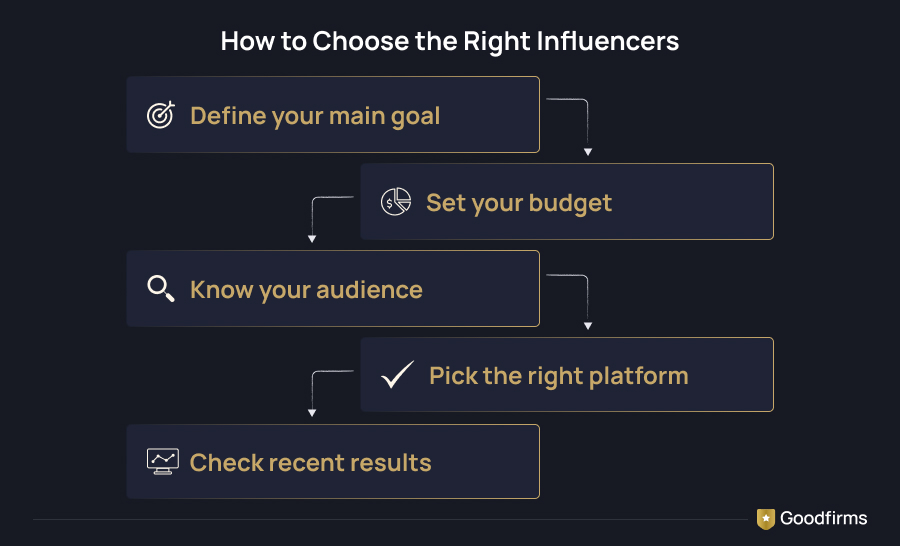
- What is your main goal? If awareness is the priority, a macro creator can provide broader reach. If engagement or sales matter more, micro creators may offer more targeted interaction. If you need both, consider combining the two tiers.
- What is your budget? Micro-influencer posts in Australia often cost under AUD $500, while macro-influencer rates can start around AUD $3,000. If one macro post would use most of your budget, working with several micro creators may give you more room to test different audiences and content.
- Who is your audience? Local or niche audiences may be a better fit for micro-creators, while national, mass-market audiences can benefit from the broader reach of macro-influencers.
- Where does your audience spend its time? Engagement rates and content performance vary across platforms. Compare creators on the platforms your target customers actually use rather than choosing based on follower count alone.
- Does the creator check out? Ask for recent post results and compare engagement with other creators in the same niche and with similar follower counts. Look beyond likes to metrics such as comments, shares, saves, views, and clicks where relevant.
Whichever tier you choose, make sure the partnership is clearly disclosed. In Australia, gifted products can constitute payment for influencer content. In March 2026, PhotobookShop paid AUD $39,600 in penalties after the ACCC issued two infringement notices for influencer reviews that failed to disclose that the influencers had received free products.
If you would rather hire help, Goodfirms has reviewed some of the best influencer marketing companies in New South Wales. You compare these companies based on factors such as client reviews, services, and budget to find an agency that fits your campaigns.
How do you Measure Whether the Strategy Worked?
Likes and views are easy to count, but they don't tell you whether a campaign paid off. Measure it against the goal you set at the start.
Step 1: Match the metric to the goal.
- Awareness: track reach and impressions.
- Engagement: track engagement rate and cost per engagement.
- Sales: track clicks, conversions, and cost per conversion.
This keeps the micro vs. macro comparison fair. Macro creators should win on reach, and micro creators should win on engagement and cost per result.
Step 2: Track every creator separately
Give each influencer a unique tracking link or discount code. Without one, you can't tell which creator drove a sale.
Step 3: Work out the cost per result
Divide your spend by what you got back.
- Cost per engagement: total spend ÷ total engagements. For example, AUD 1,000 and AUD 500 engagements each come to AUD 2.
- Cost per conversion: total spend ÷ total conversions.
After each campaign, move budget towards the creators and the tier with the lowest cost per result, and rebook the ones that delivered. That is how you build an influencer marketing strategy in Australia that improves with every campaign.
FAQs
What is the difference between micro and macro influencers in Australia?
Micro-influencers in Australia have smaller, niche audiences and can generate stronger engagement, while macro-influencers offer broader reach to a larger audience. The right choice depends on your campaign goals, budget, and target audience.
How much do influencers charge in Australia?
Influencer rates in Australia vary based on follower count, engagement, content format, niche, and usage rights. Micro-influencers may charge around AUD $100 to $500 per post, while macro-influencer rates can start at around AUD $3,000 per post.
Are micro influencers more effective than macro influencers?
Neither influencer tier is universally more effective. Micro-influencers can be valuable for niche targeting, engagement, and community trust, while macro-influencers can help brands achieve wider awareness quickly. Your campaign objective should guide the choice.
How do you choose the right influencer marketing strategy in Australia?
Start by defining your campaign goal, budget, target audience, and preferred platform. Micro-influencers can suit local or niche campaigns, while macro-influencers may be better suited to national awareness campaigns. Brands with broader goals can also combine both tiers.
What is the impact of AI on influencer marketing?
The impact of AI in influencer marketing includes faster creator discovery, audience analysis, campaign optimization, content generation, and performance tracking. However, brands still need to evaluate a creator's authenticity, audience quality, content style, and relevance before partnering with them.
How do you measure the success of influencer marketing in Australia?
Track metrics based on your campaign goal. Reach and impressions help measure awareness, while engagement rate and cost per engagement show audience interaction. For sales-focused campaigns, track clicks, conversions, cost per conversion, and revenue generated through each creator.
Final Words
The micro vs. macro debate can make influencer marketing sound more complicated than it is. Start with the audience you want to reach, the result you want from the campaign, and what you can realistically spend. Then look for creators who fit those requirements.
Follower count is only one part of the picture. A smaller creator may bring a highly relevant audience, while a larger one can give you the reach needed to get a campaign noticed. And sometimes, the answer is to use both.
If you need help finding the right creators or managing the campaign, top influencer marketing companies in Australia can help you take it from strategy to execution.