If you are running your business from the UK, be ready to earmark a significant portion of your marketing budget for digital marketing in the UK.
Why? Because a staggering 97.8% of the UK population (67.8 million) was online in early 2025, and nearly 79% (54.8 million) were social media users. This means that if you ignore digital marketing, you won't attract enough traffic and leads.
UK users are scrolling through Instagram, networking on LinkedIn, and searching on Google, so, in short, your digital footprint will define your traffic, leads, and sales now and from now on.
The blog explores the 5 most widely used digital marketing channels by UK businesses. We have narrowed down the digital channels to help start-ups and small businesses in the UK focus on those that need prioritization for maximum impact.
Why is Digital Marketing Essential for UK companies?
The UK has high digital penetration and has the most digitally engaged population in the world.
Sample this:
- 97.8% of the UK population is active online
- 79% are active social media users
- Over 54.8 million YouTube users and 45 million LinkedIn members create a perfect digital-first environment for videos, networking, and B2B content strategies.
- The UK digital ad spend reached £38 billion in 2024 and is expected to continue escalating in 2025. (We Are Social & Meltwater, Digital 2025: The UK).
UK businesses that ignore digital marketing don’t literally exist for UK consumers.
What are the Biggest Benefits of Digital Marketing for UK companies?
The UK market is considered to be one of the most connected in the world. Leveraging digital marketing in the UK gives your business a competitive edge.
Here are the key benefits:
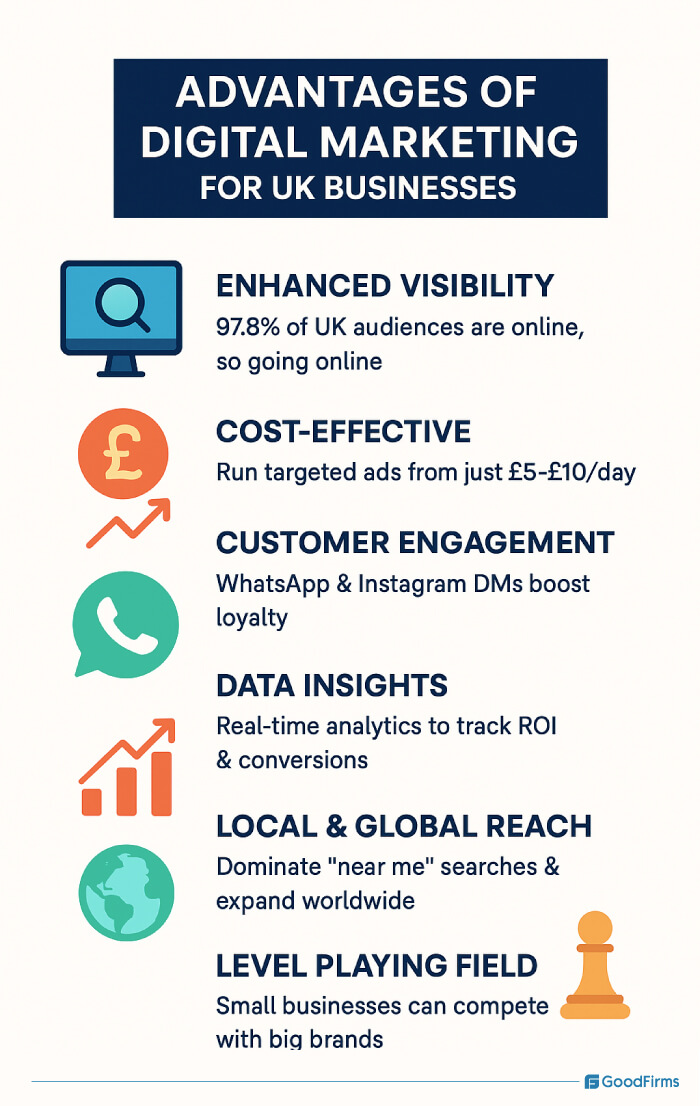
1. Enhanced Online Visibility
97.8% of UK audiences are online, so going online ensures your business is discoverable on social media, Google searches, and other platforms where customers hang out.
2. Cost-Effective
Traditional advertising is expensive; however, digital advertising can be scaled only when necessary. For example, small UK businesses can run targeted ads for just $5-$10.
3. Improved Customer Engagement
WhatsApp and Instagram DMs are becoming increasingly popular for direct customer support. Engaged customers are likely to bring in more repeat customers.
4. Data-Driven Insights
Digital platforms offer real-time analytics to track campaign performance. Businesses can measure clicks, conversions, and ROI and adjust their campaigns accordingly.
5. Local & Global Reach
Local SEO enables UK businesses to dominate “near me” searches, while online marketing helps them expand their global reach.
6. Level Playing Field
Digital marketing allows small businesses to take on larger businesses by targeting niche audiences effectively.
The advantages are plentiful for businesses that use digital marketing in the UK. Now let's explore the top 5 digital marketing channels that UK businesses can leverage.
Top 5 Digital Marketing Channels for UK Businesses
Digital marketing in the UK primarily focuses on five channels, as they are highly ROI-driven, given the large number of users.
#1. Social Media Marketing: Non-negotiable for UK businesses
79% of UK companies consider Social Media Marketing a non-negotiable part of their Digital Marketing Strategy. Why? Because UK consumers spend an average of 1 hour and 37 minutes daily on social media.
Yes, daily usage dropped 11% in 2023, but don’t take it as a sign of users' waning interest in social media. Instead, it’s a signal for marketers to restrategize and focus on creating quality content that effectively captures the audience's attention.
- UK businesses spend £3.6 billion every year on social media advertising.
- By 2026, nearly 25% of overall marketing budgets will be allocated to social media.
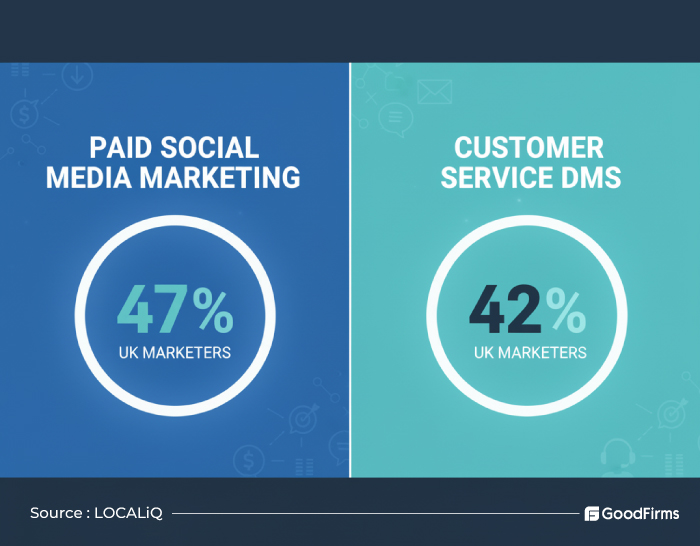
- 47% of UK marketers engage in paid social media advertising.
- 42% use DMs for customer service, building customer engagement and trust.
- 69% of businesses are satisfied with their social media marketing outcomes and plan to increase efforts.
Top Social Media Platforms UK (Early 2025)
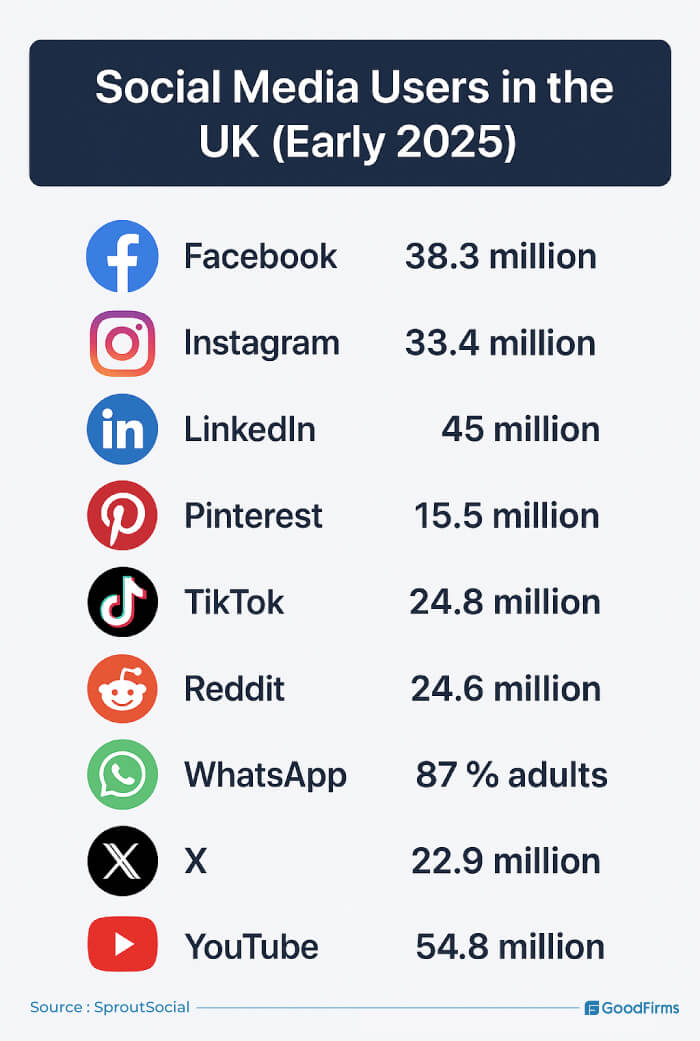
As of early 2025, social media usage statistics in the UK are as follows:
|
Platform |
Users (Millions) |
Targetable Population (%) |
Notes |
|
|
38.3 |
64.6% |
Older audiences spend more time; Gen Z <15 min/day |
|
|
33.4 |
56.3% |
Frequent visitors aged 18-34 |
|
|
45 |
64.9% |
Professional networking |
|
|
15.5 |
22.4% |
Visual Discovery |
|
TikTok |
24.8 |
- |
Highly engaged younger audience |
|
|
24.6 |
52% |
Community-driven content |
|
|
--- |
87% |
Highest reach among messaging apps |
|
X/Twitter |
22.9 |
33% |
News and trends |
|
YouTube |
54.8 |
79% |
Video content leader |
UK consumers regularly use social media to search for products and services when they need something urgently. Therefore, businesses need to understand consumer behavior and especially consider demographics while tailoring social media strategies so that they resonate with the target audience.
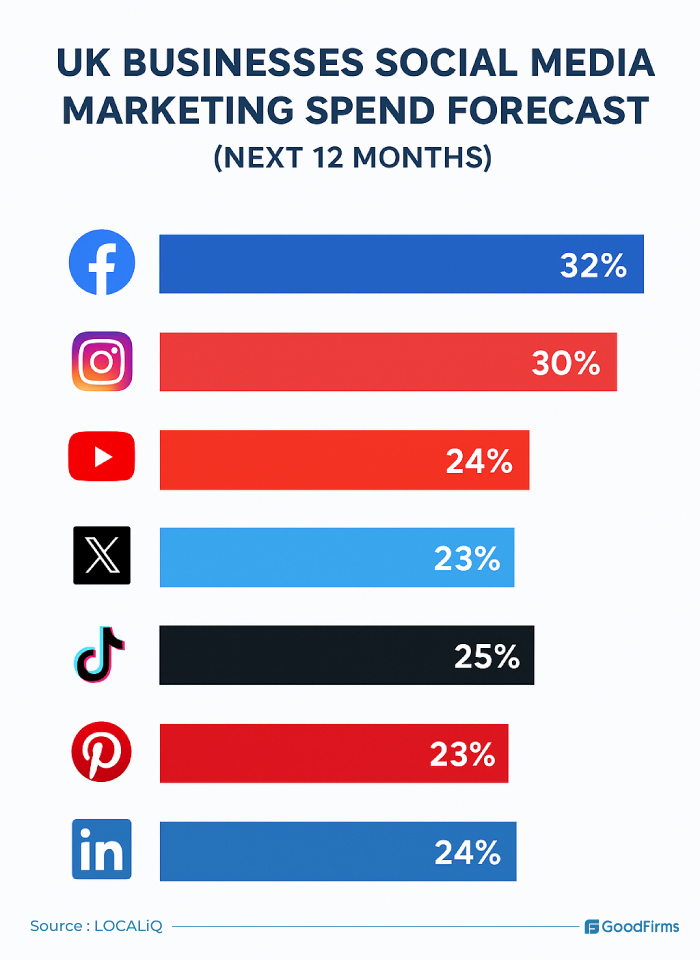
Projected Growth in Social Media Marketing Spending by UK Businesses for the next 12 months
|
Social Media Platforms |
Marketing Spend by UK Businesses (%) |
|
Meta/Facebook |
32% |
|
|
30% |
|
YouTube |
24% |
|
X/Twitter |
23% |
|
TikTok |
25% |
|
|
23% |
|
|
24% |
Actionable Insights for UK Startups for Social Media Marketing
Do those numbers overwhelm and perplex you? Don’t worry! Just remember not to spread yourself too thin. Focus on platforms that have proven successful for existing businesses, such as Meta/Facebook, Instagram, and TikTok, and go after them.
Additionally, if your budget permits, leverage paid social media marketing to attract a specific group of audiences, as 47% of UK businesses are already doing it.
More importantly, small businesses should join their customer service efforts with a social media strategy. In other words, UK businesses should use Instagram DMs to respond promptly and professionally to customer inquiries.
Bottomline:
- Leverage high-impact platforms: Facebook, Instagram, TikTok
- Combine paid campaigns with customer service through DMs
- Repurpose content across platforms to maximize reach and ROI
#2. Content Marketing brings in the Highest ROI for UK Businesses
72% of businesses actively invest in content marketing because it drives trust, engagement, and sales.
Content formats that generate the highest ROI for UK Businesses
|
Content Formats |
ROI(%) |
|
Short-form video |
27.5% |
|
Long-form video |
16.4% |
|
Images |
11.7% |
|
Blogs |
10.5% |
|
Infographics |
9.9% |
|
Newsletters |
9.4% |
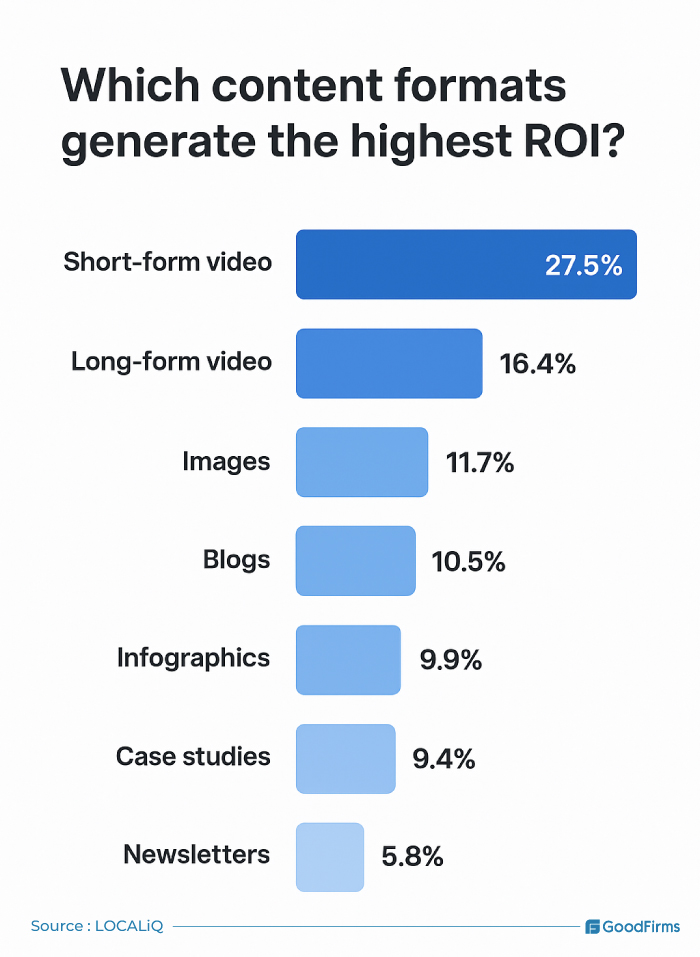
Short-form videos top the list of all the content formats, followed by long-form videos, images, blogs, infographics, and more.
Now, why short-form videos, you ask? Wistia states that short-form videos (less than 1 minute) yield the highest engagement. Still, you need to balance them out with long-form videos (30 to 60 minutes), for the latter generates maximum conversion.
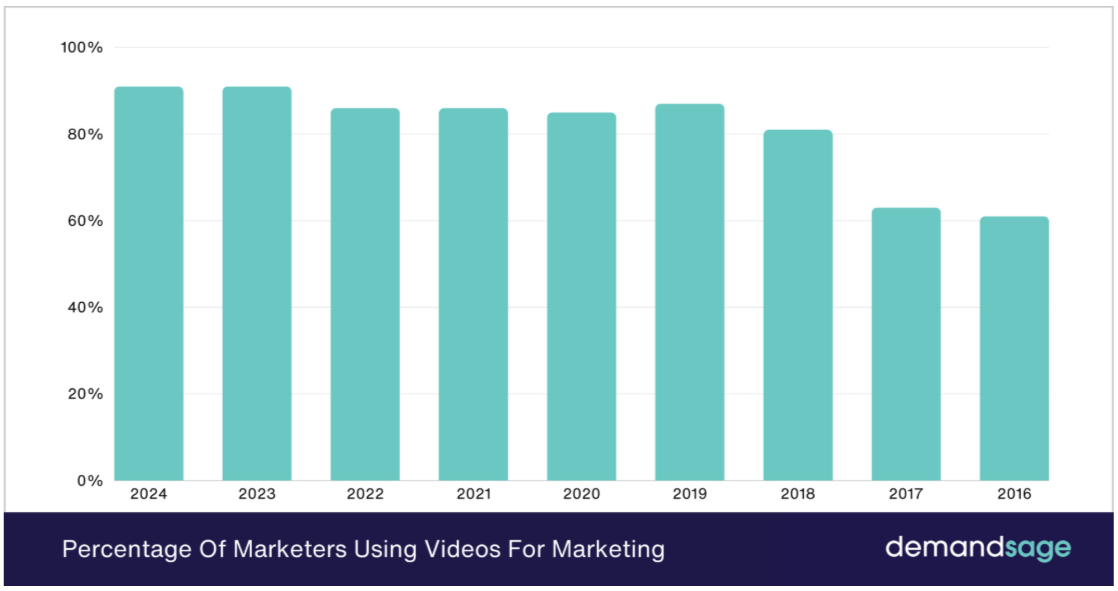
According to DemandAge’s video marketing stats, around 91% of marketers are currently using video in their marketing strategies globally. Of these, 90% report positive ROI from video marketing.
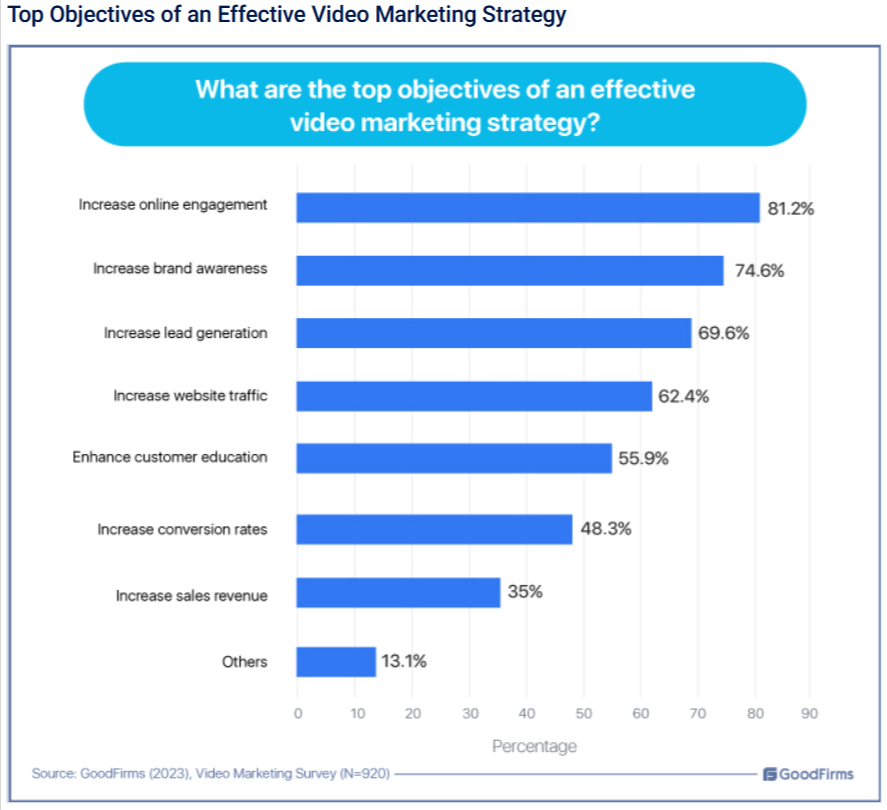
According to a survey by Goodfirms, companies worldwide increasingly rely on Video marketing to increase their brand’s online presence, better engage with customers, generate leads, increase website traffic, enhance customer education, and increase conversion rates and sales revenues, among other things.
Businesses in the UK generally distribute content through repurposing, that is, by using the same content across all platforms. However, if the platform demands, marketers can design content for specific platforms when distributing online. Businesses can use a mix of both.
Actionable Insights for UK Startups for Content Marketing
Focus on short-form videos as they have emerged as a clear-cut winner in terms of ROI among UK businesses. So, it goes without saying that startups should also make short-form videos their number one priority in their content strategy. However, think of a hybrid distribution model instead of creating different video content formats for diverse platforms.
For instance, you can create high-quality, long-form videos for webinars, product demonstrations, etc. Then, repurpose this long-form content to platform-specific clips for TikTok, Instagram Reels, and YouTube Shorts.
The approach enables UK marketers to optimize their resources and generate the highest ROI.
Bottomline:
- Short-form videos (<1 minute) for engagement.
- Long-form videos for webinars, demos, or educational content, then repurpose them for social media.
- A hybrid distribution model maximizes resources and reach.
#3. Emails are an ROI Powerhouse for UK businesses
44% of marketing professionals in the UK use emails in their marketing strategy. So, if
you think email marketing is a money-loser, you should audit your strategy because this is what I learned from the Emailtootester survey.
On average, for every US$1 invested in emails, there is $36 return.
Retail, ecommerce, and consumer goods sectors have seen better returns, $45 for $1.
Sending out 5-8 emails monthly results in the highest ROI, averaging $48 per $1 spent.
Brands with a 10+ million subscriber base draw an ROI of $46 for every dollar spent, vis-à-vis $30 for $1 spent for businesses with a list of fewer than 500,000 subscribers.
However, complying with GDPR and PECR laws is essential when planning an email marketing campaign in the UK.
Some of the GDPR rules that businesses have to comply with include:
- Collect only relevant data for your marketing campaign
- Data breach should be reported to customers within 72 hours
- Take consent from subscribers before sending marketing emails
This last point is crucial because 77% of people prefer permission-based promotional messages from brands via email.
Actionable Insights for UK Startups for Email Marketing
For startups in the UK, the top priority should be building customer trust from day one. Content and design are equally important, but not at the cost of trust. Treat GDPR and PECR compliance as a crucial part of your marketing strategy.
Ensure you obtain consent from all subscribers before adding them to your email list. More importantly, choose an email marketing platform that automatically manages unsubscribe requests instantly without hassle.
Also, complying with GDPR guidelines can help you avoid fines and build a high-quality, engaged list of subscribers who are genuinely interested in interacting with you. This will ensure better return on investment in the long run.
Bottomline:
- Start building trust from day one
- Use email platforms that manage unsubscribe requests immediately
- Focus on building a quality subscriber list
#4.SEO to Drive Organic Growth
According to sqmagazine, organic search drives 53.1% of global website traffic, while paid search generates just 15.7% traffic.
Despite this, only 60% of UK businesses have an SEO strategy, while 40% still consider it. That’s a huge gap that startups can exploit.
Popular SEO Tactics for UK Businesses (2025)
|
SEO Tactics for UK Businesses |
UK Businesses (%) |
|
Local SEO |
56% |
|
Content Marketing |
50% |
|
Technical SEO |
48% |
|
Keyword Research |
46% |
|
Off-page SEO |
36% |
|
Competitor Analysis |
22% |
|
On-page SEO |
20% |
|
Other |
1% |
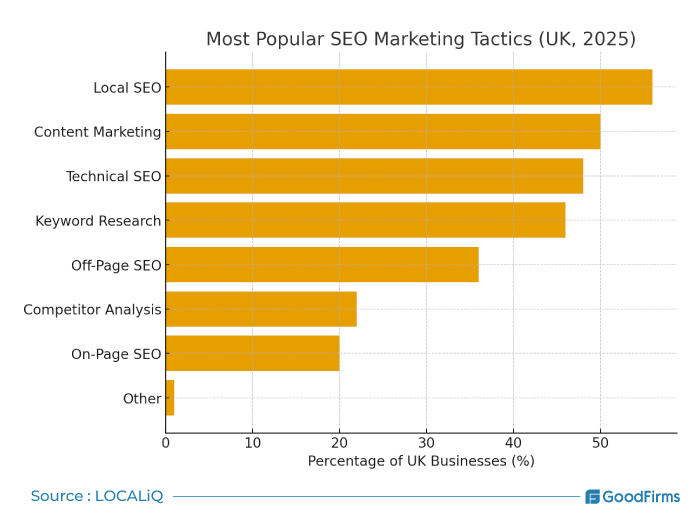
Why Local SEO: 46% of UK searches have local intent, and 18% are local mobile searches leading to purchases within a day.
Actionable Insights for UK Startups for SEO
Focus on Local SEO: UK-based startups and small businesses should work on building strong local visibility, as it drives speedy results. They should optimize their Google Business Profile, accumulate more customer reviews, and create local citations for this.
Invest in Content Marketing: Publish blogs, infographics, videos, and whitepapers that address customer issues and indirectly align with search intent. But then, remember businesses that generate long-form content ( at least 2,000 words) rank in the top 5 positions than those with short-form content.
Leverage Technical SEO: Technical SEO ensures that your website loads quickly, is mobile-friendly, and has a clean XML sitemap.
Prioritize long-tail keywords: Long-tail and location-based keywords help your target audience reach you faster with less competition.
Balance On-Page and Off-Page SEO: Meta-tags, internal linking, and structured URLs, which are part of On-page SEO, and quality backlinks and digital PR, which are part of off-page SEO, should work hand-in-hand.
Use AI in SEO: 86.07% of SEO professionals globally use AI-driven SEO strategies. That’s too significant a percentage for your business to ignore.
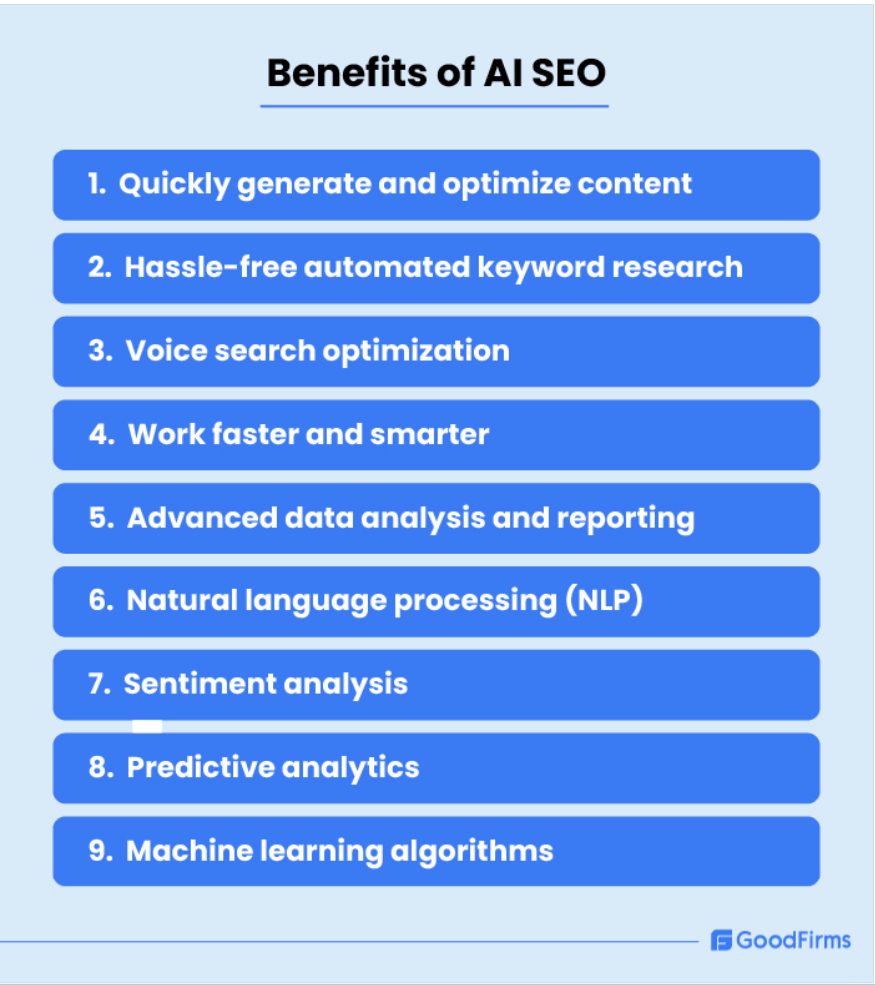
Review Regularly: Review your SEO performance quarterly or monthly and adjust tactics as needed.
Analyze Competitors: Stay updated on competitor SEO tactics. This is a cost-effective way to identify gaps in your SEO and address them.
Bottomline:
- Focus on local SEO: update Google Business Profile, and reviews
- Publish long-form content (2,000+ words) to rank higher.
- Use technical SEO for site speed, mobile-friendliness, and structured data
- Target long-tail & location-based keywords for faster results
- Integrate AI in SEO: 86% of SEO pros globally use AI tools
#5. AI Marketing to Accelerate Growth
85% of businesses in the UK use AI in their marketing strategy for content creation, marketing automation, graphic design, image/video generation, customer service, and more.
AI Usage Across Various Marketing Categories by UK Businesses
|
AI Usage Across Marketing Functions |
UK Businesses (%) |
|
Content Creation |
63% |
|
Marketing Automation |
44% |
|
Graphic Design |
32% |
|
Image/video Generation |
31% |
|
Campaign Optimization |
30% |
|
Customer Service |
12% |
|
Other Aspects |
2% |
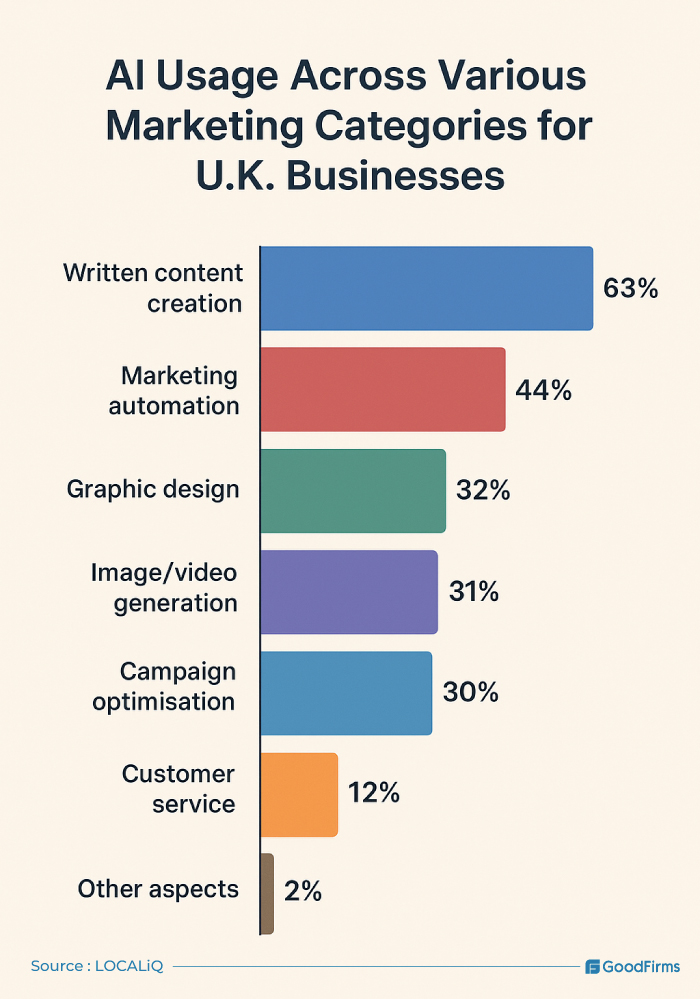
The most popular AI tools leveraged by UK businesses include Google Bard, ChatGPT, Bing AI/Co-Pilot, CapCut, DALL.E, Midjourney, and more.
Actionable Insights for UK Startups for AI Marketing
Start Small: Use one or two AI tools that address immediate needs, such as ChatGPT for content creation or CapCut for video editing. Using too many tools can overwhelm your team and dilute ROI.
Automate Repetitive Tasks: Use AI toschedule posts, send emails, and manage social media campaigns.
Boost Content Creation: AI can quickly generate blog ideas, video scripts, social media captions, and graphics. But then, don’t forget to combine your brand voice with AI output to make it sound authentic.
Engaging Visual Content: Tools like DALL.E, MidJourney, or CapCut can generate high-quality images and videos for startups with small design teams.
Personalized Customer Service: AI-powered chatbots offer instant responses and improve user experience.
Analyze and Optimize Campaigns: Use AI to monitor click-through rates and conversions.
Team Upskilling: Encourage your marketing team to learn about AI tools and prompt engineering basics.
Track ROI: Track performance metrics of every AI-assisted initiative.
Stay Updated: The AI landscape is changing, so look for new tools and features relevant to marketing.
Remember: Dentsu Creative reported that 78% of CMOs believe AI can never replace human imagination, and 97% of marketers admitted to making at least one change in AI-generated content before it went live.
Bottomline:
- Start with 1–2 AI tools to solve immediate needs
- Automate repetitive tasks (emails, social posts)
- Use AI for visual content creation
- Upskill your team on AI tools and prompt engineering
Digital Marketing Mistakes UK Businesses Make
We have made it very clear why UK businesses need a digital presence. But then, while undertaking different measures to cement your digital presence, here are a few mistakes that can affect your efforts and might as well damage your brand reputation.
Here are common mistakes that you should be aware of and avoid:
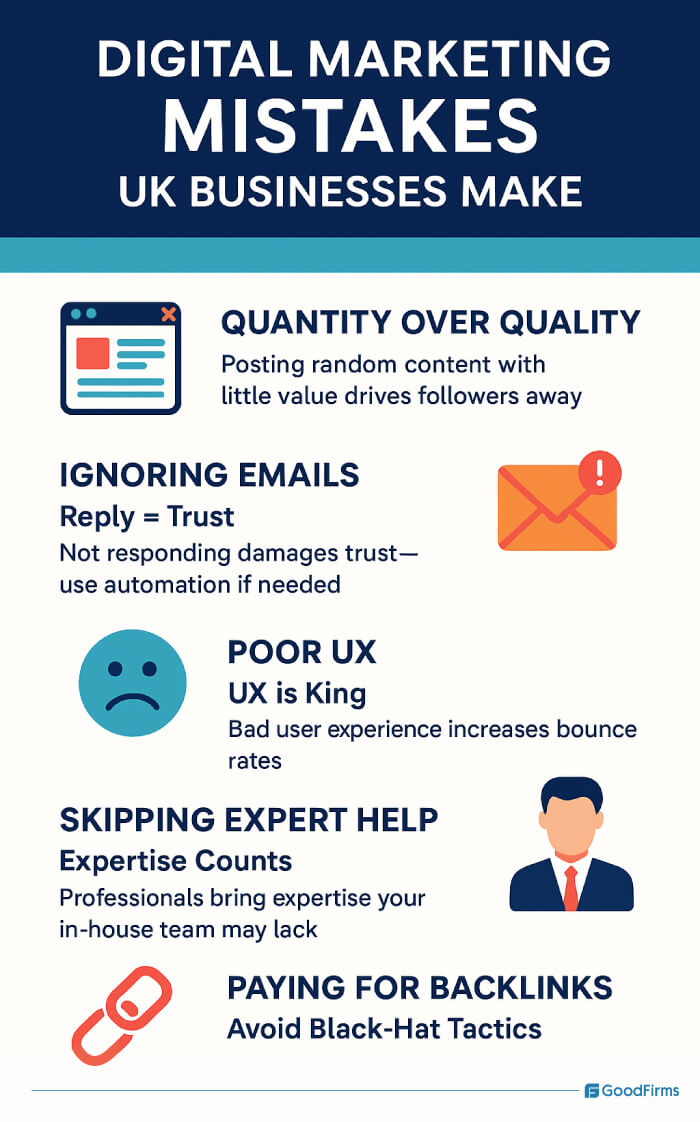
Prioritizing Quantity over Quality: In our effort to meet the marketing or SEO quota, we often post meaningless, random content that tends to offer less value to customers. This could result in losing followers over time.
Not Answering Emails: If you ignore client emails, you may lose customer trust and conversion. If answering all emails manually is not possible, leverage automation to manage things efficiently.
Overlooking UX: Ignoring user experience comes with a cost as it leads to lower user engagement and increased bounce rates.
Avoiding Expert Help: Digital marketing is an ever-evolving arena. Partnering with experts can give you an edge that you or your in-house team may not be able to offer.
Paying for Backlinks - It’s a black-hat SEO trick that goes against Google’s guidelines and can result in penalties.
Avoiding these common mistakes is crucial if businesses wish to take maximum advantage of their digital marketing strategies.
Wrapping up
UK’s digital economy is booming, and businesses are investing millions to stay ahead. I hope the message is loud and clear to startup and small business owners:
- Social media to build reach
- Content marketing drives engagement.
- Email to build trust and high ROI.
- SEO for organic visibility.
- AI accelerates growth.
If you don’t want your business to disappear from SERPs (meaning if you don’t want to pull down your shutters), here’s our three-word advice:
Invest in digital marketing. Pronto.
FAQs - Digital Marketing in the UK
How to choose a digital marketing agency in the UK
To select a digital marketing agency in the UK, first identify your business goals and budget. Once you have done that, look for a company that matches your requirements. Check out their portfolio, industry experience, and client reviews to understand whether they have done the work you are looking for. Inquiry into their communication and reporting methods, including their pricing strategy. Also, how committed they are to data-driven tactics and continual improvement to determine whether they are a good culture fit.
Who offers the best digital marketing in the UK?
Many digital marketing agencies in the UK offer comparable services. To narrow your search, be specific about your needs, budget, and industry. Some of the leading digital marketing firms in the UK listed on Goodfirms include WebFX, Searchbloom, Supple Digital, Smartsites, and more. These agencies are data-driven and known to deliver ROI-driven digital marketing strategies that drive business growth.
What is the digital marketing salary in the UK?
Entry-level - £22,000 and £25,000.
A mid-level executive - £27,000 and £30,000.
Senior digital marketing - £40,000 to £60,000+