Key takeaways
- Fintech has the highest average CAC of any industry — $1,450 for SMB, $14,772 for enterprise. A fintech digital marketing agency that doesn't account for this in strategy is working from the wrong baseline.
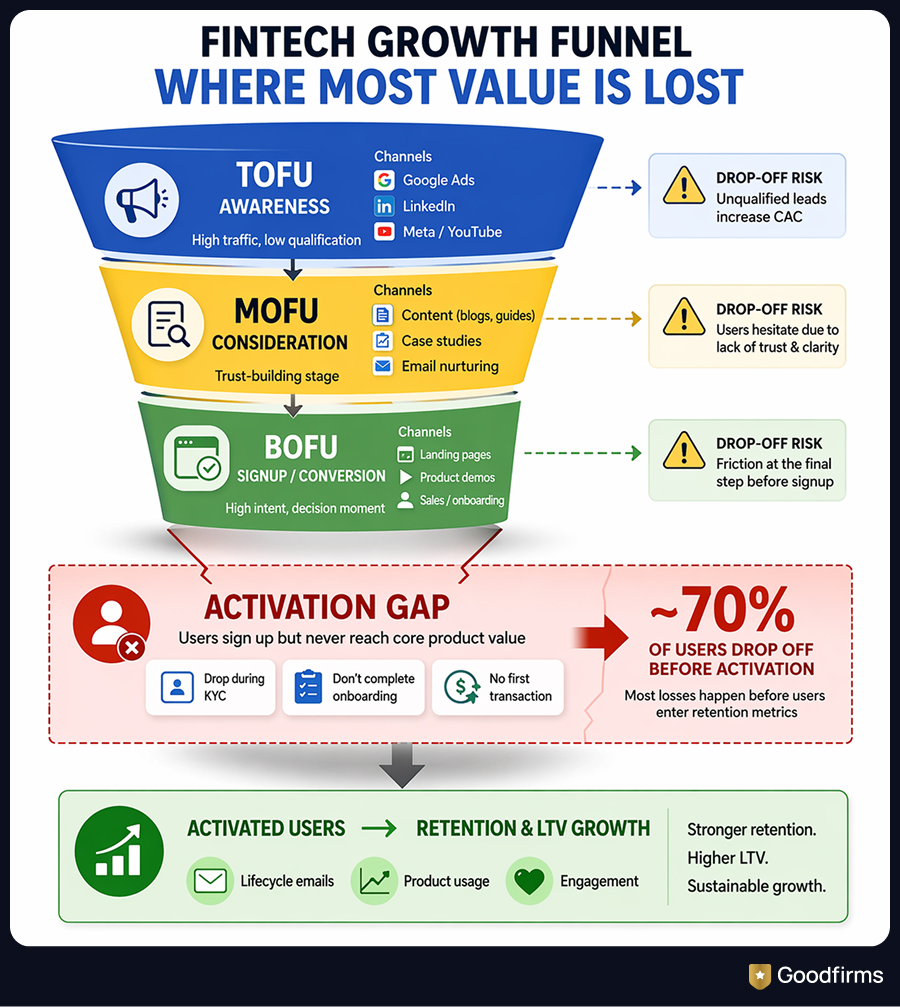
- Most fintech funnels lose the most value at two specific points: the TOFU-to-MOFU handoff (poor qualification) and post-signup activation (users churn before reaching the product's core value).
- A 3:1 LTV: CAC ratio is the industry minimum, not the target. Fintech growth marketing that scales before reaching 4:1 typically accelerates spend on a model that hasn't been validated.
- CAC payback periods average 18–24 months in B2B fintech, which means marketing investment and cash runway decisions are the same decision, not separate ones.
- Reducing monthly churn by 1 percentage point increases LTV by 10–30%. At scale, retention spend consistently delivers better ROI than acquisition spend.
What core problem will a fintech digital marketing agency be facing when the global fintech market is projected to reach $1.1 trillion by 2032?
The opportunity seems obvious. What's less obvious is why so many companies keep scaling on their fintech digital marketing strategy and still can't produce predictable, sustainable growth.
The answer is rarely the budget. Fintech digital marketing strategy budgets have jumped 45% over the last three years, and firms plan to spend even more.
More money is going in. But without the right framework behind it, that spending produces activity, not growth.
This is the core problem a fintech digital marketing agency is supposed to solve. Solve the unit economics problem that sits underneath every growth decision.
McKinsey projects fintech revenue to grow nearly three times faster than traditional banking between 2023 and 2028, but only for companies that build the right growth infrastructure.
This blog breaks down exactly what that looks like.
Find top fintech digital marketing agencies on Goodfirms, compare real client experiences, and find a partner that actually helps you improve CAC, LTV, and long-term growth.
Where Fintech Funnels Actually Lose Money
The standard marketing funnel awareness, consideration, conversion exists in fintech, but the failure modes at each stage are specific to financial services in ways that generic digital marketing for fintech companies consistently gets wrong.
Trust is not a soft variable here. It is the primary conversion variable. Every stage of the funnel is, in part, a trust-building exercise. And because fintech products ask people to share financial data, move money, or make investment decisions, the bar for that trust is significantly higher than it is in SaaS, e-commerce, or most other B2B verticals.
Any fintech digital marketing strategy that treats the funnel as a traffic problem will consistently underperform. The real diagnosis comes from when you know where qualified interest stops converting, and why?
Top of Funnel: Generate Right Awareness
The job at the top of the funnel is to generate the right ones. In fintech, unqualified TOFU volume is expensive in two ways: the direct cost of the channel, and the downstream waste of nurturing prospects who were never going to convert.
For B2B fintech, Google paid search is well-documented as cost-inefficient at the TOFU stage. Financial keywords carry among the highest CPCs in the paid search ecosystem. On the other hand, recent Goodfirms research shows that nearly 60% of searches now end without a click, as AI-generated answers increasingly resolve queries directly on the SERP, shifting the focus from rankings to visibility.
When it comes to CPC, LinkedIn consistently outperforms because it allows segmentation by company size, job function, and seniority. These variables actually help you predict whether someone has the authority and budget to buy. If you find difficulty handling this segment, you can also partner with the best digital marketing agency that can handle all this for you.
Middle of Funnel: Where Funnels Fail
MOFU is where fintech funnels lose the most value, and it's the stage that fintech marketing agencies most frequently underinvest in.
The lead has been captured. Interest exists. But the conversion to a sales conversation, a product trial, or a demo doesn't happen. The reason is that either nurture is generic, the content doesn't address what the buyer is actually weighing, or the follow-up is too slow.
In financial services digital marketing, the MOFU role is to move a prospect from awareness of the problem to confidence in this specific solution. That requires you to build a strong content marketing strategy calibrated to the consideration stage. Because one of the research from Goodfirms says rankings alone no longer guarantee traffic, as visibility across AI answers, snippets, and SERP features now determines actual discovery.
A good content marketing strategy will help create regulatory compliance whitepapers, case studies showing documented ROI, comparison frameworks, and live or recorded product demos, all of which perform better at MOFU than brand-level thought leadership.
The other important factor you must consider is speed. Speed matters here more than most teams acknowledge. Businesses that respond to inbound leads within the first hour are 7x more likely to qualify them.
Bottom of Funnel: Gap That Costs
The most expensive place in any fintech funnel is the gap between signup and activation. A signed-up user is not an acquired customer. A user who creates an account, starts KYC, and drops off has generated an acquisition cost without generating any revenue. And this gap is far larger than most fintech growth marketing teams report.
Fintech app Day-1 retention is around 30%. That means roughly 70% of users who download or sign up disengage before experiencing the core product. Average 30-day retention across apps sits at just 11%. Most of this drop-off happens during onboarding, before users even reach the stage where they would be counted in retention metrics.
Hence, a fintech digital marketing strategy that doesn't include activation rate as a core metric is measuring only half the funnel.
70%
Approximate share of fintech app signups that disengage before reaching the core product value. This churn is invisible in acquisition reports — but it's the most expensive leak in the funnel.
Growth marketing plays a role here, too. The messages in your ads, what your landing page promises, and the emails users receive after signing up all shape expectations. For example, if you say “open an account in 2 minutes,” but the KYC takes 48 hours, it is not a product issue; it starts with marketing.
You can learn more about driving growth in finance sector here. Raphael Rohner, CEO of R17 Ventures AG, shares his insights on a podcast with Goodfirms.
Fintech Digital Marketing Agency CAC Benchmarks and Why Most Teams Miscalculate
Customer acquisition cost in fintech is the highest of any industry. The regulation, trust barriers, decision-making complexity, and long sales cycles that make fintech products valuable are the same things that make acquiring customers expensive.
The problem arises when your fintech digital marketing agency calculates CAC incorrectly and makes budget decisions on a number that understates the real cost by 30–50%.
$1,450 is the average CAC for fintech companies targeting SMBs.
Enterprise fintech CAC reaches $14,772.
Knowing your segment benchmark changes every acquisition decision you make.
The Right Way to Calculate Fintech CAC
CAC Formula
CAC = Total Sales & Marketing Spend ÷ New Customers Acquired
What "Total Spend" Must Include
Ad spend + agency / team costs + marketing tools + content production + events + acquisition incentives
Most fintech marketing teams calculate CAC using ad spend alone. This produces a number that looks efficient but hides the true cost of acquisition. When salaries, agency fees, tools, and content costs are included, CAC typically rises 30–50% from the ad-spend-only figure. The higher number is harder to present in a board meeting, but it's the number that actually informs whether an acquisition model is sustainable.
A common and costly error:
Calculating CAC against total signups rather than activated customers. In fintech, where activation rates can run below 40%, a signup-based CAC calculation can understate the true cost of acquiring a revenue-generating customer by more than 2x. So, calculate CAC against customers who completed onboarding and made at least one transaction.
CAC Benchmarks by Segment and Channel
|
Segment / Channel |
Avg CAC (2025) |
Primary Driver |
Typical Payback Period |
|
Fintech SMB (B2B) |
$1,450 |
Procurement complexity, trust-building |
12–18 months |
|
Fintech Mid-Market (B2B) |
$4,903 |
Multi-stakeholder decisions, longer cycles |
18–24 months |
|
Fintech Enterprise (B2B) |
$14,772 |
Security reviews, regulatory due diligence |
24+ months |
|
Consumer Banking / Neobanks |
$200–$300 |
Paid social, referral programs, volume acquisition |
6–12 months |
|
Wealth / Insurance Fintech |
$1,000+ |
High trust bar, advisor-influenced decisions |
12–18 months |
|
Via Paid Search |
~$802 (B2B avg) |
High CPC in financial keywords |
Depends on LTV |
|
Via Organic / SEO |
~$290 |
Lower per-acquisition cost, compounds over time |
Shorter once established |
|
Via Referral Programs |
~$150 |
Trust transfer, low friction conversion |
Often under 6 months |
Two things this data makes clear.
- First, CAC via paid channels has risen 40–60% between 2023 and 2025 driven by increased competition for financial keywords, privacy changes reducing targeting precision, and multi-touch attribution becoming harder to instrument correctly.
- Second, organic and referral channels deliver substantially lower CAC but require upfront investment that takes 6–12 months to compound.
LTV (Lifetime Value): How to Calculate It Correctly
LTV is the metric that determines how much CAC is justified. The most common mistake fintech teams make is calculating LTV from revenue rather than gross profit, which, depending on the product category, can overstate customer value by 30–60%.
Basic LTV
LTV = ARPU (Average Revenue Per User) ÷ Monthly Churn Rate
Gross Profit LTV (More Accurate for Fintech)
LTV = (ARPU × Gross Margin %) ÷ Monthly Churn Rate
Using revenue LTV in these categories produces a number that justifies acquisition spend that the real economics don't support.
LTV:CAC — What Each Ratio Actually Means
|
LTV:CAC Ratio |
What It Signals |
What a Fintech Marketing Agency Should Recommend |
|
Below 1:1 |
Losing money on acquisition. |
Stop all acquisition scaling. Fix product economics or pricing first. |
|
1:1 to 2:1 |
Unsustainable. |
Reduce churn. Improve activation. Don't increase acquisition spend. |
|
3:1 |
Industry minimum, viable but not ready to scale. |
Validate with real cohort data. |
|
4:1 to 5:1 |
Healthy unit economics. Ready for growth investment. |
Increase acquisition spend. Test new channels. Begin scaling confidently. |
|
Above 6:1 |
Strong. May signal underinvestment. |
Consider accelerating spend. You may be leaving growth on the table. |
Churn is a Marketing Problem, Not Just a Product Problem
The mathematical relationship between churn and LTV is non-linear in its impact. At 5% churn, a $150 ARPU customer is worth $3,000. At 3% churn, the same customer is worth $5,000. That's a $2,000 difference in customer value from a 2-point retention improvement.
Reducing monthly churn by 1 percentage point increases LTV by 10–30%. Most fintech marketing strategies underweight this lever because retention doesn't generate the same visible activity as acquisition campaigns, but the ROI comparison is rarely close.
Fintech content marketing agencies play a structural role in retention that's often underappreciated. Educational content like regulatory updates, product deep-dives, and use-case tutorials keeps users engaged with the product beyond the initial activation moment. CDP (Customer Data Platform) triggered lifecycle emails that respond to user behavior (inactivity, product limit reached, underused features) are consistently documented to improve LTV by 20–30% without any change to the acquisition model.
FAQs on Fintech Digital Marketing Strategy
1. How do you choose the right fintech digital marketing agency?
Choosing the right fintech digital marketing agency starts with evaluating how they approach unit economics. A strong fintech marketing agency will analyze CAC, activation rates, and LTV across channels rather than focusing only on traffic or leads. Look for proven fintech experience, case studies, and the ability to work within compliance constraints. The right partner should optimize the entire funnel, ensuring that growth is scalable and aligned with long-term profitability.
2. Why is customer acquisition cost so high in fintech?
Customer acquisition cost is higher in fintech due to regulatory friction, trust barriers, and longer decision-making cycles. Financial services digital marketing requires building credibility before conversion, which increases both time and cost. In B2B fintech, multiple stakeholders are often involved, while in consumer fintech, onboarding friction further impacts conversion. A strong fintech digital marketing strategy accounts for these factors and focuses on improving activation and retention, not just acquisition.
3. What is a good LTV: CAC ratio for fintech companies?
A 3:1 LTV: CAC ratio is considered the minimum viable benchmark in fintech growth marketing, but it is not ideal for scaling. Most fintech companies need to reach at least 4:1 before increasing marketing spend aggressively. Ratios below 3:1 typically indicate inefficient acquisition or high churn, while higher ratios signal strong unit economics. Sustainable growth depends on improving retention and activation alongside acquisition efficiency.
4. How long does it take to see results from digital marketing for fintech companies?
Digital marketing for fintech companies typically takes longer to deliver results than in other industries. In B2B fintech, consistent pipeline growth can take 6 to 12 months due to long sales cycles and trust requirements. Consumer fintech may see faster user acquisition, but sustainable growth depends on improvements in activation and retention. Early indicators, such as improved conversion rates and activation metrics, usually appear before the revenue impact becomes visible.
5. Is organic marketing more effective than paid marketing in fintech?
Organic and paid marketing serve different roles in a fintech marketing strategy. Paid channels deliver faster acquisition but often come with high CAC due to competitive financial keywords. Fintech content marketing and SEO, on the other hand, provide lower long-term acquisition costs and compound over time. The most effective approach combines both, using paid campaigns for immediate traction and organic channels to improve efficiency and reduce dependency on ad spend.
What Separates a Fintech Digital Marketing Agency That Scales Growth from One That Just Runs Campaigns
The difference isn't channel expertise. Most agencies can run paid search and LinkedIn campaigns. The difference is whether the seo agency understands that fintech growth marketing is a unit economics problem first and a campaign execution problem second.
The funnel, the CAC, and the LTV are not three separate things. They are one system. Fix the funnel leaks first. Measure CAC correctly. Validate LTV from real data. This creates what we can call the Fintech Growth System: Funnel × CAC × LTV – a model that determines whether growth is scalable or not. This will help you find the right fintech digital marketing agency that can show you exactly which channels justify more investment and which ones are subsidized noise.