Survey Highlights at a Glance
- 89% of brands appear in Google AI Overviews for their target queries.
- 76% of marketers say the SERP has shifted from a list of links to an AI-generated answer layer.
- 86.5% say ranking #1 still matters — but mainly for commercial-intent queries.
- Only 14% track AI/LLM citation visibility, despite 43% naming AI optimization a core 2026 strategy.
- 100% of respondents agree E-E-A-T will matter more in 2026 — the only unanimous finding in the survey.
- 65% cite adapting to AI-driven search as their single biggest SEO challenge.
- Personalization is the least-adopted SEO practice, used by only 43% of marketers.
- Only 70% use plain, simple language, despite AI systems favoring it for citation.
- 43% are actively implementing GEO strategies, up from near-zero a year earlier.
The latest AI SEO statistics for 2026 reveal one clear trend: search visibility now matters more than rankings alone.
Over 58.5% of Google searches now end without a click, up to 83% of AI-generated answer queries are resolved directly on the results page, and only 14% of marketers track AI visibility. Together, these trends show that SEO success is no longer measured by rankings alone but by visibility across AI Overviews, featured snippets, and other SERP features.
This report combines 35+ verified AI SEO statistics from leading industry sources with 9 original Goodfirms research findings based on a survey of 100+ SEO and marketing professionals across 20+ countries. It explores how marketers are adapting to AI-driven search, where execution gaps remain, and what businesses need to do to stay visible in 2026.
For a deeper analysis of how these changes affect traffic and referrals, read our companion research: SERP Visibility: Why Rankings No Longer Drive Organic Traffic.
Looking to improve your visibility across Google, AI Overviews, and AI search? Compare leading SEO companies and Digital Marketing Companies on Goodfirms that specialize in AI SEO, GEO, and modern search optimization.
Goodfirms Survey Findings: AI Search, Rankings & Zero-Click Behavior
Here is what the data actually shows — starting with the shift that underpins everything else.
1. AI Search Trends 2026: Is Google Becoming an Answer Engine?
Yes — and most practitioners agree on exactly how. The SERP has shifted from a ranked list of links to an AI-generated answer layer, with Google increasingly resolving queries before a user clicks anywhere. This shift is the context for every other finding in this report.
Before getting into strategy and data, it's worth understanding how practitioners actually see the landscape they're working in. We asked respondents to describe the difference between the traditional and modern SERP. The responses were consistent enough to feel like a consensus.
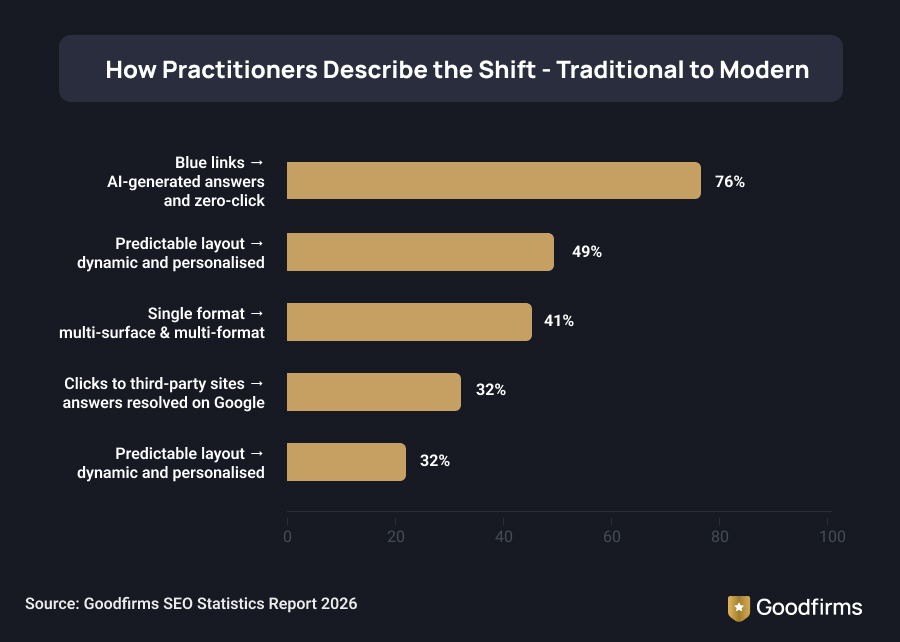
The Shift - from Traditional SERP to Modern SERP
|
The Shift |
What Respondents Said |
% of Respondents |
|---|---|---|
|
Transition from Blue links to AI-generated answers and zero-click |
Traditional SERPs were a list of ten links. Modern SERPs increasingly answer the question on the page itself through AI Overviews, featured snippets, and knowledge panels — before any website is visited. |
76% |
|
Transition from Keyword matching to intent and context driven |
Traditional SERPs matched keywords. Modern SERPs interpret what the user actually wants — the intent behind the query — and surface results accordingly. |
49% |
|
Transition from Single format to Multi-surface and Multi-format |
Traditional SERPs had a predictable, uniform layout. Modern SERPs are dynamic — combining text, images, video, maps, shopping results, and AI answers in layouts that change based on query type. |
41% |
|
Transition from Clicks to Third-party sites to Answers resolved on Google |
The old model sent users to websites to get their answer. The new model resolves more queries on Google's own page — reducing the volume of referral traffic to third-party sites. |
32% |
|
Transition from a Predictable layout to a Dynamic and Personalised |
Traditional SERPs looked the same for every user. Modern SERPs vary by location, device, search history, and context — making "the ranking" less universal than it once was. |
22% |
Three-quarters of respondents described the same fundamental change: the SERP used to be a list of options. Now it's an answer. And when the search engine becomes the destination, the rules of visibility change completely.
The secondary shifts matter too. Intent-driven results at 49% and multi-surface formats at 41% both point in the same direction — ranking position alone is no longer a complete measure of whether you're actually visible.
The fourth shift — answers resolved on Google rather than sent elsewhere — only 32% identified as the defining characteristic. But the practitioners who flagged it are largely the same group who see Google's feature removals as a deliberate long-term direction rather than routine housekeeping. They're describing the same thing from two angles. Google is becoming the destination, not the directory.
 |
"Traditional SERP was mostly blue links. Modern SERP includes AI summaries, snippets, local packs, and multiple search surfaces. Visibility today means occupying strategic positions across all of them — not just ranking #1 on Google. " Biljana, CEO & SEO, Digitalni Puls, Croatia |
Key takeaway 01:
76% of practitioners describe the future of SEO in 2026, where visibility depends less on ranking position and more on presence across AI search, SERP features, and intent-driven surfaces.
2. AI Search Rankings & CTR: Does Ranking #1 Still Matter?
Yes, but only for commercial queries. For informational searches, AI Overviews now answer the question before a user reaches the top organic result — so the click never happens. For commercial and transactional searches, where someone needs to compare providers, get a quote, or make a purchase, the #1 spot still drives measurable traffic.
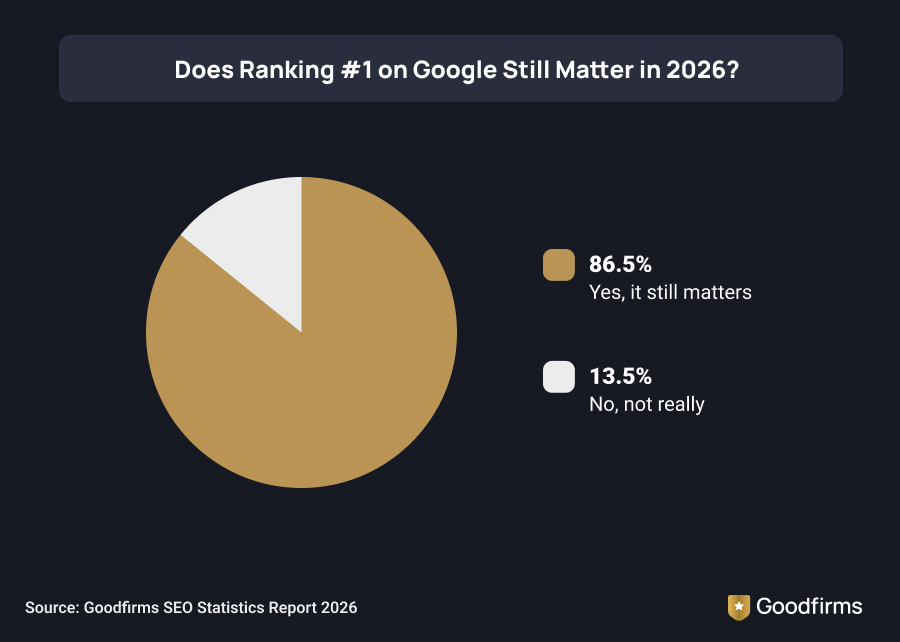
Does Ranking #1 on Google Still Matter in 2026?
|
Response |
% of Respondents |
|---|---|
|
Yes, it still matters |
86.5% |
|
No, not really |
13.5% |
Backlinko's organic CTR research puts the #1 result at roughly 27.6% click-through rate, though this drops sharply when SERP features are present. Ahrefs' click distribution research suggests queries with featured snippets and AI elements can reduce organic CTR by as much as 58%.
The practical implication: the type of content you're investing in matters more than it used to. Informational content that AI can summarise is a harder case to make. Commercial-intent content, where a ranking actually produces a visit, is where organic SEO still generates a clear return.
 |
“TOFU content — something that AI can easily answer — has no chance to perform anymore. Content needs to be focused on something unique and in-depth. Something AI wouldn't dare generate on its own.” — Roman Zelvenschi, Chief Storyteller, RomanZ Media Group, USA |
Key takeaway 02:
In 2026, SEO success depends not just on rankings, but on aligning content with commercial intent, where clicks still happen.
In short, the top organic spot is still valuable, but only for commercial queries. Businesses still investing heavily in informational content may be wasting resources if they haven’t made this distinction.
This naturally leads to a broader question. If users are increasingly interacting with search results without clicking through to websites, what role do SERP features — from AI Overviews to Featured Snippets — actually play in driving visibility and value?
3. AI Overviews & Zero-Click Search: What Happens to Organic Traffic?
Both — and that distinction is what most analytics tools miss. SERP features drive two types of value: trackable direct traffic from Local Pack listings and rich snippets, and unmeasured brand influence from AI Overviews and Featured Snippets. Most analytics platforms only capture the first type, making the second invisible in reporting.
Do SERP Features Drive Organic Traffic?
83.8% of respondents said yes, but 13.5% of marketers aren’t sure these features drive meaningful traffic.
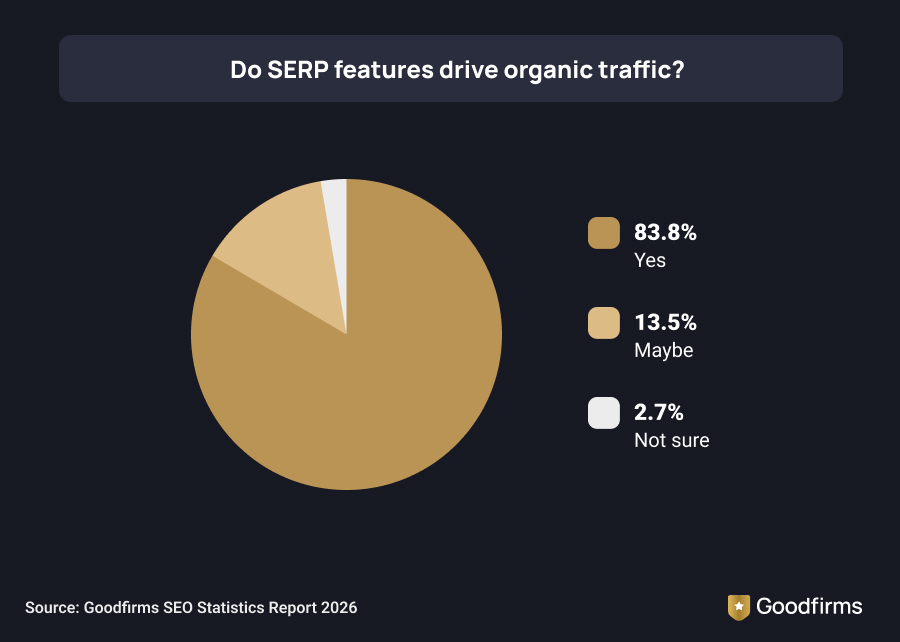
Do SERP Features Boost Organic Traffic or Bury it?
|
Response |
% of Respondents |
|---|---|
|
Yes |
83.8% |
|
Maybe |
13.5% |
|
Not sure |
2.7% |
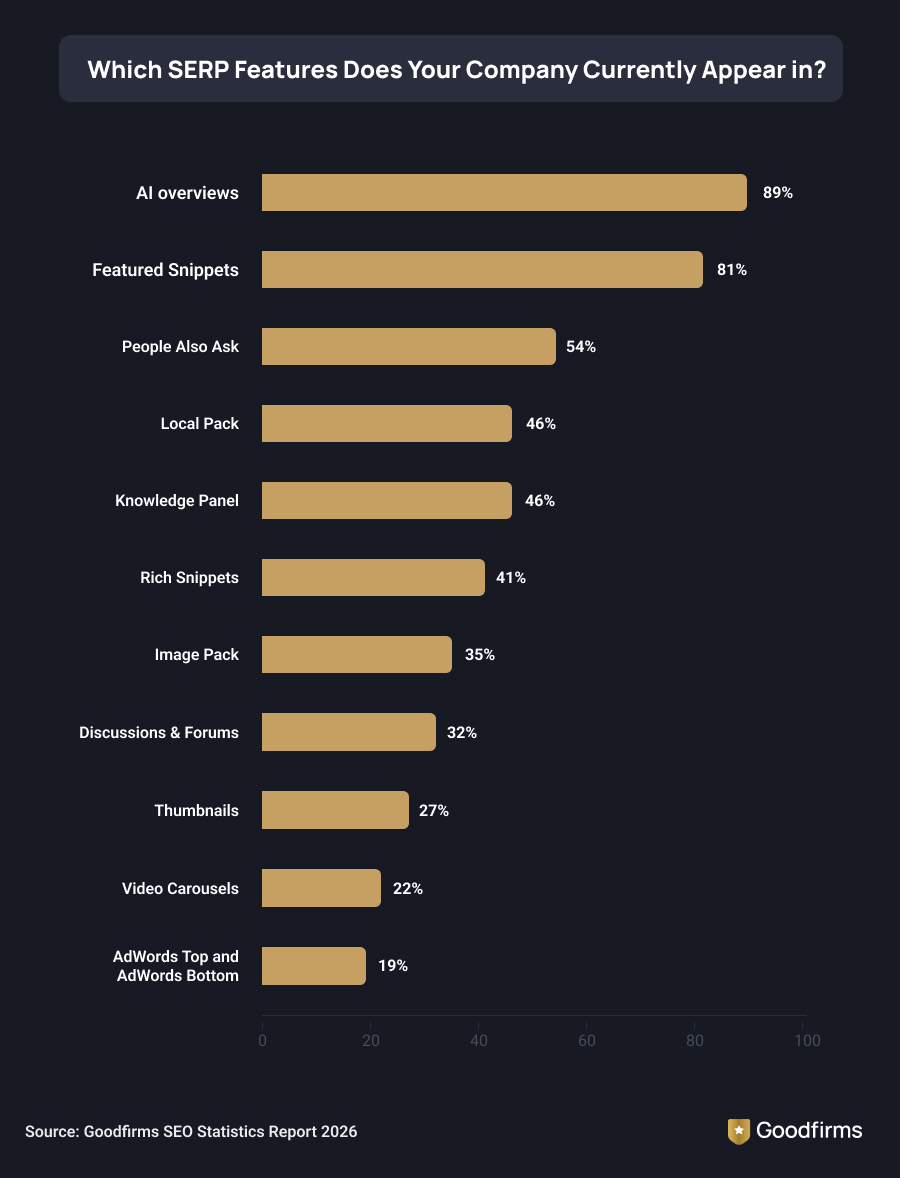
Which SERP Features does your Company Currently Appear in?
| SERP Features | % of Respondents |
|---|---|
| AI overviews | 89% |
| Featured Snippets | 81% |
| People Also Ask | 54% |
| Local Pack | 46% |
| Knowledge Panel | 46% |
| Rich Snippets | 41% |
| Image Pack | 35% |
| Discussions and Forums | 32% |
| Thumbnails | 27% |
| Video Carousels | 22% |
| AdWords Top and AdWords Bottom | 19% |
| Top Stories | 16% |
The real issue: measurement. Analytics platforms mostly track direct visits, not the indirect influence of a brand mention in an AI answer, or someone calling after seeing a Local Pack listing. These interactions matter, but go uncounted.
Some SERP features (like Local Pack and star-rich snippets) drive trackable actions—clicks, calls, directions. Others (like AI Overviews and Featured Snippets) are trickier: tools can report impressions, but not the long-term influence of a brand being cited in an answer that triggers a later search or purchase.
External research supports this gap. SparkToro and Datos confirm that a growing share of search interactions result in no clicks, reinforcing that visibility ≠ traffic.
.jpg) |
"We track SERP visibility across three layers: traditional organic — rankings, impressions, and CTR in GSC, segmented by branded vs. non-branded. Then SERP feature presence. Then LLM visibility: whether our clients are being cited in ChatGPT and Perplexity. Rankings don't tell the full story anymore." — Jonny Nastor, Founder & Head of Strategy, Digital Commerce Partners (Canada) |
Key takeaway 03:
SERP features now deliver two types of value — direct traffic and long-term brand influence through AI citations. Most analytics only capture the former, making much of search impact unmeasured
4. SERP Feature Trends in 2026: How Search Results Are Changing
59% of marketers view Google’s removal or consolidation of SERP features as sensible product simplification, while 24% see it as a neutral trade-off. Only 16% believe the changes point to a broader pattern of reducing opportunities for users to click through to third-party websites.
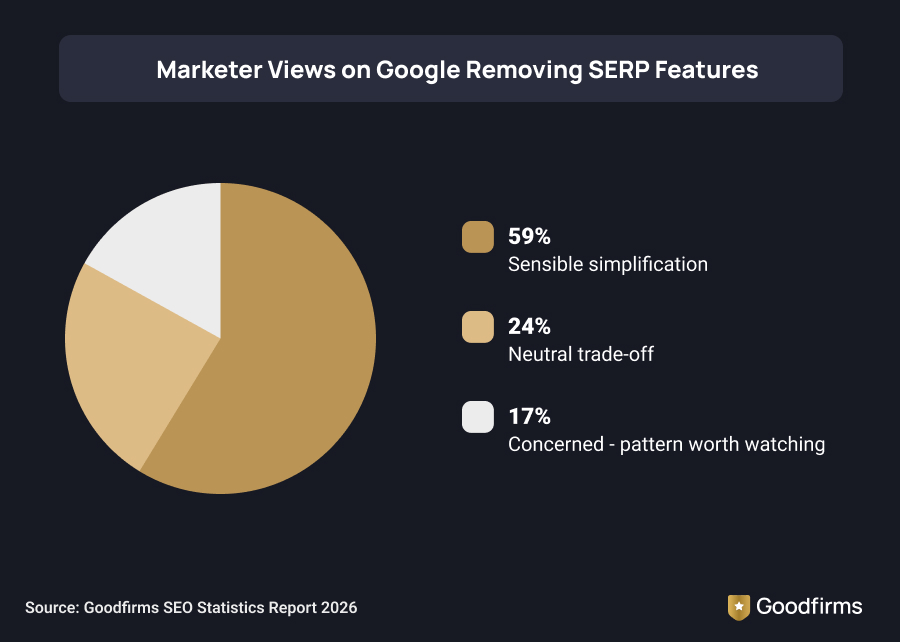
Marketer Views on Google Removing SERP Features
|
Position |
Core view |
% of Respondents |
|---|---|---|
|
Sensible simplification |
Unused features carry maintenance costs without proportional user value. Removing them is standard product housekeeping and ultimately improves the search experience. |
59% |
|
Neutral / trade-off |
The removals are understandable but involve trade-offs — simplicity gained at the cost of flexibility or transparency for some users and publishers. |
24% |
|
Pattern worth worrying |
Viewed across time, features being removed consistently sent traffic to third-party sites. What replaces them keeps users on Google. The cumulative effect on organic referral traffic is real regardless of intent. |
16% |
That means most marketers are not treating disappearing SERP features as an immediate threat. The concern is concentrated among a smaller group that sees a wider shift in how Google keeps users within the search experience. As AI Overviews and other answer-led formats occupy more SERP space, brands may continue to earn visibility without receiving the same level of referral traffic.
For SEO teams, the practical implication is to measure more than rankings and clicks. Visibility across AI answers, SERP features, brand mentions, and citations is becoming part of the search performance picture.
 |
“It is unfortunate for SEO and web traffic, but that's the way Google is heading. AI and social media UX trends are shaping this — Google is just keeping up with the times. Each removal makes it a little harder to get organic clicks.” — Filip Silobod, SEO Manager, Honest Marketing, Ireland |
Key takeaway 04:
This reflects a broader trend in Google search — more user interactions are resolved within the platform, reducing reliance on external websites for answers.
Simply put, don't build your strategy around any single Google feature. The rules — and the playing field — keep changing. Relying on Google to send you traffic and then relying on Google's own tools to measure whether it's working creates a fragile dependency in both directions.
5. AI SEO Challenges in 2026: What Marketers Struggle With Most
Adapting to AI-driven search changes is the #1 challenge for 65% of marketers — and unlike most challenges, it's one nobody can opt out of. Rapid algorithm changes and proving ROI follow closely at 51.4% each, with the ROI measurement problem being the most damaging because it's the one that directly causes budgets to be cut.
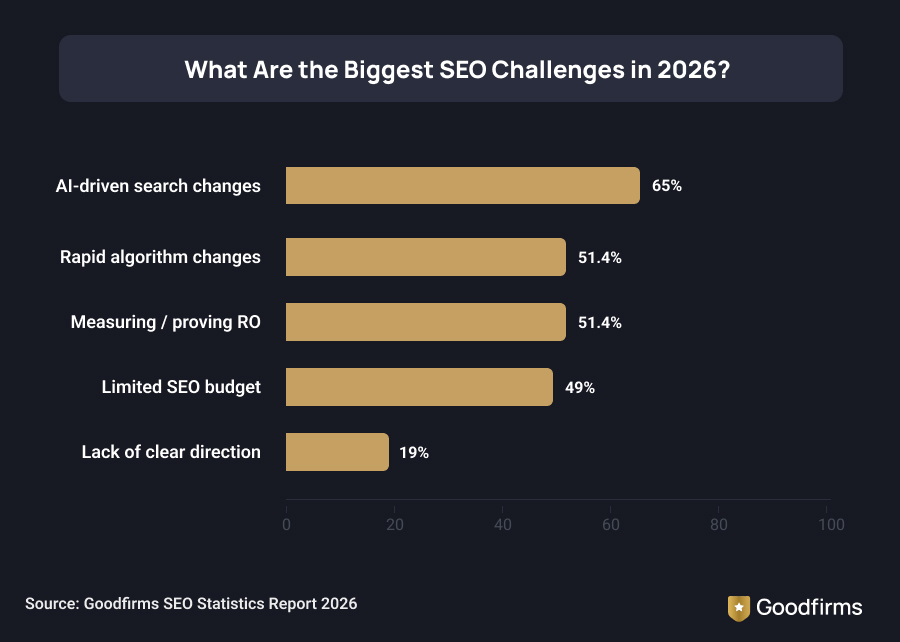
What are the Biggest SEO Challenges in 2026?
|
SEO Challenges |
% of Respondents |
|---|---|
|
AI-driven search changes |
65% |
|
Rapid algorithm changes |
51.4% |
|
Measuring/proving ROI |
51.4% |
|
Limited SEO budget |
49% |
|
Lack of clear direction |
19% |
The top challenge — adapting to AI-driven search at 65% — is the one nobody can opt out of. Every market participant faces it equally. The most telling number is at the bottom: only 19% cited lack of strategic direction. Most practitioners know what they should be doing. The problem is that the ground keeps moving while they're trying to do it.
The ROI measurement problem is the one that does most damage because it doesn't just affect reporting — it affects budgets. The challenge is becoming even more pronounced as businesses invest in AI search optimization. Goodfirms' SEO Pricing Research found that among agencies that increased prices in 2025–2026, 37% cited GEO and AEO services as the primary reason, with AI search optimization often priced separately. As SEO budgets expand to cover AI visibility, proving ROI has become more important than ever.
The old model was clean: organic sessions come in, some convert, you calculate the return. That worked when visibility and traffic were basically the same thing. They're not anymore.
Someone sees your brand cited in an AI answer and searches for you by name three days later — that influence never registers as a session. A phone call from a Local Pack listing, a trust effect from a knowledge panel appearance, a recommendation inside ChatGPT — all of it carries real commercial value, and none of it shows up on a standard dashboard. The ROI looks weaker than it is. And when ROI looks weak, budgets get cut
.jpg) |
"Measuring SERP visibility is definitely a challenge at the moment. For our clients, we are pulling from multiple platforms and helping connect the dots from how searchers are discovering them and ultimately converting." Andrea Schultz, Director of SEO — Sure Oak (USA) |
Key takeaway 05:
The biggest SEO challenge is not ranking—it is proving value. Gartner reports increasing pressure on CMOs to justify ROI. This means expanding your definition of “ROI” to include AI citations, branded search growth, Local Pack actions, and multi-surface visibility will reveal more true value from SEO.
This makes it essential to understand not just what is difficult, but what is working. To that end, we asked respondents to describe the strategies they are actively using to adapt to this evolving search landscape.
6. AI SEO Strategies in 2026: GEO, AEO & Content Optimization
Content quality and search intent are the #1 active strategy in 2026, named by 54% of respondents. AI and LLM optimization — essentially zero as a named discipline a year ago — is now at 43%. The most notable gap: only 19% name brand authority as a strategic priority, despite 81% already practicing backlinks and digital PR as routine.
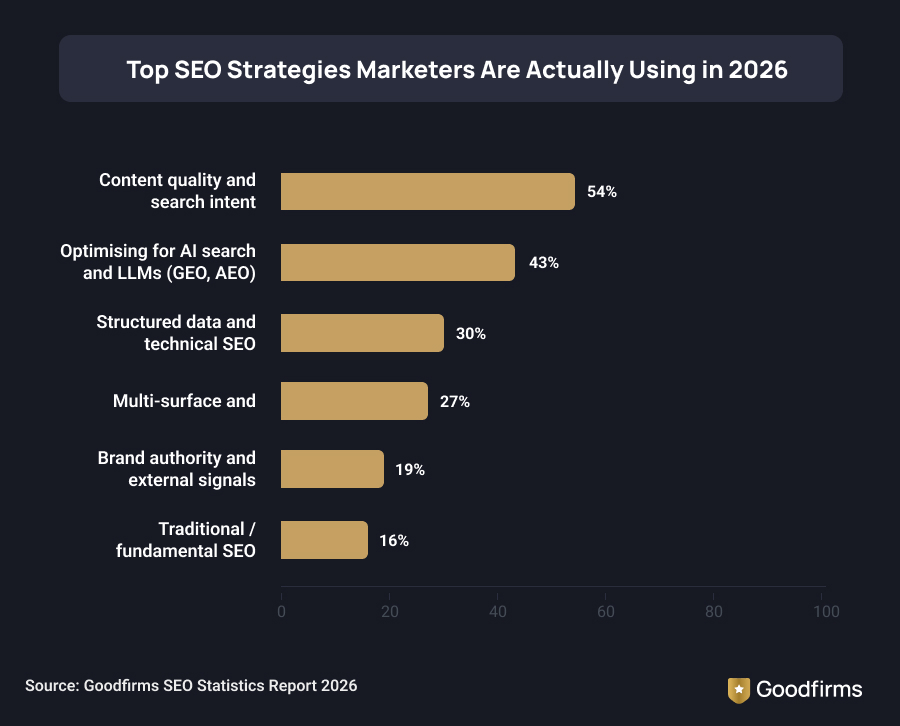
What SEO Strategies are Working in 2026?
|
Strategy Theme |
Core View |
% of Respondents |
|---|---|---|
|
Content quality and search intent |
Creating genuinely useful, intent-matched content — unique, in-depth, and structured so AI systems can parse and cite it. Moving away from generic, easily summarised content toward content that requires real expertise. |
54% |
|
Optimising for AI search and LLMs (GEO, AEO) |
Actively targeting visibility inside ChatGPT, Perplexity, and Google AI Overviews. Implementing llm.txt, structured data, and clear language so AI crawlers can understand and reference the content. |
43% |
|
Structured data and technical SEO |
Clean site architecture, schema markup, entity signals, and strong internal linking — the technical foundations that serve both traditional search and AI retrievability. |
30% |
|
Multi-surface and channel diversification |
Expanding visibility beyond Google organic — Local Pack, featured snippets, video, social discovery feeds, email marketing — so that no single channel carries all the risk. |
27% |
|
Brand authority and external signals |
Building credibility through backlinks, digital PR, podcast appearances, and brand mentions — the external validation signals that AI systems use to decide which brands to trust and cite. |
19% |
|
Traditional / fundamental SEO |
Maintaining the basics — site structure, technical health, keyword research, and on-page optimization — as a stable foundation while adapting tactics around it. |
16% |
Content quality at 54% reflects a shift that's been building for a while, a shift many businesses are addressing by working with content marketing experts to create more authoritative, intent-driven assets.
Keyword-volume content is fading. What's replacing it is content that demonstrates genuine expertise and is structured clearly enough that AI systems want to cite it rather than paraphrase it.
AI and LLM optimization at 43% shows how fast the industry has moved. This represents one of the strongest AI SEO adoption trends in 2026, with marketers increasingly investing in Generative Engine Optimization (GEO) and Answer Engine Optimization (AEO) to improve visibility across AI search platforms. A year ago, most practitioners were still figuring out what GEO and AEO meant. Now they're actively building strategies around them - driving demand for AI-powered search optimization services that go beyond traditional SEO.
But the most interesting number is the gap at the bottom. Only 19% named brand authority as a strategic priority for 2026. Yet 81% already do backlinks and digital PR as regular practice. Most practitioners are doing the work — they've just stopped thinking of it as a strategy. It's become routine. Background noise. That's a problem, because brand authority isn't maintained. It's the primary signal AI systems use when deciding which brands to surface.
 |
"We are treating visibility as a system, not a channel — measuring how content performs across classic SERPs, AI answers, and emerging discovery surfaces." — Chris Lojniewski, CEO, Pagepro · Poland |
Key takeaway 06:
The businesses with the strongest search visibility in 2026 have one thing in common: they have stopped optimizing for individual Google features and started building genuine, compounding authority across their entire brand footprint. Content quality, external credibility, multi-surface presence, and integrated marketing are durable assets. Feature-level tactics will continue to evolve — the underlying authority those tactics build does not.
These strategies reflect the growing importance of AI search optimization (AEO and GEO) alongside traditional SEO fundamentals.
7: E-E-A-T and AI Search: Does Trust Matter More in 2026?
Unambiguously yes — and it matters more than ever. Every single respondent in Goodfirms' 2026 survey agreed that trust and credibility signals are becoming more important as AI systems take on the work of deciding which sources to surface. The shift is structural: trust has stopped being just a ranking factor and is now the primary filter for AI inclusion.
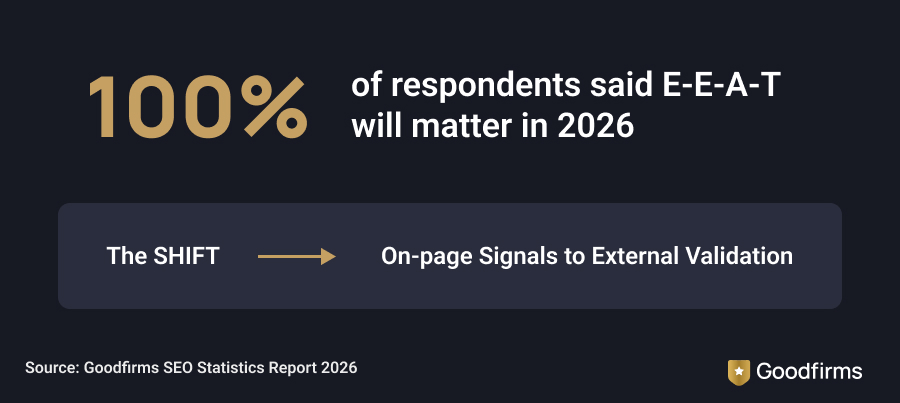
It's rare for a survey question to produce near-unanimous agreement. When it does, it usually means something real is happening. And what's happening here is a genuine shift in how trust functions in search: as AI systems take on more of the work of deciding which sources to surface, trust has stopped being just a ranking factor. It's now the primary filter. If an AI doesn't trust your brand, it simply won't include you in the answer.
Several respondents flagged a misconception that's worth unpacking. Most businesses still treat E-E-A-T as an on-page problem — better author bios, credentials pages, a 'why trust us' section tucked into the footer. It feels like the right response because it's visible and controllable.
But that's not how AI systems evaluate trust. They're not reading your author byline. They're looking across the entire web at how your brand is represented: which credible sources cite you, which authoritative publications mention you, which trusted platforms reference you. It's an aggregate judgment built from signals you don't fully control — and it's a fundamentally different model from anything traditional on-page optimization was designed to address.
If you're only investing in your own website, you're working on the wrong surface
E-E-A-T is often misunderstood. Most people believe it is something you personally control — authorship, author bylines, and having a page that explains why you are an expert. But what actually matters is that other people say you are the expert. Backlinks, brand mentions, podcast appearances, and social presence. You need consensus from others, not yourself.
.jpg) |
"E-E-A-T is misunderstood. It's not about author bylines or explaining why you're an expert. What matters is that others say you are — backlinks, brand mentions, social presence. Consensus from others, not yourself." Jeremy Moser, CEO — uSERP (USA) |
 |
"The big question in AI-driven search is: who is trusted enough to be cited? That's E-E-A-T. The sites that win will have real-world experience, authority backed by mentions and links, and trust through accuracy. The SERP layout changes. Trust doesn't." — Jon Rivers, COO, Marketeery · USA |
Key takeaway 07:
Every respondent agreed that trust matters. The question now is whether day-to-day practices actually reflect that — and the answer, as Finding 08 shows, is more complicated.
8: AI SEO Adoption in 2026: Where Marketers Are Falling Behind
Foundational practices are near-universal. The practices most relevant to AI-driven search — external authority building, plain-language optimization, and personalization — have the lowest adoption rates in the dataset. The gap between what practitioners believe matters and what they're actually doing is widest exactly where it's most consequential.
Finding 06 mapped out what practitioners believe will drive search visibility. Finding 08 asks the harder question: Is any of it actually happening? Not as much as you'd expect.
Local SEO Practices
Local SEO Practices: Best Practices Followed in 2026
|
Local SEO Practice |
Adoption |
|---|---|
|
Optimize Google Business Profile |
92% |
|
Increase online reviews |
84% |
|
NAP citations |
70% |
|
Location-specific landing pages |
62% |
GBP optimization is almost universal at 92%, which lines up neatly with the 46% of respondents showing up in Local Pack results —a strategy commonly implemented by experienced Local SEO Companies. But there's a gap worth pausing on: while 92% have optimized their GBP profile, only 70% are actively managing NAP citations — the consistent name, address, and phone number details that appear across directories. That matters because NAP consistency is what underpins GBP accuracy in the first place. Polishing your profile while letting citations go inconsistent is a bit like repainting the front door while the foundations are cracking.
The other concern is location-specific landing pages, adopted by only 62% of respondents. So a meaningful share of practitioners are putting real effort into their map presence (GBP) without the supporting landing page web content that reinforces it. The listing gets people interested. The landing page is what should be there when they follow through.
Organic Search Practices
Organic Search: Best Practices Followed in 2026
| Organic Search Practices |
Adoption |
|---|---|
|
High-quality, regularly updated content |
97% |
|
Strong technical SEO |
95% |
|
Keyword research & on-page optimization |
92% |
|
Structured site architecture |
86% |
|
Authoritative backlinks and digital PR |
81% |
Content quality and technical SEO are table stakes. The number that stands out is authoritative backlinks and digital PR at 81% — the least adopted organic practice, and the one that matters most right now. Finding 07 established that external validation is the primary signal AI systems use to evaluate brand trust. One in five respondents still isn't actively building it. That's not a minor gap. It's the most consequential one in the data.
Paid Search Practices
Paid Search: Best Practices Followed in 2026
| Paid Search Practices |
Adoption |
|---|---|
|
Precise keyword targeting |
84% |
|
Optimized landing pages |
84% |
|
High-quality ad copy |
76% |
|
A/B testing of ads and creatives |
62% |
|
Ongoing bid strategy optimization |
54% |
The fundamentals are solid. The optimization layer is thin. Only 62% run continuous A/B tests and just 54% actively manage bid strategy — on the channel practitioners most commonly cite as their fastest route to showing returns. The spend is there. The work to make it perform isn't always keeping pace.
Content Optimization Practices
Content Optimization: Best Practices Followed in 2026
| Content Optimization Practices |
Adoption |
|---|---|
|
Search intent-led content |
95% |
|
Natural keyword optimization |
95% |
|
Internal linking for topical authority |
92% |
|
Structured formatting |
89% |
|
Refreshing and updating older content |
84% |
|
Plain, simple language |
70% |
Content practices are broadly strong. The gap is 70% in plain language. There's an irony worth naming: the dense, authoritative writing that signals expertise to a human reader is often exactly what AI will paraphrase rather than cite directly — it gets processed and flattened. Simpler writing gets quoted. Plain language has shifted from a readability preference into something closer to a visibility requirement.
User Experience Practices
User Experience: Best Practices Followed in 2026
| User Experience Practices |
Adoption |
|---|---|
|
Fast page load times |
92% |
|
Clean, intuitive navigation |
89% |
|
Clear CTAs and consistent layouts |
86% |
|
Mobile-first, responsive design |
81% |
|
Readable typography and accessible design |
76% |
|
Personalisation features |
43% |
Personalization at 43% is the single lowest-adopted practice across all five categories. AI-driven search is moving toward delivering results based on individual user context — what someone has searched before, where they are, and what they're likely to want next. Platforms without personalization aren't just offering a less tailored experience. They're also sending weaker relevance signals to the systems that decide who gets surfaced. The industry is moving in one direction. The majority of practitioners haven't followed yet.
Key takeaway 8:
The fundamentals of search — content quality, technical health, page speed — are near-universally adopted. The practices least adopted are precisely those most relevant to AI-driven search in 2026: external authority building, plain-language optimization, and personalization. The data highlights one of the biggest challenges in modern SEO: the gap between what practitioners believe matters (Findings 06 and 07) and what they are actually doing is wide, exactly where it is most consequential.
Taken together, these findings reveal a consistent pattern. The practices that matter most in the current search environment — external authority building, AI visibility, plain-language content, and personalization — are widely recognized, but unevenly implemented.
The result is a measurable gap between understanding and execution — and it is within this gap that the greatest opportunity for competitive advantage now exists.
9. AI SEO Measurement: How Marketers Track AI Visibility and LLM Citations
Google Search Console and third-party tools dominate measurement stacks — but both are built for a search environment that has fundamentally shifted. Only 14% of respondents track AI and LLM citation visibility, despite 43% naming AI optimization as a core 2026 strategy. The gap between AI SEO adoption and AI SEO measurement remains significant, highlighting the need for better AI citation tracking and visibility monitoring tools.
SEO Measurement Tools
|
SEO Measurement Tools |
Adoption |
|---|---|
|
Google Search Console |
70% |
|
Third-party tools (Semrush, Ahrefs, etc.) |
65% |
|
Website analytics (GA/GA4) |
32% |
|
SERP feature presence tracking |
22% |
|
Keyword rankings as primary metric |
16% |
|
AI/LLM citation visibility |
14% |
|
Branded search/share of voice |
11% |
Google Search Console at 70% and third-party tools at 65% are reliable, well-established, and built for a search environment that has fundamentally shifted. For most practitioners, they form the backbone of how performance gets reported — and that's precisely the problem.
Only 14% are tracking AI and LLM citation visibility using tools like Otterly.ai, Promptmonitor, or Peec AI. Set that against the 43% in Finding 06 who named AI optimization as a core 2026 strategy. The ambition to appear in AI-generated answers is there. The infrastructure to know whether it's actually happening, largely isn't.
Only 11% monitor branded search volume or share of voice — and this matters more than it might appear. When someone sees your brand cited in an AI answer and searches for you by name a few days later, it won't appear in your referral data. But it might show up as a lift in branded searches. Most practitioners are missing the one signal that could at least partially illuminate what they're otherwise blind to.
This isn't a tooling problem. The tools exist, and they're accessible. It's an awareness problem — and until the measurement stack catches up with the strategy, it's genuinely difficult to know what's working.
 |
"We combine SE Ranking, Pro Rank Tracker, GSC, and GA4 for traditional visibility — then layer in Prompt Monitor and Peec AI for LLM visibility, because that's where a growing share of first-touch discovery now happens." — Ela Galanxhi, Marketing Lead, Scopic · USA |
Key takeaway 9:
Most practitioners measure SEO with well-established tools — Google Search Console and third-party platforms. Only 14% are tracking AI citation visibility, and only 11% monitor branded search or share of voice. The measurement gap that results from underinvestment in search is not a data availability problem — it is a measurement scope problem. The tools to close it exist; most practitioners have not yet added them to their reporting stack.
The Goodfirms Model: Three Layers of Search Visibility in 2026
Layer 01: Traditional rankings
Your position in organic results. Still critical for high-intent, commercial queries. Well-measured by existing tools.
Layer 02: SERP feature presence
Visibility across AI Overviews, featured snippets, People Also Ask, and Local Packs drives value — including brand trust and downstream search behavior — even without a direct click.
Layer 03: AI citation visibility
Whether your content is referenced in AI-generated answers, used in summaries, or surfaced inside tools like ChatGPT and Perplexity, without a search ever taking place. The fastest-growing layer. The least measured.
Insight: Brands no longer compete for rankings—they compete for presence across all three layers. For a full breakdown of how this affects referral traffic measurement, see SERP Visibility: Why Rankings No Longer Drive Organic Traffic.
How to Rank in Google in 2026 (New SEO Playbook)
Every finding in this report points toward the same pattern: the practices that matter most in 2026 are the ones with the lowest adoption rates. The knowing-doing gap is widest exactly where it's most consequential. These nine actions are the most direct path to closing it.
|
01. Audit your content portfolio by intent type. |
Shift investment toward commercial-intent content where organic rankings still drive measurable traffic. Pull back from informational content where AI is most likely to answer first — and your click never comes. |
|
02. Expand your measurement framework before drawing ROI conclusions. |
Add branded search volume growth, Local Pack interaction tracking, AI citation frequency — via Otterly.ai, Promptmonitor, or Peec AI — and multi-surface impression share alongside your existing session data. |
|
03. Optimize key content for AI retrievability. |
Clear headings, plain language, direct answers to specific questions, and clean, structured data markup. Only 70% currently prioritize plain language. In 2026, it's a prerequisite for AI citations—not just a readability nicety. |
|
04. Treat external authority building as core infrastructure, not background maintenance. |
Editorial mentions, authoritative backlinks, podcast appearances, verified reviews — these are the primary signals AI systems use when deciding which brands to trust. One in five respondents still isn't actively building them. |
|
05. Stop building your visibility strategy around any single Google feature. |
Diversify deliberately — email, social, direct, and partner channels all reduce the concentration risk that every Google product cycle compounds. Features come and go. Authority compounds. |
|
06. Start tracking AI citation visibility now. |
Monitor whether your brand is being referenced inside ChatGPT, Perplexity, and Google's AI Overviews. A growing share of first-touch discovery is happening in these spaces. Only 14% of respondents are currently measuring it. |
|
07. Close the knowing-doing gap on the three practices that matter most. |
Personalization at 43% adoption. Plain language at 70%. External authority building is at 81%. These aren't fringe tactics — they're what 2026 search rewards most, and they're the three areas where belief most outpaces implementation. |
|
08. Expand your measurement stack beyond GSC and third-party ranking tools. |
Add AI citation tracking. Monitor branded search volume as a proxy for upstream AI influence. Most businesses are faithfully measuring yesterday's surfaces while trying to win on tomorrow's. |
|
09. Reframe what search visibility means in your internal reporting. |
If your stakeholder reporting only shows ranking positions and organic sessions, it's telling an incomplete story — and that incomplete story is what gets SEO budgets cut. Presence in AI Overviews, featured snippets, Local Pack, and multi-format surfaces belongs in the conversation. |
Beyond Goodfirms: 35+ AI SEO Statistics at a Glance
Beyond Goodfirms' first-party research, here is what the broader industry data shows — drawn from Ahrefs, SparkToro, Semrush, Pew Research, BrightEdge, and others.
1. Zero-Click Search & AI Overviews Statistics
| Key Statistic | Source |
|---|---|
| 58.5% of US Google searches end without a click — only 360 out of every 1,000 searches result in a click to the open web. On mobile, the zero-click rate climbs to 77%. | SparkToro, 2024 |
| 83% of searches that trigger AI Overviews end without a click | Similarweb, 2025 |
| 93% of searches in Google's AI Mode end without a click. | Semrush, 2025 |
| Only 1% of users click on links inside an AI Overview. | Pew Research Center, 2025 |
| AI Overviews peaking at nearly 25% in July 2025, then declining to 15.69% by November 2025 | Semrush, 2025 |
| 26% of searches with AI Overviews ended with users abandoning their session entirely, versus 16% on traditional results pages. | Pew Research Center, 2025 |
2. AI Search Ranking & CTR Statistics
| Key Statistic | Source |
|---|---|
| 58% reduction in clicks on the #1 organic result when an AI Overview is present — up from 34.5% in April 2025 | Ahrefs, December 2025 |
| When an AI Overview is present, only 8% of users click a traditional result, versus 15% without one. | Pew Research Center, July 2025 |
| The top three organic results receive 68.7% of all clicks; positions 4–10 share the remaining 31.3%. | SE Ranking, 2024 |
| Moving from position #2 to #1 generates a 74.5% increase in clicks. | Backlinko |
| 94% of all web pages receive zero traffic from Google. | Ahrefs |
| Brands cited in AI Overviews earn 35% more organic clicks (0.70% vs 0.52% CTR) and 91% more paid clicks. | Seer Interactive, September 2025 |
3. AI Citation & AI Visibility Statistics
| Key Statistic | Source |
|---|---|
| Brands are 6.5x more likely to be cited in AI answers through third-party sources than through their own domains. | Airops, 2025 |
| 44.2% of all LLM citations come from the first 30% of an article — the intro. Only 24.7% come from the conclusion. | Growth Memo, 2026 |
| 38% of AI Overview citations came from top-10 pages, down from 76% in mid-2025 | Ahrefs, 2026 |
| Distributing content to a wide range of publications can increase AI citations by up to 325% compared to publishing on your own site alone. | Stacker, 2025 (content distribution agency, self-published report) |
| Only 7.2% of domains appear in both Google AI Overviews and LLM results — the two surfaces cite very different sources. | Search Engine Land, 2025 |
4. AI Content & Search Behavior Statistics
| Key Statistic | Source |
|---|---|
| 74.2% of new webpages now contain AI-generated content in some form. | Ahrefs, 2025 |
| There is less than a 1 in 100 chance that ChatGPT will surface the same list of brands across 100 identical queries. | SparkToro January 2026 |
| 80% of consumers rely on AI-powered summaries to answer at least 40% of their searches without clicking anywhere. | Bain & Company, December 2024 |
| AI-referred traffic converts at 4.4x the rate of traditional organic search in some analyses. | Semrush, 2025 |
5. AI Search Platform & Market Share Statistics
| Key Statistic | Source |
|---|---|
| ChatGPT reached 900 million weekly active users in February 2026, up from 400 million in February 2025. | TechCrunch, February 2026 |
| AI search traffic share: ChatGPT 64.6%, Gemini 22.0%, Grok 3.5%, DeepSeek 3.3%, Claude 2.1%, Perplexity 1.9%, Copilot 1.1%. | Similarweb, January 2026 |
| Google AI Mode has reached 75 million daily active users and over 100 million monthly active users — a 4x increase since its May 2025 launch. | Digital Applied, early 2026 |
| Perplexity reached 45 million active users in H2 2025, with $148M ARR and 370% year-over-year growth. | Business of Apps, 2026 |
| Over 30% of all referral traffic from ChatGPT goes to just 10 domains — and over 20% of ChatGPT referral traffic goes to Google. | Semrush, April 2026 |
| 93.7% of ChatGPT searches are informational — only 0.1% are transactional. | Rosemont Media, 2025 |
6. GEO & Content Optimization for AI
| Key Statistic | Source |
|---|---|
| GEO-style content changes increased visibility in generative engine responses by up to 40% in controlled testing. | Arxiv |
| Branded web mentions have the strongest correlation (0.664) with AI Overview appearances — significantly higher than backlinks (0.218). | Ahrefs, 2026 |
| Comparison pages with 3 tables earn 25.7% more ChatGPT citations. Shortlist pages averaging 10 or fewer words per sentence earn 18.8% more citations. | AirOps, April 2026 |
| Content with 5–7 statistics earns a 20% higher AI citation likelihood — early-discovery, data-grounded content performs best | AirOps, April 2026 |
| ChatGPT is more likely to cite content that uses definite (not vague) language, contains a question mark, has high entity density, and uses simple writing structures. | Growth Memo, February 2026 |
7. Advertising & Revenue Impact
| Key Statistic | Source |
|---|---|
| Google Ads appearing alongside AI Overviews grew from 5.17% to 25.56% of AI Overview searches in eight months — a 394% increase. | Semrush, October 2025 |
| AI search ad spend is projected to grow from 1.3% of total search ad spend in 2026 to 13.6% by 2029. | Emarketer, 2026 |
| Google Q4 2025 search revenue reached $63 billion — up 17% year-over-year — suggesting AI features are expanding the advertising surface area rather than shrinking it. | Google / Alphabet, Q4 2025 Earnings |
FAQS - AI SEO in 2026
1. What are the top SEO trends in 2026?
The top SEO trends in 2026 are: zero-click search (nearly 60% of Google searches end without a click), AI Overviews appearing in 89% of brand search results, growing importance of E-E-A-T as a trust filter for AI systems, the shift from ranking position to multi-surface visibility, and the rise of Generative Engine Optimisation (GEO) and Answer Engine Optimisation (AEO) as distinct disciplines. According to Goodfirms' 2026 survey of 100+ digital marketing practitioners across 20+ countries, 65% of marketers cite AI-driven search changes as their single biggest challenge this year.
2. Does ranking #1 on Google still matter in 2026?
Yes, but only for the right type of query. For commercial and transactional searches — where a user wants to compare providers, request a quote, or make a purchase — the #1 organic position still drives significant click-through. For informational queries, Google's AI Overviews now answer the question before users reach organic results. Ahrefs (December 2025) reports that AI Overviews reduce organic CTR for position one by up to 58%. Goodfirms' 2026 survey found 86.5% of marketers say ranking #1 still matters — but consistently qualify this as relevant primarily for commercial-intent content.
3. What is zero-click search, and why does it matter for SEO?
Zero-click search refers to a Google search session that ends without the user clicking through to any external website — the answer is resolved directly on the search results page through AI Overviews, featured snippets, or knowledge panels. According to SparkToro's 2024 zero-click search study, 58.5% of US Google searches end without a click. For SEO, this matters because visibility and traffic are no longer the same metric — a brand can appear prominently in search results while receiving no referral traffic from that appearance.
4. What is GEO (Generative Engine Optimization) in SEO?
Generative Engine Optimization (GEO) is the practice of optimizing content so that it is cited, referenced, or summarised by AI-powered answer engines such as ChatGPT, Perplexity, and Google's AI Overviews. Unlike traditional SEO, which targets position in a ranked list of links, GEO targets inclusion in AI-generated answers — a form of visibility that may produce no direct click but significantly influences brand trust and downstream search behavior. Goodfirms' 2026 survey found 43% of marketers are actively implementing GEO strategies, up from near zero in 2025.
5. How is E-E-A-T evaluated by AI systems?
Experience, Expertise, Authoritativeness, and Trustworthiness (E-E-A-T) is evaluated by AI systems not through on-page signals like author bios or credentials pages, but through off-site validation: which authoritative publications mention or link to your brand, which trusted third-party platforms reference you, and what the broader web consensus is about your credibility. This is a fundamental difference from traditional on-page SEO. Every respondent in Goodfirms' 2026 survey agreed that E-E-A-T is becoming more important — and the practitioners who flagged it most strongly were those building backlink profiles and digital PR as primary trust signals.
6. What tools track AI and LLM citation visibility?
The primary tools for tracking whether your brand is cited in AI-generated answers include Otterly.ai, Promptmonitor, and Peec AI. These tools monitor brand mentions inside ChatGPT, Perplexity, and Google AI Overviews — surfaces that traditional tools like Google Search Console and Semrush do not track. Goodfirms' 2026 survey found only 14% of marketers currently use AI citation tracking, despite 43% naming AI search optimization as a core 2026 strategy. This represents the largest measurement gap in the current SEO landscape.
7. Why are SEO budgets being cut in 2026?
SEO budgets are being cut primarily because of the ROI measurement problem: when search visibility is hard to prove, it starts to look like it isn't working. Traditional analytics platforms track direct sessions and conversions, but do not capture the indirect influence of a brand mention in an AI answer or a phone call from a Local Pack listing. Goodfirms' 2026 survey found 51.4% of marketers cite measuring and proving ROI as a top challenge. Gartner's 2025 CMO Spend Survey confirms the broader pressure: 59% of CMOs report insufficient budget to execute their strategy.
8. Is SEO dead in 2026?
No, but the definition of SEO has fundamentally changed. Traditional SEO (ranking a page in the blue links list) is declining in value for informational queries, where AI Overviews now resolve searches without a click. However, SEO as a broader discipline — building brand authority, earning AI citations, appearing in SERP features, and maintaining technical quality — is more important than ever. The SEO industry itself is projected to grow from $82.3 billion in 2023 to $143.9 billion by 2030. The practitioners who are struggling are those who still define SEO purely as keyword ranking. Those who have expanded their definition to include AI visibility and multi-surface presence are finding more opportunities, not fewer.
9. How do I get my brand cited in ChatGPT and AI Overviews?
The most reliable signals for AI citation are external brand mentions (correlation of 0.664 with AI Overview appearances, per Ahrefs 2026), domain authority (sites with over 32,000 referring domains are 3.5x more likely to be cited by ChatGPT), and content structure. Specific content practices that increase citation rates include: leading articles with clear, direct definitions; using 5–7 data points per piece; writing in plain language with short sentences; and using comparison tables. Distributing content through third-party publications matters too — brands are 6.5x more likely to be cited in AI answers through third-party sources than through their own domains, per Airops (2025). Profiles on Trustpilot, G2, and Capterra also increase citation likelihood by approximately 3x.
10. What percentage of Google searches are zero-click in 2026?
As of the latest available data, approximately 58.5% of US Google searches end without a click to an external website, according to SparkToro (2024). On mobile, this rises to 77%. Among searches that specifically trigger AI Overviews, Similarweb (2025) reports that 83% end without a click. For searches in Google's newer AI Mode, Semrush (2025) puts the zero-click rate at 93%. The practical implication: for every 1,000 Google searches, roughly 360 result in a click to the open web. SEO strategy must account for this reality — visibility and traffic are no longer equivalent.
11. How do I measure AI search visibility?
Start by adding three tools to your measurement stack alongside Google Search Console: Otterly.ai, Promptmonitor, or Peec AI for direct AI citation monitoring; a branded search volume tracker in GSC to catch downstream searches triggered by AI mentions; and Local Pack interaction tracking if you have physical locations. Then expand your reporting framework to include AI Overview impression share, featured snippet presence, and share of voice in People Also Ask results. Goodfirms' 2026 survey found only 14% of marketers currently do this — meaning most businesses are flying blind on the fastest-growing search surface. Setting up even basic AI citation monitoring now puts you ahead of 86% of your competitors.
12. What is the difference between GEO and AEO?
Generative Engine Optimization (GEO) focuses on getting content cited or referenced inside AI-generated responses from tools like ChatGPT, Perplexity, and Google's AI Overviews. Answer Engine Optimization (AEO) is the practice of structuring content to directly answer specific questions — particularly the kind that trigger featured snippets and People Also Ask results in traditional search. In practice, the two approaches overlap significantly: plain language, direct answers, structured data, and credible sourcing improve performance on both surfaces. The key difference is that GEO requires building external brand authority (mentions, backlinks, reviews) as a signal to AI systems, while AEO is more focused on on-page structure and query matching.
Methodology
This report is based on a structured survey conducted by Goodfirms between January and February 2026. Responses were collected from 100+ verified marketing professionals across 20+ countries, all active practitioners in SEO or digital marketing. Respondents were self-selected and represent a range of company sizes (1–500 employees), market focuses (local, national, and global), and geographic regions, including the United States, India, Canada, Australia, Poland, Spain, Italy, Croatia, Portugal, Ireland, Argentina, Malaysia, Nepal, UAE, Pakistan, Israel, and Bangladesh.
As a self-selected sample of engaged practitioners, findings should be read as directional rather than statistically representative of the broader industry.
Qualitative responses have been lightly edited for clarity and grammar only — never for substance. Percentage figures for single-select questions reflect the proportion of respondents choosing each option. Multi-select question figures reflect the proportion of respondents selecting each option and will not total 100%. All figures have been rounded to the nearest whole number. Three respondents whose answers consisted only of URLs, single words, or 'not sure' were not quoted in this report but are included in all quantitative figures.
References
- Ahrefs. (2025). AI Overviews and organic click-through rates.
- Ahrefs. (2026). AI Overview citation sources and branded mention correlation.
- AirOps. (2025). AI citation likelihood and third-party sourcing.
- AirOps. (2026, April). Structured content and ChatGPT citation rates.
- Bain & Company. (2024, December). Goodbye Clicks, Hello AI: Zero-Click Search Redefines Marketing
- Backlinko. (2024). Google organic CTR benchmarks.
- Business of Apps. (2026). Perplexity AI user and revenue statistics.
- Digital Applied. (2026). Google AI Mode user growth.
- Emarketer. (2026). AI search advertising spend projections 2026–2029.
- Google/Alphabet. (2025, Q4). Q4 2025 earnings report.
- Growth Memo. (2026, February). ChatGPT citation language patterns.
- Growth Memo. (2026). LLM citation location within articles.
- Pew Research Center. (2025, July). AI Overviews and user click behaviour.
- Rosemont Media. (2025). ChatGPT search intent distribution.
- SE Ranking. (2024). Organic click distribution by ranking position.
- Search Engine Land. (2025). Domain overlap between Google AI Overviews and LLM results.
- Seer Interactive. (2025, September). AI Overview citations and organic paid click uplift.
- Semrush. (2025). AI Overview frequency and AI Mode user data.
- Semrush. (2025, October). Google Ads alongside AI Overviews.
- Semrush. (2025). AI-referred traffic conversion rates.
- Semrush. (2026, April). ChatGPT referral traffic concentration.
- Similarweb. (2025). Zero-click rates for AI Overview queries.
- Similarweb. (2026, January). AI search platform traffic share.
- SparkToro. (2024). Zero-click search study: US Google searches.
- SparkToro. (2026, January). ChatGPT brand surfacing consistency.
- TechCrunch. (2026, February). ChatGPT weekly active user growth.
- US Department of Justice. (2023–2024). United States v. Google LLC — antitrust proceedings.
- Gartner. (2025). CMO Spend and Strategy Survey.