Key takeaways
- Ranking #1 no longer guarantees traffic — zero-click searches now dominate.
- SERP visibility in 2026 = rankings + SERP features + AI citations, not clicks alone.
- 89% of brands appear in AI Overviews — multi-surface presence is now the baseline.
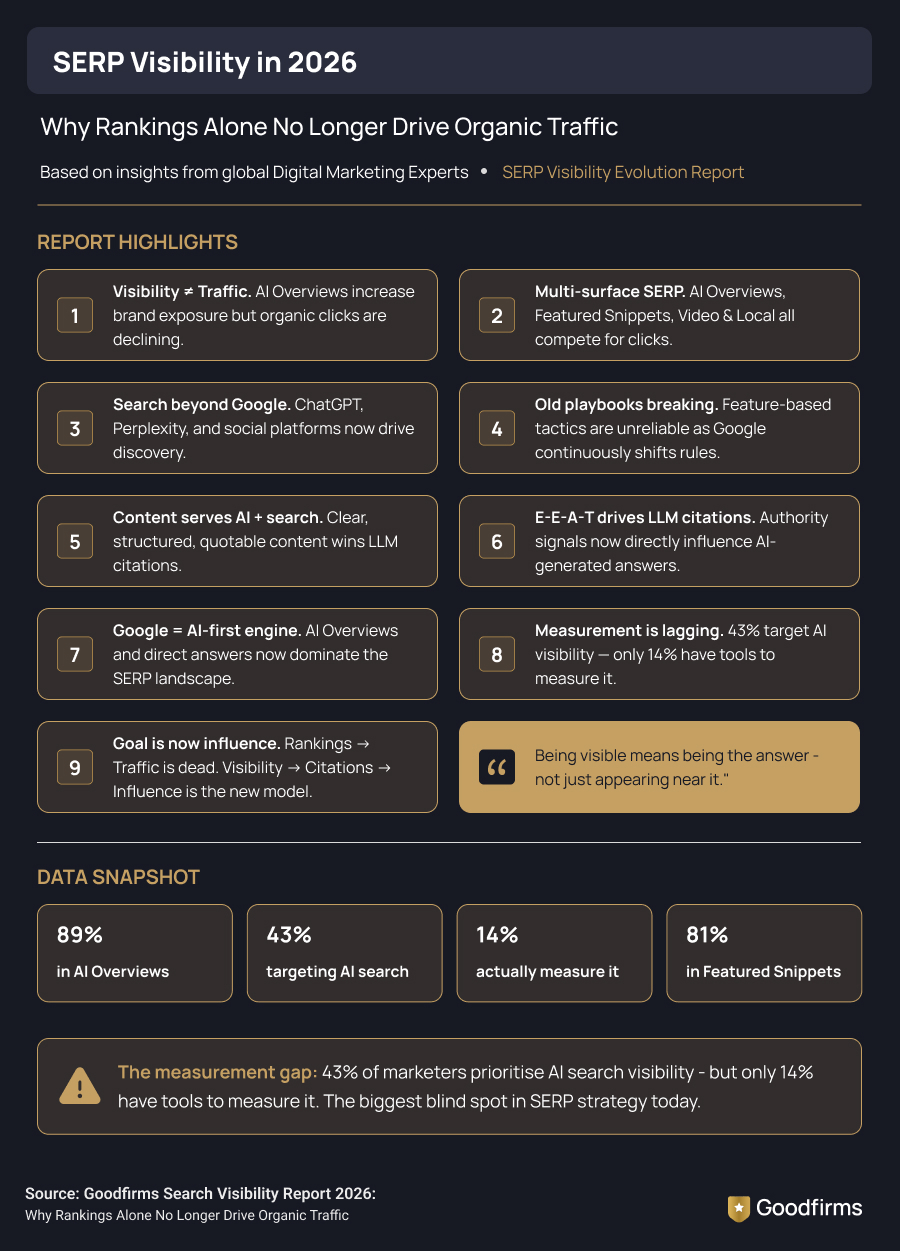
- 43% of marketers target AI visibility; only 14% measure it. That gap is the opportunity.
- Content must be structured to rank and be cited — clarity is now a competitive advantage.
- E-E-A-T across the whole web — not just on-page — drives LLM citation decisions.
- Google is shifting from a search engine to an answer engine. Optimize for both.
- Commercial-intent content still drives clicks. Informational content drives citations.
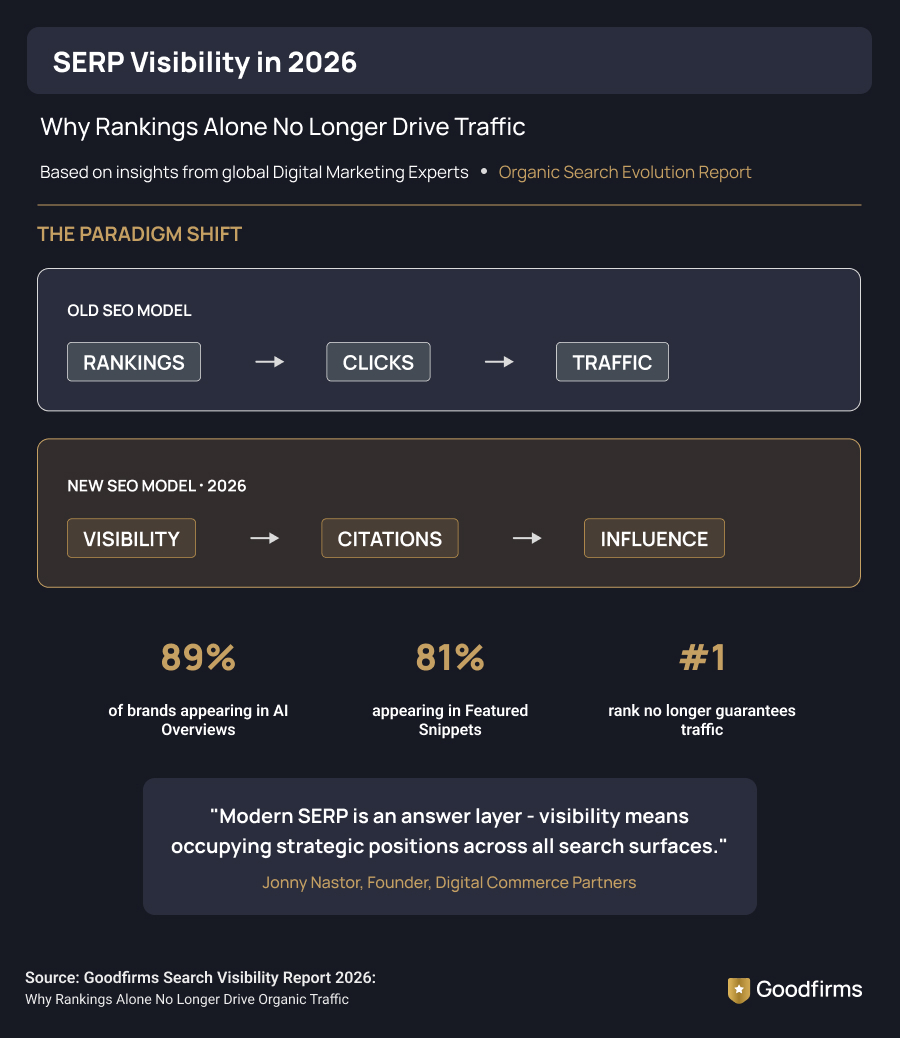
- The new SEO model: Visibility → Citations → Influence — not Rankings → Clicks → Traffic.
SERP visibility has become one of the most misunderstood SEO metrics in the AI search era. Based on Goodfirms' 2026 research involving verified SEO professionals across 20+ countries, this report examines why rankings alone no longer determine search performance. It analyzes how AI Overviews, zero-click searches, LLM citations, and evolving SERP features are reshaping organic visibility—and what businesses should measure instead.
What Is SERP Visibility?
SERP visibility (Search Engine Results Page Visibility) is an SEO metric that measures how visible a website is across Google's search results for its target keywords. Traditionally, SERP visibility has been measured using keyword rankings, search volume, and estimated click-through rates (CTR). In 2026, however, SERP visibility extends beyond organic rankings to include AI Overviews, Featured Snippets, AI citations, and other search experiences.
In this research, SERP visibility refers to a brand's presence across traditional organic search, AI-generated search experiences, and other SERP features that influence discovery, even when they don't generate website clicks.
What actually influences SERP visibility today:
- Keyword rankings
- AI citations
- Featured Snippets
- Brand authority
- Search intent alignment
- E-E-A-T signals
Traditionally, SERP visibility was driven primarily by keyword rankings and click-through rates. Today, search visibility is influenced by a broader combination of AI-generated search experiences, SERP features, brand authority, and content quality.
Why Ranking #1 on Google No Longer Guarantees Traffic
Something quietly changed in search. A page can sit at the very top of Google's results, appear inside an AI-generated answer, and still pull fewer clicks than it would have three years ago. Not because it failed — but because SERP looks different now.
Search visibility has expanded beyond the familiar row of blue links. AI Overviews, Featured Snippets, local packs, video carousels, shopping results, and LLM-generated answers now capture a growing share of user attention directly within the search results. In many cases, someone types a question, reads the answer, and leaves — without ever landing on your website.
For brands, this creates a strange new dynamic: search visibility is rising while organic traffic — especially from informational queries — is quietly shrinking. These aren't contradictory trends. They're two sides of the same shift.
The Shift Traditional SEO Didn't Prepare Us For
Old-school SEO had a clean feedback loop: rank higher, get more clicks, drive more traffic. The logic was linear. The metrics told a clear story.
That loop has been interrupted.
| Traditional SEO | SERP Visibility SEO |
|---|---|
| Rankings | Multi-surface presence |
| Clicks | Citations |
| Traffic | Visibility |
| Blue links | AI Overviews + snippets |
| Sessions | Brand exposure |
Rankings still matter — but they're no longer the finish line. They're one layer inside a broader visibility ecosystem where AI retrieval, citations, and multi-surface brand presence increasingly shape how people discover content, even when they never click through.
What This Means for SEO Teams
The harder question now isn't "how do we rank?" It's "what are we actually optimizing for?"
Are you building content designed to drive clicks? Earn AI citations? Establish brand presence? Influence buying decisions before someone ever reaches your website?
Those are genuinely different strategies — and most reporting systems weren't built to tell them apart.
Getting clear on that distinction is, arguably, the most important thing an SEO team can do in 2026.
For the full quantitative data behind these findings — including survey insights, CTR patterns, and SERP feature distribution — refer to the Goodfirms AI SEO Statistics Report 2026.
The Three Signals That Now Define SERP Visibility: Traffic, Rankings, and Citations
SERP visibility is no longer a function of ranking position alone. It is distributed across multiple surfaces within the search results.
Clicks and traffic are declining for informational queries. AI-generated answers are resolving user intent directly in the SERP, often before the user has any reason to visit a site.
Rankings and position still matter — but their role has shifted. They improve eligibility and discovery, not outcomes. You do not need to rank at the top to be cited, but you do need to be retrievable. Being ranked does not guarantee you will be cited, and being cited does not guarantee you will be visited.
Visibility and brand presence are actually increasing, driven by AI Overviews, Featured Snippets, and LLM-generated answers — even when no click follows. In many cases, brands are being seen, referenced, and trusted without ever registering a session.
The practical question for any SEO practitioner right now is not whether to chase rankings. It is which of these three outcomes their content strategy is designed to deliver — traffic, citations, or visibility — and whether their measurement system can actually distinguish between them.
Find, compare, and hire SEO experts who understand AI search, zero-click trends, and real ROI.
Finding 1: Organic Traffic Is Falling. Brand Visibility Is Growing. Both Are True
The instinct when organic traffic drops is to look for something that broke — a penalty, a technical issue, a ranking change. For many businesses in 2026, particularly in B2B, there is nothing broken. The traffic is simply being absorbed by the SERP itself.
AI Overviews now resolve a significant share of informational queries before the user leaves Google. A user asking how something works, what a term means, or which option is better for a general use case often receives a complete enough answer to close the tab. No click. No session. No conversion — but potentially a brand impression, if the source is cited.
Andrew Shum, Head of SEO at SeoProfy, put it plainly: "AI Overviews don't drive nearly as much traffic compared to what's been lost."
That loss is not evenly distributed. Commercial-intent queries — comparisons, pricing, service-specific searches — still produce clicks, because the user must visit a site to complete their intent. Informational content is where the gap is widest.
"Commercial intent queries still drive the highest clicks," said Jeremy Moser, CEO of uSERP. "In 2026, that's where organic ROI comes from."
This has a direct implication for content investment that most editorial strategies have not yet caught up with. Informational content still has value — it drives AI citations and builds topical authority — but the expectation that it will generate traffic in the same way it did three years ago is no longer realistic. The ROI calculation has changed. The content mix probably needs to as well.
Andrea Ronzano, an independent SEO consultant based in Italy, framed the trade-off clearly: "You can rank well but still lose clicks to zero-click SERP features."
That is not a bug. It is the current design of the SERP.
Key takeaway: If your informational content traffic is declining despite stable rankings, the content is probably working — it just isn't producing clicks anymore. The strategic response is not to fix the content. It is to rebalance the content mix toward commercial intent and to start measuring citation value separately from traffic value.
Finding 2: Not All SERP Features Work the Same Way — and Most Analytics Miss Half of Them
Among GoodFirms survey respondents, 89% reported appearing in AI Overviews and 81% in Featured Snippets. Multi-surface presence is now standard, not a performance milestone.
The more important question is not whether brands appear in SERP features, but what that presence actually produces.
SERP features operate through two fundamentally different value systems, and most SEO measurement frameworks fail because they treat them as a single category.
Some features are click-generating surfaces. Transactional results, local packs, and shopping modules still drive users to websites because the interaction requires completion outside the SERP. These flows are captured accurately in traditional analytics systems.
Others are visibility-only surfaces. AI Overviews, Featured Snippets in informational queries, and Knowledge Panels often resolve intent directly within the results page. They generate exposure, recall, and authority signals without producing measurable sessions.
This creates a structural blind spot in SEO reporting. Standard analytics tools measure traffic and conversions, but they do not capture how often a brand is seen, summarized, or reused inside search interfaces.
The result is a dual distortion: businesses underestimate the value of informational content and overprioritize pages that generate clicks, even when those clicks represent only part of the actual influence being created.
"Visibility now matters more than position alone," said Kamron Yazdani, COO, Kollab UAE.
Chris Lojniewski, CEO of Pagepro in Poland, pushed that further: "It is about being understood and reused by systems." That framing is worth sitting with. Being reused by systems — cited in AI answers, surfaced in Overviews, pulled into Snippets — is a form of visibility that traditional SEO was never designed to measure or optimize for.
Dan Gower, VP Marketing at Sketch Development Services, described the practical challenge this creates: "Traditional SERPs were predictable. Modern SERPs are dynamic and intent-driven — there's no fixed formula anymore."
There isn't. Which is why the businesses gaining ground right now are the ones building measurement systems that capture both types of value, not just the half that shows up in Google Analytics.
Key takeaway: If your analytics only measure clicks, you are only seeing half the SERP's business impact. The half you are missing — brand impressions, AI citations, authority signals — is the half that is growing. Build measurement for both, or you will keep undervaluing the content that is actually doing the most work.
Understanding SERP visibility requires tracking beyond traditional analytics, including SERP features, AI Overviews, and citation-based exposure signals.
To evaluate how your brand appears across modern search surfaces, explore SEO SERP Report Software tools designed for SEO performance tracking and SERP visibility analysis.
Finding 3: Google Is One Channel. Search Strategy in 2026 Covers Several
Here is where Findings 1 and 2 create a tension worth naming directly. If Google-driven traffic is declining for informational queries, and if citation visibility in AI tools is becoming a primary brand touchpoint, then optimizing exclusively for Google is increasingly an incomplete strategy.
Survey respondents reflected this shift: 43% are now actively targeting AI serp visibility in tools like ChatGPT and Perplexity. Another 27% are diversifying their traffic sources beyond Google entirely, including YouTube, social platforms, and owned channels.
"We are treating visibility as a system, not a channel," said Chris Lojniewski.
Andrew Shum added: "Being cited inside AI tools is now a primary goal."
This is a meaningful departure from how search strategy has operated for the past decade. The optimization target is no longer a single algorithm. It is a set of systems — Google's organic index, Google's AI Overview layer, Perplexity's citation model, ChatGPT's source selection — each with different signals and different content preferences. The overlap between them is substantial but not complete.
The businesses that are getting ahead of this are not necessarily doing anything dramatically different. They are being more deliberate about why they are doing them — producing content that earns citations, not just rankings, and distributing it in ways that build authority signals across platforms rather than just on-page.
Key takeaway: Google-only search strategy is now a coverage gap, not a complete approach. The question is not whether to optimize for AI tools — it is how to prioritize that work alongside traditional SEO without doubling the team's workload. Most of the underlying signals overlap. The content structure, authority building, and clarity that earn Google rankings also improve citation likelihood in ChatGPT and Perplexity.
Finding 4: Feature-Specific SEO Tactics Have a Short Shelf Life
One pattern that emerged clearly across respondents was frustration with feature-based optimization strategies that became obsolete faster than the content built to support them.
Andrea Ronzano identified the cycle: "Google introduces features, gets SEOs to optimize, then pulls them away."
This is not new, but the pace has accelerated. Schema types that drove rich results were deprecated in early 2026. AI Overview behavior has changed multiple times since launch. SERP features that existed 6 months ago are gone or have been restructured.
The practical implication is that any SEO strategy built primarily around optimizing for specific SERP features is inherently short-term. It works until Google changes the feature — which Google does, regularly, and without much notice.
What persists across feature changes is content quality, topical authority, and the structural signals that make content citation-ready. These signals influence AI systems, Featured Snippets, and organic rankings simultaneously, and they do not expire when Google removes a schema type or restructures an Overview format.
The underlying investment has to go into durable signals — ones that survive feature changes, not depend on them.
Key takeaway: If a tactic depends on a specific SERP feature continuing to exist in its current form, it is not a strategy — it is a bet. The respondents who reported the most stable performance across SERP changes were those whose core investment was in content quality and topical authority, not feature optimization. Those signals happened to serve every feature iteration rather than just the one they were built for.
Finding 5: Content Now Has Two Jobs — and They Sometimes Pull in Opposite Directions
This is the finding that surprised respondents most, and it is the one that has the most direct implications for editorial strategy.
Content in 2026 serves two simultaneous functions: ranking in traditional search results and being cited in AI-generated answers. These objectives are related but not identical — and the content decisions that serve one do not always serve the other.
AI systems consistently favor content with clear structure, direct answers, and easily extractable claims. Content that buries its conclusions, uses hedging language throughout, or avoids taking a clear position is harder for AI to cite. It may still rank. But if it does not get cited, it will not appear in AI Overviews or LLM-generated answers — which, for informational queries, is increasingly where brand exposure happens.
Roman Zelvenschi, Chief Storyteller at RomanZ Media Group, captured the challenge concisely: "Content needs to be something AI wouldn't dare generate."
That is a high bar, and it is worth being specific about what it means. AI-generated content is competent, comprehensive, and thoroughly unsurprising. It synthesizes existing information well. What it cannot do is take a position that requires accountability, cite an experience that requires having had it, or make a judgment that requires knowing the reader's specific context. Content that does those things — that is specific, positioned, and grounded in genuine expertise — is what AI systems cite because it is what they cannot produce themselves.
Bryan Philips, Head of Marketing at In Motion Marketing in Australia, described the execution side: "Content is structured to be quotable and scannable."
Despite this being relatively well understood, only 70% of survey respondents prioritized plain language in their content approach. That gap — between knowing clarity matters and actually writing clearly — is one of the most accessible competitive advantages in content right now.
Key takeaway: The 30% of teams not prioritizing plain language are leaving citation opportunities on the table for a reason that has nothing to do with budget, authority, or technical SEO. Clarity is an editorial discipline. It is also, right now, a competitive advantage — because most content is still written to demonstrate expertise rather than to transfer it.
Finding 6: E-E-A-T Has Expanded. It Now Lives Across the Web, Not Just the Page
E-E-A-T has been a Google ranking consideration for years. What has changed is its scope and where it gets assessed.
AI systems do not evaluate authority by reading a single page. They assess it across the wider information environment: backlinks and editorial references from third-party sources, brand mentions in publications and directories, named authorship with verifiable credentials, and cross-platform presence across social, video, and community platforms.
This changes the strategic priority. On-page E-E-A-T signals — author bios, credentials, first-person experience — still matter. But they are now necessary rather than sufficient. The citation decisions made by AI systems are heavily influenced by what the rest of the web says about you, not just what your own pages say.
Jeremy Moser framed it directly: "What matters is that others say you are the expert."
Building that external authority starts with fundamentals — the backlink strategies and content tactics from 100+ SEO experts we documented earlier remain the foundation on which this newer citation-driven environment is built.
The implication for marketing investment is uncomfortable but clear. PR, digital outreach, thought leadership in trade publications, and community presence are no longer separate from SEO. They are now part of the same signal set that determines whether you appear in AI-generated answers. Teams that have historically treated these as distinct budgets may need to reconsider where the boundary is.
Key takeaway: The budget boundary between SEO and PR is a legacy of a measurement system that treated them as separate channels. In an AI-citation environment, they are the same signal. A mention in a respected trade publication does more for your AI serp visibility than a dozen well-optimized pages that nobody externally references. The teams restructuring their approach around this are not spending more — they are spending across channels with a clearer shared objective.
Finding 7:Google Is Becoming an Answer Engine. This Is Not a Temporary Experiment
Several findings in this research point in the same direction, but this one connects them.
Google is not experimenting with AI-generated answers. It is systematically restructuring its product around them. AI Overviews, AI Mode, and the broader integration of generative responses into the SERP represent a deliberate direction, not a feature test. The practical effect is that for a growing share of informational queries, Google is the destination — not a directory pointing to destinations.
Jonny Nastor, Founder and Head of Strategy at Digital Commerce Partners in Canada, put it plainly: "Modern SERP is an answer layer."
For SEO practitioners, this requires a genuine reorientation in how success is defined. The question "how do I rank for this query?" is still necessary. It is no longer sufficient. The companion question — "will AI systems cite my content when answering this query?" — sometimes has a different answer, and requires different content decisions to influence.
Ranking is a prerequisite for citation. It is not a guarantee.
Key takeaway: Every piece of content now has two audiences — the ranking algorithm and the citation algorithm — and they do not always want the same thing. A long, comprehensive page may rank well and never get cited because AI systems cannot extract a clean answer from it. A shorter, more direct piece may rank lower but get cited consistently. The question worth asking for every piece of content is not just "will this rank?" but "is there a sentence in here that an AI would pull out and use?"
Finding 8: Most Teams Are Targeting AI Visibility Without Any Way to Measure It
This is the finding with the most immediate operational implication.
43% of survey respondents are actively optimizing for AI Serp Visibility. Only 14% have built systems to measure it. That gap — between strategic intent and measurement capability — means the majority of teams investing in AI visibility cannot determine whether their investment is working.
Emerging tools are beginning to address this. Platforms including Prompt Monitor, Peec AI, and Otterly.ai track LLM citation frequency and AI Overview appearances. But adoption is early, and most teams are still using analytics frameworks built for a world of blue links and direct clicks — frameworks that, by design, cannot see the type of value that AI visibility delivers.
"Rankings are still useful — but incomplete," said Andrea Ronzano.
Until measurement catches up with strategy, there is a real risk that businesses are investing in AI visibility without any feedback loop to tell them what is working. The teams that close this gap first will have a durable analytical advantage over those still measuring search success entirely in sessions and click-through rates.
Key takeaway: The 29-point gap between teams targeting AI visibility (43%) and teams measuring it (14%) is not a knowledge gap — most practitioners know the measurement tools exist. It is a prioritization gap. Setting up LLM citation tracking takes less than a day with current tooling. The teams that have done it are already making smarter content decisions than the ones still flying blind on this.
Finding 9: The Goal of SEO Has Changed. Most Reporting Systems Haven't
The traditional SEO model is a chain: rankings produce clicks, clicks produce traffic, traffic produces leads, and conversions produce revenue. Each link in that chain was measurable, and the whole system was legible in a standard analytics dashboard.
That chain is broken in the middle. Rankings no longer reliably produce clicks for informational queries. The traffic that does arrive is increasingly skewed toward commercial intent. And a growing share of brand exposure is happening in the SERP itself — in AI Overviews, Featured Snippets, and LLM citations — with no clicks or sessions to show for it.
The model that better describes 2026 is: visibility produces citations, citations build influence, and influence shapes purchase consideration. The problem is that "influence" does not appear in Google Analytics. Branded search volume growth, share of voice in AI-generated answers, and citation frequency in LLM tools are the proxies — and most reporting frameworks are not yet tracking them.
Biljana Jelić, CEO at Digitalni Puls in Croatia, described the strategic shift: "Visibility today means occupying strategic positions across all search surfaces."
That is true. The harder challenge is convincing internal stakeholders that occupying those positions has value when the evidence for it shows up in brand health metrics and pipeline velocity rather than session counts.
This is, ultimately, a measurement and communication problem as much as an SEO problem. The teams solving it are the ones redefining what search success means in their organizations — before the gap between what they can see and what is actually happening becomes too wide to explain.
Key takeaway: The new SEO model — visibility → citations → influence — requires a reporting system that can see all three stages, not just the last one. If you are only reporting sessions and conversions, you are presenting a story that starts halfway through. The teams that will hold SEO budget in 2027 are the ones that have already figured out how to show the full picture — including the brand impressions, citation appearances, and authority signals that precede the click.
How to Improve SERP Visibility in 2026
The findings in this report point in a consistent direction, but they only become useful when translated into decisions. For most teams, the challenge is not understanding what has changed. It is knowing what to do differently without overcorrecting or adding unnecessary complexity.
1. The first shift is measurement. If rankings are stable but traffic is declining, the issue is not performance — it is visibility being captured elsewhere. In that case, continuing to optimize purely for sessions will misrepresent the value of your content. Citation frequency, branded search growth, and share of voice in AI-generated answers need to become part of the reporting layer, even if they sit alongside — not inside — traditional analytics tools.
2. The second is content allocation. Informational content still plays a critical role, but its function has changed. It builds authority and earns citations more than it drives clicks. Commercial-intent content — pricing pages, comparison pages, service-specific landing pages — is where direct ROI now concentrates. For most businesses, this means rebalancing the content mix rather than increasing output.
3. The third is content structure. Content that ranks but does not get cited is structurally incomplete for the current search environment. Clear answers, strong positioning, and extractable insights are no longer stylistic choices — they directly influence whether a piece of content is reused by AI systems. The question is not just whether a page answers a query, but whether it does so in a way that can be lifted, quoted, and trusted.
4. The fourth is authority building. E-E-A-T signals now extend beyond the page, which means SEO cannot operate in isolation. Editorial mentions, third-party validation, and consistent authorship signals across platforms influence citation decisions as much as on-page optimization. Treating PR, content, and SEO as separate functions creates fragmentation in a system that evaluates them together.
5. The fifth is strategic focus. Not every emerging SERP feature or AI surface requires a dedicated tactic. The teams achieving the most stable results are not chasing features—they are investing in durable signals: clarity, authority, and relevance. These are the same signals that influence rankings, citations, and visibility across systems, regardless of how the interface changes.
Taken together, these shifts do not require a complete rebuild of your SEO strategy. They require a clearer understanding of what each piece of content is expected to deliver — traffic, citation visibility, or brand influence — and a measurement system that can distinguish between them. Without that clarity, it becomes easy to optimize for the wrong outcome, or to undervalue the content that is already working in ways your current reporting does not capture.
FAQs -SERP Visibility in 2026
Why is my organic traffic dropping even though my rankings haven't changed?
This is the question behind most of the findings in this report. When AI Overviews resolve a user's query without requiring a click, the ranking holds, but the traffic disappears. It is most visible in informational queries—how-to content, definitions, comparisons with clear answers. If your content is primarily informational and your traffic is declining despite stable rankings, AI-generated answers are almost certainly absorbing the visits. Commercial-intent content — where users must visit a site to complete their goal — is far less affected.
What is the difference between ranking for a query and being cited in an AI Overview?
Ranking is about position in the organic results list. Citation is about being selected as a source when an AI system constructs a generated answer. You need to rank to have a realistic chance of being cited, but ranking does not guarantee citation. AI systems favor content with clear structure, direct answers, strong E-E-A-T signals, and language that is easy to extract. Content that hedges, buries its conclusions, or lacks a clear point of view tends to rank without being cited.
What type of content still drives organic clicks in 2026?
Commercial-intent content — product comparisons, pricing pages, service landing pages, transactional queries — continues to drive meaningful clicks because the user has to go somewhere to complete their intent. Informational content is where zero-click behavior is most pronounced. This does not mean informational content has no value — it builds topical authority and drives AI citations — but expecting it to generate direct traffic at the same rate it did two or three years ago is no longer realistic.
How do I measure AI SERP Visibility if it doesn't show up in analytics?
Tools like Prompt Monitor, Peec AI, and Otterly.ai track how often a brand or domain is cited in AI-generated answers across ChatGPT, Perplexity, and Google's AI systems. Branded search volume trends are a useful proxy — if AI citations are building awareness, branded searches typically increase over time. Share of voice in AI-generated answers for target queries is the most direct measure, but it requires dedicated tooling that most teams do not yet have in place.
What does E-E-A-T mean in practice for AI SERP Visibility?
In the context of AI citation decisions, E-E-A-T is less about what your page says about itself and more about what the wider web says about you. Third-party editorial mentions, backlinks from authoritative sources, named authorship with verifiable credentials, and consistent brand presence across platforms all influence whether AI systems treat a source as authoritative. On-page signals still matter, but they are necessary rather than sufficient. Off-page authority building — PR, thought leadership, community presence — now directly influences Serp Visibility in a way it did not when rankings were the only outcome that mattered.
How should SMBs prioritize SEO investment in 2026?
Start with commercial-intent content — pages tied to products, services, and specific buying decisions — because this is where clicks and conversions still happen. Layer in informational content strategically to build topical authority and earn AI citations, but measure it on citation frequency and branded search growth, not traffic. Add at least basic AI visibility tracking (one of the tools above). And treat any PR or editorial outreach as SEO infrastructure, not a separate budget — because in the current SERP environment, it is.
What This SERP Visibility Research Actually Points To
Nine findings across 20+ countries, from practitioners running search programs at companies of different sizes, in different markets, with different business models. The picture they produce is consistent.
Search has not broken. It has restructured. The restructuring favors content that is citable over content that is merely rankable, authority that is distributed across the web rather than concentrated on-page, and measurement systems that can see brand influence, not just sessions.
The businesses that adapt to this are not doing something radically different. They are being more deliberate about the same things that have always mattered in SEO — quality, authority, relevance — but applying them to a broader set of surfaces and measuring them with a more complete set of tools.
The businesses that do not adapt will keep seeing their rankings hold while their traffic slowly erodes, without a clear explanation for why, because their measurement systems are not built to show them.
That gap between what is happening and what is being measured is the defining challenge of SERP visibility in 2026.
Methodology
This report presents qualitative findings from the GoodFirms survey conducted in January–February 2026. Respondents are verified marketing professionals across 20+ countries. All quotes are lightly edited for grammar only — never for substance. For full quantitative data, see the Goodfirms SEO Statistics Report 2026.