Key takeaways:
- Google's Core Web Vitals and load balancing software with AI features help in prioritizing fast, efficient content, enabling slow sites to stay relevant and competitive
- Load balancing ensures uptime, traffic distribution, scalability, and resilience during spikes.
- Intelligent load balancing software enhances Core Web Vitals, response times, and global performance stability.
- Companies that treat performance as a strategic growth investment outperform competitors.
Faster load times and higher website conversion rates are interlinked. According to Google, 53% of mobile users abandon websites that take longer than 3 seconds to load.
To ensure speed and stability, businesses are increasingly relying on Google’s Core Web Vitals, a set of KPIs that assess loading speed, interactivity, and visual stability.
Parallely, modern websites rely on robust infrastructure to ensure consistent performance during traffic spikes and global user access.
This is where load balancing software plays a crucial role, efficiently distributing incoming traffic across multiple servers and providing critical performance insights that help maintain uptime, optimize response times, and ensure that performance standards, such as Core Web Vitals, are consistently met.
In this guide, we’ll explore the relationship between Core Web Vitals and Intelligent Load Balancing Infrastructure, which work together to influence page speed and conversions. You will have answers to how to measure your website in 2026, what load balancing software is, and discover how businesses use these technologies to maintain speed, reliability, and scalability as traffic grows.
Let’s quickly start by understanding how to measure website performance in 2026-
How to Measure Website Performance in 2026?
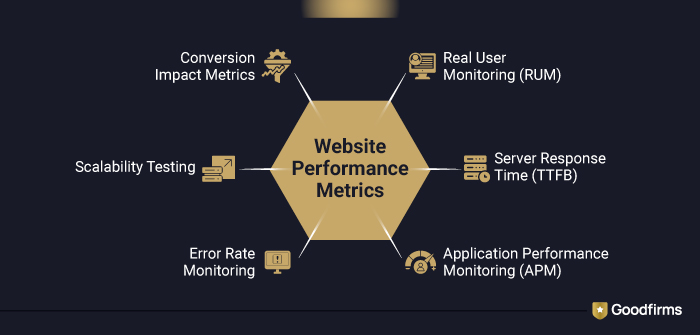
Modern website performance measurement goes beyond page speed. Businesses now track:
1.Real User Monitoring (RUM): This captures real-time performance data from actual users across devices, locations, and networks.
2. Server Response Time (TTFB): Time to First Byte is one of the significant factors for backend or website server performance analysis.
3. Application Performance Monitoring (APM): It helps in tracking backend services, APIs, database performance, and latency of microservices.
4. Error Rate Monitoring: It identifies the downtime, failed transactions, or degraded services.
5. Scalability Testing: Simulates traffic spikes to evaluate performance under heavy loads.
6. Conversion Impact Metrics:Companies now relate performance data with the:
• Revenue per session
• Cart completion rates
• Bounce rates
• Average order value
• Customer lifetime value
As Luca Ziveri, Chief Strategy Officer (CSO) at SaidText, explains:
“We measure performance as a mix of user experience + reliability + business outcomes such as Core Web Vitals + real user monitoring (RUM), Availability + resilience, Conversion-critical funnels, Cost efficiency. For production, we use cloud load balancing in front of our application services to handle spikes, distribute traffic, and enable safe deployments.”
By monitoring website performance through the combination of the above-stated key metrics, businesses can improve load times, SEO, user retention, and overall success.
Now that you understand how to measure website performance, let's focus on one of the key metrics that define it—starting with Google Core Web Vitals.
How to Use Google Core Web Vitals in 2026 to Improve Website Performance?
Google has raised the bar while heading towards 2026 with its initiative Core Web Vitals (CWV) - a subset of Web Vitals that includes three aspects that impact user experience of the website - loading, interactivity, and visual stability. It is important that businesses of all sizes measure these metrics to ensure they follow a user-centric approach and stay competitive.
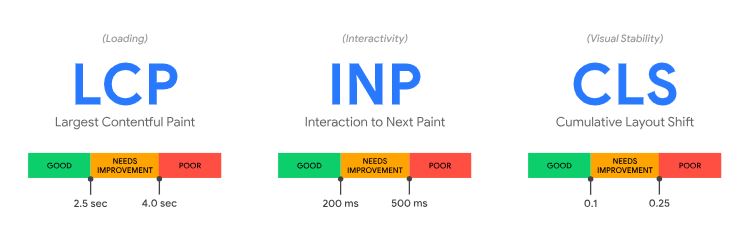
Source: Google-Core Web Vitals
Let’s take a closer look at the three core web vital metrics:
Largest Contentful Paint (LCP)- Loading Performance
• Measures when the largest visible element loads.
• Ideal target: within 2.5 seconds.
Interaction to Next Paint (INP) - Interactivity
• Replaces First Input Delay (FID) as the responsiveness metric.
• Measures how quickly the page responds to user interactions.
• Ideal target: 200 milliseconds or less.
Cumulative Layout Shift (CLS) - Visual Stability
• Measures unexpected layout movements.
• Ideal target: 0.1 or less.
Organizations that proactively monitor and measure these metrics strengthen their search rankings, which allows them to build faster, more reliable, and trust-driven digital experiences for their audiences.
While Core Web Vitals help measure performance from a user perspective, the backend infrastructure—such as load-balancing software—also plays a critical role in maintaining those metrics.
What is Load Balancing Software?
Load balancing software plays an essential role in managing Core Web Vitals (CWV), Google metrics for measuring user experience, page load speed, and server response time. Through load-balancing software, the server's response during peak times can be optimized. The software acts as a reverse proxy, distributing incoming network traffic across a pool of servers, virtual machines, or containers to prevent any single server from becoming overloaded.
As of 2026, load balancing software has become a crucial part of web infrastructure, not only directing traffic but also actively measuring and optimizing website performance through real-time analytics and AI-driven insights, ensuring it remains responsive and operational during high-demand periods.
Reliable load balancing software listed on Goodfirms with verified ratings and reviews includes Site24x7, ManageEngine OpManager, Citrix ADC, Barracuda Load Balancer ADC, Elastic Load Balancing, Cloud Load Balancer, Varnish Enterprise, NeoLoad, Quotaguard, NGINX Plus, and many more.
Understanding what load balancing software is sets the foundation—now let’s explore how it directly impacts website performance.
Role of Load Balancing in Website Performance
Load balancing is the process of distributing incoming network traffic across different servers so that no single server is overwhelmed. This technique is essential for ensuring that websites are able to handle high-traffic volumes, thereby giving users an uninterrupted experience.
The size of the global load balancer market was valued at USD 6.26 billion in 2024 and is expected to reach from USD 7.09 billion in 2025 to USD 19.40 billion by 2033, growing at a CAGR of 13.40% during the forecast period (2025-2033). This increasing demand for network or application traffic management in hybrid cloud, AI, and edge environments is driving a shift from hardware to software-defined solutions.
Once you understand its role, the next step is to explore the different types of load-balancing software available for various business needs.
What Types of Load Balancing Software are Out There?
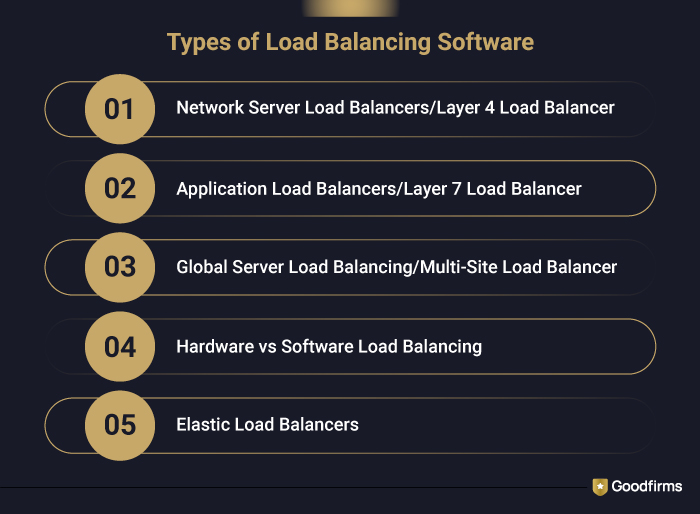
- Network Server Load Balancers/Layer 4 Load Balancer - Here, the operators at the transport layer forward the traffic based solely on IP addresses and ports.
- Application Load Balancers/Layer 7 Load Balancer - This performs routing decisions based on HTTP headers, URLs, and SSL sessions.
- Global Server Load Balancing/Multi-Site Load Balancer - These distribute traffic across multiple data centers or geographical locations for disaster recovery and high availability.
- Hardware Load Balancing - These physical appliances are designed for high-performance traffic management with the help of hardware devices.
- Software and Virtual Load Balancing - These run on standard servers that are virtual or physical, which are more flexible and scalable than hardware.
- Elastic Load Balancers - It is a managed cloud service that automatically scales to handle the changing traffic demands without manual intervention.
Tom Jauncey, Head Nerd at Nautilus Marketing, explains:
“We assess our achievements by using Core Web Vitals together with server response times, uptime measurements, essential conversion rates, and page speed data. Our business operations depend on Cloudflare Load Balancing and AWS Elastic Load Balancing because these cloud solutions deliver vital operational capabilities.” Similarly, Mihai Cirstea, CEO of Site Pixel Media, notes:
“We tie performance directly to Core Web Vitals, real user data, and revenue per millisecond gained. Predictive load balancing that uses AI to anticipate traffic spikes before they happen. Instead of reacting to overloads, we're preventing them entirely, which keeps conversion rates stable even during viral content moments or campaign launches.”
Beyond types, it’s equally important to understand the algorithms that power load balancing decisions and traffic distribution.
Types of Load Balancing Algorithms
Modern load balancers rely on intelligent algorithms to determine optimal routing, such as:
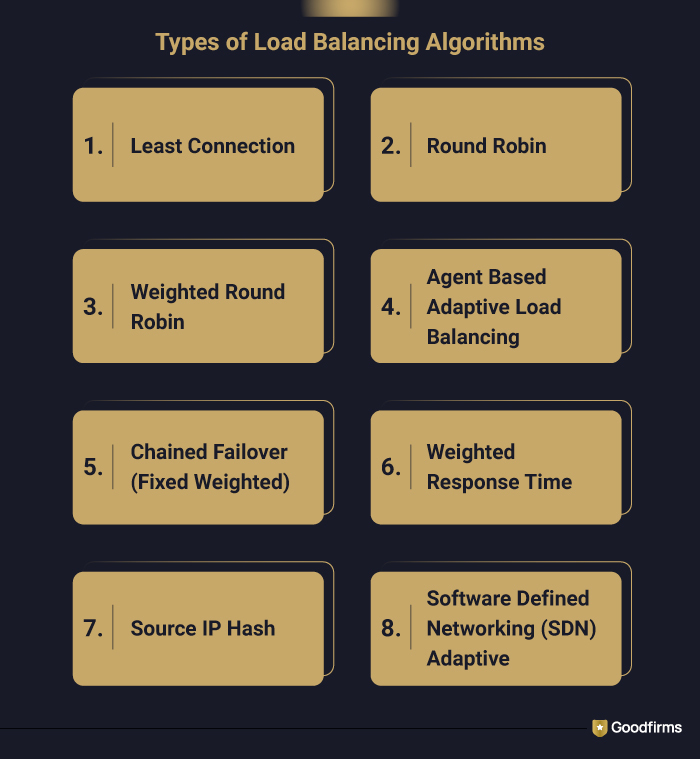
- Least Connection: It uses the current number of active connections to distribute the traffic to minimize the overload of the server.
- Round Robin: It helps in distributing requests to all the incoming request servers in a circular list order, regardless of server capacity.
- Weighted Round Robin: It helps in assigning more requests to the right servers with higher capacity based on assigned performance weights.
- Agent-Based Adaptive Load Balancing: It provides dynamic load balancing using real-time, agent-reported data (CPU, RAM) to route traffic to the least burdened server.
- Chained Failover (Fixed Weighted): If the primary high-weighted server fails, it smoothly moves the traffic to the next in the chain.
- Weighted Response Time: It routes traffic to the server that is responding faster to health check requests, thus providing minimum latency.
- Source IP Hash: It ensures the use of client IP address data to generate a unique hash, with consistent and persistent connections to the same server.
- Software Defined Networking (SDN) Adaptive: It dynamically routes traffic by combining with upper-layer application data and real-time lower-layer network state information.
As digital ecosystems get more complex and unpredictable with traffic patterns, businesses must move forward from reactive fixes and adopt infrastructure designed for resilience and scale. This is where intelligent load balancing becomes a strategic investment rather than a technical add-on.
Now that you have seen the types of load balancing software available, let’s look at why businesses must invest in these solutions to improve performance, uptime, and scalability.
Why Businesses Must Invest in Load Balancing Software
Businesses must invest in load-balancing software to ensure high availability, faster performance, and seamless user experiences even during traffic spikes.
- Guaranteed Uptime: Prevent outages by distributing traffic across different servers and locations.
- Consistent Performance: Maintains consistent response times, even when there is a sudden traffic surge.
- Scalability on Demand: Integrates easily with auto-scaling to support business growth.
- Improved User Experience: Enables websites to meet Core Web Vitals to improve user experience and overall site responsiveness.
- Revenue Protection: It protects conversion rates during the peak campaigns, product launches, or viral moments.
- Global Optimization: Routes users to the nearest and healthiest server for lower latency.
- Resilience & Failover: Automatically redirects the traffic away from unhealthy instances.
- Operational Efficiency: Reduces the infrastructure strain and optimizes the use of resources.
Conclusion:
In 2026 and beyond, only high-performing websites can expect to become revenue-generating platforms. In the digital economy where speed impacts search rankings, user experience, and brand perception, website performance is no longer just an SEO strategy but a strategic growth investment.
Organizations that proactively invest in resilient, performance-driven digital solutions position themselves ahead of competitors instead of acting after the damage has already been done. In today's landscape, it's the reliability that builds trust, speed drives conversions, and performance ultimately defines market leadership.
Are you looking forward to launching a high-performing website that can help you meet all your business goals? Just go through this list of the best load balancing tools and invest in one that best suits your budget and the features required.