Key takeaways
- Paid verification is not the same as credibility. A badge may indicate a subscription or a completed identity check, depending on the platform.
- X Premium and Meta Verified offer paid plans. Their features, eligibility rules, and prices vary by tier, country, and account type.
- Free verification is still available. TikTok, LinkedIn, and YouTube have their own verification programs, each with specific eligibility requirements.
- A verified badge won't guarantee more followers or engagement. Content quality and audience interest still matter.
- Account support and impersonation protection can make paid verification worthwhile. Businesses facing fake accounts or account access issues may find these benefits useful.
- Check the features before subscribing. Compare the price, renewal terms, support options, and benefits to make sure the plan solves a real need.
Paid verification on social media gets you a badge, some account support and protection against impersonation. It does not prove you are trustworthy, and that gap is where most people get confused.
X, Instagram, and Facebook all sell a version of it now. The price, the checks, and the perks are different on each platform, and on some of them the badge only shows that you pay a monthly fee. If you run a business or build an audience online, that's worth knowing before you add another subscription to the pile.
Below, we cover what each platform actually gives you, what it costs, which platforms verify for free, and how to decide whether paying makes sense for you.
Businesses that need help with content, audience engagement, or platform-specific campaigns can compare top social media marketing agencies on Goodfirms before deciding what to manage in-house. To smoothen social media management in-house, explore the best social media management software.
What is Paid Social Media Verification?
It's a monthly or annual subscription. You pay, you pass the platform's checks, and your profile gets a verified badge. Most plans add a few extras, like account support, impersonation protection, or premium tools.
What the badge means depends on where you see it. On X, the blue checkmark tells people you hold an eligible premium plan. That's about all. Meta Verified goes a step further and asks creators for a government ID, so some identity check sits behind the badge. Older badges, handed out before paid plans existed, are still around as well. Two identical ticks in the same feed can mean two different things.
Paid verification is only one part of managing a brand's social presence. The right social media management software can also help teams plan posts, monitor engagement, and manage conversations across platforms.
Importance of Paid Verification Subscription Services
Picture a small skincare brand on Instagram. Someone sets up a copycat account and starts selling fakes. A paid plan gives the real brand a badge that sets it apart, plus a support route for reporting the copycat. That's the situation these plans handle best.
Support is the second reason people pay. Meta Verified includes account support, and X's higher tiers come with prioritized replies. The extras vary. X Premium adds post editing, longer posts, and fewer ads. Meta's plans add profile features. For a business answering customers over DMs, a few dollars a month for better support can be a fair trade.
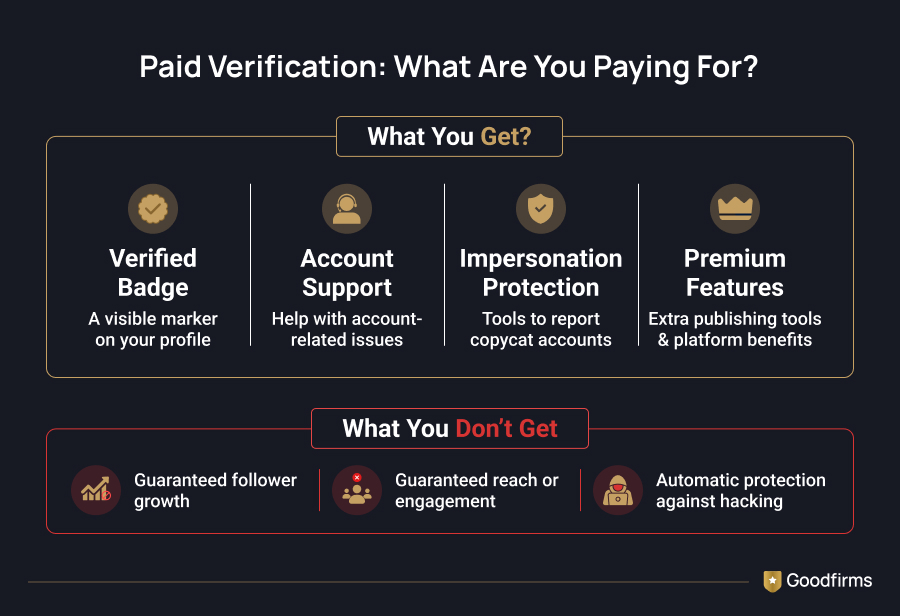
What a badge won't do is grow your following. No platform promises that, and a badge can't stand in for content people want to read. It also isn't a security tool. Phishing and hacking still happen to verified accounts, so keep two-factor authentication on and use strong passwords either way.
X Premium
X sells three tiers: Basic, Premium and Premium+. The blue checkmark comes only with the top two, and X reviews your account before it appears. Businesses and organizations get separate plans, with gold or gray checkmarks depending on the account type.
The old checkmark meant X had judged an account active, notable and authentic. The current one mostly means the account holder pays. Treat it that way.
Beyond the badge, what you get depends on the tier. Options include post editing, longer posts and videos, prioritized replies, less advertising and creator monetization. Premium+ adds an ad-free experience across most of X.
To qualify, your account needs a display name, a profile photo and a confirmed phone number. It also has to be active in the last 30 days, with no sign of spam, deception or manipulation. Change your photo, display name or username later and X may review the account again. The badge can disappear until that review clears.
Signing up takes a few minutes:
- Sign in on the X website or app.
- Open the Premium section from the menu.
- Pick a tier and pay. Confirm your phone number if asked.
- If you chose Premium or Premium+, wait for X to review your account.
Pricing varies by country, platform and tax. On X's US web pricing page, Basic costs $3 a month or $32 a year, Premium costs $8 a month or $84 a year, and Premium+ costs $40 a month or $395 a year. Basic has no checkmark, so if the badge is the point, that cheapest plan is the wrong one. Prices and features change, so check X's official pricing page for your region before paying.
You can use X without any of this. Posting, following, replying and sharing media are free. Longer posts and some creator tools are the main things behind the paywall, and plenty of people build an audience without them. You can also connect with Twitter advertising agencies to help you manage the account.
Meta Verified
Meta Verified is Meta's paid service for eligible creators and businesses on Facebook and Instagram. You get a verified badge, account support and impersonation protection. The exact mix depends on the plan, your account type and your country.
If you are managing multiple profiles, you may also want to compare social media management tools for features such as account monitoring, customer engagement, and content management.
Meta has been adding to the offer. In September 2026 it introduced Meta One, a bundle of AI features, profile enhancements, publishing tools and customer support options for creators and businesses. Some business plans include the badge and impersonation protection, subject to successful verification. Source: Meta Newsroom
Reach is the thing to watch. Meta removed increased reach from the original Meta Verified offer as it expanded to more countries. So don't pay for it expecting a visibility boost. Judge the plan on what's actually listed. Source: Meta Newsroom
Eligibility differs between creators and businesses. Creators generally need to meet the minimum age, live in a supported country, use an eligible Facebook or Instagram account and provide the details Meta asks for. Meta may also ask for a government-issued ID that matches your profile. Businesses follow separate rules for their Facebook Page, Instagram professional account or other supported business account. Availability depends on the account, the country and the plan, so read Meta's official eligibility pages before applying.
The application works like this:
- Open Facebook or Instagram and go to your account settings or professional dashboard.
- Find Meta Verified, or the subscription offered to your account.
- Check the eligibility rules, benefits and price.
- Submit your identity or business information.
- Pay, then wait for Meta to review the application.
Approval isn't instant. Meta may ask for more information or turn the application down.
There's no single price. Creator and business plans cost different amounts, and the charge depends on your country, tier, billing method and the number of accounts covered. When Meta launched in India in 2023, creator plans cost ₹699 a month through the iOS and Android apps, with a lower web price announced for a later rollout. That figure is out of date, so don't plan around it. Check the price shown in your own account, especially now that Meta One is in the mix. For business plans in India, Meta's official announcement explains how the subscription is structured.
Tumblr
Tumblr shows up in some verification roundups, but it never built a paid identity-verification program like X Premium or Meta Verified. In November 2022 it launched a parody of Twitter's paid checkmark and let users buy a novelty badge. It was a joke. It's still a handy reminder that a badge means little without a real check behind it.
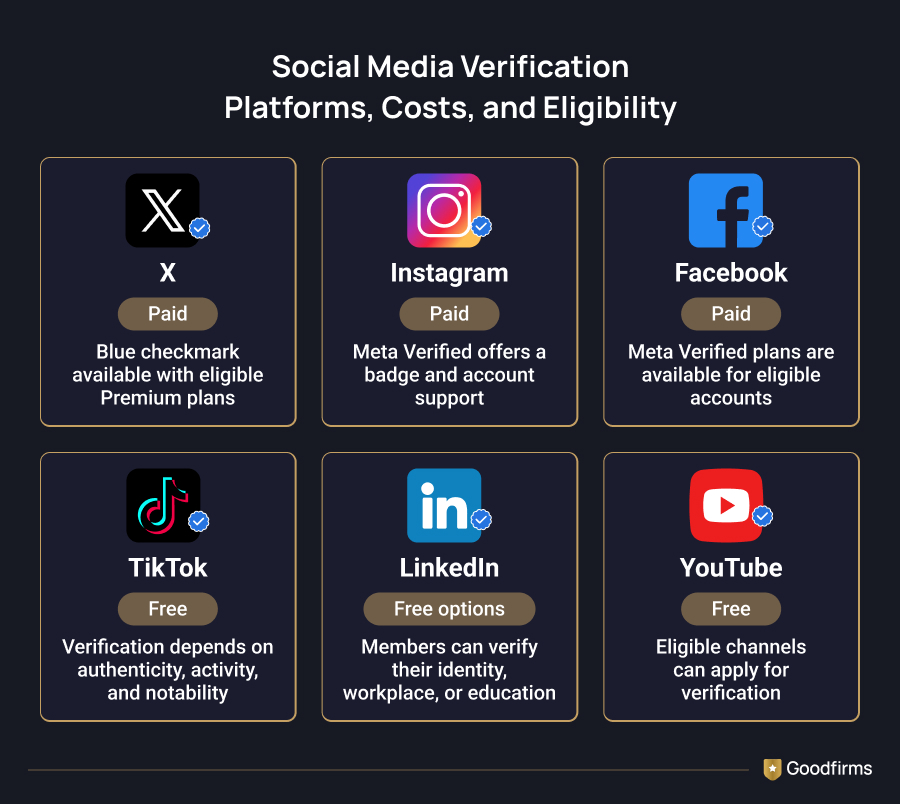
Platforms That Verify for Free
Not every platform charges. TikTok, LinkedIn and YouTube run their own programs, each with different rules.
TikTok
TikTok gives a free badge to eligible individuals, businesses, organizations and public figures. The review looks at authenticity, activity, uniqueness and notability. Follower and like counts don't decide it. In the app, open your profile, go to Settings and privacy, then Account, then Verification, if it's available in your region. TikTok warns against third parties who claim to sell badges. The badge means TikTok confirmed the account's identity, not that it endorses the account or its content. Connect with TikTok marketing agencies for smooth account managament.
LinkedIn lets members verify their identity, workplace or school at no extra cost, depending on eligibility and region. Company Pages can be verified too, which helps confirm that a Page represents the real organization. Eligibility depends on factors like Page activity, accurate business information and the company's relationship with LinkedIn. Some paid products, including Premium Company Page subscriptions, can make a Page eligible to request verification, but paying doesn't guarantee approval. You can also look for LinkedIn advertising companies if you are planning to outsource LinkedIn account management.
YouTube
YouTube lets channels apply for verification after they reach 100,000 subscribers. The channel must be authentic, complete and public, with two-step verification turned on for the linked Google Account. YouTube may verify some well-known channels with fewer subscribers. You can't buy the badge, it unlocks no extra features, and it doesn't mean YouTube endorses the content. If all these is complicated for you, hire a YouTube marketing agency.
Myths About Paid Verification Subscription Services
Anyone can get verified by paying. No. Platforms set their own eligibility rules, and some review accounts first. X checks Premium subscribers before awarding the checkmark, and TikTok verifies for free after looking at authenticity and notability.
A paid badge guarantees trust. It doesn't. On X it signals a paid plan. On TikTok it confirms an identity. Same icon, different meaning, so find out what a badge confirms before you rely on it.
Paid verification is only for businesses. Creators and individuals use it too. Whether it pays off comes down to what you need from the plan, and plenty of users don't need any of it.
How to Decide Before You Subscribe
Start with the platform. A badge matters if your customers or audience are on it and you're dealing with copycats or constant support issues. If your audience hardly uses the platform, the badge buys you very little.
Then read the billing terms. Does the plan renew automatically? Are taxes extra? What happens if you cancel? Compare monthly and annual prices too, because the cheapest tier often leaves out the badge, as X's Basic plan does.
Look at what's actually included. Support, impersonation protection, publishing tools and fewer ads vary by plan. Find out whether you get dedicated support or just access to the standard channels, how the platform handles impersonation reports and what gets a badge removed.
Last, be honest about your goal. If you want support or protection against impersonation, check that the plan covers it. If you're hoping for more followers or sales, remember that nobody guarantees either.
The Future of Paid Social Media Verification
Verification has moved past the blue checkmark. Platforms now sell it as a bundle of support, protection and publishing tools, and each one writes its own rules. Expect tiers, prices and eligibility requirements to keep shifting.
So the smart move is to pay for what you'll use. Someone fighting repeated impersonation attempts may get real value from a plan. A creator who wants longer posts might care more about publishing tools. Everyone else can probably stay on a free account and lose nothing. The badge is an option, not proof of credibility.
FAQs - Paid Social Media Verification
What is paid social media verification?
It's a subscription that gives eligible users a verified badge and extra features such as account support, impersonation protection and premium tools. X Premium and Meta Verified are the main examples. A paid badge doesn't always confirm identity or reputation, because that depends on each platform's checks.
Which social media platforms offer paid verification?
X and Meta, through X Premium and Meta Verified. X gives a blue checkmark to eligible Premium and Premium+ subscribers. TikTok, LinkedIn and YouTube also have verification programs, but those aren't paid subscriptions.
How much does paid social media verification cost?
It depends on the platform, tier, region and billing method. On X's Indian web pricing page, Basic starts at ₹243.75 a month, Premium at ₹650 and Premium+ at ₹3,470. Only Premium and Premium+ are eligible for the checkmark. Meta Verified has separate creator and business plans with different prices. Check the official pages, because rates change. X Premium pricing | Meta Verified for businesses in India
Does paid verification increase followers and engagement?
No platform guarantees it. Features like prioritized replies may help you reach your audience, but results depend on content quality, audience interests and how consistently you post.
Can you get verified on social media without paying?
Yes. TikTok verifies eligible users for free, LinkedIn offers profile verifications at no extra cost and YouTube verifies eligible channels. Meeting the requirements doesn't guarantee approval. Apply through official channels, and never pay a third party who claims to sell badges.
Is paid social media verification worth it for businesses?
Sometimes. It makes sense when a business needs account support, impersonation protection or extra profile features. Compare plans, check eligibility and ask whether the included features solve a real problem. A badge alone won't guarantee customer trust, reach or sales.