Key takeaways
- 39% of brands say proving influencer ROI is a major challenge (IAB, 2025). Affiliate software tracks sales through links, promo codes, UTM parameters, pixels, and attribution windows, but it doesn't find creators or manage relationships.
- Three in four brands still use flat fees for direct creator deals, versus 49% using performance-based models. Tracking works with flat-fee, hybrid, commission, and gifting arrangements.
- Creator discovery and vetting is the most commonly outsourced influencer marketing function, at 19.44% (Influencer Marketing Hub, 2026). Choose software, an agency, or both based on creator count and team capacity.
You pay an influencer to promote your product. The post gets views and positive comments. But how many sales did it actually bring in? Performance-based influencer marketing answers that question. With affiliate marketing software, brands can track clicks, sales, and signups through unique links and promo codes. Tracking covers only part of the job, though. Someone still has to find creators, negotiate deals, manage content, and keep relationships healthy, and influencer agencies handle that work.
Many brands struggle to measure influencer results. The IAB's 2025 Creator Economy Ad Spend & Strategy Report found that 39% of brands name proving ROI as a major measurement challenge, and 34% have trouble attributing sales to creators.
This blog explores when and how brands should use affiliate software and an agency, or both together.
Need help finding the right creators or tracking their sales? Browse verified influencer marketing agencies to shortlist a partner for your campaign, or compare affiliate marketing software to track clicks, conversions, and payouts.
Software vs. Agency: What Each One Does
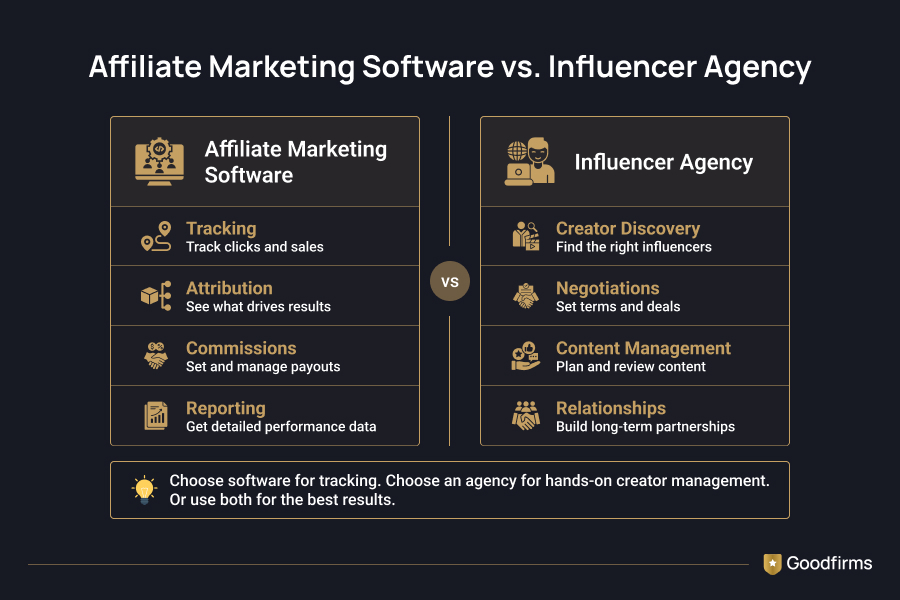
Affiliate marketing software and influencer agencies support different parts of a campaign. One handles the technology behind tracking and payments; the other manages the people and activities involved in running creator partnerships.
A company with a small group of established creators can manage partnerships in-house and use affiliate software to track and process payments.
Brands that manage many creators need an agency for sourcing and communication, while the software handles tracking. Some agencies even use affiliate platforms on behalf of their clients, so the brand receives campaign reports and results without directly managing the software.
In practice, the agency finds and manages the creators, and the software shows what each one sells.
The following comparison highlights where the two approaches differ in responsibilities, capabilities, and the type of support they offer.
Key Differences at a Glance
|
Aspect |
Affiliate Marketing Software |
Influencer Agency |
|---|---|---|
|
Core role |
Tracks campaign performance through technology |
Manages creator partnerships through human expertise |
|
Creator discovery |
Doesn’t find or vet creators |
Finds creators who match your audience and industry |
|
Contracts and fees |
Doesn’t negotiate terms |
Negotiates fees and contract terms |
|
Creative direction |
Doesn’t prepare briefs or review content |
Prepares briefs, gives creative direction, and manages approvals |
|
Tracking and attribution |
Creates tracking links and promo codes, records clicks and sales, and attributes purchases to influencers |
Typically relies on software for tracking |
|
Payments |
Calculates commissions and manages payout schedules |
Resolves payment concerns and partnership issues |
|
Reporting |
Generates performance reports |
Shares campaign results and insights, often drawn from the software |
|
Relationships |
None |
Maintains creator relationships and handles renewals |
|
Best suited for |
Brands with a few established creators that can manage partnerships in-house |
Brands working with dozens or hundreds of creators, or entering a new product category |
To see why affiliate tracking matters in creator campaigns, it helps to look at how performance-based influencer marketing works.
What Is Performance-Based Influencer Marketing?
Traditional influencer campaigns start with a fixed fee, in which a brand pays a creator for a video or post, and the creator receives that amount regardless of how many sales result. This method is good for building brand awareness, but it’s harder to defend when the marketing team has to show revenue.
Performance-based influencer marketing changes that. Instead of paying only for content, brands reward creators for results like clicks, sales, or signups. A skincare brand, for example, might give each influencer a unique discount code. Every time a customer uses it, the sale is credited to that creator, and the brand calculates the commission from the agreed terms.
Both sides benefit. Brands see which partnerships bring in business, and creators earn more when their content performs. Budget pressure drives the shift, too: paid search and social already come with detailed reports, and influencer marketing is now held to the same standard. For a wider look at paying for measurable results across channels, see this guide to performance marketing.
Fixed fees still have a place. A brand can pay a guaranteed fee for an awareness campaign and use affiliate tracking to measure the resulting sales. The difference is that engagement numbers are no longer the only evidence.
Brands can tie creator payments to results in different ways. The right arrangement depends on campaign goals, creator expectations, and the level of risk each side is willing to take.
Influencer Pricing Models: Flat Fees, Commissions, Hybrid Deals, and Gifting
Affiliate tracking doesn't lock brands into one payment structure. It can support several arrangements, depending on campaign goals and the agreement between the creator and the brand.
Performance-based deals are becoming part of the influencer marketing mix, but fixed payments remain common. Many brands use flat fees for specific deliverables, while others tie compensation to clicks, conversions, or sales.
The IAB's 2025 report found that three in four brands use flat-fee structures for direct creator partnerships, compared with 49% using performance-based models.
Here are four common models.
1. Flat fee
The creator receives a fixed payment for the agreed-upon content, regardless of sales numbers.
This model suits brands that want to reach a particular audience or build awareness. The campaign can still add tracking links and promo codes to measure sales, even when the creator's pay isn't tied to them.
2. Hybrid (base fee plus commission)
The creator receives a guaranteed payment plus a commission on the sales they generate.
A brand might pay a base fee for a video, then add a commission on every qualifying purchase through the creator's link. Creators get some security and room to earn more when their content converts. It's often a practical fit for established creators who don't want to work purely on commission.
3. Pure commission or affiliate model
Creators earn a commission on the sales they generate, with no guaranteed payment. Commission rates vary depending on the product category, profit margins, and the agreement between the brand and creator. Some brands offer higher commissions to encourage creators to generate more sales.
This model works for ongoing affiliate programs and for creators who are comfortable earning from actual conversions.
4. Gifting
Brands send products to creators without necessarily paying a cash fee. The creator may choose to feature the product, and some arrangements add a commission on sales through their link or code.
Tracking helps here because it shows whether gifting is actually bringing in customers. That can guide them on which creators are worth approaching for paid collaborations later.
How tracking changes influencer payments
Once sales data are available, brands have a basis to discuss compensation with creators. A creator who delivers steady sales may earn more through commission than through an earlier flat fee. A campaign with high engagement but very few purchases may prompt a brand to rethink its spend. To see how creator size affects what you pay, this guide to micro vs. macro influencers in Australia compares rates and engagement by tier.
Whichever payment model a brand chooses, it needs reliable sales data to evaluate creator performance. Affiliate marketing software provides that data through several tracking methods.
How Does Affiliate Marketing Software Track Influencer Sales?
Affiliate marketing software connects a creator's promotion to the purchases their audience makes. It combines several tracking methods to work out where each sale came from.
The 2025 Influencer Marketing Report found that 83% of surveyed brands track ROI using custom links, coupon codes, and affiliate dashboards.
Here are the five commonly used methods.
1. Tracking links
Each influencer gets a unique link to share with their audience. When someone clicks it, the platform logs the visit and ties it to that creator.
A fashion brand, for example, might give two influencers different links to the same collection. Even if both promote the same products, the brand can see which creator drove more visits and purchases.
2. UTM parameters
UTM parameters are tags added to a URL that show the source, medium, and campaign behind a website visit.
They enable marketing teams to review influencer traffic in tools like Google Analytics and compare creators without relying only on the affiliate dashboard. By running both systems side by side, brands can cross-check their data.
3. Promo codes
Not everyone clicks a link before buying. Some people remember a discount code from an Instagram Reel or YouTube video and type it in at checkout.
Here, promo codes are useful. If an influencer shares the code CREATOR20 and a customer uses it, the order is credited to that creator. Codes are especially handy on platforms where links aren't easy to tap.
4. Pixels and cookies
Pixels and cookies help affiliate platforms link a visitor's earlier click to a later purchase.
When someone clicks an influencer's link, a tracking cookie is placed on their browser. If that visitor buys, a pixel on the confirmation page sends the conversion data back to the affiliate platform, which then identifies the creator behind the sale. Cookie duration varies by platform and campaign settings.
5. Attribution windows
An attribution window sets how long after a click a purchase can still be credited to an influencer. With a 14-day window, a sale made on day 10 is credited to the creator, while one on day 20 falls outside the window and isn’t credited, though platform rules can differ.
Match the window to your product. Low-cost items are often bought quickly, while expensive purchases may take weeks to decide on.
Once a sale is attributed, the software calculates the creator's commission at the agreed rate. Many platforms also let brands hold payouts until the return period ends, so refunded orders don't trigger commissions.
Setup is usually manageable. Most affiliate platforms integrate with popular ecommerce systems through plugins or apps, so adding tracking links and a conversion pixel takes little development work.
Once tracking is in place, the next consideration is cost. Software subscriptions and agency services are priced differently, so brands should understand what each option includes before making a decision.
Affiliate Software vs. Influencer Agency: What Does Each Cost?
The two are billed differently. Affiliate software is a flat monthly subscription, while agencies charge by the hour or as a share of campaign spend. What creators are paid is a separate cost, covered next.
|
Comparison |
Affiliate software |
Influencer agency |
|---|---|---|
|
How it's priced |
Monthly subscription, sometimes with additional fees or a share of tracked sales |
Hourly rates, project fees, retainers, or other negotiated arrangements |
|
Price point |
LeadDyno's monthly plans range from $49 to $749, depending on the plan and number of active affiliates. |
Goodfirms has reviewed 2,652 influencer marketing agencies across 93 countries. The category has a median hourly rate of $37. Its top-ranked agency, SmartSites, charges $100–$149 per hour. (November 2026) |
|
Example (illustrative) |
$49– $749 per month, depending on the selected plan |
30 hours per month would cost approximately $1,110 at the median rate or $3,000–$4,470 at the top-ranked firm's listed rate |
|
What the fee covers |
Affiliate tracking, attribution, commission management, and reporting |
Creator sourcing, negotiations, campaign briefs, and campaign management |
Agency costs can also be considered in relation to the overall influencer marketing budget. The ANA's first influencer agency compensation study found that, on average, 30% of influencer marketing spend went to agencies and 70% to creators.
The study included 84 client-side marketers who passed the screening process, and the split varied among respondents. This is an average budget allocation, not a standard agency fee. Since hourly, project-based, and retainer quotes cover different scopes of work, ask agencies to price the same deliverables before comparing proposals.
Price matters, but it shouldn't be the only deciding factor. The amount of work your team can handle, and the scale of your creator program, also determine whether software, an agency, or both make sense.
When Should Brands Combine Affiliate Software and Influencer Agencies?
Some brands manage influencer partnerships on their own. Others find that sourcing creators, reviewing content, and handling campaign communication takes far more time than they planned for.
Creator discovery is a common pain point that agencies can help address. Influencer Marketing Hub's 2026 Benchmark Report found that creator discovery and vetting was the most commonly outsourced influencer marketing function, chosen by 19.44% of respondents.
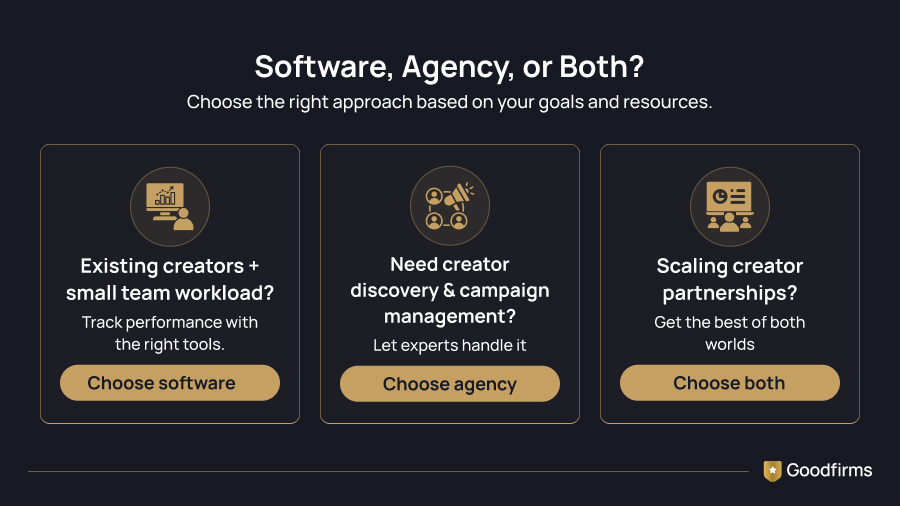
These four examples show where each approach fits.
1. A skincare brand working with 12 creators.
A direct-to-consumer skincare company has worked with 12 micro-influencers for over a year. The creators know the products and the messaging, and one person on the marketing team spends about 4 hours a week on outreach, tracking-link setup, and content review. Affiliate software is probably enough here. The relationships are in place, and there's no need for an agency to find new partners or run the creative side. To see how similar programs are planned and measured, read this guide: micro-influencer marketing in Manchester.
2. A supplement startup growing from 8 to 80 creators.
A supplement company wants to scale its creator partnerships from 8 to 80 over two quarters. The current team doesn't have time to research new influencers, negotiate individual deals, follow up on content deadlines, and manage all those relationships. Affiliate software plus an agency makes more sense. The software handles tracking and commissions, and the agency takes on discovery and campaign coordination. For a program growing this fast, you can compare enterprise influencer marketing companies that manage large creator rosters.
3. An apparel brand entering a new category.
An activewear company wants to launch golf apparel. It has a solid customer base but little experience with golf creators, and it doesn't know which ones have engaged audiences or would suit the brand. An agency with category experience can identify partners and negotiate collaborations, while the software measures what each creator sells. Before agreeing to a creator partnership, make sure you understand the terms of the contract. This guide to TikTok Creator Contracts explains the key clauses to look out for.
4. A retailer with inconsistent creator content.
A retail chain with 40 locations works with 25 creators, but the content varies a lot in tone, quality, and presentation. Affiliate tracking already shows who drives sales, but it can't fix the problem of inconsistent brand messaging. An agency can help with content briefs, creative direction, and campaign coordination.
Can you manage the program yourself?
Start with the hours the work takes: outreach, agreements, content reviews, and payments. If your team can handle all these, without dropping other marketing work, running the program in-house may be practical.
If you plan to grow your partnerships and nobody clearly owns finding and managing creators, an agency could save you a lot of time. If your program relies heavily on commissions and affiliate links, you can also compare affiliate marketing companies that run the program for you.
In an article by Marketing Dive, ANA vice president Leah Marshall points to the budget side of going fully in-house:

It does take a lot of budget to do things in-house only.
After deciding how much work to manage in-house and where to seek outside support, brands can identify the tools needed to run the program smoothly.
Essential Tools in an Influencer Marketing Tech Stack
Running an influencer program takes more than finding creators and giving them promotional links. Brands need ways to manage partnerships, track results, process payments, and review performance. A typical influencer marketing tech stack has four parts.
1. Creator discovery
This is where brands find influencers who align with their audience, industry, and campaign goals. The in-house team, an agency, or a specialized research tool can handle discovery. The aim is to find creators whose audience matches the brand.
2. Affiliate and tracking software
Once creators join a campaign, the affiliate software monitors their performance. It manages tracking links, promo codes, UTM parameters, attribution windows, and commission calculations, and it shows which partnerships drive traffic and sales. Tools such as Tracknow, LeadDyno, iDevAffiliate, and CAKE fall in this category.
3. Payment and invoicing
Creators need to be paid on the agreed terms. Some affiliate platforms offer built-in payment processing, while others integrate with separate payment processors or accounting systems. If brands use hybrid deals, they may need to handle fixed fees and commissions separately, since they follow different payment schedules.
4. Reporting and analytics
The final layer brings campaign data together.
Marketing teams can review metrics such as:
- Revenue generated by each creator
- Cost per acquisition
- Clicks and conversion rates
- Repeat purchases from influencer-driven customers
- Commission payments and campaign costs
These reports help brands understand which partnerships are worth continuing and where campaign budgets may need to change.
Influencer agencies may work across several of these layers, particularly creator discovery, campaign management, and reporting. However, many rely on existing affiliate platforms rather than developing their own tracking systems.
For brands, the important thing is to understand what each tool or service actually covers before investing.
With the right combination of people, platforms, and reporting tools, brands can manage creator partnerships more effectively and make better use of their campaign budgets.
Final Thoughts
Before choosing affiliate marketing software or an influencer agency, identify what your team needs most. If you already have creator relationships but need better sales tracking, software is probably enough. If you need help finding influencers and managing campaigns, an agency fills that gap. For growing programs, using both makes sense. Choose based on your team’s workload, resources, and campaign goals.
FAQs- Affiliate Software vs. Influencer Agencies
What is the simplest way to start tracking influencer sales?
Give each creator a unique tracking link and a unique promo code. The link records clicks and purchases, and the code catches buyers who skip the link and type it at checkout. Add UTM parameters to the links so the same traffic appears in Google Analytics as a cross-check against the affiliate dashboard.
Can affiliate marketing software replace an influencer agency?
No, not when a brand needs help with creator discovery, negotiation, creative direction, or relationship management, because software only handles tracking, attribution, and payments. It can replace an agency for small programs with established creators. Influencer Marketing Hub’s 2026 Benchmark Report found that 66.33% of respondents manage influencer marketing entirely in-house. A useful test: if nobody on the team owns finding creators and negotiating deals, add an agency.
What influencer pricing models work best with performance tracking?
Hybrid and commission-based models fit best, because creator pay is tied to measurable sales. Hybrid (a base fee plus commission) suits established creators who want some security, while pure commission suits ongoing affiliate programs. Flat-fee and gifting deals can still be tracked. After the first campaign, compare sales per creator and adjust each creator’s pay model.
How much does an influencer agency cost compared with affiliate software?
Affiliate software and influencer agencies have different cost structures. Software usually charges a monthly subscription, while agencies bill for services through hourly rates, project fees, or retainers. For example, LeadDyno's plans range from $49 to $749 per month. Goodfirms reports a median hourly rate of $37 across 2,652 reviewed influencer marketing agencies, with its top-ranked firm, SmartSites, listing rates of $ 100–$ 149 per hour (November 2026). Agency fees may also vary depending on the number of creators, campaign requirements, and level of management involved.
Do influencer agencies use affiliate software?
Yes, some agencies run affiliate platforms on behalf of clients, so the brand receives campaign reports without having to manage the software. Many rely on existing platforms rather than building their own tracking systems. Before signing, ask which platform the agency uses and whether tracking runs in your account, so your sales data stays with you if the relationship ends.


.jpg)