Key takeaways
- Agiloft pricing is quote-based across three tiers, with published Vendr marketplace data indicating a median buyer spend of roughly $67,132 per year.
- The license fee is only part of the bill. Implementation, integrations, and premium support typically account for 60-70% of what a company actually spends — the license itself covers just 30-40%.
- Simple rollouts can go live in 8-12 weeks, but enterprise-scale deployments with heavy customization often stretch to 6 months or longer.
Agiloft's website has no pricing page. Yet third-party tier estimates start as low as $6,000 a year, while Vendr's marketplace data puts the median buyer at $67,132 — and this blog breaks down why that gap exists and what other factors go into your real spend.
What Does Agiloft Cost in 2026?
Planning a rollout is easier when you're not figuring out implementation costs on your own. Compare verified Agiloft implementation service providers on Goodfirms to review hourly rates and ratings before requesting a quote.
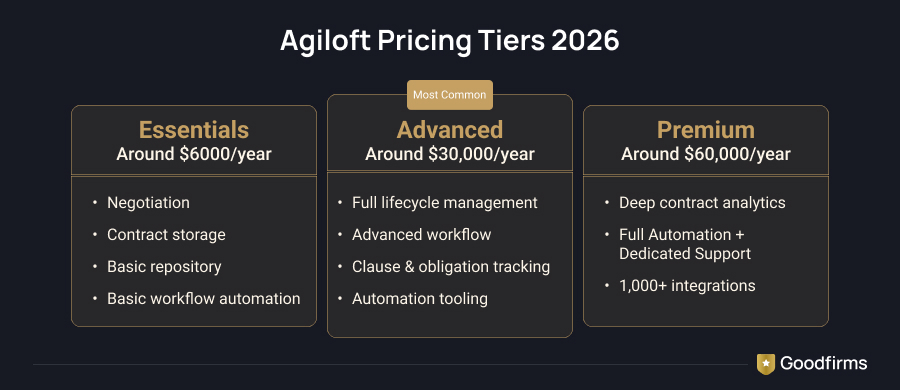
Since Agiloft doesn't publish pricing on its website, the one usable reference point is transaction data from third-party CLM research and Vendr's marketplace, which tracks what real buyers have actually paid. That data points to three pricing tiers of Agiloft — Essentials, Advanced, and Premium — with annual costs running from around $6,000 to over $60,000, depending on user count, features, and integrations.
|
Tier |
Estimated annual cost (third-party research) |
What it typically includes |
|---|---|---|
|
Essentials |
Around $6,000 |
Core contract management: negotiation, execution, storage, a repository, and basic workflow automation |
|
Advanced |
Around $30,000 |
Full lifecycle management, advanced workflow design, clause and obligation tracking, and automation tooling |
|
Premium |
$60,000 and up |
Deep contract analytics, full automation, dedicated implementation support, and access to the 1,000+ tool integration hub |
It's worth noting that these figures aren't confirmed by Agiloft directly; they're directional estimates rather than a fixed price list. Agiloft prices every deal individually based on user count, contract volume, and configuration, so an exact number can only be obtained by requesting a quote directly.
If you’re still comparing platforms before committing to Agiloft, explore Goodfirms’ contract management software to compare CLM tools, features, and alternatives.
A note on our methodology: Agiloft doesn't publish pricing publicly, so every figure in this guide is either sourced from Vendr's marketplace data (based on real buyer transactions) or from third-party CLM pricing research and industry analyses. We've labeled estimates as estimates throughout, and you should treat all numbers here as directional — a starting point for your own conversation with sales, not a substitute for a formal quote.
Astra Public Pricing
There’s a different pricing arc of Agiloft in which it publishes pricing to Astra, its standalone contract-intelligence product.
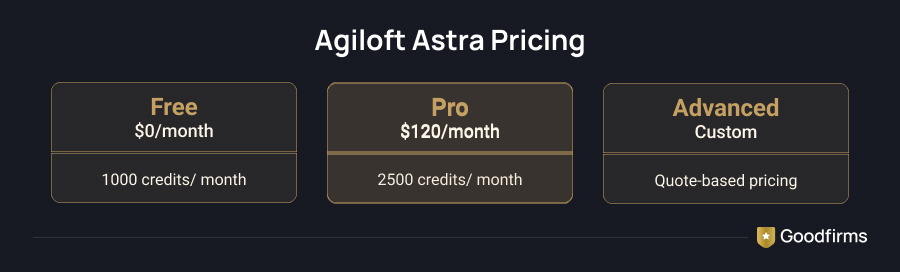
According to Agiloft's Astra page, Astra comes with a free tier ($0/month, 1,000 analysis credits, with Microsoft Word contract reviews not counted against that credit total) and a Pro tier at $120/month. In contrast, the Advanced tier remains custom-quoted like everything else Agiloft sells.
Chief Product Officer Andy Wishart has described the company's ambition to transform CLM "from a system of record into a system of autonomous action." It is worth noting that though Astra's public pricing is separate from core Agiloft CLM pricing, it's not a reliable signal of what your own Agiloft deployment will cost — that still comes down to a custom quote.
Next, let's take a look at how Agiloft pricing sits next to other CLM platforms.
How Agiloft Pricing Compares to Other CLM Platforms
Most vendors do not publish rates in enterprise CLM; they quote on a custom basis. They can be compared on what buyers actually pay, based on Vendr's transaction data.
|
Platform |
What buyers actually pay |
Features included |
|---|---|---|
|
Agiloft |
$67,132 median (range $62,629–$80,344), per Vendr |
Yes, plus paid add-ons |
|
Ironclad |
$40,000 median across 363 purchases (range $15,000–$104,272), per Vendr |
Custom-scoped |
|
DocuSign CLM |
$20,000–$60,000 at 10–25 users, scaling to $200,000+ above 100 users, per Vendr |
Modular |
|
SpotDraft |
$10,000–$30,000/year depending on company size (50–500 employees) |
Included in package |
Mid-market CLM tools range between $15,000–$50,000, so Agiloft's Advanced tier falls within that range. SpotDraft sits at the lower end of that same range, making it a common alternative for smaller legal ops teams. Ironclad and DocuSign CLM scale sit in the higher end as user counts and contract volume grow.
The wider CLM software market is valued at $3.30 billion in 2026 and is projected to reach $7.79 billion by 2033, growing at a 13.2% CAGR, according to Coherent Market Insights, so pricing across Agiloft, Ironclad, DocuSign CLM, and SpotDraft alike is likely to keep shifting as vendors compete for the same enterprise budgets.
Knowing where Agiloft sits relative to Ironclad, DocuSign, and SpotDraft is useful, but it won't tell you where the sticker price will land. What actually shows up on the invoice often looks quite different from the quote.
What are the Hidden Costs of Agiloft?
A widely cited CLM pricing analysis estimates the license fee typically covers only 30-40% of the total cost of ownership over a three-year window — the rest comes from costs that get mentioned during the sales process but rarely make it into the headline number, according to industry pricing guides:
- Implementation fees generally range from $5,000 to $75,000, depending on how much customization and data migration the rollout requires
- Premium support, usually priced at 20-30% of the annual license fee
- SSO authentication, often sold as a separate add-on rather than bundled in
- Sandbox environments, typically $750 to $1,500 per month for each one you need
- Data migration, commonly billed at $100 to $500 per gigabyte for legacy contract cleanup and import
Individually, none of these hidden costs looks alarming. But put together — premium support at 20-30% of the license, implementation at $5,000 to $75,000, plus SSO and sandbox add-ons — and a buyer's real first-year spend can land well above the quoted license number. The gap is most dramatic for Essentials-tier buyers: even the low end of implementation costs can exceed the entire annual license fee. In contrast, Premium-tier buyers see a smaller proportional increase, since their license fee already accounts for a larger share of the total.
Cost and timeline go hand in hand. Every extra week of configuration adds to the services bill.
What is the Timeline to Implement Agiloft?
Based on patterns reported by current users, a straightforward deployment in a single department with modest customization and not much legacy data typically takes 8 to 12 weeks from kickoff to go-live.
Organizations rolling out across multiple departments with custom workflows, deep integrations, and a full data migration should plan for about 6 months. If legacy contract data is messy and requires significant cleanup before import, then it takes longer.
Agiloft has reported a 99.6% implementation success rate and a 97% customer retention rate, which emphasizes how well the platform performs once it's live. However, reaching that level takes time and requires more hands-on configuration than lighter-weight CLM tools do.
The next step is about a budget you can actually defend internally.
How do you Budget for Agiloft?
Here are a few practical steps to help plan an Agiloft budget.
1. Ask for a three-year total, not just an annual license quote. This forces them to include implementation and support costs upfront, so you're not blindsided by extra charges after you've already signed.
2. Scope your integration list before the sales call. Knowing exactly which systems need to connect — your e-signature tool, your ERP, your CRM — lets the vendor quote integration work accurately rather than overestimating.
3. Confirm which AI features are bundled and which are add-ons. ConvoAI, the AI contract review tools, and the full integration hub aren't always included by default outside Premium.
4. Budget separately for training time. Even with a capable in-house team, admin certification adds real weeks to the timeline that should be reflected in your internal project plan.
5. Explicitly state the support tier cost. Since premium support can run 20-30% of your license fee annually, it's a recurring cost that deserves its own line in the budget, not an afterthought.
A point to ponder: for an Essentials-tier buyer paying around $6,000 a year, implementation fees alone can range from $5,000 to $75,000 — meaning the one-time setup cost can equal or exceed the cost of the software itself in year one. For smaller deployments in particular, the license is often the cheaper half of the bill, not the more expensive one. Budgeting around the subscription price alone misses where the real spend is likely to land. Implementation is a major part of the total cost, so it’s worth comparing implementation service provider before finalizing your rollout budget.
One of those budget line items deserves its own closer look: whether you handle implementation in-house or bring in outside help.
Should you hire an Agiloft Implementation Service Provider?
Agiloft offers its own implementation support in the Premium tier. But mid-size to enterprise buyers hire a certified third-party implementation partner, either in place of Agiloft's own team or working alongside it.
Self-implementation works fine for a small, single-department deployment with minimal customization. But once certification requirements, multi-month timelines, and the fact that most of the cost lies in services rather than the license fee come into play, then larger deployments require outside help.
Anything involving multiple integrations, legacy contract migration, or Advanced/Premium-tier features benefits from a partner who's done Agiloft rollouts before. It shortens the timeline and reduces the risk of costly rework on early configuration decisions.
Hourly rates and specializations vary from provider to provider, so it makes sense to compare more than one before requesting a quote. A few examples from Goodfirms' research-backed reviews and ratings of Agiloft implementation service providers:
|
Provider |
Rating |
Hourly rate |
Notable for |
|---|---|---|---|
|
Itransition |
5.0 |
$25–49/hr |
Enterprise-level implementations, operating since 1998 |
|
Collins Technology Consulting |
Not yet rated |
Under $25/hr |
Agiloft Platinum Partner specializes exclusively in Agiloft and CLM workflow automation |
|
SDLC Corp |
4.9 |
$25–49/hr |
High review volume, full-spectrum software, and digital transformation work |
|
Agile Infoways LLC |
5.0 |
Under $25/hr |
19+ years in enterprise software, ISO 9001:2015 Certified |
Itransition brings deep enterprise experience since 1998, while Collins Technology Consulting's Agiloft Platinum Partner status means certification that a generalist firm won't have — often worth more than a lower hourly rate when it comes to avoiding rework. SDLC Corp stands out for its full-spectrum software and digital transformation capabilities, while Agile Infoways LLC brings ISO 9001:2015 certification and nearly two decades of experience in enterprise software.
For broader contract lifecycle management expertise, you can also compare CLM consulting companies specializing in implementation, migration, workflow design, and integrations.
Concluding Remarks
Agiloft pricing rewards buyers who ask the right questions upfront. Once you know which tier fits your contract volume, which add-ons you actually need, and what a realistic implementation timeline looks like, the quote-based model stops feeling opaque and starts looking like any other enterprise software negotiation — one where preparation determines the outcome as much as the vendor's list of features does.
A few quick answers to the questions that come up first.
FAQs- Agiloft Pricing Guide 2026
Does Agiloft publish its pricing publicly?
No. Agiloft uses a custom, quote-based pricing model across its Essentials, Advanced, and Premium tiers, so exact costs depend on user count, contract volume, and required integrations.
How much does a typical company spend on Agiloft per year?
Based on Vendr marketplace data, the median Agiloft buyer pays $67,132 annually, though costs range from around $6,000 to $60,000 or more, depending on tier and scope.
How long does Agiloft take to implement?
Simple, single-department rollouts typically take 8 to 12 weeks. Enterprise deployments involving heavy customization, multiple integrations, and legacy data migration can take 6 months or longer.
Is Agiloft a good fit for small businesses?
Agiloft is built primarily for mid-sized and large enterprises. Smaller teams often find the certification requirements and total cost of ownership harder to justify compared to lighter-weight CLM tools.
What's the highest hidden cost in an Agiloft deployment?
Implementation services and premium support are the two largest unplanned costs in an Agiloft deployment — implementation typically runs $5,000-$75,000, while premium support adds 20-30% of the annual license fee.


.jpg)