Key takeaways
- In-house AI brand tracking can be cost-effective, with self-service tools often starting below $100/month.
- GEO agencies cost considerably more, but then you are paying for strategy, expertise, execution, and reporting and not just software.
- The build-vs-buy decision depends on five factors: bandwidth, skills, budget, urgency, and monitoring complexity.
- A hybrid model can work well: keep routine tracking in-house and use specialists for strategy and visibility improvements.
Someone searches for the “best mobile app developers,” and your brand shows up in a ChatGPT answer.
Great!
But then, the problem is that GPT threw up an answer, which wasn’t entirely correct.
Or it could be the other way: your brand name was skipped entirely while naming two competitors like they’re old friends.
Now the marketing guys on your team want to know why. That’s the moment a marketing director opens eleven tabs — one of them a calculator, one of them a half-written Slack message to the CMO — and starts hunting for
AI brand mention tracking tools.
But the real question underneath the search isn’t:
“Which tool should we buy?”
It’s:
“Should we build this capability in-house or hire a GEO agency that already knows how to do it?”
Both paths can work. And neither is free. And the software subscription is only one piece of the bill.
What Is AI Brand Mention Tracking?
AI brand mention tracking is the process of monitoring whether, how often, and in what context AI systems such as ChatGPT, Gemini, Claude, and Perplexity mention, cite, describe, or recommend your brand.
Think of it as SEO rank tracking’s weirder, moodier cousin.
Traditional rank tracking is relatively straightforward. You monitor where a page ranks for a keyword and check whether that position changes over time.
AI answers are less consistent.
The prompt can change. The model can change. Results may vary across repeated queries, and additional context can alter the response.
What you measure is different too.
A Google ranking gives you a position. An AI answer gives you a response that needs interpretation.
You may need to ask:
- Was the brand mentioned?
- Was it recommended?
- Was the description accurate?
- Which sources were cited?
- Did a competitor receive the stronger recommendation?
There is also no single Search Console equivalent for AI visibility.
No one dashboard provides a definitive record of how your brand appears across every major AI platform.
That is why AI visibility tracking usually combines scheduled prompts, response logging, competitor comparisons, citation analysis, and human judgment.
And inside many companies, this work lands with the SEO or content team, often without additional resources.
That is where the build in-house vs. hire a GEO agency decision becomes important.
Need help tracking how AI answers mention and recommend your brand? Compare GEO agencies on Goodfirms by client reviews, services, and pricing.
Building AI Brand Mention Tracking In-House: Stack, Skills & Cost
You can absolutely build AI Brand Mention internally, too. In fact, plenty of teams are already building this.
Just don’t make the mistake of assuming: “The tool costs $99, so this costs us $99.”
It doesn’t.
The Tooling Stack
At minimum, you need a way to:
- run a repeatable set of buyer-style prompts
- check multiple AI engines
- record brand mentions and recommendations
- monitor competitors in the same responses
- identify cited sources
- compare results over time
- and turn the whole thing into something leadership can understand.
The good news is that the software itself does not necessarily require an enterprise budget.
For example, Citations.io currently publishes three standard tiers at:
- $39/month for 25 tracked prompts;
- $69/month for 75 tracked prompts;
- $99/month for 150 tracked prompts.
Its plans cover ChatGPT, Perplexity, Gemini, and Claude, with higher tiers adding more brands, competitors, reporting, and alerts.
CitePulse publishes another pricing model:
- $89/month for its Shield plan;
- $169/month for Protect;
- $349/month for Scale, which includes up to 10 client domains.
Its monitoring covers combinations of ChatGPT, Perplexity, Gemini, and Grok depending on the plan.
So the useful takeaway is not:
“AI visibility software costs X.”
The market is too young and varied for that.
It is: You can get started for tens of dollars per month. Costs increase as you add prompt volume, brands, markets, engines, competitors, reporting, and enterprise controls.
Running AI brand mention tracking in-house? Compare engine coverage, prompt frequency, and citation reporting in the Goodfirms AI visibility tools buyer’s guide.
The Skills Are the Expensive Part
Somebody still has to decide what to ask. And this is where things get messy.
A useful prompt is not:“best payroll software” wearing a question mark.
It should look like the actual questions a buyer might ask:
“Which payroll platforms are best for a 200-person company with employees in the U.S. and UK?”
Then somebody has to read the answers and check.
- Was your brand merely mentioned?
- Was it actually recommended?
- Was something factually wrong?
- Was a competitor consistently positioned better?
- Which websites seem to be influencing the answer?
And, most importantly:
What are you going to change on the basis of what you found? Prompt testing without interpretation is just a growing spreadsheet.
The Hidden Cost Is Staff Time
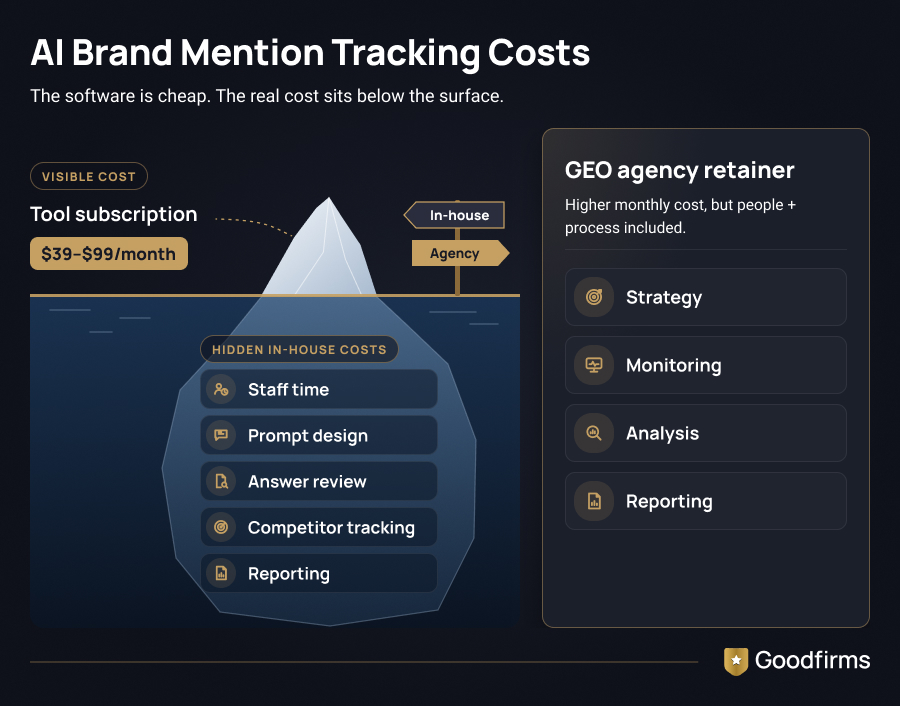
This is where I would avoid pretending there is a universal “six hours per week” number.
There isn’t.
Your workload depends on:
- how many prompts you track
- how many AI engines you test
- how often you rerun them
- how many competitors you compare
- whether you monitor one brand or ten
- and how detailed your reporting needs to be.
But someone has to own it.
That means refreshing prompts, investigating changes, reading responses, checking citations, reporting trends, and deciding what deserves action.
The subscription may be cheap. What raises the price is the person doing all that work.
In-House Also Has a Ramp-Up Cost
There is some useful external evidence here.
First Page Sage’s 2026 GEO/AEO pricing study paired agency-pricing data with a survey of 362 marketing leaders running GEO/AEO internally.
Its cost model estimated that an in-house GEO/AEO specialist took 13.6 weeks to a first deliverable, compared with 3.4 weeks for a Growth-tier agency.
Importantly, the researchers say much of the in-house delay came from recruiting time, so this should not be read as “GEO takes 13.6 weeks to learn.”
Still, the broader point stands:
If you already have the right person, building internally is one thing. If you have to hire and build the capability from scratch, that changes the economics considerably.
Where In-House Usually Makes Sense
In-house is attractive when:
- you have one or a small number of brands;
- somebody already understands SEO, content, and analytics;
- your team has real capacity;
- leadership does not need a polished program immediately;
- and you want direct ownership of the prompts, methodology, and data.
If your team is already stretched to breaking point, adding “AI visibility analyst” onto somebody’s existing job description may be less cheap than it looks.
Hiring a GEO Agency: What Are You Actually Paying For?
A GEO agency can run much of the same monitoring.
The difference is that you are paying for a ready-made process.
Ideally, that means:
- an existing prompt methodology
- analysts who already know how to read AI outputs
- competitive benchmarking
- reporting infrastructure
- citation/source analysis
- and recommendations tied to actual content or technical work.
Instead of figuring out how to build the machine, you are renting one that already runs.
At least, that’s the theory.
What Might Be Included
A typical engagement can include:
- a baseline AI visibility audit;
- recurring monitoring across relevant AI engines;
- competitor share-of-voice analysis;
- sentiment or positioning analysis;
- citation-source analysis;
- recommendations for content changes;
- technical or structured-data recommendations;
and recurring reporting or strategy sessions. The important word there is can. GEO is still a young category.
Two agencies charging the same amount may be selling completely different things.
Which brings us to money.
How Much Does a GEO Agency Cost?
This is one place where we now have better data than vague “it depends” estimates.
First Page Sage published a 2026 pricing study based on 1,146 GEO and AEO quotes from 214 agencies, collected from published pricing pages, proposals, and signed contracts.
It found an overall median monthly GEO/AEO retainer of $6,850.
Its reported pricing bands were:
| Engagement | Monthly range | Median |
|---|---|---|
| Starter | 1,800–4,200 | $2,950 |
| Growth | 4,500–11,000 | $7,400 |
| Advanced | 11,000–22,000 | $14,600 |
| Enterprise | 22,000–60,000+ | $31,500 |
The same research found that 68% of agencies priced GEO/AEO as either a custom or tiered monthly retainer.
Custom monthly retainers typically fell between $3,000 and $15,000, while tiered packages ranged from about $2,500 to $25,000/month.
There is one caveat worth stating loudly: First Page Sage is itself a GEO/SEO agency.
So I would use this as a useful market dataset — particularly because it publishes its sample and methodology — but not treat it as an official industry price index.
The market is young. Prices will keep moving.
In-House vs. Agency Cost Is Not as Simple as Tool Fee vs. Retainer
This is where build-vs-buy comparisons often become misleading.
They compare:
$99 software
against:
$7,000 agency retainer
and announce that in-house is obviously cheaper.
Well, yes.
If the employee doing all the work happens to be free.
First Page Sage’s model estimated:
- $146,028/year for one in-house GEO/AEO specialist;
- $363,512/year for a three-person internal team;
- $98,400/year for a Growth-tier agency;
- $227,228/year for a hybrid setup combining an internal specialist with an agency.
Those figures rely on that company's salary and cost assumptions, so I would not copy them directly into your budget.
But they illustrate an important point: In-house does not mean free.
Software is usually the easy line item to see.
Salary, training, management, opportunity cost, and the time spent building the process are easier to miss.
5 Red Flags When Hiring a GEO Agency
Now for the fun part. GEO is new. Which means there are some excellent specialists. And there are also SEO decks wearing a fresh coat of GEO paint.
Watch for these.
1. They Won’t Show You a Live Prompt Test
If the entire pitch lives in PowerPoint, ask questions.
A vendor selling AI visibility monitoring should be comfortable showing you an actual AI answer and walking through what they measure.
2. They Count Mentions Without Showing the Answer
“Your brand appeared 47 times.”
Great.
Was it recommended? Criticized? Listed behind six competitors? Misrepresented?
A mention count without context can be almost meaningless.
3. They Can’t Explain Their Prompt Methodology
Ask:
Who writes the prompts?
Where do they come from?
How often are they refreshed?
How do you keep comparisons consistent over time?
You should get a real answer. Not interpretive dance.
4. They Guarantee Top Placement in AI Answers
Run.
Nobody controls ChatGPT, Gemini, Claude, or Perplexity results.
Nobody. Full stop.
Even monitoring platforms themselves acknowledge that visibility is not something they can guarantee. CitePulse, for example, explicitly states that users “do not buy a citation” and that no one can guarantee one.
5. They Won’t Show a Sample Report
If you are paying thousands a month for visibility reporting, you should know what the report looks like before signing the contract.
A real GEO partner should be comfortable showing how raw AI answers become findings, actions, and reporting.
How Do You Choose a Good GEO Agency?
The category is too young to rely on ten years of historical performance.
So look for evidence you can inspect now.
Client reviews matter.
But don't stop at:“Great agency. Five stars.”
Look for reviews that describe:
- what was actually done;
- whether specific outcomes changed;
- how transparent the reporting was;
- whether the same strengths appear across multiple clients;
- and whether the agency genuinely works in GEO rather than simply adding the term to its SEO services page.
You can compare GEO agencies on Goodfirms by reviews, service focus, pricing information, and other profile details before getting pulled into five sales calls.
Before you shortlist anyone, ask:
- Can you show us a sample report?
- Which AI engines do you currently track?
- How do you build and refresh prompt libraries?
- How do you distinguish a mention from a recommendation?
- Can we see the raw AI responses behind the metrics?
- How do you handle model changes?
- What do we retain if we end the engagement?
- Which parts of your work are monitoring, and which parts are actual optimization?
If the answers get fuzzy, that tells you something too.
Build In-House or Hire a GEO Agency? A 5-Factor Decision Framework
Forget the grand strategy deck for a minute. Answer these five questions.
| Factor | In-house points toward | Agency points toward |
|---|---|---|
| Bandwidth | Someone has genuine spare capacity | Team is already overloaded |
| Skill | Existing SEO/content/analytics expertise | Significant ramp-up required |
| Budget | Staff capacity exists; cash budget is tighter | Predictable outside budget is available |
| Urgency | You can build and refine gradually | Leadership needs a working program quickly |
| Scale | One brand, limited markets | Multiple brands, markets, products or languages |
1. Bandwidth
Do you actually have the hours?
Not: “We can probably squeeze it in.”
We are talking about “actual hours.”
If the person you assign already owns SEO, content strategy, analytics, reporting, and whatever emergency landed in Slack this morning, your “in-house program” may become a dashboard nobody updates.
2. Skill
Does someone already know how to:
- design repeatable buyer prompts
- evaluate AI answers
- analyze citations
- compare competitors
- and turn noisy data into decisions
If yes, great. If not, include the learning curve in the build plan.
3. Budget
If cash is limited but you already have capable staff with capacity, an in-house setup can be attractive because self-service monitoring software can start very cheaply.
If the team has no spare capacity but you can fund a predictable retainer, hiring may make more sense.
Don't compare only invoices. Compare total resources.
4. Urgency
Do you need useful reporting this quarter?
Or is leadership comfortable letting the team test tools, build prompts, establish baselines, and refine the process?
First Page Sage's 2026 model found agencies reaching a first deliverable materially faster than newly built in-house teams, although recruiting accounted for much of that gap.
If time matters, that deserves a line in the spreadsheet.
5. Number of Brands, Markets, and Products
One brand in one market is one thing.
Five brands across three markets and four languages is another.
Every additional brand multiplies:
prompts,
competitors,
responses,
citations,
and reporting.
Scale can turn a manageable monitoring habit into somebody's actual job surprisingly quickly.
What About a Hybrid Model?
This may be the most interesting option for teams sitting in the middle.
You might:
keep routine monitoring in-house
while using an agency for:
- methodology;
- quarterly deep dives;
- competitor analysis;
- content strategy;
- technical fixes;
- or major launches.
That gives your internal team direct visibility without requiring them to build every piece of the program alone.
I would not claim that “most mid-size companies do this.”
We do not have evidence for that.
But for a mid-size company with some internal capability and limited specialist expertise, it can be a very rational compromise. If your team already tracks AI mentions and needs help updating the content those findings point to, compare content marketing agencies on Goodfirms.
FAQ
What are AI brand mention tracking tools?
AI brand mention tracking tools monitor how brands appear in responses from AI systems such as ChatGPT,
Gemini, Claude, and Perplexity. Depending on the platform, they can track mentions, recommendations, competitors, cited sources, sentiment, share of voice, and changes over time.
How much do AI brand mention tracking tools cost?
Published self-service pricing varies significantly.
For example, Citations.io currently charges $39, $69, or $99/month across its standard tiers, while CitePulse lists standard monitoring plans at $89, $169, and $349/month. Enterprise and high-volume requirements can cost more.
How much does a GEO agency cost?
A 2026 First Page Sage study of 1,146 GEO/AEO quotes found an overall median retainer of $6,850/month.
Starter engagements ranged from 1,800–4,200/month, Growth from 4,500–11,000, Advanced from 11,000–22,000, and Enterprise from 22,000–60,000+.
Actual pricing depends heavily on scope, markets, brands, deliverables, and whether the engagement includes only monitoring or also content and optimization.
Can a small business track AI visibility without an agency?
Yes.
For one brand and a manageable prompt set, a small team can start with a self-service tool and a regular review process.
The main question is not whether the software exists.
It does.
The question is whether someone will consistently own the monitoring, interpretation, and follow-up.
Which GEO agencies have the best reviews?
There is no single agency that is automatically right for every company.
Look for verified client feedback, evidence of actual GEO work, transparent methodology, sample reporting, clear pricing or scope, and experience relevant to your market.
The Decision Is Less About Software Than It Looks
At first glance, this looks like a tooling decision.
It isn't.
You can buy AI visibility software for less than the cost of a team lunch.
The harder questions are:
Who owns it?
Who understands the answers?
Who decides what changes next?
If you have that person internally, building your own AI brand mention tracking process can make a lot of sense.
If you don't, buying five tools will not magically create them.
And if your leadership needs reliable monitoring, strategy, and reporting quickly, the agency premium may be paying for something very specific:
not the dashboard, but the people who know what to do with it.
If you're ready to compare specialists instead of building the whole thing from scratch, browse GEO service providers on Goodfirms and shortlist agencies by reviews, service focus, pricing, and specialization before you sign anything.
Reference Sources
- Citations.io pricing — $39, $69, and $99/month for 25, 75, and 150 tracked prompts.
- CitePulse pricing — $89, $169, and $349/month, with coverage and limits by tier.
- First Page Sage’s 2026 pricing report — $6,850 median monthly retainer, agency pricing bands, and modeled costs and timelines.
- OpenAI API documentation — Chat Completions can vary across repeated requests.
- Google Search Central — AI Overviews and AI Mode are included in Search Console’s Web performance report.
- CitePulse terms — CitePulse offers monitoring without guaranteeing citations.