Key takeaways
- Ranking on Google no longer guarantees that a brand gets seen; if AI doesn't mention it, the buyer may never discover it.
- Semrush proved the gap is closable fast: acting on AI visibility data took its AI share of voice from 13% to 32% in one month.
- Getting mentioned isn't winning. Birdeye's data shows 80% of brands appear in AI answers, but only 15% actually claim the top spot.
- AI visibility tools don't have a fixed price; costs can range from about $25 to $500+ per month, depending on the platform, engine coverage, prompt volume, and included features.
- SEO and AI visibility aren't the same race. One earns rankings; the other earns recommendations, and brands need both to actually compete.
Try asking ChatGPT which is the best project management tool, and look how confidently it recommends some without ever visiting their website.
That’s the real shift most brands haven’t caught up to yet. Search is moving from “search and click” to “search and answer.” A 2026 study found that AI Overviews appeared for 51.5% of representative real-user queries, while users clicked sources cited within an AI Overview in only about 1% of visits.
Yet only 14% of marketers currently track AI visibility, according to Goodfirms research, leaving most brands without a clear picture of how often they appear in AI-generated answers.
What this means for brands is simple: users can now discover, evaluate, and form an opinion about a brand without ever visiting its website. That makes tracking how brands appear in AI-generated answers increasingly important.
|
Comparison Factor |
Traditional SEO |
AI Visibility |
|---|---|---|
|
Measures |
Page ranking in search results |
Brand mentions in AI answers |
|
Happens On |
Google, Bing |
ChatGPT, Gemini, Perplexity, AI Overviews |
|
Key Signal |
Backlinks, keywords |
Mentions, citations, sentiment |
This guide includes what these tools actually track, provides a simple framework for choosing one, and compares the AI visibility platforms worth considering right now.
Ready to strengthen your brand's presence? Explore top-rated AI visibility tools on Goodfirms today.
What Is an AI Visibility Tool?
An AI visibility tool is software that tracks how a brand appears in AI-generated answers across platforms such as ChatGPT, Gemini, Google AI Overviews, Perplexity, and Claude. It tracks factors such as brand mentions, citations, recommendations, sentiment, and competitor visibility to show how a brand appears across AI platforms.
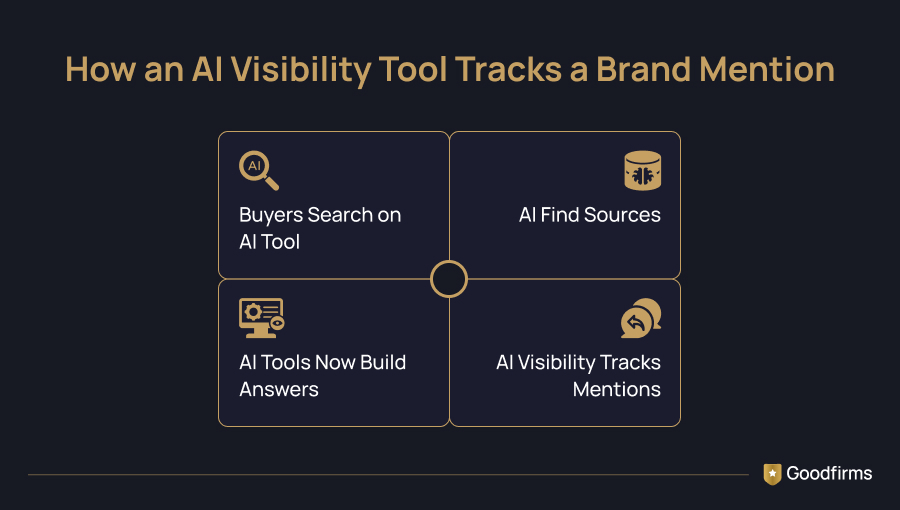
Unlike traditional SEO software that focuses only on search rankings, AI visibility tools show how AI systems discover, describe, and recommend a brand. They can also reveal which websites influence AI responses and where competitors gain visibility.
For businesses, these tools turn AI visibility into something you can monitor consistently over time, rather than manually checking everything every few weeks by typing prompts into ChatGPT.
Why Do Businesses Need AI Visibility Tools?
There are multiple reasons why businesses often require AI visibility tools: today, most users ask AI tools for recommendations before visiting any website, and a brand missing from those recommendations never gets a chance to compete.
- Monitor Conversational Engines: Track whether ChatGPT, Gemini, Perplexity, and Copilot mention your brand when real buyers ask category-specific questions, not just whether you rank on Google.
- Analyze Share of Voice: Measure how often you're recommended against named competitors. Semrush has publicly reported that its AI share of voice jumped from 13% to 32% in a single month after acting on this data.
- Uncover Citation Gaps: Identify the exact topics or queries where a brand never appears, turning "we're invisible in AI search" into a specific, fixable list of missing content.
- Manage Sentiment: Confirm whether AI platforms describe a company accurately and favorably, since a factual error repeated across thousands of AI answers can quietly damage trust at scale.
- Fix Technical Blockers: Audit whether AI crawlers can actually read and parse a site's content, since a page an AI can't ingest is a page it can never cite, no matter how good the content is.
- Capture High-Intent Traffic: Protect the buyers already convinced by an AI's recommendation. Traffic that arrives pre-sold by a trusted assistant tends to convert at a higher rate than traffic from a cold click on a results page.
- Benchmark Against Competitors in Real Time: See not just whether a rival is mentioned more often, but which of their pages the AI is citing to justify the recommendation intelligence that a Google rank tracker was never built to show.
Why AI Visibility Is Harder to Measure Than Traditional Search Visibility
AI visibility is considered more complex to measure than traditional visibility because it doesn’t have a fixed ranking position to check, as even the same prompt can return a different answer every time it’s asked, even with nothing on your site changed. Other reasons include:
- There's no single "position #1": Google gives you a rank that is considered SEO. However, ChatGPT, Gemini, and Perplexity give you an answer sometimes you're named first, sometimes third, sometimes not at all, and the model isn't obligated to be consistent between two people asking the exact same thing minutes apart.
- Every AI Model works differently: ChatGPT, Google AI Overviews, Gemini, Perplexity, and Claude each pull from different sources, weigh freshness and authority differently, and update on their own release schedule, so an AI visibility score in one engine rarely predicts your standing in another.
- There's no public API for "how did you decide this": With traditional SEO, tools like Ahrefs or Semrush can crawl the web and reverse-engineer ranking factors. AI engines don't expose that logic, so AI visibility tracking software has to approximate it by running large batches of real prompts repeatedly and treating the pattern of answers as the signal.
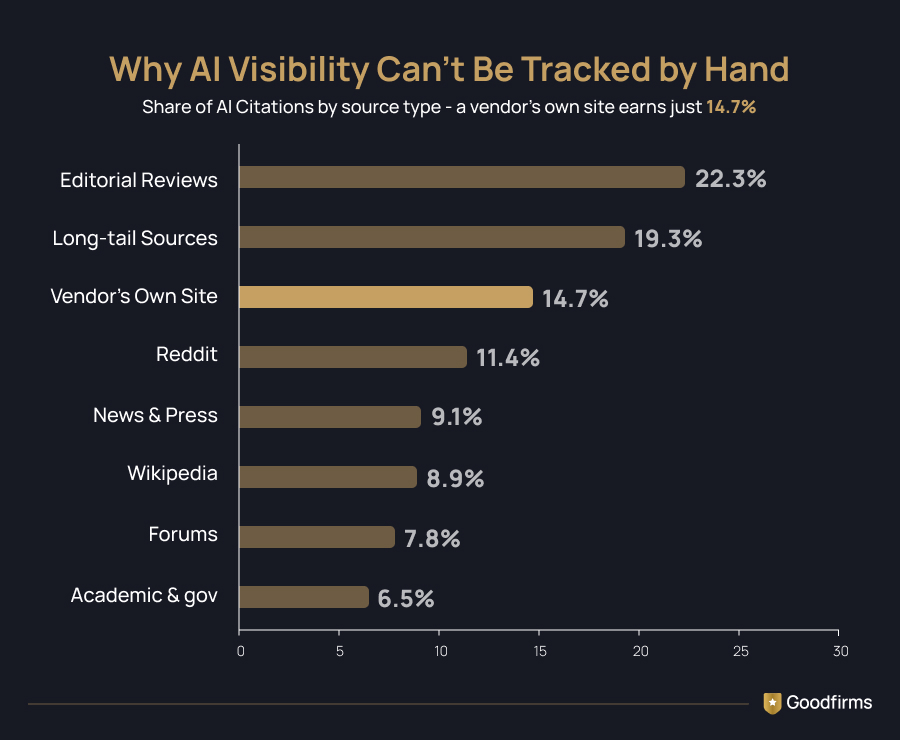
- A brand's own site barely factors in: A 2026 study of 1,200 buyer-intent prompts across ChatGPT, Claude, Gemini, and Perplexity found that a vendor's own site accounts for just 14.7% of AI citations in editorial reviews (22.3%), with long-tail sources (19.3%) outweighing it. Most of a brand's AI visibility lives on pages it doesn't control, which is exactly why it can't be checked by eyeballing a few prompts.
- Personalization confuses the reading: AI generally recommends results based on your chat history, location, and past questions, which can make it seem like one person’s “invisible” brand can be a top pick for another.
- Citations aren't rankings: Being cited as a source and being recommended as the best option are two different outcomes, and many AI visibility monitoring tools still blur the line between the two in their reporting, even though a buyer cares about which one they're actually getting.
- Volume makes manual checking impossible: A team can type ten prompts into ChatGPT and call it a spot-check, but real AI visibility tracking means running hundreds of prompt variations across five engines on a schedule, at a scale no person will do by hand every week.
What Do AI Visibility Tools Actually Track?
AI visibility tools track how often, where, and in what contexts a brand appears in AI-generated answers. Depending on the platform, they monitor brand mentions, citations, share of voice, sentiment, recommendations, competitors, and the sources AI systems rely on.
- AI Brand Mentions: Whether a brand's name comes up at all when someone asks an AI a relevant question is the most basic sign of AI visibility, and still the one most brands haven't checked.
- AI Citation Tracking: Which specific pages an AI pulled from to build its answer, turning a vague "we're not showing up" into a real list of content gaps to fix.
- AI Share of Voice: These tools help brands track how often their brand is mentioned compared to competitors within the same category of prompts, an AI-era version of a ranking comparison.
- AI Sentiment Tracking: Whether the AI describes a brand favorably, neutrally, or gets something wrong. A brand can be mentioned constantly and still be losing business if the sentiment is off.
- AI Recommendation Tracking: Not just a mention, but whether the AI actually suggests the brand in response to a buying question is the metric that maps most closely to real revenue impact.
- AI Search Rankings by Engine: How visibility differs between ChatGPT, Gemini, Perplexity, Claude, and Google AI Mode in the search era, since a brand can be strong in one and nearly absent in another.
- AI Competitor Tracking: Which competitors are showing up in the same prompts, and how often the direct benchmark most brands are missing entirely.
- AI Source Analysis: The pattern of domains an AI trusts enough to cite repeatedly in a category, which often points to exactly where to get published or featured next
How to Choose an AI Visibility Tool
Choosing the right AI visibility tool comes down to matching engine coverage, prompt methodology, and pricing to what a brand actually needs to track, not picking whichever platform lists the most features. For brands that also need to improve their presence in AI-generated answers, partnering with generative engine optimization companies can turn those visibility insights into a broader optimization strategy.
- Confirm engine coverage first: Coverage varies widely across tools; some track only ChatGPT and Gemini, while others cover five or more engines, including Perplexity and Google AI Overviews. Since visibility differs by engine, a narrow tool only ever shows part of the picture.
- Check the prompt methodology: A tool that runs a handful of prompts once a week can't capture the day-to-day volatility of real AI answers. Ask exactly how many prompts run per topic and how often they run.
- Prioritize citation-level detail over mention counts: "You were mentioned 12 times" is far less useful than knowing the exact pages the AI cited to reach that answer. That's the difference between data and a to-do list.
- Ask for evidence behind any accuracy claim: If a vendor advertises a specific coverage or accuracy number, ask how it's measured. Ranqo, for instance, backs its visibility claims with a published study of 102 brands that's the kind of receipt worth expecting from any tool making similar claims.
The 8C AI Visibility Tool Buyer Framework
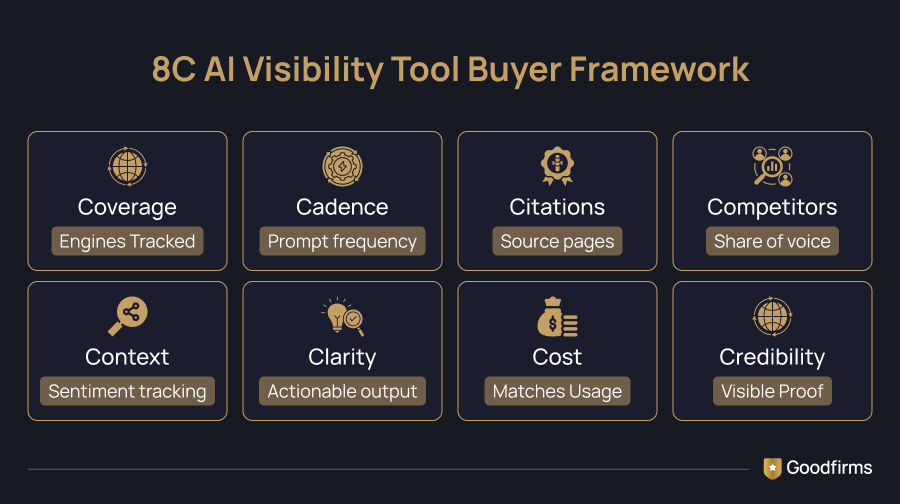
Choosing an AI visibility platform gets complicated quickly because vendors measure visibility differently. The 8C Citable Framework covers an eight-point evaluation model, including Coverage, Cadence, Citations, Competitors, Context, Clarity, Cost, and Credibility, giving buyers a consistent way to compare AI visibility tools rather than judging each one by whatever it happens to advertise.
|
The 8C |
What to Check |
Why It Matters |
|---|---|---|
|
Coverage |
Engines tracked ChatGPT, Gemini, Perplexity, Claude, Google AI Overviews |
Incomplete coverage means an incomplete picture of visibility. |
|
Cadence |
Prompts run per topic, and how often |
Low-frequency sampling misses real day-to-day volatility. |
|
Citations |
Named source pages behind each answer |
Turns a mention count into a fixable content gap. |
|
Competitors |
Share of voice against named rivals |
Visibility only means something measured in context. |
|
Context |
Sentiment and factual accuracy tracking |
A brand can be mentioned often and still be described poorly. |
|
Clarity |
Actionable output vs. raw dashboard |
Identical data can differ completely in real usefulness. |
|
Cost |
Pricing model vs. actual usage pattern |
Mismatched pricing means overpaying or hitting caps fast. |
|
Credibility |
Visible methodology behind vendor claims |
An unverifiable claim is marketing, not data. |
How We Evaluated the Best AI Visibility Tools
Each tool below was scored against the 8C framework, with checks for real engine coverage, prompt cadence, citation depth, and vendor credibility, before a single tool made this list.
- Verify Engine Coverage: Cross-check each vendor's own documentation against ChatGPT, Gemini, Perplexity, Claude, and Google AI Overviews support, rather than trusting a generic "multi-engine" claim.
- Confirm Prompt Cadence: Establish how many prompts each tool runs per topic and how frequently, since low-frequency sampling can't catch real AI answer volatility.
- Demand Citation-Level Data: Rule out tools that report mention counts alone without naming the actual source pages behind each AI answer.
- Pull Live Pricing: Source pricing directly from public vendor plans as of mid-2026, flagging any tool where pricing requires a sales call just to see it.
- Identify Unverifiable Claims: Note any vendor claims about accuracy or coverage numbers that lack a visible methodology.
- Exclude Sponsored Bias: Use vendor blogs and comparison pages only as research inputs to understand the category, never as the basis for the final tool selection.
Best AI Visibility Tools Compared
Semrush, Ahrefs, Birdeye, Rankability, Peec AI, and Surfer AI are among the most established AI visibility tools in 2026, each built for a different kind of buyer, from SEO foundations to AI visibility teams already inside a familiar suite to multi-location enterprises managing thousands of listings.
Here's how the leading platforms compare before we get into the details.
The top AI visibility tools: in a nutshell
|
Tool |
Best for |
Choose if |
Skip if |
|---|---|---|---|
|
Semrush AI Visibility Toolkit |
AI visibility + SEO in one platform |
You want AI tracking paired with SEO and content workflows you already use |
You only need a standalone AI tracker with no SEO layer |
|
AHref Brand Radar |
Existing Ahrefs users, large-scale source research |
You already pay for Ahrefs and want AI mentions cross-referenced with backlink data |
You want a single affordable price for full engine coverage |
|
Birdeye Search AI |
Multi-location and enterprise brands |
You manage visibility across dozens or hundreds of locations |
You're a single-location brand needing simple mention tracking |
|
Rankability |
Agencies combining content + AI tracking |
You want content briefs, optimization, and AI tracking in one dashboard |
You only need visibility monitoring, not a content platform |
|
Peec AI |
Mid-market teams and agencies |
You want project-level flexibility and unlimited seats |
You need a low-cost entry point or broad engine coverage on the base plan |
|
Surfer AI Tracker |
Teams already using Surfer for content |
You want AI visibility added to an existing Surfer workflow |
You need a dedicated, standalone AI visibility platform |
1. Semrush: Best for AI visibility + SEO at any scale
Semrush brings AI visibility tracking, SEO, competitor research, and content optimization into one platform useful because the signals that shape a Google ranking often shape AI visibility too.
Top features
- Large prompt database: Draws on 289M+ real LLM prompts to inform AI search strategy.
- Wide platform coverage: ChatGPT, Perplexity, Gemini, Google AI Overviews, with Claude and others on Enterprise plans.
- Brand performance and sentiment: Show how AI platforms describe a brand versus competitors.
- Competitor benchmarking: Compares visibility, mentions, and citations against named rivals.
What makes it special
- Sits alongside Semrush's existing SEO database, so AI visibility connects directly to backlinks, keywords, and authority signals already being tracked
- Semrush has publicly reported growing its own AI share of voice from 13% to 32% in a single month after acting on this data
Pricing: AI Visibility Toolkit starts at $139/month per domain; Semrush One (SEO + AI bundled) starts at $199/month; Enterprise is custom. (Source)
2. Ahrefs Brand Radar: Best for existing Ahrefs users and source research
Brand Radar points Ahrefs' web-scale crawl index at a new question: how often a brand shows up in AI answers, and which URL the AI pulled the mention from.
Top features
- Six-engine tracking: Google AI Overviews, AI Mode, ChatGPT, Perplexity, Gemini, and Copilot.
- Source-level attribution: Shows the exact URL behind every AI mention of a brand's own site, a Reddit thread, or a competitor's blog.
- Backlink cross-referencing: Correlates AI citations with existing backlink authority data.
What makes it special
- Runs on Ahrefs' long-standing crawl index rather than a newly built one, which gives its source analysis unusual depth
- Bundled alongside YouTube, TikTok, and Reddit mention tracking (currently free in beta)
Pricing: Requires an active Ahrefs plan starting at $129/month; Brand Radar adds $249/month per engine, or $449/month for all six. (Source)
3. Birdeye Search AI: Best for multi-location and enterprise brands
Birdeye is built specifically for brands managing visibility across multiple locations at once, tying AI mention tracking to listings, reviews, and local search data in a single dashboard.
Top features
- Multi-engine tracking: ChatGPT, Gemini, Perplexity, and Copilot
- Location-level intelligence: Rolls up AI visibility, reviews, and listing accuracy across 100 to 10,000+ locations
- Enterprise governance: Corporate-level oversight with local team management underneath
What makes it special
- Birdeye's own 2026 State of AI Search report found 80% of brands are cited at least once in AI-generated answers, but only 15% secure the top position, a gap that compounds fast across many locations
- Recognized as Top AI Product Globally at G2's 2026 Best Software Awards
Pricing: Custom, based on the number of locations and selected products. Public reviews put typical costs between $299 and $700+ per location per month. (Source)
4. Rankability: Best for agencies combining content and AI tracking
Rankability bundles AI search tracking into a broader content optimization platform, so agencies get keyword research, AI-assisted briefs, and visibility monitoring without having to stitch tools together.
Top features
- Crawlability checks: Confirm whether key pages are accessible to AI crawlers in the first place
- Citation and domain tracking: Detects brand mentions and ranks which cited domains dominate a category
- Competitor gap-finding: Surfaces prompts where competitors appear, and a brand doesn't
What makes it special
- Combines content optimization, AI writing, and AI visibility tracking in a single agency-focused platform, rather than three separate tools
- Unlimited clients and users on every plan, differentiating on prompt credits rather than seats
Pricing: Starter $99/month, Scale $399/month, Agency $799/month. All plans include the full platform. (Source)
5. Peec AI: Best for mid-market AI visibility tracking
Peec AI gives marketing teams a straightforward way to track AI visibility without the complexity of enterprise platforms, with custom alerts for sudden gains or losses in visibility.
Top features
- Flexible engine tracking: Choose three LLMs per plan from ChatGPT, Gemini, Perplexity, Claude, and others
- Source analysis: Shows which sites AI tools cite most often, to inform outreach
- Multi-country tracking: Monitors AI search across 80+ countries for localized visibility comparisons
What makes it special
- Unlimited users on every plan, so agencies aren't paying per seat
- Data exports via CSV, Looker Studio, or API for teams building custom reports
Pricing: Starter $80/month (50 prompts), Pro $205/month, Advanced $420/month; agency custom plans. (Source)
6. Surfer AI Tracker: Best for teams already using Surfer for content
Surfer AI Tracker extends Surfer's existing content-optimization workflow into AI visibility monitoring, aimed at teams that want to see where they're winning or losing citations without leaving their current tool.
Top features
- AI mention tracking: Monitors brand appearance across ChatGPT, Gemini, and Google AI Overviews
- Competitor gap visibility: Flags where competitors are winning AI citations
- Integrated workflow: Visibility data sits next to the content briefs and optimization scores teams already use in Surfer
What makes it special
- No separate platform to adopt AI visibility becomes another layer on top of content already being optimized in Surfer
Pricing: AI visibility tracking is an add-on to Surfer's base plans, which start at $99/month (Essential) and $182/month (Scale); Enterprise is $999/month. (Source)
Questions to Ask Before Buying an AI Visibility Tool
Here is a list of questions that you must definitely ask yourself before shortlisting an AI visibility tool:
- Does it cover every major engine? ChatGPT-only tools miss most of the picture; buyers ask Gemini, Perplexity, and Copilot too, and a brand can be strong on one and invisible on another.
- Does it track continuously? A single check is unreliable; the same prompt can return a different answer run to run, so visibility has to be measured on a steady cadence, not eyeballed once a month.
- Does it go to the source level? A mention count without the pages behind it is a vanity metric; the useful data is which URL actually earned the citation.
- Does it benchmark competitors honestly? Share of voice only means something measured against a real competitive set, not reported as a standalone number for your brand alone.
- Does it audit your pages for AI readiness? Visibility starts with being crawlable and citation-ready. A tool that only reports mentions without checking this misses half the problem.
- Does it tell you what to fix? The difference between a report and a tool is that a prioritized action list with data with no next step attached just sits in a dashboard.
Common Mistakes When Buying an AI Visibility Tool
Most bad AI visibility tool purchases come down to the same handful of mistakes: choosing based on price or engine count alone, and treating the dashboard as the finish line rather than the starting point.
- Picking the cheapest option without checking prompt cadence. A low entry price often means fewer tracked prompts and less frequent sampling; the tool ends up too thin to catch real visibility swings, which defeats the purpose of buying it at all.
- Assuming broad engine coverage is included by default. Several LLM SEO tools advertise five or six engines but lock most of them behind higher-tier plans, so you can confirm exactly what's covered at the price you actually pay, not the price on the homepage.
- Treating a mention count as the whole picture. Knowing a brand was mentioned 40 times means little without knowing which pages earned those mentions; that source-level detail is what makes the data usable.
- Ignoring sentiment entirely. A brand can show up constantly and still lose ground if the AI describes it inaccurately or unfavorably. Visibility without sentiment is only half the story.
- Buying without testing the output on a real prompt set. A demo full of polished dashboards can still hand back reports nobody on the team knows how to act on. A trial run, even a short one, exposes this quickly.
- Skipping the question of who benchmarks against whom. Share of voice only means something when measured against a real, named competitive set; a tool that reports a brand's numbers in isolation isn't really benchmarking anything.
- Not asking how a vendor's accuracy claim is calculated. A stated percentage with no visible methodology behind it is a marketing number, not a data point worth building a decision on.
FAQs - AI visibility tool
What is an AI visibility tool?
An AI visibility tool is software that tracks how often and how accurately a brand appears in AI-generated answers from platforms like ChatGPT, Gemini, Perplexity, and Google AI Overviews. It monitors mentions, citations, sentiment, and share of voice against competitors.
How do AI visibility tools work?
They run large sets of real prompts against multiple AI engines on a schedule, then analyze the answers for brand mentions, cited sources, and how the brand is described, turning inconsistent AI outputs into a trackable pattern over time.
Are AI visibility tools worth it?
For brands that depend on buyers researching before purchase, yes, a growing share of searches now end in an AI answer with no click to any website, so a brand absent from that answer is invisible to that portion of demand, regardless of how well it ranks on Google.
What is the difference between AI visibility and SEO?
SEO measures how a page ranks in traditional search results. AI visibility measures whether and how a brand is mentioned inside an AI-generated answer, a related but separate outcome, since strong SEO doesn't guarantee that an AI will cite or recommend the brand.
How much do AI visibility tools cost?
Pricing ranges from around $25–29/month for entry-level monitoring tools to $500+/month for enterprise platforms with full engine coverage and custom prompt volumes. Most mid-market teams land somewhere between $90 and $300/month.
Can AI visibility tools track competitors?
Yes, most tools benchmark a brand's share of voice against named competitors using the same set of prompts, showing not just whether a brand is mentioned but also how often it is mentioned relative to specific rivals.
Which AI visibility tool is best?
There isn't one AI visibility tool that is best for every business. Semrush is a strong choice for teams that want AI visibility alongside SEO. Ahrefs Brand Radar suits existing Ahrefs users; Birdeye is designed for multi-location brands; Rankability fits agencies; and Peec AI is geared toward teams wanting dedicated AI visibility tracking. The right choice depends on engine coverage, prompt volume, citation data, competitor tracking, and budget.
Final Words
AI visibility is becoming something businesses can't afford to ignore.
Picking the right tool really just comes down to three things: which AI engines it actually covers, how deep the tracking goes, and whether the price fits how the team will use it. Not whichever tool has the longest feature list.
Running any shortlist through a framework like the 8C model we covered earlier helps too. It gives the decision something solid to stand on, rather than relying on whatever a sales call promises.
Also worth keeping in mind, AI visibility isn't separate from SEO; it builds on it. A brand with strong SEO fundamentals usually has an easier time getting picked up by AI chatbot tools in the first place. For businesses that need help connecting SEO, content, and AI search strategies, digital marketing companies can help bring these efforts together.
And since pricing and features in this space change often, it's always worth double-checking the latest details with a vendor before signing anything.