Key takeaways
- Only 14% of marketers track AI visibility, which means there's a massive first-mover opportunity for brands that start now.
- The right tool depends on your scale: Nightwatch and Wincher for smaller teams, BrightEdge and Authoritas for enterprise.
- Start with a baseline snapshot across 20–50 target queries before you try to improve anything.
- Content structure matters as much as SEO; direct answers, original data, and FAQ formatting help AI systems cite you.
- Track SERP features (AI Overview, PAA, Top Stories), not just keyword positions
- Connect visibility metrics to business signals: brand search volume, direct traffic, and lead attribution.
Let's be honest, most of the traditional SEO dashboards were not built for 2026; they only track blue links. They measure Google rankings. They were designed in a world where search looked like a list of ten results and people clicked through.
But that world is changing fast. AI Overviews, ChatGPT, Perplexity, and Gemini are now answering questions directly, often without a single click.
According to Goodfirms' research on SEO and AI search trends, only 14% of marketers are tracking whether their brand even shows up in those AI answers, leaving 86% with no idea if they are even placed in the search landscape, and that's quietly replacing the one they've been optimizing for.
If you're a brand, agency, or in-house marketer trying to get a handle on what AI search visibility actually means and how to measure it, this guide breaks it down practically. No hard words. Just a clear answer to how to track AI visibility, and the tools that make it possible.
Brands that want to stay ahead should consider working with top digital marketing companies that are already integrating AI into their core strategy.
What's an AI Visibility Tool, Actually?
Before you track anything, you need the right instrument to track AI visibility. There are some amazing AI visibility tools that monitor how and when your brand (or your clients' brands) show up in AI-generated search results, think Google's AI Overviews, SGE, or answers from LLM-based engines. Here are the top ones worth knowing:
|
Tool |
Best For |
Key Feature |
|---|---|---|
|
Semrush |
Broad SEO + AI overlap |
AI Overview tracking integrated with rank data |
|
Ahrefs |
Keyword + SERP monitoring |
AI Overview SERP feature detection |
|
Nightwatch |
Geo-rank tracking |
Location-specific rank visibility |
|
Wincher |
Daily rank tracking |
Lightweight, budget-friendly monitoring |
|
BrightEdge |
Enterprise AI search |
Dedicated AI search share-of-voice |
|
Authoritas |
AI-specific visibility |
Purpose-built for LLM/AI answer monitoring |
|
Search Monitor |
Brand + competitive |
AI and paid search brand monitoring |
Semrush
Semrush started as a rank tracker and quietly became one of the most complete SEO suites on the market. For AI visibility specifically, it now flags which of your tracked keywords trigger AI Overviews, and whether your domain shows up inside them. If you're already using Semrush for SEO, layering AI tracking on top costs nothing extra in workflow.
- Built for - In-house teams and agencies already invested in traditional SEO who want AI Overview data without switching platforms
- Standout capability - AI Overview presence detection baked into the standard rank tracking dashboard
- Where it falls short - Doesn't track LLM platforms like Perplexity or ChatGPT; Google-centric
- Watch out for - Feature depth can overwhelm smaller teams; most will use maybe 30% of what's there
- Pricing - Starts at $139.95/month (Pro); AI-specific features available across most plans
Ahrefs
Ahrefs is the go-to for content teams obsessed with keyword research and backlink data, and it's gotten sharper on SERP feature tracking, including AI Overviews. Where it edges out Semrush is in keyword data freshness and the depth of its content gap analysis, which directly feeds into figuring out why a competitor is getting cited in AI answers, and you aren't.
- Built for - Content-led SEO teams focused on building topical authority and finding citation gaps
- Standout capability - SERP feature detection, including AI Overview triggers, combined with best-in-class content gap tools
- Where it falls short - AI visibility tracking is a byproduct of its SEO suite, not a dedicated feature
- Watch out for - The interface learning curve is steeper than Semrush; keyword explorer can turn into a rabbit hole fast
- Pricing - Starts at $129/month (Lite); $249/month for Standard
Nightwatch
When we question how to track AI visibility, Nightwatch is a go-to answer to a rank tracker built around one thing most tools treat as a footnote: location. It tracks keyword rankings at hyper-local levels - city, postcode, even neighborhood - which matters when your AI visibility question is "do I show up when someone in [specific city] searches for [my service]?"
- Built for - Local businesses, multi-location brands, and agencies running geo-specific SEO campaigns
- Standout capability - Granular geo-rank tracking down to the city level, updated daily
- Where it falls short - Limited content analysis; purely a rank and visibility tracker, not a full SEO suite
- Watch out for - If geo-rank isn't your primary concern, you're paying for features you won't use
- Pricing - Starts at €79/month; scales by keyword volume
Wincher
Wincher is the no-fuss option. Daily rank tracking, SERP feature reporting (including AI Overviews), and none of the price tag or complexity that comes with enterprise platforms. For small agencies or solo SEOs who want clean rank data without the noise, Wincher handles the fundamentals well.
- Built for - Freelancers, small agencies, and lean in-house teams who need solid rank data without a bloated toolset
- Standout capability - Daily rank updates with SERP feature flags at an accessible price point
- Where it falls short - No backlink analysis, minimal content tools, limited AI-specific insight beyond rank tracking
- Watch out for - Reporting customization is basic; not designed for polished client-facing dashboards
- Pricing - Starts at $49/month for up to 500 keywords
BrightEdge
BrightEdge sits firmly in enterprise territory. Built for large marketing teams managing thousands of keywords across multiple markets, its AI search tracking features are among the most purpose-built of any major platform. It measures AI search share-of-voice, tracks brand appearances in generative search results, and surfaces competitive gaps at scale. Overkill for most teams - the right call for the right size.
- Built for - Enterprise marketing teams, large brands, and agencies managing high-volume multi-market SEO
- Standout capability - Dedicated AI search share-of-voice measurement with competitive benchmarking built in
- Where it falls short - Pricing and complexity rule it out for anyone below mid-enterprise scale
- Watch out for - Implementation takes time; expect an onboarding process, not a quick-start setup
- Pricing - Custom pricing only; no public self-serve tier
Authoritas
Authoritas is one of the few tools where AI answer monitoring is a core feature, not an afterthought. It tracks brand and keyword citations across LLM-driven platforms, including Perplexity and Google AI Overviews - making it one of the more forward-looking options on this list. If you need to understand how AI systems are talking about your brand across multiple platforms at once, this one deserves a serious look.
- Built for - SEO teams and brand managers who need multi-platform AI citation tracking beyond just Google
- Standout capability - Tracks brand mentions in LLM-generated answers across Google, Perplexity, and other AI platforms simultaneously
- Where it falls short - Smaller ecosystem than Semrush or Ahrefs; fewer third-party integrations
- Watch out for - Still maturing as a product; some AI-specific features are newer and may evolve quickly
- Pricing - Starts at around $119/month; enterprise tiers available on request
Search Monitor
Search Monitor focuses on brand protection and competitive intelligence, tracking where your brand (and competitors) appear across paid, organic, and AI-generated results. Less about climbing rankings, more about knowing when your brand is being mentioned, outcompeted, or misrepresented in any answer format. Best used alongside a broader SEO tool rather than as a standalone.
- Built for - Brand managers and competitive intelligence teams monitoring brand presence across all answer types
- Standout capability - Real-time brand mention alerts across paid, organic, and AI search placements in one view
- Where it falls short - Not a full SEO or content tool; narrow focus means it works best paired with another platform
- Watch out for - Feature overlap with brand monitoring tools like Brandwatch; worth comparing use cases before committing
- Pricing - Custom pricing based on tracked domains and keyword volume
Why "Rankings" Don't Tell the Full Story Anymore
Traditional SEO tracked your position: are you #1, #3, #10? Where AI search has flipped that model. There is no position 1 in an AI Overview - either your brand is referenced, or it isn't. Either your content is synthesized into an answer, or it's ignored entirely.
Search keywords like "AI visibility tool" (2,500 monthly searches) and "AI visibility" (1,600 monthly searches) are exploding, both are relatively new terms that barely registered before 2024. Meanwhile, older tracking terms like "search monitoring" and "search engine monitoring software" are declining. The market is shifting its vocabulary because the problem itself is different now.
What AI visibility actually measures:
- Brand mention rate - how often does your brand appear in AI-generated answers for relevant queries?
- Citation frequency - is your content being used as a source in AI Overviews or LLM responses?
- Answer share - across a topic cluster, what percentage of AI answers reference your brand vs. competitors?
- Geo-specific presence - are you visible in AI answers for location-based queries?
How to Track AI Visibility - Step by Step
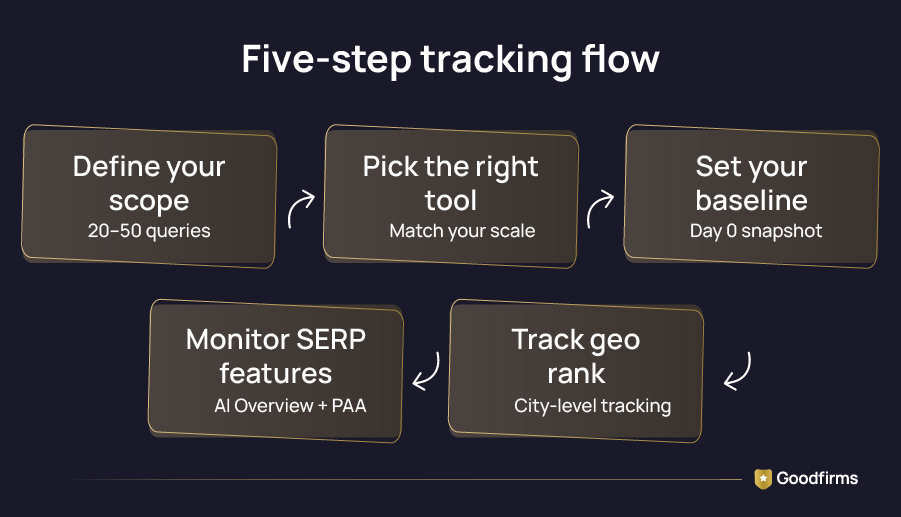
1. Define Your Tracking Scope
Start by deciding what you're tracking. This sounds obvious, but most teams skip it and end up with meaningless data.
- Pick 20–50 high-intent queries that represent your core product/service territory
- Separate branded queries from non-branded ones.
- Note which of these already trigger AI Overviews - you can check manually in Google or use a tool like Semrush's AI Overview tracker
The keyword data shows that "AI search visibility" has both Informational and Commercial intent, which means people are in research mode and buying mode at the same time. That's your sweet spot for content and monitoring.
2. Choose the Right Tool for Your Situation
Not every single team needs enterprise-grade AI monitoring. Here's a rough guide:
You're a small agency or solo consultant:
- Nightwatch or Wincher work well for budget-conscious daily rank tracking
- Manually spot-check AI Overviews weekly for your 10–15 most important queries
You're a mid-size brand or in-house team:
- Ahrefs or Semrush with AI Overview monitoring turned on
- Set up alerts for branded mentions inside AI answers using Search Monitor or similar
You're an enterprise or managing multiple clients:
- BrightEdge or Authoritas for dedicated AI visibility dashboards
- Layer in geo-tracking (tools like Nightwatch's geo-rank feature) if you serve multiple markets
3. Set Up a Baseline
Before you can track improvement, you need a snapshot of where you stand right now.
- Run your target queries through Google and note which trigger AI Overviews
- For each AI Overview triggered, does your brand appear? Is your content cited?
- Record this in a simple spreadsheet or your tracking tool of choice
- Do the same in Perplexity and ChatGPT for your most important queries (manual check is fine to start)
This baseline is your "Day 0." Everything after this is measurable progress or decline.
4. Monitor SERP Features, Not Just Positions
The keyword data reveals something important: queries like “how to track AI visibility” or "search visibility tool" now trigger AI Overview, Thumbnail, Video preview, Top stories, AND People Also Ask - all at once. That's a lot of content that isn't found in traditional blue links.
Track these SERP features for your target queries:
- AI Overview presence - is one triggered at all?
- Your brand in the AI Overview - are you cited or mentioned?
- People Also Ask - Are you appearing in PAA boxes? (These feed AI answers)
- Top Stories - are your content/PR pieces showing up here?
Most modern SEO tools track SERP features. Make sure yours does, and that AI Overview is one of the features it flags.
5. Track Geo-Rank Separately
If your business serves specific locations, geo-specific AI visibility matters enormously. A query like "best [service] in [city]" may trigger completely different AI answers depending on where the search originates.
Keywords like "geo location rank tracking" (600 monthly searches) and "geo rank tracker" (1,300 monthly searches) are specifically searched by people who understand this gap. Nightwatch is purpose-built for this. Semrush and Ahrefs have local rank tracking features too.
The Content Side of AI Visibility
Tools track AI visibility. Content creates it. These two things should work together, but most brands focus only on one.
What content actually gets cited in AI answers?
From what Goodfirms' research and the broader search landscape shows:
- Authoritative, data-backed content - original statistics, surveys, and research get cited far more often than opinion pieces
- Structured, direct answers - content that answers a question in the first 2–3 sentences is more likely to be pulled into AI Overviews
- FAQ-style formatting - questions and answers are easy for AI systems to parse and reference
- Updated content - Updated content performs better because current numbers and recent data; a page last updated in 2022 is losing to one refreshed last month.
Optimize for AI citations, not just rankings
The difference:
- Traditional SEO goal: rank #1 for "AI visibility tool"
- AI SEO goal: be the source cited when an AI answers "what is the best AI visibility tool"
That shift in goal changes what you create, how you structure it, and how you promote it. Think about it less like climbing a rankings ladder and more like building a reputation that AI systems recognize and trust.
Red Flags: Signs Your AI Visibility Is Suffering
Check yourself against these warning signs:
- Your branded queries trigger competitor mentions in AI Overviews, and someone else is taking your spot
- Your content ranks in the top 5, but never appears in AI Overviews; your structure may not be AI-friendly
- Zero baseline data, if you haven't measured it yet, you're already behind
- Relying only on organic traffic as a proxy, clicks are declining even for #1 results because of zero-click AI answers; traffic isn't the signal anymore
Connecting AI Visibility to Business Outcomes
This is where most tracking efforts fall apart: they measure the thing, but not what it means.
Here's a simple framework to connect AI visibility to real outcomes:
- Visibility → Awareness: Is your brand appearing in AI answers for discovery-stage queries?
- Citation → Authority: Is your content being used as a source? That signals topical authority.
- Zero-click influence → Brand recall: Even if they don't click, do people remember your name from an AI answer? Track brand search volume as a downstream signal.
- Geo presence → Local leads: For local businesses, AI visibility in geo-specific answers drives direct contact and visits.
If you're unclear on what AI-era SEO investment looks like in terms of budget and scope, SEO pricing plans broken down by service type is a good place to start.
How AI Visibility Differs Across Search Platforms
One thing most guides don't talk about: AI visibility isn't one thing. It varies significantly depending on which AI system you're trying to appear in - and they don't all work the same way.
1. Google AI Overviews
Google's AI Overviews pull from indexed web content. The selection logic leans heavily on E-E-A-T signals (Experience, Expertise, Authoritativeness, Trustworthiness), structured content, and freshness. If your content ranks well organically but isn't structured for direct answers, you can still get skipped in AI Overviews.
2. ChatGPT and Perplexity
These platforms rely on their own training data and real-time web search plugins. Perplexity in particular is extremely citation-heavy - it pulls from live web results and displays sources openly. Being cited here means your content is being actively retrieved and surfaced. Track it manually or with tools like Authoritas that specifically monitor LLM visibility.
3. Gemini (Google)
Gemini's answers in Google Search are closely tied to Knowledge Graph data, structured content, and Google's own indexing signals. Brands with strong Google Business Profiles and schema markup tend to appear more consistently here.
The practical takeaway: Don't assume that appearing in Google AI Overviews means you're visible everywhere. Build a platform-by-platform tracking habit - even if it's just a monthly manual spot-check across Google, Perplexity, and ChatGPT for your 10 most important queries.
AI Visibility for Different Business Types
This isn't a one-size-fits-all problem. How to track AI visibility depends a lot on what kind of business you run.
B2B Companies
For B2B, the queries that matter are usually high-intent, solution-oriented searches - "best [tool category] for [use case]." AI answers for these queries are where buying decisions start forming. Your goal is to be mentioned in those answers as a credible option, not just ranked in organic results.
Focus on:
- Thought leadership content with specific data points
- Third-party review platforms (G2, Capterra, Goodfirms) - AI systems frequently cite these
- Technical documentation and comparison content
B2B brands working with verified SEO agencies that specialize in AI search are seeing faster citation gains than those trying to figure it out in-house.
Local and Service Businesses
For local businesses, geo-specific AI answers are everything. "Best plumber in Austin" triggering an AI Overview that doesn't mention you is a real visibility loss - even if you rank #2 in organic results.
Focus on:
- Google Business Profile completeness and review volume
- Location-specific landing pages with structured data
- Geo-rank tracking tools (Nightwatch is worth the investment here)
E-commerce Brands
Product-level AI visibility is emerging - AI answers are increasingly pulling in product recommendations for certain query types. Structured product data, rich snippets, and strong review signals matter.
Focus on:
- Product schema markup
- Brand authority signals across review platforms
- Content that answers "best [product type] for [use case]" questions directly
Building an AI Visibility Reporting Cadence
Tracking without reporting is just data hoarding. Here's a simple reporting rhythm that actually drives decisions:
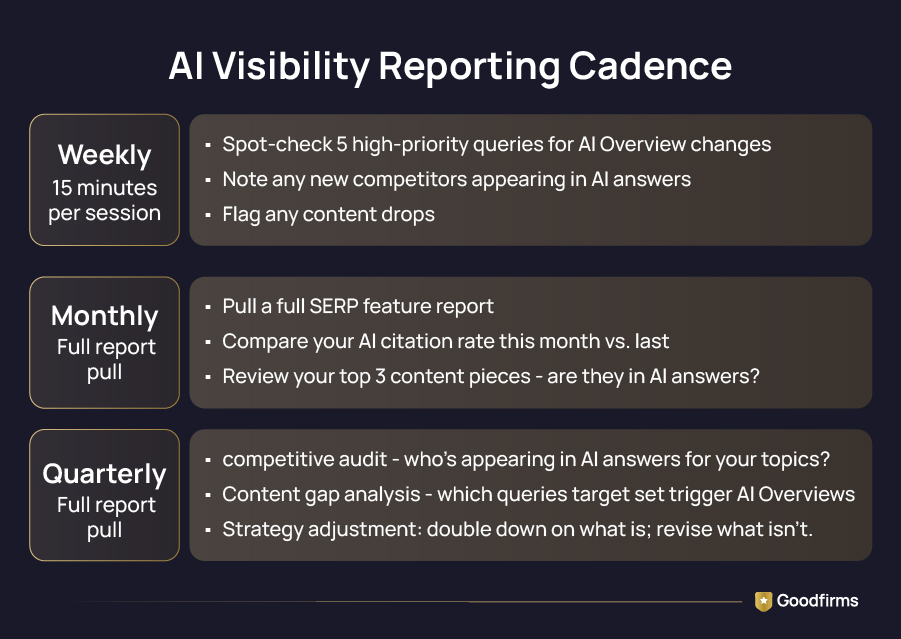
Weekly (15 minutes):
- Spot-check 5 high-priority queries for AI Overview changes
- Note any new competitors appearing in AI answers for your branded terms
- Flag any content drops (if a page you're tracking stops appearing in AI Overviews)
Monthly:
- Pull a full SERP feature report from your tracking tool
- Compare your AI citation rate this month vs. last
- Check brand search volume as a downstream signal of AI-driven awareness
- Review your top 3 content pieces - are they still being cited in AI answers?
Quarterly:
- Full competitive audit - who's appearing in AI answers for your priority topics?
- Content gap analysis - which queries in your target set trigger AI Overviews where you're absent?
- Strategy adjustment - based on what's working, double down; based on what isn't, revise.
This cadence keeps AI visibility from becoming an abstract metric and turns it into something that actually informs your content and SEO strategy week-to-week.
The Zero-Click Reality and What It Means for Your Strategy
Here's the elephant in the room: even if you achieve great AI visibility, you might not see it in your traffic numbers. Zero-click searches - where the AI answer satisfies the query without any clicks - are rising sharply.
This doesn't mean AI visibility isn't worth chasing. It means the ROI looks different:
- Brand recall over direct traffic - being cited in AI answers builds top-of-mind awareness even without a click
- Influence on consideration - people remember brands mentioned in authoritative AI answers and search for them later (hence: watch your branded search volume)
- Competitive defense - if you're not in the AI answer, a competitor is. That's market share lost in a place you can't see on your analytics dashboard
The metric shift here is real: start treating AI citation rate and branded search volume as primary KPIs, alongside - not below - organic traffic.
Conclusion
AI visibility isn't a trend to watch - it's already the reality of how a significant chunk of search queries are being answered. The 14% of marketers who are tracking it aren't ahead of some future shift; they're operating in the present while the rest of the field catches up.
The good news is that the gap is still closeable. Most of the fundamentals - authoritative content, clear structure, original data, strong technical SEO - haven't changed. What's changed is where the payoff shows up. Rankings are still worth tracking. But citation rate in AI answers, brand mention frequency, and presence across platforms like Perplexity and ChatGPT are now equally important signals.
Start with a baseline. Pick your tools based on what your business actually needs. Build a reporting cadence you'll stick to. And if you need strategic support getting there, connecting with the right agency partner makes all the difference.
Frequently Asked Questions
1. What is AI visibility, and how is it different from SEO visibility?
Traditional SEO visibility measures how prominently your pages appear in ranked search results - positions 1 through 10 and beyond. AI visibility measures whether your brand or content is cited, referenced, or mentioned in AI-generated answers from systems like Google AI Overviews, ChatGPT, Perplexity, and Gemini. The core difference: traditional SEO is about ranking in a list; AI visibility is about being included in a synthesized answer. You can rank #1 organically and still have zero AI visibility for the same query.
2. How do I know if my content is being cited in AI answers?
The most reliable method is direct monitoring - run your target queries regularly in Google, Perplexity, and ChatGPT, and note whether your content or brand appears. Tools like Authoritas and BrightEdge offer automated AI citation tracking at scale. For Google AI Overviews specifically, Semrush and Ahrefs both flag which queries trigger AI Overviews and, increasingly, whether your domain is among the cited sources.
3. Can small businesses or solo marketers realistically track AI visibility?
Yes, and you don't need an enterprise tool budget to start. A manual tracking sheet for 15–20 high-priority queries, checked weekly across Google and Perplexity, gives you a meaningful baseline. Nightwatch and Wincher are affordable tools that cover geo-rank and daily rank tracking. The key is consistency - a simple system you actually run beats a sophisticated one you never open.
4. Does ranking well in traditional search automatically help AI visibility?
It helps, but it's not guaranteed. AI systems draw from multiple signals beyond just organic rank - content structure, topical authority, freshness, third-party citations, and schema markup all play a role. A page ranked #5 that directly answers a question in its first paragraph may be cited in an AI Overview over a #1-ranked page that buries the answer in paragraph seven. Ranking well gets you in the pool of considered sources; content structure determines whether you're actually pulled in.
5. How often should I be updating my AI visibility tracking?
A weekly spot-check for your most critical queries takes about 15 minutes and keeps you aware of sudden changes - like a competitor appearing in AI answers for your branded terms. A full monthly report covering SERP features, citation rates, and brand search volume trends is enough for strategic decision-making. Quarterly, do a full competitive audit to see who's gaining or losing AI answer presence in your space. The cadence matters less than the consistency - pick one you'll actually maintain.