Key takeaways
- A good Amazon advertising agency is judged on eight criteria: expertise, account ownership, reporting, full-funnel thinking, track record, contract terms, pricing, and fit, not how polished its pitch sounds.
- How an agency charges affects how it acts. Percentage-of-spend fees can push it to spend more, not spend smarter; flat or hybrid pricing usually keeps incentives closer to your actual profit.
- Not every "Amazon agency" does the same job. Full-service, PPC-only, agency of record, and consultant setups each fit a different stage of business.
- Going cheap usually costs more in the end, through wasted ad spend and falling organic rank.
- Give a new agency at least 90 days. Small changes show up in 30–60 days, but real impact on rank and profit takes three to six months.
When we think of Amazon advertising, we think it's simple: set a budget, pick some keywords, and watch the sales roll in. In practice, it is one of the most competitive auction systems in digital marketing. And a poorly managed account can burn through the whole budget without moving the needle on revenue.
That is why more and more brands are now outsourcing to an Amazon advertising agency. But not every agency that claims Amazon expertise actually has it. This guide breaks down exactly what to check before you sign a contract, so you can confidently find the best Amazon advertising agency for your brand.
Ready to compare vetted options? Browse verified, client-reviewed Amazon advertising agencies on Goodfirms and shortlist partners by rating, pricing, and portfolio.
What Makes a Good Amazon Advertising Agency? At a Glance
Before the full breakdown, here's the snapshot version: what separates a genuinely good agency from an average one across the criteria that matter most.
|
Criteria |
Good Agency |
Average / Risky Agency |
|---|---|---|
|
Platform expertise |
Amazon-specific, hands-on Seller/Vendor Central experience |
Repurposed Google/Meta playbook applied to Amazon |
|
Account ownership |
Named manager, ~10-12 accounts per person |
Rotating staff, 20+ accounts per manager |
|
Reporting |
Revenue/profit-tied, reconciled to your own data |
Vanity metrics (impressions, clicks) in isolation |
|
Strategic scope |
Full-funnel — PPC, listings, content, Brand Store |
PPC-only, treated as a bidding-tweak service |
|
Track record |
Named case studies, client-selected references |
Vague "grew clients by X%" with no attribution |
|
Contract terms |
Month-to-month after onboarding, clear exit clause |
12-month lock-in, no performance exit |
|
Pricing model |
Flat or hybrid, incentives tied to efficiency |
Pure percentage-of-spend with no guardrails |
|
Fit |
Matches your revenue stage and category |
One-size-fits-all pitch regardless of brand size |
Why This Decision Matters More Than It Looks
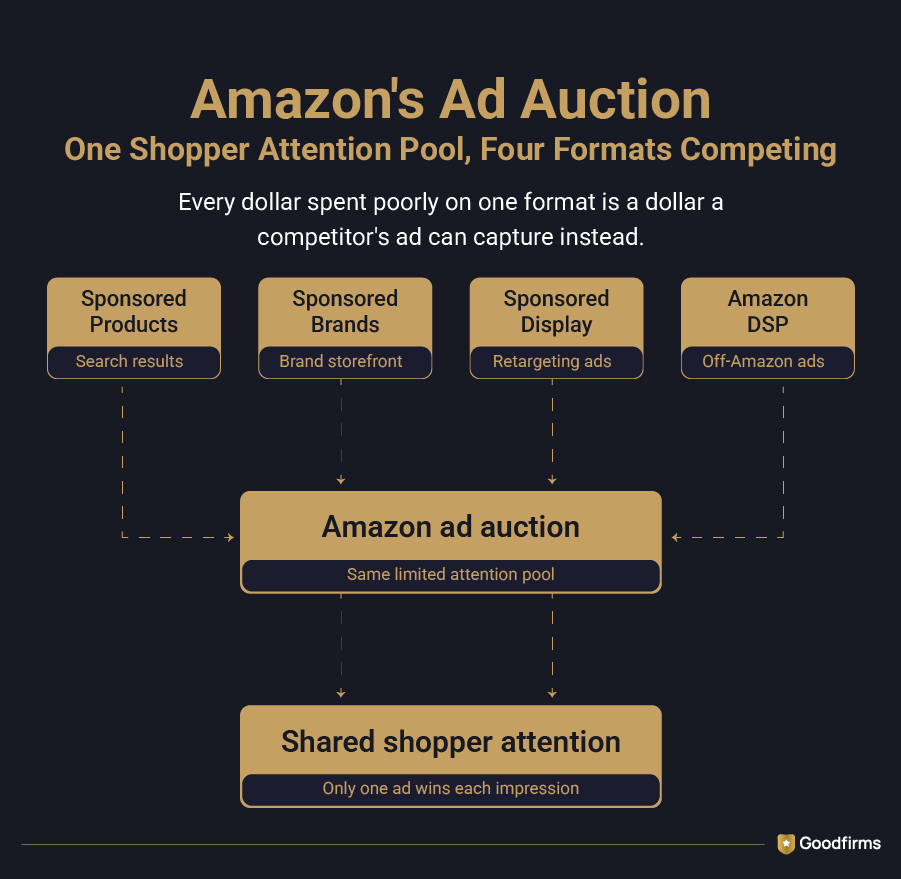
Amazon now operates more like a search-and-media platform than a simple storefront. Sponsored Products, Sponsored Brands, Sponsored Display, and Amazon DSP all draw from the same limited pool of shopper attention, and every dollar spent poorly on one campaign is a dollar a competitor's ad can capture instead. A capable agency does not just "run ads." It manages bid strategy, campaign structure, creative, keyword architecture, and reporting as one connected system tied to profit, not just clicks.
Hiring the wrong partner rarely just wastes ad spend; it can quietly tank organic rank for months before anyone notices why. This is the reason a structured evaluation process, rather than a gut-feel pick from a sales call, matters so much.
What Makes a Good Amazon Advertising Agency? The Core Checklist
This is the crux of it, the eight things worth verifying before you sign anything. Treat this as your working checklist during discovery calls.
1. Amazon-Specific Expertise, Not Repurposed Google or Meta Playbooks
Amazon runs on shopper intent, not upper funnel awareness. When anyone searches "wireless earbuds," it is usually close to buying, unlike the same search on Google. The teams that have shifted over from Google Ads or paid social mainly carry over habits which don't translate well - optimizing for cost per click without necessarily lifting sales. It is important to check how the team actually built its Amazon skillset: is Amazon just one of several platforms a generalist account manager touches, or a dedicated specialty" Has anyone worked Amazon-side or inside Vendor Central, where co-op, chargebacks, and vendor ad mechanics differ from Seller Central? Fluency in ACoS vs. TACoS and search term harvesting signals real depth, not borrowed language.
2. A Real, Named Account Owner — And a Reasonable Account Load
Two questions matter, and agencies often answer only one unless pushed. First: who exactly manages your account day to day, by name? Second, and more revealing: how many other brands does that person currently handle? A manager juggling 20-plus accounts is running templated playbooks and automated bid rules, not a strategy built for your catalog and margins. A workable range for real attention sits closer to 10-12 accounts per manager, fewer for large or multi-marketplace catalogs. Ask what a typical week looks like for your account, hours spent, what's manual versus automated, and how often you'll actually talk to the person doing the work rather than a client-success layer in between.
3. Transparent, Reconciled Reporting
A trustworthy agency shows more than a polished dashboard of impressions and ROAS in isolation. Useful reporting ties ad spend to real revenue and profit, not just ad-attributed sales, and tracks how spend trends against total Amazon revenue (TACoS) and margins after fees. It also flags what didn't work, rising ACoS, softening conversion, falling organic rank, as clearly as it highlights wins, and reconciles cleanly against your own Seller Central or Vendor Central numbers. If the agency's dashboard and your own data tell different stories, investigate before signing. Ask to see a real, redacted monthly report from a current client; the gap between a report built to inform you and one built to retain you is usually obvious within minutes.
4. Full-Funnel Thinking Beyond PPC
PPC is the most visible lever an agency pulls, but rarely the biggest one available. Listing quality, A+ content, main image conversion, backend search terms, review velocity, and Brand Store traffic often move revenue more than another round of bid tweaks. A perfectly bid campaign can still underperform if the listing it drives traffic to converts poorly. A genuinely good agency treats PPC as one part of a larger system, not the whole job. Ask them to walk through recent accounts where the biggest improvement came from something other than bidding, a title rewrite, image change, keyword cleanup, or pricing fix. If every answer is "we lowered bids," the toolkit is narrower than the job requires.
5. Documented, Verifiable Track Record
Case studies that name the brand, cite specific numbers, and show a clear before-and-after timeframe carry far more weight than vague claims like "we grew clients by 40% on average" with no attribution. Numbers without a baseline, timeframe, and named source are marketing copy, not evidence. The strongest verification step most buyers skip: ask to speak with two or three clients you select yourself from the agency's stated portfolio, rather than the references they proactively offer. A confident agency won't flinch at this request. One that steers you firmly toward a few curated testimonials, and resists letting you pick, is telling you something worth noting before you sign.
6. Fair, Exit-Friendly Contract Terms
Contract structure is one of the most honest signals of how confident an agency is in its own performance. Look for month-to-month terms after an initial onboarding period (typically 60-90 days), a reasonable cancellation notice window (30-60 days), no punitive early-termination fees, and a clean, documented handoff of account access, campaign history, and creative assets if you leave. Long lock-ins with no performance-based exit clause usually signal the agency is relying on contractual friction rather than results to keep clients. Ask specifically what happens to your data, campaign history, and files on day one after cancellation. A good agency has already documented this because they've done it before.
7. A Pricing Model That Doesn't Create Bad Incentives
How an agency gets paid quietly shapes how it treats your account. A pure percentage-of-ad-spend model can reward recommending higher budgets over better efficiency; the fee grows whether or not your profit does. Flat retainers remove that problem, since revenue stays fixed regardless of spend, pushing incentives back toward efficiency. Hybrid models, a base retainer plus a smaller performance component, are increasingly common because they balance predictable cost with some incentive alignment. There's no single correct model, but you should be able to explain, in one sentence, why your agency's fee structure rewards outcomes you actually want. If you can't, ask directly: Is your fee tied to my budget size, or to results delivered?
8. Category and Brand-Stage Fit
An agency built around $50K/month DTC beauty brands rarely operates as one built around $5M/month enterprise CPG catalogs, tooling, team structure, and even vocabulary differ. Category matters too: an agency deeply experienced in apparel may have limited exposure to supplement compliance rules or electronics' technical listing requirements. Ask directly which revenue range and product category the agency serves best, and request case studies specifically from that range, not a flagship enterprise logo if you're an early-stage seller evaluating a $2,000/month retainer, and not a scrappy startup story if you're a $10M brand needing enterprise infrastructure. A mismatch in stage or category is one of the most common and avoidable reasons a capable agency underdelivers.
Types of Amazon Advertising Partners - Know What You're Actually Hiring
Not every "Amazon agency" offers the same scope of work. Understanding the category helps you compare apples to apples.
|
Agency Type |
What They Manage |
Best Fit For |
|---|---|---|
|
Full-service Amazon agency |
PPC, DSP, listing optimization, A+ content, inventory, brand protection, reporting |
Brands that want one accountable partner for the entire channel |
|
PPC-only / Amazon Ads specialist |
Sponsored Products, Sponsored Brands, Sponsored Display, sometimes DSP |
Brands with strong listings that just need advertising run as a profit engine |
|
Amazon advertising agency of record |
Acts as the single accountable partner across all ad accounts and channels, similar to an AOR relationship in traditional media |
Larger brands consolidating multiple vendors under one strategic owner |
|
Amazon consultant |
Strategy and audits only; execution stays in-house |
Brands with a capable internal team that needs direction, not hands-on keyboard work |
|
SEO / listing optimization specialist |
Keyword research, titles, bullets, backend terms, indexing |
Brands whose main gap is organic visibility, not ad spend |
If your primary need is media buying rather than full-channel management, it's worth comparing dedicated PPC agencies that specialize purely in paid search and Sponsored Ads execution.
What Amazon Advertising Actually Costs
Pricing varies with scope, catalog size, and ad spend. These ranges reflect common industry patterns as of 2026.
|
Pricing Model |
Typical Range |
What It Usually Means |
|---|---|---|
|
Flat monthly retainer |
$1,500–$5,000/month (small-to-mid brands); $5,000–$15,000+/month (enterprise, full-service) |
Predictable fee regardless of spend; keeps the agency's incentive on efficiency, not budget size |
|
Percentage of ad spend |
10–20% of monthly ad spend (most common); up to 30% at agencies bundling deep strategy/creative work |
Fee scales automatically with budget; can reward higher spend over better ROAS if there's no cap |
|
Hybrid (retainer + performance) |
$1,000–$2,000/month base + 2–5% of ad-attributed revenue (one published real-world example: $1,499 base + 3.5% of managed ad revenue) |
Predictable base cost with upside tied to actual results, not spend |
Source - Astrasellbox, PPCJumpstart, Darkroomagency.
Real-world benchmark: For a brand doing $1M–$3M/year on Amazon, realistic full-service management runs $2,500–$3,000/month; below that typically means automated bid tweaks, not real management.
Red Flags That Should Slow You Down
- Guaranteed results. No one controls Amazon's algorithm, seasonality, or competitor moves. Guarantees on ROAS or rank are a warning sign, not a selling point.
- No named point of contact before signing. If they can't tell you who runs your account, there's no dedicated team behind the sales pitch.
- Reports you can't verify. Summary PDFs with no underlying data or console access hide more than they show.
- Pressure to raise ad spend without efficiency data. Especially common with percentage-of-spend pricing, increases should be justified by ROAS trends, not just recommended.
- Long lock-in, no exit clause. A confident agency doesn't need a 12-month contract with no escape hatch.
Amazon Agency vs. In-House Team
Many brands weigh this decision alongside the checklist above. Here's a quick side-by-side.
|
Factor |
Amazon Advertising Agency |
In-House Team |
|---|---|---|
|
Typical annual cost |
$18,000–$180,000+/year depending on scope |
$200,000–$400,000+ for a full specialist team |
|
Time to full productivity |
2–4 weeks |
3–6 months |
|
Specialist coverage |
Multiple disciplines bundled in |
Requires separate hires per discipline |
|
Scalability |
Flexible; scope adjusts with contract |
Slower; tied to hiring cycles |
|
Break-even point |
Cost-effective below ~$15M–$20M in annual Amazon revenue |
Becomes cost-competitive above ~$15M–$20M, when Amazon is 60%+ of total revenue |
Source - SupplyKick, Astrasellbox, PPCJumpstart, Darkroomagency.
Questions to Ask on the Discovery Call
Bring this shortlist into every sales conversation:
- Who specifically will manage my account, and how many other accounts do they currently handle?
- Can I see a real, recent monthly report from a client, with the brand name redacted?
- What percentage of your team's experience is Amazon-specific versus general digital marketing?
- Walk me through the last three accounts where the biggest win came from something other than PPC.
- What does cancellation, notice period, and asset handoff look like in the contract?
- Can I speak with two or three clients I select myself, rather than the ones you recommend?
Beyond Amazon: Building a Complete Marketing Bench
An Amazon advertising agency rarely operates in a vacuum. Strong listings usually depend on solid on-page and off-Amazon SEO groundwork, and A+ Content or Brand Store pages benefit from a real content strategy rather than templated copy. If your brand also needs support tightening product-page SEO fundamentals, it's worth reviewing the best SEO companies, and for brands that need stronger storytelling in A+ modules or brand storefronts, also look for content marketing agencies.
Final Thoughts
Picking the best Amazon advertising agency isn't about finding the agency with the most confident pitch; it's about finding one whose claims hold up once you actually check them. Expertise, account ownership, reporting honesty, full-funnel thinking, a verifiable track record, fair contracts, sensible pricing, and stage fit aren't nice-to-haves; together, they're the difference between an agency that compounds your growth and one that quietly caps it.
Use the checklist and the discovery-call questions above as a working document, not a one-time read. Revisit them a few months into any new partnership, too; the answers an agency gives you in the pitch should still hold true once the contract is signed and the account is live.
FAQs - What Makes a Good Amazon Advertising Agency
1. How do I find an Amazon advertising agency I can trust?
Start with a platform that verifies client reviews rather than relying on self-reported case studies. Cross-reference at least two or three references you select yourself, and confirm claims like retention rate or revenue growth wherever possible.
2. How much should I expect to pay a top Amazon advertising agency?
Fees usually start from around $1,500 per month for small PPC only support and go up to $15,000+ per month for full service enterprise management. Most agencies use a flat retainer, a percentage of ad spend, or a hybrid model.
3. What's the difference between an Amazon agency and an Amazon advertising agency of record?
A standard agency might manage one slice of the channel, such as PPC. An agency of record typically becomes the single accountable partner across all advertising channels and accounts, similar to an AOR relationship in traditional media buying.
4. How long before I can judge if an Amazon agency is working?
Ninety days is the realistic minimum. Advertising restructuring shows early signs within 30–60 days, but organic rank and full strategic impact usually take three to six months to compound.
5. Is it better to hire a full-service agency or a PPC-only specialist?
It depends on where your biggest gap is. Brands with strong listings and clean content often do well with a PPC specialist. Brands building from scratch, or with weak listings and inventory issues, typically need full-service support.